A survey conducted by Japan’s Ministry of Land, Infrastructure, Transport and Tourism (MLIT) revealed that approximately 90% of contractors who requested price and schedule adjustments for private construction projects due to rising costs successfully secured contract modifications. This trend reflects accelerating efforts to standardize fair business practices through the enforcement of the revised Construction Business Act and heightened compliance demands amid prolonged inflation in material and labor expenses.
- Contract Modifications Approved for Roughly 90% of Requesting Contractors
- Disparities by Company Size and Unaddressed Negotiation Gaps
- Contract Amendment Clauses Under the Revised Construction Business Act
- Legal Compliance Mandates Under Antitrust and Construction Laws
- Impact of Rising Material and Labor Expenses on Construction Margins
- Establishing Fair Trade Standards and Key Future Focus Areas
Contract Modifications Approved for Roughly 90% of Requesting Contractors
According to the FY2025 Survey on Promoting Workstyle Reform through Appropriate Construction Periods conducted by MLIT, approximately 90% of contractors who engaged in price adjustment negotiations with clients for private projects contracted after December 2024 secured actual contract modifications. Specifically, among contractors who requested changes due to inflation, 19.5% reported that their contracts were fully modified, while 73.7% had their contracts partially modified, bringing the total approval rate to 93.2%. A parallel survey targeting 43 private project owners in real estate and housing showed similar results: among 31 clients that entered negotiations upon contractor requests, 7 fully approved contract changes and 20 partially approved them. This demonstrates that around 90% of participating clients adjusted contract values or construction schedules. These findings underscore a growing collaborative effort between clients and contractors to share financial risks driven by escalating material and labor costs. Refer to the figure below.
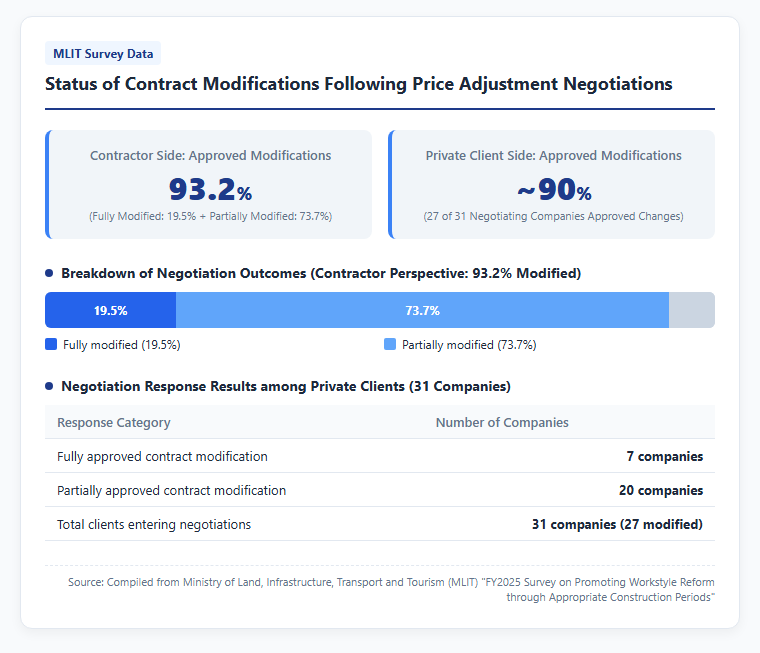
- Percentage of requesting contractors receiving full contract modifications: 19.5%
- Percentage of requesting contractors receiving partial contract modifications: 73.7%
- Percentage of participating private clients approving contract modifications: Approx. 90%
Disparities by Company Size and Unaddressed Negotiation Gaps
Despite these positive statistics, the survey highlights significant disparities based on contractor size. Overall, only 35.0% of contractors affected by rising prices actually initiated adjustment negotiations with their clients, while 33.9% submitted no request at all. Furthermore, 10.1% of contractors requested negotiations but were turned down by clients. An analysis by annual completed construction volume reveals that larger firms—those generating 1 billion to 3 billion yen or more—were the most proactive in pursuing contract modifications. Conversely, among smaller firms with an annual volume between 500 million and 1 billion yen, the most common response was to refrain from requesting negotiations altogether. Smaller contractors often hesitate to push for price adjustments out of fear of damaging client relationships or jeopardizing future bidding opportunities. Additionally, the fact that roughly 10% of negotiation requests were outright rejected indicates that unfair business practices placing undue burdens on contractors still persist in the market.
- Percentage of cost-impacted contractors initiating negotiations: 35.0%
- Percentage of contractors refraining from requesting negotiations: 33.9%
- Percentage of contractors whose negotiation requests were rejected: 10.1%
Legislative and Legal Background Driving Contract Fair Practice
Contract Amendment Clauses Under the Revised Construction Business Act
A critical catalyst for fair trading in private construction is the revised Construction Business Act, which took effect in December 2024. The legislation mandated that procedures for modifying contract prices and schedules be explicitly stipulated in contract documentation, effectively prohibiting clauses that categorically deny contract adjustments or omit modification terms. However, a follow-up survey assessing real-world conditions as of January 2026 revealed that only 54.9% of prime contractors included modification clauses in all or most of their contracts—a decline from 60.2% recorded in the FY2024 pre-enforcement survey. Similarly, among private clients such as real estate developers and homebuilders, the proportion incorporating adjustment clauses dropped to 56.4%, down from 66.1% the previous year. While legal frameworks now mandate these terms, the findings indicate that updated practices have not yet fully permeated day-to-day contracting routines, highlighting a delay in breaking away from entrenched industry habits. Refer to the figure below.
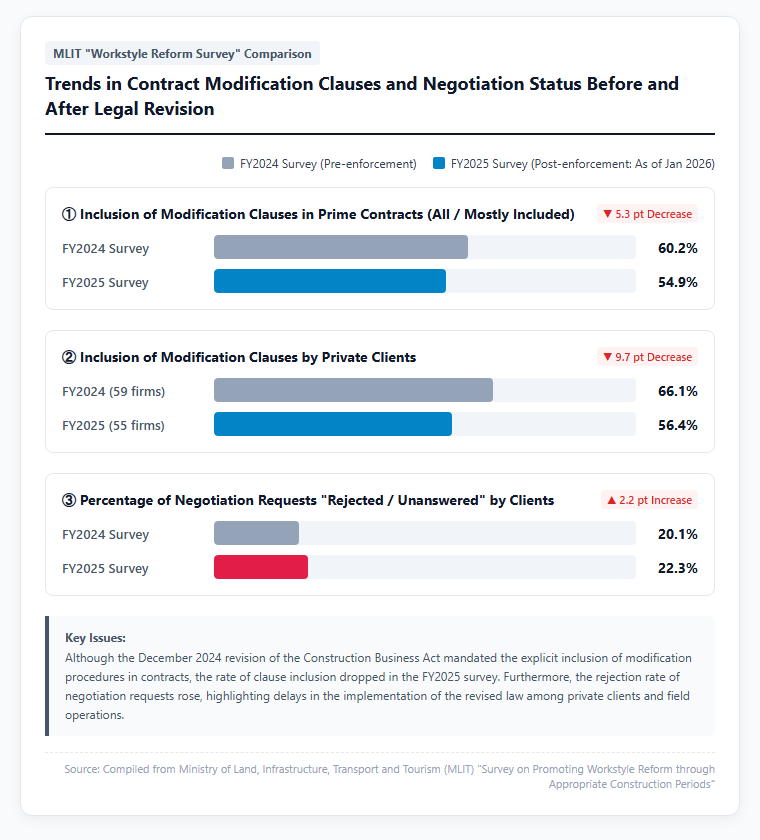
- Proportion of prime construction contracts with adjustment clauses: 54.9%
- Proportion of private client contracts with adjustment clauses: 56.4%
- Enforcement date for mandatory contract adjustment terms: December 2024
Legal Compliance Mandates Under Antitrust and Construction Laws
MLIT and the Japan Fair Trade Commission (JFTC) have taken a firm stance against private construction contracts where clients unilaterally shift price fluctuation risks onto contractors. Regulatory authorities warned that explicitly prohibiting price revisions in contracts or refusing to engage in negotiations may constitute an “abuse of a superior bargaining position” prohibited under the Antimonopoly Act. Furthermore, under Article 19-3 (Prohibition of Unreasonably Low Contract Amounts) and Article 19-5 (Prohibition of Unreasonably Short Construction Periods) of the Construction Business Act, failure to adjust contracts in response to post-signing material inflation or delivery delays can trigger legal violations. In May 2026, MLIT issued official directives (such as Kokufu-ken No. 18) urging major private sector associations to facilitate smooth price adjustment discussions in light of raw material and energy cost surges triggered by Middle East instability. Clients are required to engage in good-faith negotiations regardless of whether advance risk notices were formally submitted.
- Prohibition of unreasonably low contract amounts: Construction Business Act, Article 19-3
- Prohibition of unreasonably short construction periods: Construction Business Act, Article 19-5
- Official directive issued on price adjustments amid global cost surges: May 2026
Structural Shifts and Future Outlook in the Construction Industry
Impact of Rising Material and Labor Expenses on Construction Margins
The construction sector continues to grapple with dual pressures: soaring material costs and escalating labor expenses caused by severe workforce shortages. According to MLIT’s Construction Cost Deflator, the unit construction cost for steel-framed office buildings rose by 10.3% in the fourth quarter of 2025 compared to the same period in 2022. Against this backdrop, major listed construction firms have successfully passed on these cost increases. Financial results for 50 major listed contractors in FY2025 showed total combined revenue rising 5.0% year-on-year to 21.4097 trillion yen, while average gross profit margins improved by 1.7 percentage points to 13.5%. With capacity constrained by labor shortages, major contractors have prioritized high-margin projects and leveraged price escalation clauses. However, smaller prime contractors and subcontractors with weaker bargaining power continue to struggle with cost pass-through, deepening a polar split across the industry that threatens broader market stability.
- Increase in steel-framed building cost unit (vs. 2022): +10.3%
- Total combined revenue of 50 major listed contractors (FY2025): 21.4097 trillion yen
- Average gross profit margin of major listed contractors: 13.5%
Establishing Fair Trade Standards and Key Future Focus Areas
To cement fair business practices in private construction, establishing proper contract terms at execution and embedding smooth negotiation protocols during cost fluctuations remain essential. The MLIT survey data demonstrating a 90% approval rate when negotiations take place highlights the vital importance of contractors presenting solid evidence during price discussions. For clients, abandoning traditional, one-sided contracts that place all inflation risks on contractors in favor of equal partnerships will directly protect project quality and site safety. The Japanese government is strengthening oversight through channels such as the Construction Industry Follow-up Consultation Hotline to catch unlawful practices and prevent unfair cost shifting. Moving forward, the primary challenge lies in extending these fair trade practices beyond major general contractors to reach small and medium-sized subcontractors throughout the supply chain. Refer to the figure below.
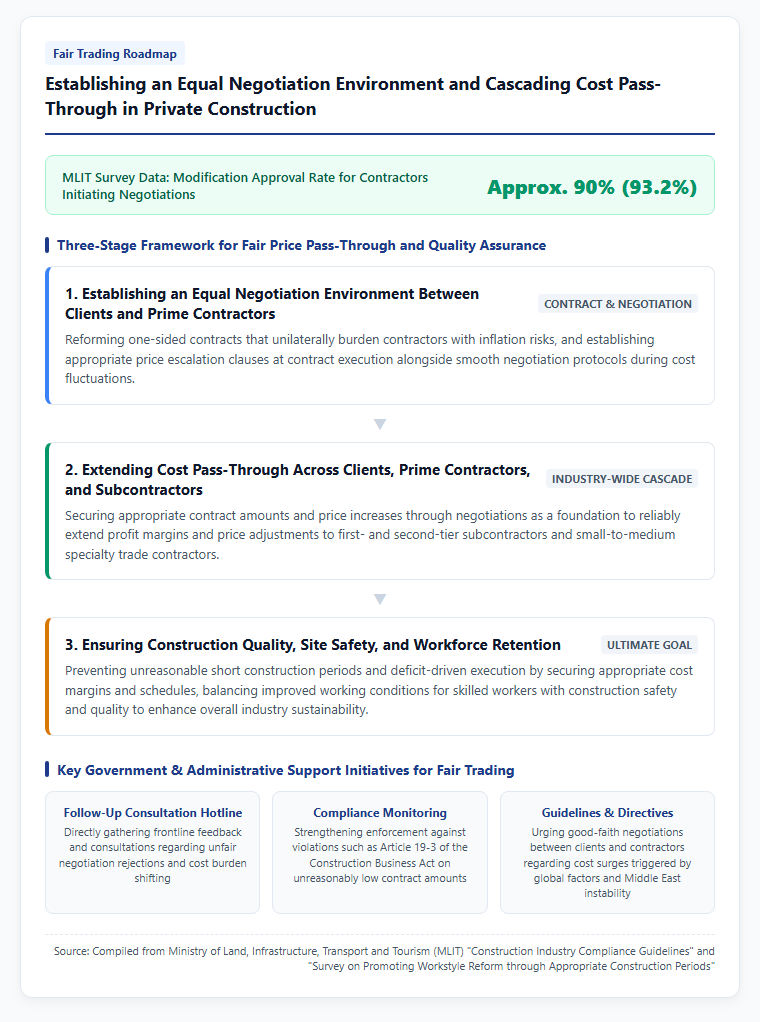
- Establishing a collaborative negotiation environment between clients and contractors
- Strengthening market oversight via the Construction Industry Follow-up Hotline
- Expanding fair trade practices to small and medium-sized subcontractors
Reference Pages
- 【MLIT Guidelines for Quality Assurance Act Enforcement】http://www.mlit.go.jp/totikensangyo/const/totikensangyo_const_tk1_000089.html
- 【MLIT Public Works Design Labor Unit Price】http://www.mlit.go.jp/totikensangyo/const/1_6_bt_000217.html
- 【MLIT Social Insurance Coverage Measures】http://www.mlit.go.jp/totikensangyo/const/totikensangyo_const_tk2_000080.html
【#PrivateConstruction #ConstructionBusinessAct #MLIT #FairTrading #CostPassThrough #ContractModification】


コメント