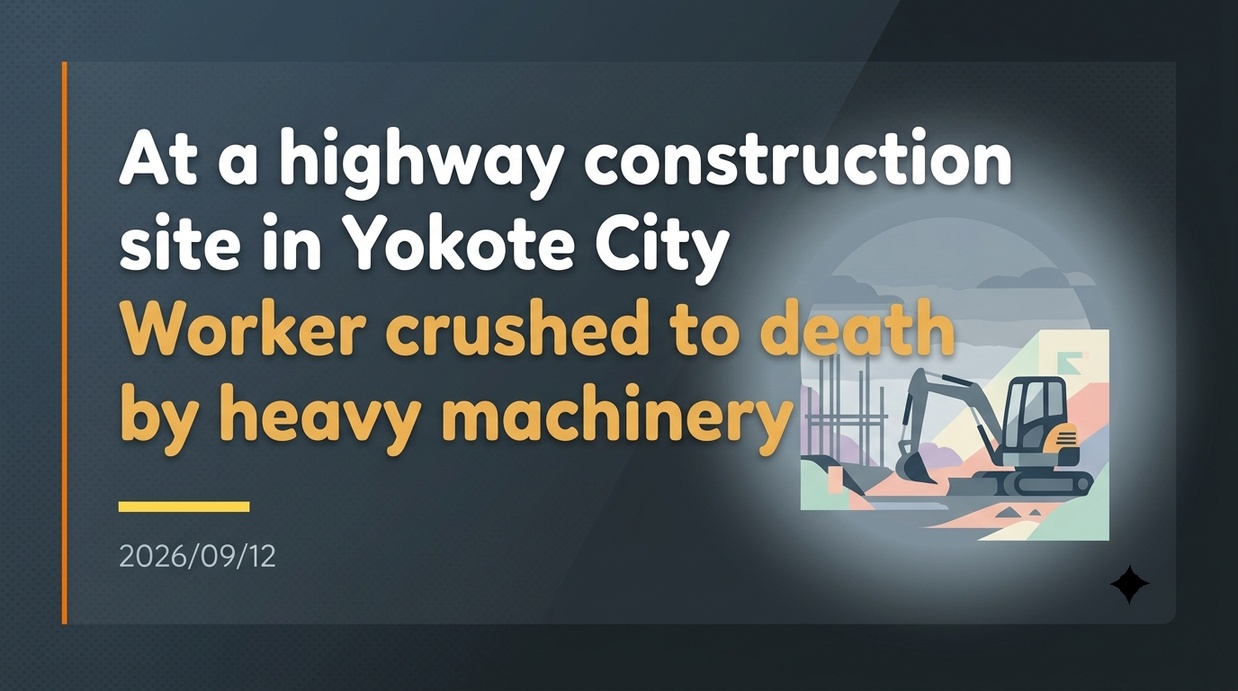
On September 11, 2026, a tragic fatal accident occurred at an expressway construction site in Yokote City, Akita Prefecture, where a 47-year-old male worker was caught between compact heavy machinery and construction materials. This incident underscores critical site safety management issues amidst accelerating infrastructure projects, as well as broader structural challenges facing the construction industry, including chronic labor shortages and ongoing labor reforms.
- Accident Circumstances and Summary of Casualties
- Site Working Environment and Safety Management Issues
- Sharp Rise in Civil Engineering Accidents Under Omagari Labor Standards Inspection Office Jurisdiction
- Common Factors in Vehicle-Type Construction Machinery Accidents and Preventive Measures
- 2024 Overtime Caps and the Operational Strain of Labor Shortages
- Emerging Technologies and Strategies Toward Zero Occupational Accidents
Accident Circumstances and Summary of Casualties
At approximately 9:00 a.m. on September 11, 2026, an accident occurred at an expressway construction site in Oya-shinmachi, Yokote City, Akita Prefecture, in which a male worker became trapped between heavy machinery and construction materials. The victim was a 47-year-old company employee residing in Natori City, Miyagi Prefecture. He had been engaged in reinforcement work on bridge piers that form the structural foundation of the road. At around 8:30 a.m. that morning, he began operating an open-canopy compact excavator alone, grading the ground in an area separated from his colleagues. It appears that while reversing the equipment, he lost his balance and his upper body was crushed between the operator’s cab and nearby shoring materials, including wooden earth-retaining boards and steel beams installed to prevent soil collapse. A fellow worker discovered him trapped and alerted emergency services. Although paramedics rushed him in a state of cardiopulmonary arrest to a hospital in Yokote City, he was pronounced dead approximately two hours after discovery. Police and fire officials are conducting a thorough investigation into the precise circumstances and root causes of the accident, including whether proper operational procedures and site safety protocols were maintained.
Site Working Environment and Safety Management Issues
The accident site is located approximately one kilometer east of the Yokote Interchange. Across Akita Prefecture, a major infrastructure expansion is underway to widen a 42.8-kilometer provisional two-lane section of the Akita Expressway between the Omagari and Kitakami-Nishi Interchanges to four lanes, with a total project budget of 209 billion yen. Although the project had been making steady progress—highlighted by the breakthrough of the 2,438-meter Yamanai Tunnel in July 2026—ensuring worker safety on site remained a paramount priority. A major point of concern in this incident is that the worker was operating heavy machinery alone, away from his crew. Operating heavy equipment inherently involves persistent risks, such as operator blind spots and unintended machine movements, making signal persons (spotters) and strict access controls around working zones essential. Solitary work environments significantly heighten the risk of delayed discovery and emergency response should an accident occur. Police and regulatory authorities are focusing their investigation on the justification of solo work, compliance with safety protocols, and the adequacy of protective measures around the machinery.
Occupational Accident Trends in the Region and Heavy Machinery Hazards
Sharp Rise in Civil Engineering Accidents Under Omagari Labor Standards Inspection Office Jurisdiction
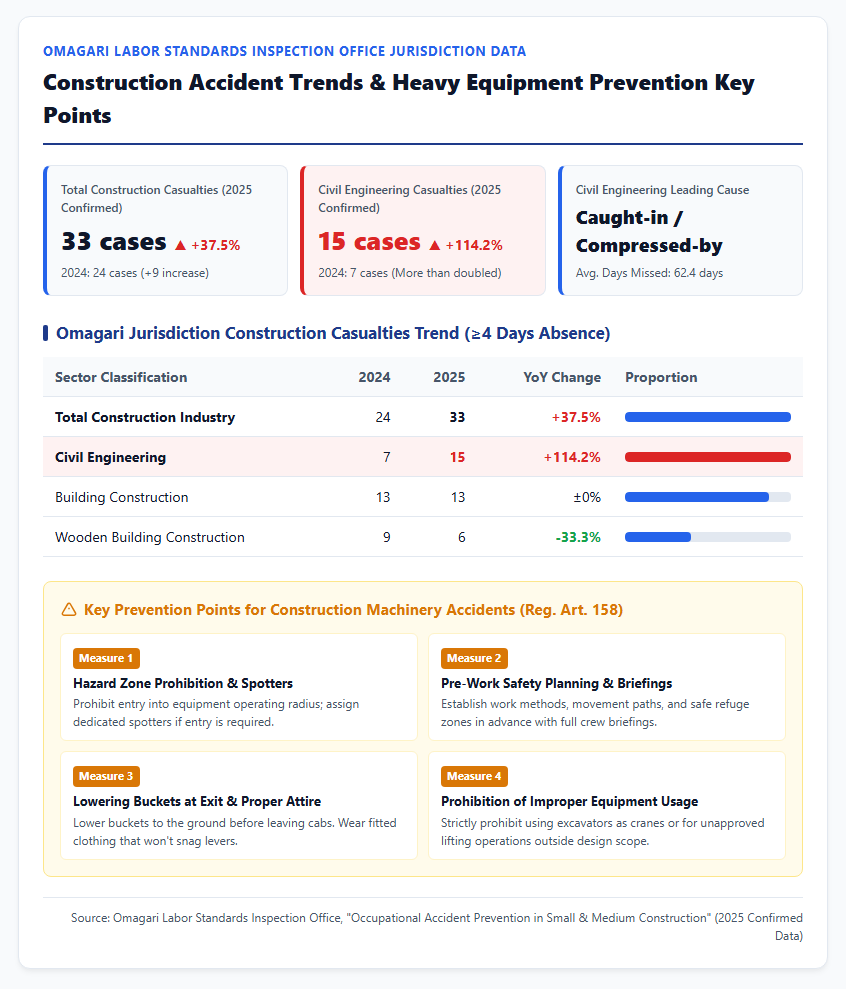
According to data compiled by the Omagari Labor Standards Inspection Office, which oversees Yokote City, occupational accidents in the local construction sector have been trending upward. Confirmed statistics for 2025 reveal that occupational casualties resulting in four or more days of absence reached 33 cases within the jurisdiction, marking a 37.5% increase from 24 cases in the previous year. The civil engineering sector experienced an especially dramatic spike, recording 15 incidents resulting in four or more days of absence—a 114.2% jump that more than doubled the 7 cases recorded the prior year. An analysis of accident types in civil engineering shows that “caught-in or compressed-by” incidents involving heavy machinery were the most frequent cause, with injuries tending to be severe, averaging 62.4 days of missed work. While falls from heights account for nearly half of all accidents across the construction industry as a whole, contact and caught-between incidents involving vehicles and construction machinery represent the single greatest hazard on civil engineering sites. These regional accident trends highlight an urgent need to re-evaluate risk assessments and implement concrete hazard prevention measures on sites utilizing heavy equipment.
Common Factors in Vehicle-Type Construction Machinery Accidents and Preventive Measures
Article 158 of the Industrial Safety and Health Regulations stipulates that workers must not enter areas where operating vehicle-type construction machinery poses a danger to personnel. When entry into hazardous zones is unavoidable, employers are legally required to assign a signal person (spotter) and ensure workers follow their instructions. A review of past caught-between accidents reveals frequent non-compliance with basic rules, such as failing to deploy spotters, working without established safety plans, or neglecting to lower excavator buckets to the ground before exiting the cab. Human errors also contribute to incidents, such as an operator’s work clothes or rain gear snagging on control levers and causing unintended, sudden swings or movements. Furthermore, unsafe practices driven by haste or overconfidence—such as improperly using excavators as cranes or giving signals within dangerous operating radii—continue to result in severe casualties. Preventing such accidents requires establishing safe refuge zones, conducting thorough pre-work briefings, and properly positioning dedicated spotters. The following diagram illustrates safety educational materials provided by the Labor Standards Inspection Office.
Labor and Safety Reforms Facing the Construction Industry and Future Outlook
2024 Overtime Caps and the Operational Strain of Labor Shortages
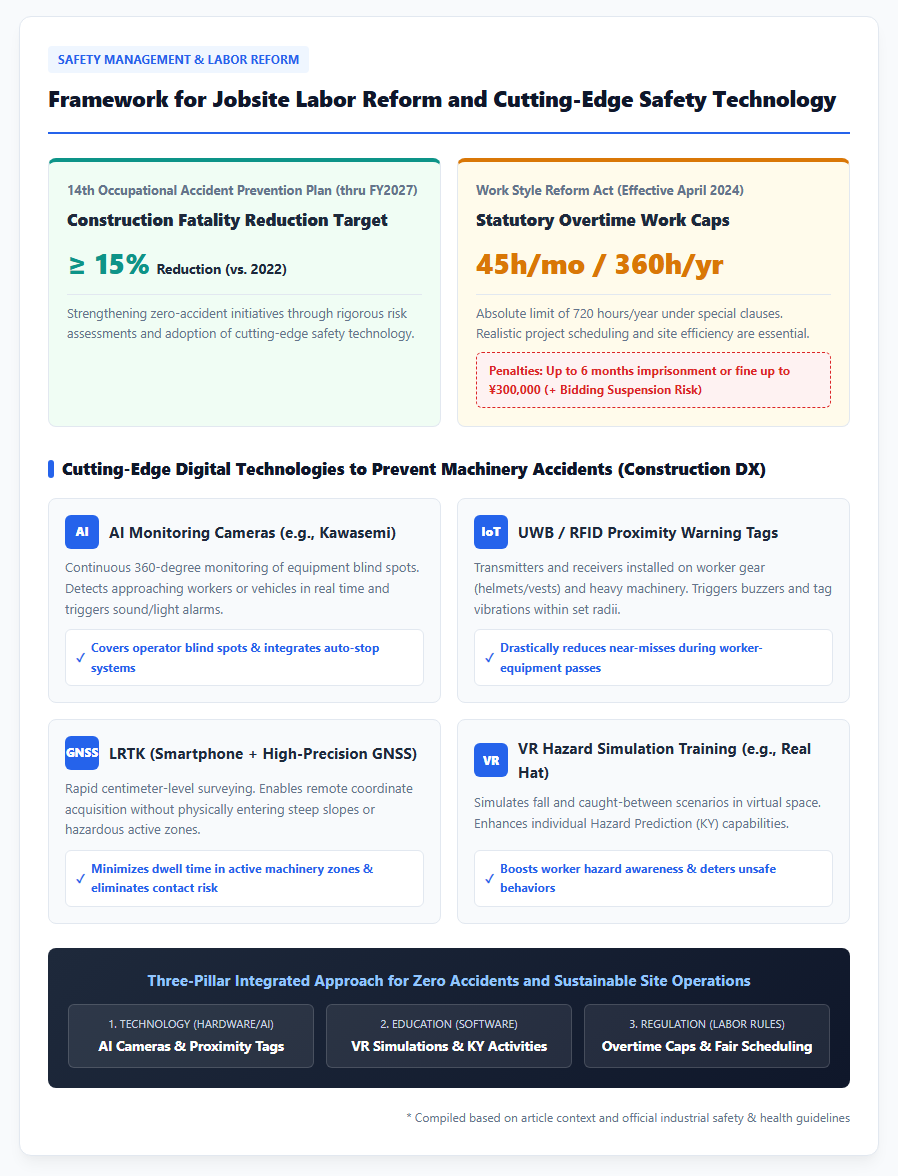
Since April 2024, the Japanese construction industry has been subject to statutory overtime caps introduced under the Work Style Reform Legislation. This reform limits overtime to a general cap of 45 hours per month and 360 hours per year, with an absolute ceiling of 720 hours per year even under special circumstance agreements; non-compliant companies face criminal penalties of up to six months’ imprisonment or fines up to 300,000 yen. However, as calls for proper labor management intensify, the industry’s chronic labor shortages and aging workforce have grown increasingly acute. Pushed to complete projects within tight schedules and limited manpower, job sites face heightened risks of operational shortcuts, such as solitary work and rushed safety checks. Furthermore, companies sanctioned for Labor Standards Act or Industrial Health and Safety Act violations face potential suspension from bidding on public works contracts—a major business risk that can freeze public sector revenue streams for months or years. Improving site environments through digitized labor management and realistic project scheduling has become indispensable for both worker safety and long-term business continuity.
Emerging Technologies and Strategies Toward Zero Occupational Accidents
To eliminate safety blind spots and prevent heavy machinery accidents, construction sites are increasingly adopting advanced digital technologies. Major contractors are deploying AI-powered camera systems that automatically detect workers in equipment blind spots and sound real-time alarms, alongside proximity warning devices utilizing ultra-wideband (UWB) tags. Additionally, smart surveying technologies combining smartphones with high-precision GNSS receivers are minimizing the time personnel must spend inside active equipment zones. On a regulatory level, the Ministry of Health, Labour and Welfare’s 14th Occupational Accident Prevention Plan targets a 15% or greater reduction in construction fatalities by 2027, driving broader adoption of comprehensive risk assessments and VR-based hazard simulation training. Achieving zero occupational accidents requires not only hardware innovation, but also unified safety committees between prime contractors and subcontractors, as well as a strong workplace culture that elevates safety awareness among every worker. For a visual overview of cutting-edge jobsite safety solutions, see the graphic below.
References
- [Ministry of Health, Labour and Welfare: Clear Explanation of Overtime Regulations] https://www.mhlw.go.jp/content/000463185.pdf
- [Ministry of Land, Infrastructure, Transport and Tourism: Current Status and Challenges in Construction] https://www.mlit.go.jp/tochi_fudousan_kensetsugyo/const/content/ccus_background.pdf
【#AkitaPrefecture #YokoteCity #OccupationalAccident #ExpresswayConstruction #HeavyMachineryAccident #SafetyManagement #WorkStyleReformInConstruction #OccupationalSafetyAndHealth】

コメント