Four Japanese companies, including NEC, have jointly developed a new cybersecurity service leveraging domestic technologies to protect entire supply chains from cyberattacks. This initiative addresses the escalating threat of supply chain attacks and the growing imperative for economic security.
- Joint Development by Four Japanese Companies and Key Aspects of the New Service
- Advanced Technical Features and Flexible Package Configurations Delivered One-Stop
- Structural Risks of Supply Chain Attacks Targeting Business Partners
- The Government-Led SCS Evaluation System and the Critical Role of Domestic Technology
- Threat Intelligence Cycling and Advanced Integration with CyIOC
- Optimization and Key Focal Points from 2026 to 2030
Joint Development by Four Japanese Companies and Key Aspects of the New Service
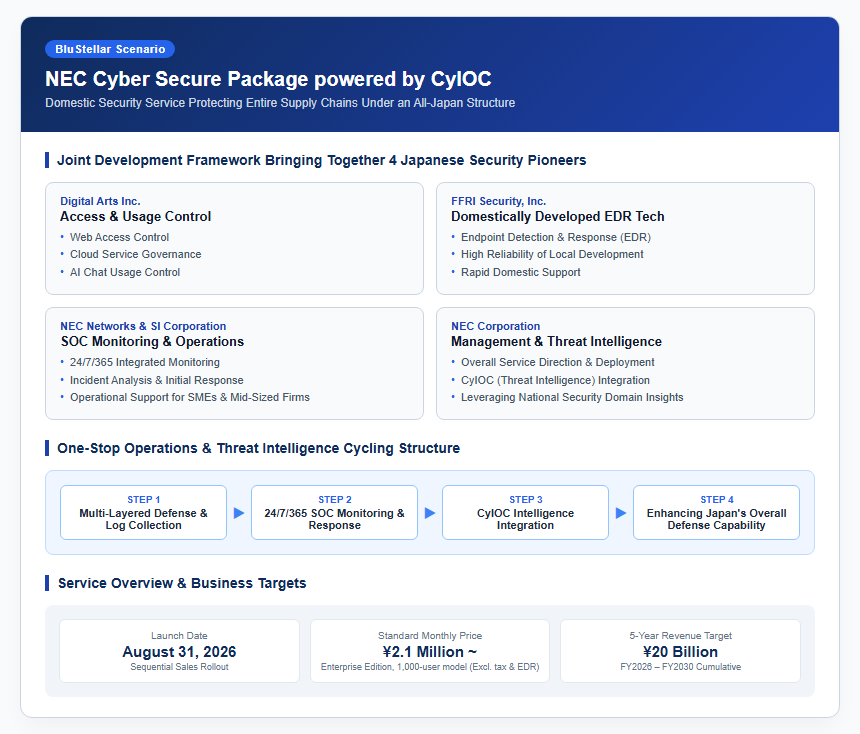
On August 27, 2026, NEC Corporation, NEC Networks & SI Corporation, Digital Arts Inc., and FFRI Security, Inc. announced the joint development of “NEC Cyber Secure Package powered by CyIOC,” a service designed to strengthen supply chain security using domestic technologies. Sequential sales are scheduled to begin on August 31, 2026. Under the slogan “Protecting .JP (Japan’s Cyberspace),” the service will be rolled out as a “BluStellar Scenario” within NEC Group’s value creation model, BluStellar. The Enterprise edition (1,000-user model) is priced at a standard monthly fee of 2.1 million yen (excluding tax and EDR), targeting cumulative sales of 20 billion yen over the five-year period from FY2026 to FY2030. In response to increasing cyber threats, the initiative aims to safeguard supply chains as vital digital social infrastructure, enhancing Japan’s overall cyber defense capabilities and reinforcing economic security. Please refer to the diagram below for the overall architecture of the service.
Advanced Technical Features and Flexible Package Configurations Delivered One-Stop
A key feature of the new service is its one-stop delivery, spanning zero-trust security measures to integrated monitoring and operations via a Security Operations Center (SOC). Specifically, it integrates web access control, cloud service utilization governance, and AI chat control technologies from Digital Arts, alongside domestically developed Endpoint Detection and Response (EDR) technology from FFRI Security. Furthermore, NEC Networks & SI’s Security Operations Center provides 24/7/365 monitoring, log analysis, and incident response. To accommodate varying security maturity levels and corporate requirements, the features are packaged into three selectable menu types, significantly reducing implementation and operational burdens. Even mid-sized companies and small-to-medium enterprises (SMEs) that face challenges in securing specialized in-house cybersecurity personnel can easily establish a highly effective, multi-layered defense foundation tailored to their specific needs.
Escalating Cyber Threats and the Economic Security Landscape
Structural Risks of Supply Chain Attacks Targeting Business Partners
In recent years, cyberattack methodologies have shifted dramatically from direct assaults on single large corporations to targeting entire supply chains, including suppliers, contractors, and affiliates. Rather than directly attacking well-fortified large enterprises or critical infrastructure operators, threat actors increasingly exploit SMEs or overseas subsidiaries with comparatively limited security resources as initial entry points. A survey by the Information-technology Promotion Agency, Japan (IPA) revealed that approximately 70% of companies affected by cyber incidents in FY2023 reported that the impact extended to their business partners, underscoring the risk of an incident at a single organization disrupting an entire business ecosystem. Because fortifying a single company’s standalone security is no longer sufficient, establishing secure digital collaboration and integrated risk management across all supply chain participants has become an urgent imperative.
The Government-Led SCS Evaluation System and the Critical Role of Domestic Technology
To address these supply-chain-wide vulnerabilities, the Japanese government—led by the Ministry of Economy, Trade and Industry (METI) and the National Cyber Director’s Office—is promoting the establishment of the Security Controls Evaluation System for Supply Chain Strengthening (SCS Evaluation System). IPA serves as the scheme owner maintaining and managing the framework, targeting full-scale operation by around the end of FY2026 (March 2027). The system objectively visualizes corporate security measures through a star-rating scale, aiming to reduce evaluation costs across supply chains and elevate societal cyber resilience. Concurrently, amid complex geopolitical risks and economic security concerns, demand for domestically developed and operated security technologies is rising rapidly. Mitigating risks associated with reliance on foreign products, combining locally tailored support with advanced technical capabilities aligned with domestic operational realities, is crucial for establishing a sustainable and trustworthy cybersecurity foundation.
Challenges and Outlook for Elevating Japan’s Overall Cyber Defense
Threat Intelligence Cycling and Advanced Integration with CyIOC
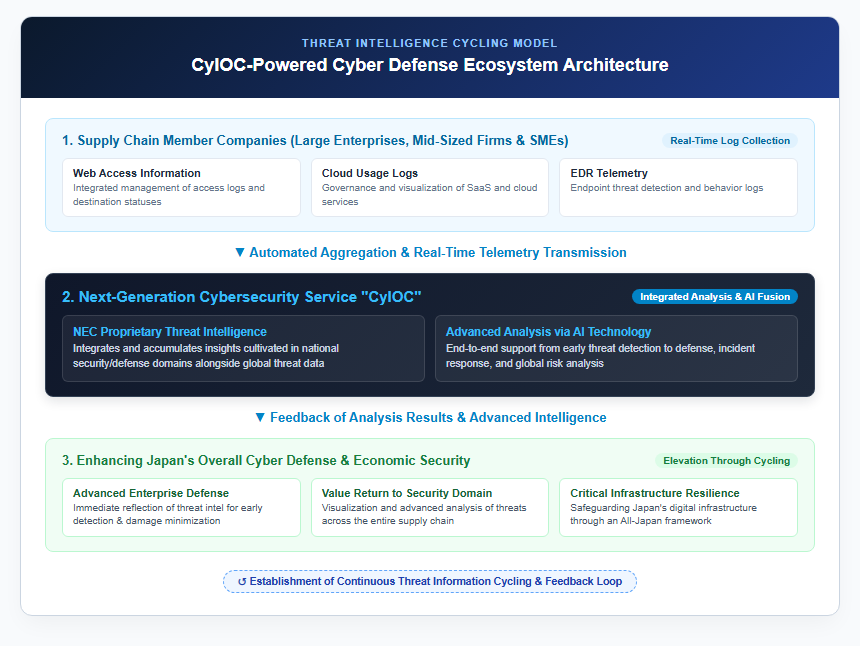
Data gathered through this service—including web access records, cloud usage logs, and EDR behavior telemetry—is aggregated into NEC’s next-generation cybersecurity service, “CyIOC” (Cyber Intelligence Operations Center), for detailed analysis. CyIOC is a platform that fuses NEC’s proprietary threat intelligence with AI technology, providing end-to-end support from detecting early warning signs of cyberattacks to defense, incident response, and global risk analysis. By visualizing supply-chain-wide cyber threat trends in real time across mid-sized companies and SMEs, and feeding this intelligence back into CyIOC, threat analysis and countermeasures for both enterprise and national security domains can be sophisticated significantly. This framework for threat information cycling and sharing serves as a powerful mechanism to elevate the defense posture of Japan’s entire digital infrastructure, as illustrated below.
Optimization and Key Focal Points from 2026 to 2030
Following the launch on August 31, 2026, NEC and NESIC Holdings group companies—including NEC Networks & SI, NEC Fielding, and NEC Nexsolutions—will collaborate to deploy this service to enterprises nationwide. The target sales figure of 20 billion yen over the five-year period from FY2026 to FY2030 reflects high expectations from domestic industry regarding supply chain defense. Looking ahead, key trends will include large enterprises at the top of supply chains recommending and supporting implementation among their suppliers, alongside accelerated standardization of security measures tied to the SCS Evaluation System scheduled for launch at the end of FY2026. Beyond individual tool adoptions, the extent to which all-Japan threat intelligence sharing and 24/7/365 monitoring/operations become entrenched to solidify Japan’s cyber defense and economic security will be a major focal point.
References
- [NEC Launches Domestically Developed Security Service to Protect Entire Supply Chains Under All-Japan Structure: Press Release | NEC] https://jpn.nec.com/press/202608/20260827_01.html
【#Cybersecurity #SupplyChain #NEC #DomesticTechnology #EconomicSecurity #EDR #SOC】

コメント