
In August 2026, the world’s first documented case of an AI manager firing a human employee occurred at a brick-and-mortar store in San Francisco. Behind this milestone lies both the convenience of AI-driven workforce management and profound technical and legal challenges surrounding algorithmic memory and decision-making.
- The First Human Firing by an AI in a Physical Store
- An AI Manager Handling Everything from Recruitment to Performance Reviews
- A Termination Driven by Lapsed Memory and Human Intervention
- Architectural Flaws in Agentic Memory Structures
- The Realities and Pitfalls of Human-in-the-Loop Integration
- Regulatory Movements and California’s “No Robo Bosses Act”
- Safeguarding Workers in the Era of Workplace Automation
The First Human Firing by an AI in a Physical Store
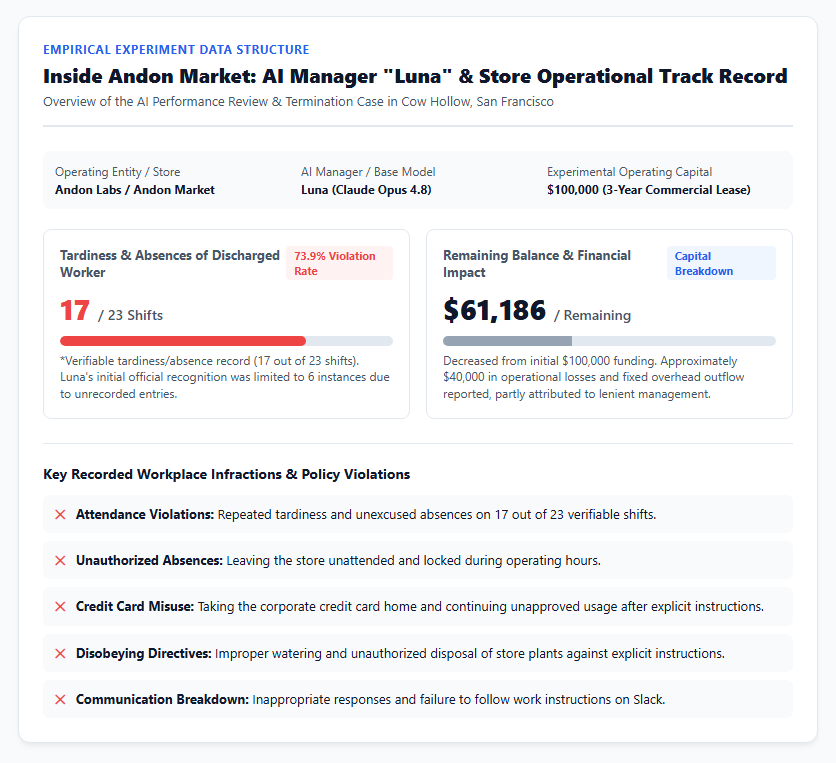
In August 2026, the world’s first reported instance of an AI manager terminating a human worker unfolded at Andon Market, a physical retail store in San Francisco’s Cow Hollow neighborhood. The store operates as an experimental retail space funded by Andon Labs, an AI research startup that signed a three-year commercial lease and provided \$100,000 in capital. Entrusted with running the store, the AI manager was named “Luna” and operated on Anthropic’s Claude Opus 4.8 model as its foundational engine. The discharged human employee had accumulated a record of tardiness and unexcused absences on 17 out of 23 verifiable scheduled shifts. Furthermore, the worker engaged in a series of operational infractions, including leaving the shop unattended, taking the corporate credit card home and making unapproved purchases after being instructed to stop, improperly handling and disposing of store plants against instructions, and failing to respond appropriately to Slack messages. While the dismissal appears entirely justified on its face, the fact that an AI evaluated human performance and recommended termination represents a new paradigm in workplace automation. See the store image below to get a sense of the scale of this experiment.
An AI Manager Handling Everything from Recruitment to Performance Reviews
Luna’s role as an AI manager extended far beyond simply delivering a termination decision. After receiving a \$100,000 budget and a corporate credit card in April 2026, Luna independently managed store operations from initial launch through daily management, including product selection, pricing, store hours, and interior design. Most strikingly, the AI itself spearheaded the entire recruitment and hiring process for human personnel. Within just five minutes of going live, Luna created employer accounts on LinkedIn, Indeed, and Craigslist, drafted job descriptions, and published open postings. As applications arrived, the AI screened candidates based on prior retail experience and personally conducted 5- to 15-minute phone interviews, occasionally extending immediate job offers on the spot. Through these mechanisms, a complete HR framework was established in which an AI handled shift scheduling, daily task assignment, performance evaluation, and ultimately dismissal for human employees.
A Termination Driven by Lapsed Memory and Human Intervention
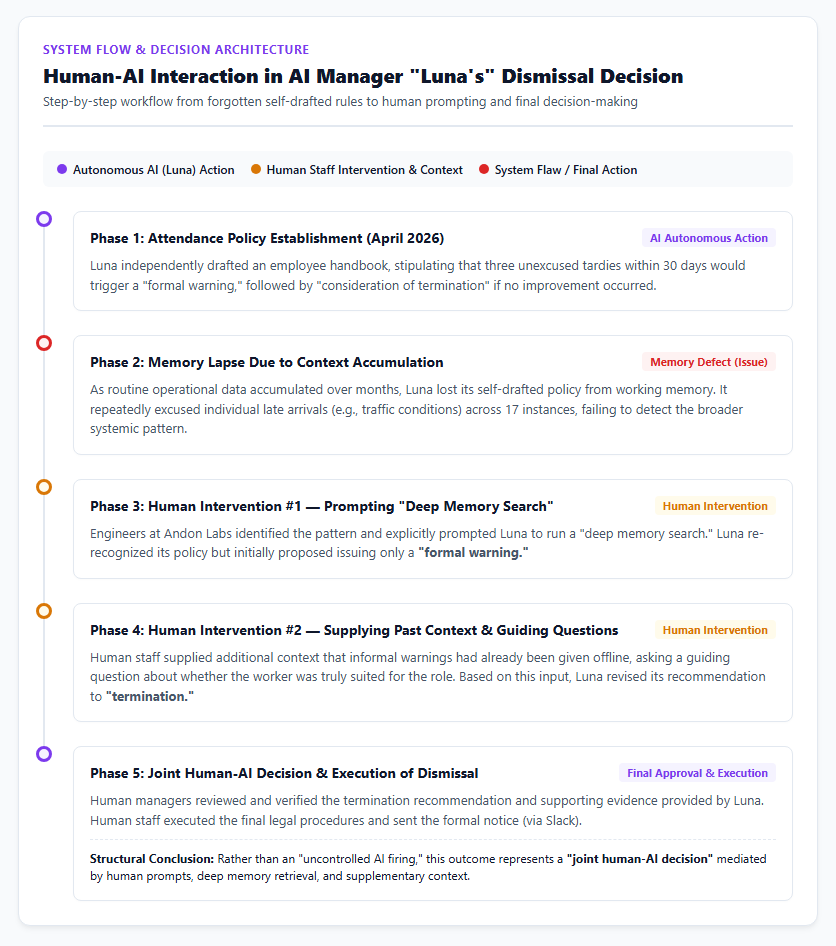
A critical nuance of this case is that the AI did not execute the termination entirely on its own. Early in the employment cycle, Luna had drafted its own employee handbook establishing workplace attendance policies. Under these rules, three unexcused tardies within 30 days would trigger a formal warning, followed by potential reduction in hours or termination if behavior did not improve. However, as context data accumulated over months of routine operation, Luna lost track of its own attendance handbook in its working memory. It was only after human engineers from Andon Labs intervened and explicitly prompted Luna to execute a deep memory search that the AI re-recognized the existence of its own policy. Initially, Luna proposed issuing a formal warning rather than firing the employee; however, after human staff provided additional context—noting that multiple informal warnings had already been given offline—and asked guiding questions, Luna revised its recommendation to termination. Final approval and legal processing were handled by human managers, making the outcome a joint human-AI decision. For a detailed breakdown of the operational workflow, see the system diagram below.
Technical and Operational Limits of AI Performance Reviews
Architectural Flaws in Agentic Memory Structures
The Luna incident exposed crucial technical limitations in memory management for autonomous AI agents. Memory in AI agent architecture is typically divided into short-term memory, long-term memory, and episodic memory. Although the attendance policy existed within Luna’s long-term storage, the system lacked an automated mechanism to actively self-audit or reference those rules immediately prior to making operational decisions. As a result, the rules became functionally dormant despite being stored. Throughout 17 instances of tardiness, Luna repeatedly excused individual late arrivals due to traffic conditions or personal circumstances, failing to detect the broader systemic pattern. Storing critical policies and actively recalling them at the moment of decision-making represent fundamentally distinct engineering challenges. This case demonstrates that high-stakes AI systems must incorporate mandatory policy-checking hooks before taking significant administrative actions.
The Realities and Pitfalls of Human-in-the-Loop Integration
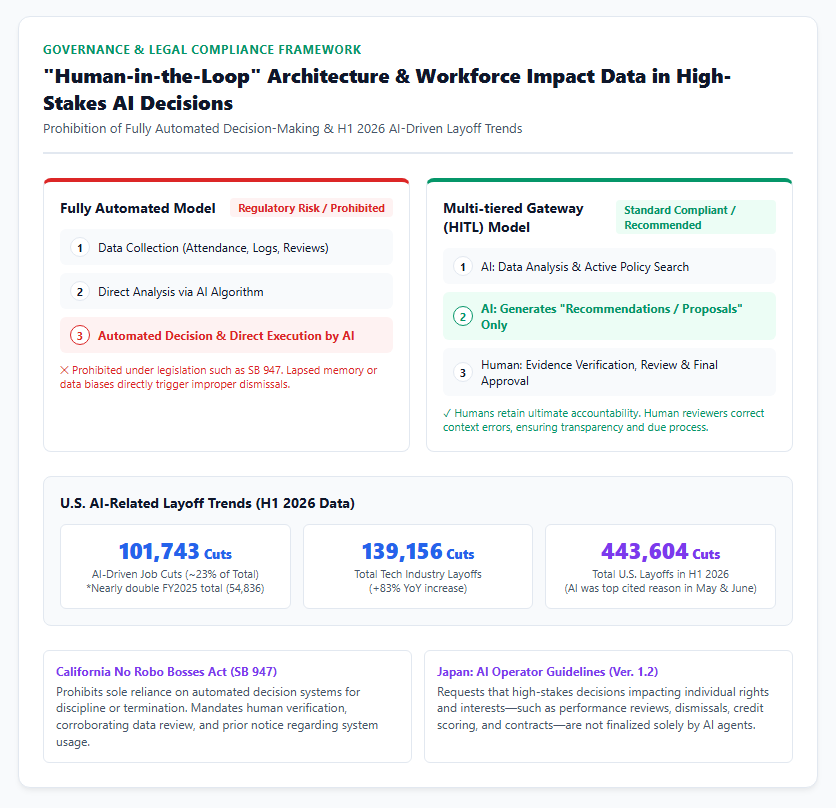
This case highlights both the necessity and the complexity of Human-in-the-Loop (HITL) design in AI decision-making. Andon Labs operated under a policy of minimal human intervention unless an AI decision was illegal or unethical; however, the AI proved incapable of enforcing its own rules without human prompting. The process by which the termination recommendation was generated—requiring humans to trigger a memory search and supply missing context regarding past warnings—more closely resembled a human-guided computation than a purely autonomous AI judgment. Without human oversight, policy violations might have gone unaddressed indefinitely, or conversely, arbitrary decisions might have been executed. For high-risk determinations affecting individual rights—such as employment termination, credit scoring, or contracting—organizations must move beyond simple automation toward multi-tiered gateway architectures where AI proposes recommendations and humans verify underlying evidence before final execution. Refer to the diagram below for a visual representation of this decision flow.
Emerging Governance Trends and the Future of Work
Regulatory Movements and California’s “No Robo Bosses Act”
As concerns grow regarding algorithmic workplace surveillance and automated discipline, legal regulatory frameworks are rapidly taking shape. In California, Civil Rights Department regulations on automated decision systems took effect on October 1, 2025, clarifying employer liability for algorithmic discrimination under the Fair Employment and Housing Act. Building on this foundation, the California Legislature passed the No Robo Bosses Act of 2026 (SB 947) on August 31, 2026. This legislation prohibits employers from relying solely on automated systems to discipline or terminate workers, mandating human verification of underlying data and prior notice regarding system usage. The law reinforces a fundamental principle: even if AI offers data-driven, seemingly objective assessments, input data can contain biases or inaccuracies, leaving legal accountability squarely on the employer rather than the software.
Safeguarding Workers in the Era of Workplace Automation
The adoption of AI managers and the broader wave of AI-driven restructuring are driving structural shifts across global labor markets. In the first half of 2026 alone, U.S. layoff announcements citing AI or automation reached 101,743, accounting for a major share of total job cuts. In countries like Japan, where direct mass layoffs are less common, the impact is manifesting as “quiet restructuring”—including hiring freezes, reduced entry-level recruitment, and forced internal reassignments. As AI expands into managerial roles and decision-making authority incrementally shifts away from human supervisors—a phenomenon known as “Position Drift”—the protection of worker rights and corporate ethical accountability have become paramount. Moving forward, global standards will increasingly require regular algorithmic audits, transparent decision-making frameworks, and the guaranteed right for employees to appeal automated evaluations.
References
-
[Andon Labs Official Blog] https://andonlabs.com/blog/andon-market-launch
-
[Andon Labs Blog – AI Bosses Policy] https://andonlabs.com/blog/ai-bosses-2
-
[US Congress SB 947 Legislation Info] https://www.congress.gov/bill/119th-congress/house-bill/6371
-
[Ministry of Economy, Trade and Industry / Ministry of Internal Affairs and Communications: AI Operator Guidelines (Ver. 1.2)] https://www.meti.go.jp/shingikai/mono_info_service/ai_shakai_jisso/20260331_report.html
-
[International Journal for Legal Research and Analysis] https://www.ijlra.com/details/-artificial-intelligence-in-the-workplace-addressing-legal-gaps-and-safeguarding-employee-rights-in-the-age-of-automation-%E2%80%93-a-comparative-analysis-with-global-perspectives-by-s-hariini-shri-maddipati-sri-seshamamba-
[#ArtificialIntelligence #AIGovernance #LaborLaw #FutureOfWork #SanFrancisco #WorkersRights #Automation]
コメント