On September 4, 2026, Japan’s Ministry of Land, Infrastructure, Transport and Tourism (MLIT) released interim reports on its “Policy for AI Implementation in Infrastructure” and “Physical AI Strategy for Construction,” establishing eight priority fields for AI deployment on job sites. This decision comes in response to severe structural challenges facing the sector, including an escalating labor shortage, aging infrastructure, and increasingly frequent natural disasters.
- MLIT Strategy for AI Implementation and Physical AI Deployment
- A “Three Pillars” Approach to Augmenting Job-Site Capabilities
- Full Scope of the “8 Priority Fields” Targeting Early Results and Problem Solving
- Transitioning from PDFs to Structured Data for AI Learning Environments
- Public-Academic-Private Consortium and the Open Platform “OPERA”
- The New “S1-Type” Bidding System and Future Outlook
MLIT Strategy for AI Implementation and Physical AI Deployment
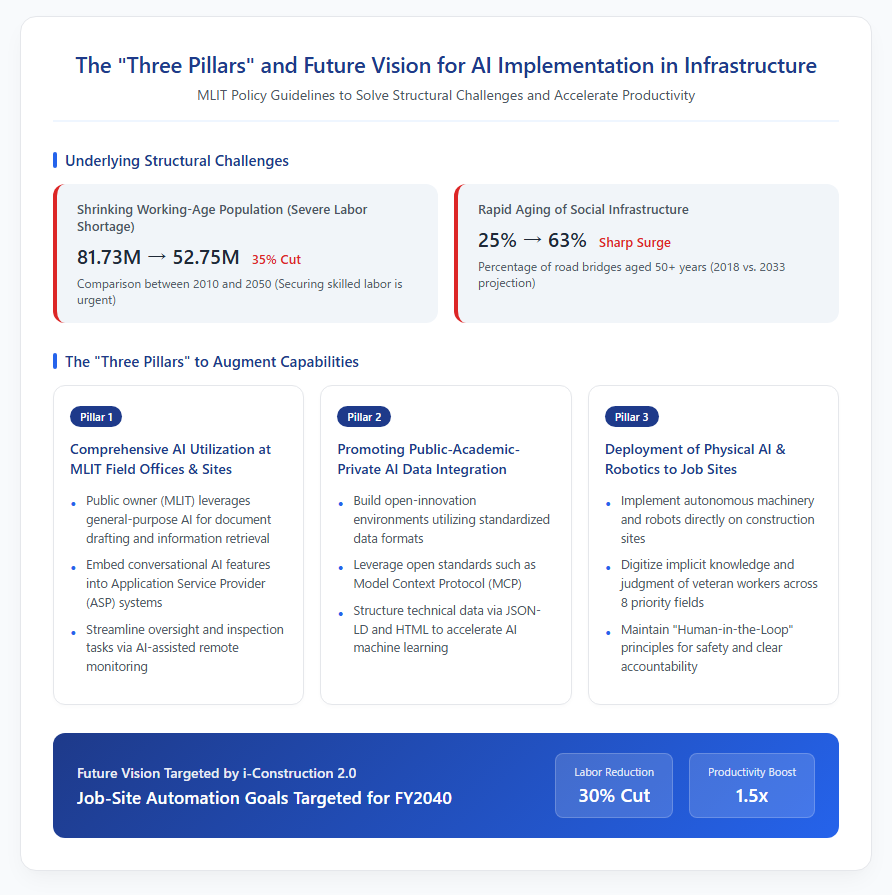
On August 26, 2026, at the 13th Infrastructure DX Promotion Headquarters meeting, Japan’s Ministry of Land, Infrastructure, Transport and Tourism (MLIT) finalized a new policy defining the direction of AI utilization across infrastructure administration alongside an interim report on physical AI strategy for construction sites, officially releasing both documents on September 4. Rather than treating AI merely as a labor-saving tool or a substitute for existing tasks, this initiative positions AI as a foundational capability to augment human workers and accelerate productivity gains on job sites. Japan’s working-age population is projected to shrink by 35%—from 81.73 million in 2010 to 52.75 million in 2050—making the shortage of skilled construction labor an existential challenge. Simultaneously, the proportion of road bridges aged 50 years or older is expected to jump from 25% in 2018 to 63% in 2033, creating a surge in maintenance demand. In alignment with national strategies—including the AI Robotics Strategy established in March 2026 and the revised Basic Plan for Artificial Intelligence updated in July 2026, both of which target construction and civil engineering for rapid social implementation—MLIT’s decision unifies government efforts behind a single roadmap.
A “Three Pillars” Approach to Augmenting Job-Site Capabilities
To realize next-generation infrastructure sites where humans and AI collaborate through defined roles, the implementation policy outlines three primary pillars to be deployed in stages:
– Comprehensive AI utilization at MLIT site offices: As the public project owner, the ministry itself will leverage general-purpose AI for document drafting and information retrieval while embedding conversational AI into the Application Service Provider (ASP) system for public-private information sharing and streamlining inspections through AI-assisted remote oversight.
– Promotion of public-academic-private AI data integration: Establishing open-innovation environments using standardized formats to encourage private-sector AI service development.
– Deployment of physical AI on construction sites: Implementing autonomous machinery and robots capable of perceiving real-world conditions, reasoning, and taking physical action on site.
Because every construction site is a custom, one-off project with unique geological and meteorological conditions characterized by high uncertainty, combining general-purpose AI with specialized vertical AI trained on construction domain knowledge alongside physical AI is deemed essential. Throughout this framework, a “Human-in-the-Loop” philosophy is prioritized, ensuring humans retain final decision-making authority and accountability. Please refer to the conceptual diagram below.
Full Scope of the “8 Priority Fields” Targeting Early Results and Problem Solving
For physical AI deployment, MLIT selected eight priority fields based on high job-site demand, data accumulation potential, speed of delivering tangible results, and societal urgency:
– Machinery construction (excavation, transport, grading/leveling, and loading in earthworks)
– Skilled manual labor (rebar placement, tying, and pressure welding; formwork assembly and dismantling; site assistance)
– On-site material transport (transportation of equipment and components within the job site)
– Structural inspection (inspection of infrastructure such as roads and rivers)
– Patrol and routine inspection (daily patrols of rivers, roads, etc.)
– Weeding, snow removal, and cleaning (environmental maintenance using heavy equipment or manual labor)
– Disaster surveying (wide-area and detailed surveys using drones and robots)
– Disaster recovery (urgent clearance operations including sediment removal, land leveling, transport, and road opening)
By digitizing the implicit knowledge and decision-making logic of veteran workers through sensors across these eight priority areas and establishing mechanisms for autonomous construction and automated inspection, MLIT aims to achieve a 30% reduction in labor requirements and a 1.5-fold boost in productivity by fiscal year 2040.
Data Structuring and Policy Frameworks Supporting AI Implementation
Transitioning from PDFs to Structured Data for AI Learning Environments
A major bottleneck hindering construction AI learning and retrieval accuracy has been the traditional reliance on PDF files for technical documents and reports. Because PDFs frequently cause text fragmentation across page breaks and misinterpretation of figures and tables, MLIT is actively transitioning to structured data formats that AI can easily reference and interpret. As a pioneer measure in September 2026, MLIT published the draft Common Specifications for Civil Engineering Work in HTML format with embedded JSON-LD alongside traditional PDFs, making semantic document structures easily readable by AI. Furthermore, the MLIT Data Platform utilizes the Model Context Protocol (MCP)—an open communication standard—enabling Large Language Models (LLMs) and conversational AI to seamlessly extract and analyze vast infrastructure datasets. This is expected to accelerate private-sector development of AI applications for design and management support.
Public-Academic-Private Consortium and the Open Platform “OPERA”
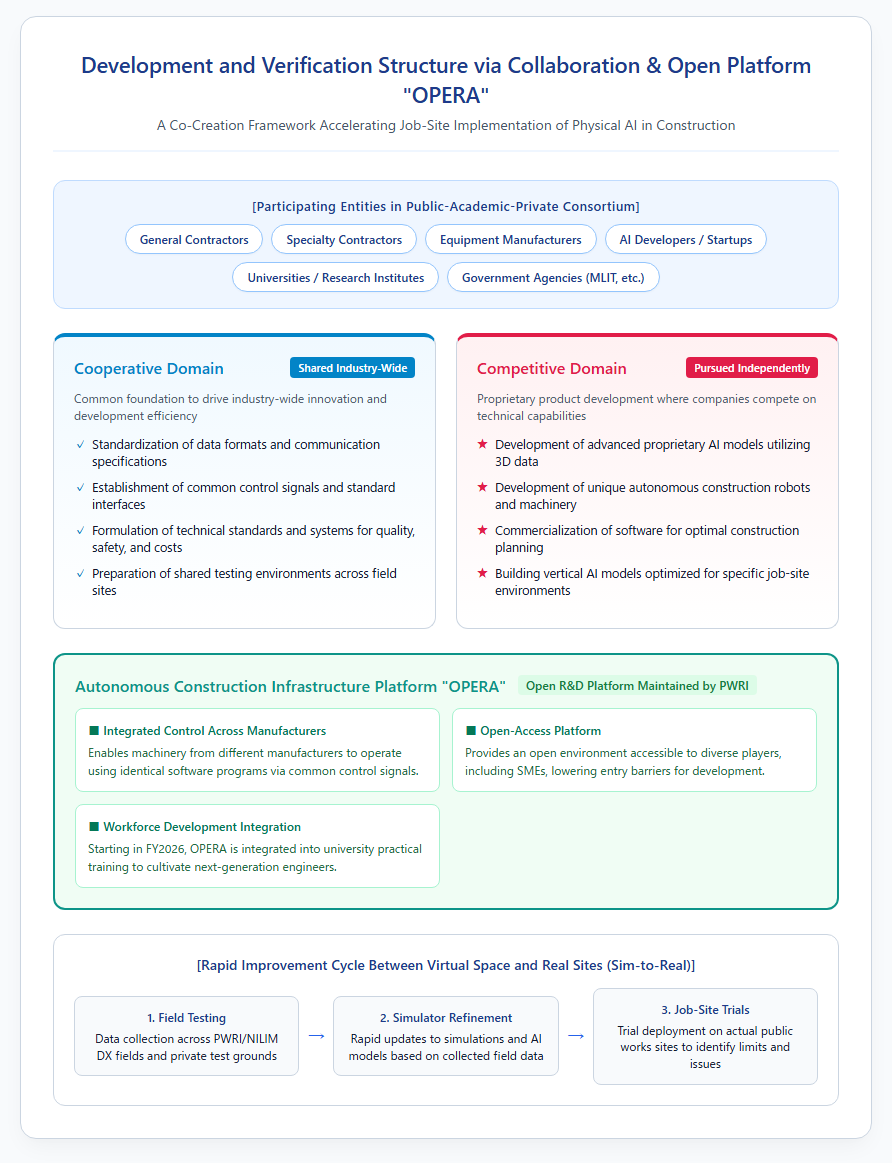
To achieve widespread adoption and development efficiency for physical AI, a collaborative consortium is being established comprising general contractors, specialty contractors, equipment manufacturers, AI developers, universities, research institutions, and government agencies. Within the consortium, dedicated Project Teams (PTs)—such as the Construction Machinery PT and Manual Labor Robot PT—will drive development by clearly delineating between cooperative domains shared industry-wide (standardization of data formats, communication protocols, safety standards) and competitive domains where companies compete on technical merits (proprietary AI models and construction robots). In addition, the Open Platform for Earthwork with Robotics and Autonomy (OPERA), maintained by the Public Works Research Institute (PWRI), provides an environment where machinery from different manufacturers can be operated using identical programs via common control signals. Starting in fiscal 2026, OPERA is also being integrated into university practical training programs for workforce development. The image below illustrates field testing.
The New “S1-Type” Bidding System and Future Outlook
Regulatory reforms supporting job-site implementation are moving forward in tandem with technology development. Following the explicit inclusion of Value for Money (VFM) principles in the June 2024 revision of the Public Works Quality Assurance Act, MLIT introduced a new contracting method: Technical Proposal Evaluation Type SⅠ (S1 Type). While the conventional S-type system prohibited technical proposals involving specification changes and required contractors to bear all associated costs, the S1 Type allows contractors to bill costs incurred from value-adding technical improvements within defined limits (currently up to 5% of the estimated contract price). In fiscal 2025, four trial contracts were awarded for automated mountain tunneling, with five additional projects scheduled for procurement in fiscal 2026. Furthermore, Cabinet Office SBIR Phase 3 funds (allocating approximately 30 billion yen over five years) are supporting field trials for autonomous heavy equipment and 3D printing construction by startups. Moving forward, expanding these technologies to local municipalities and small-to-medium construction enterprises will be a key focus as public and private sectors accelerate construction AI transformation (AX).
Reference Pages
- [MLIT] Formulation of the “Policy for AI Implementation in Infrastructure” and “Physical AI Strategy for Construction” (Interim Report) https://www.mlit.go.jp/report/press/kanbo08_hh_001361.html
- [MLIT] Outline of Policy for AI Implementation in Infrastructure https://www.mlit.go.jp/tec/tec_tk_000169.html
- [MLIT] Infrastructure DX and Thorough AI Utilization Efforts https://www.mlit.go.jp/tec/i-construction/pdf/03.11_kikaku_siryou3.pdf
【#MLIT #ConstructionAI #PhysicalAI #iConstruction #ConstructionDX #InfrastructureDX】

コメント