Ollama, an open-source tool for running local LLMs, has been updated to v0.34, bringing native integration with the ChatGPT desktop application. This update responds to growing user demand to leverage highly secure, private local models while maintaining their familiar chat interface.
- How the ChatGPT Desktop Integration Works and Why It Matters
- Simplified GUI Setup and Enhanced Usability
- Structured Output and Tool Search Optimization on Apple Silicon
- Response Compaction and Hardened Multimodal Image Handling
- Building a Unified Local Backend Across Desktop Interfaces
- The Horizon for Private AI and Strategic Considerations
How the ChatGPT Desktop Integration Works and Why It Matters
On September 5, 2026, Ollama—the open-source runner for executing large language models (LLMs) locally—was updated to version 0.34.0 (preview release v0.34.0-rc1). The standout headline of this update is native integration with OpenAI’s ChatGPT desktop application. While standard AI workflows send requests directly to cloud-hosted servers, placing Ollama as a local inference engine allows users to query models running on their own machines straight from the ChatGPT interface. Users can spin up major open-weight models such as Gemma, Qwen, and Llama locally while interacting with them through the familiar ChatGPT user experience. This empowers organizations and individual developers to harness AI capabilities without transmitting proprietary code, corporate IP, or personal data to third-party endpoints. For teams working with sensitive codebases and confidential internal documents, this setup delivers a significant security advantage. The diagram below illustrates the local processing workflow.
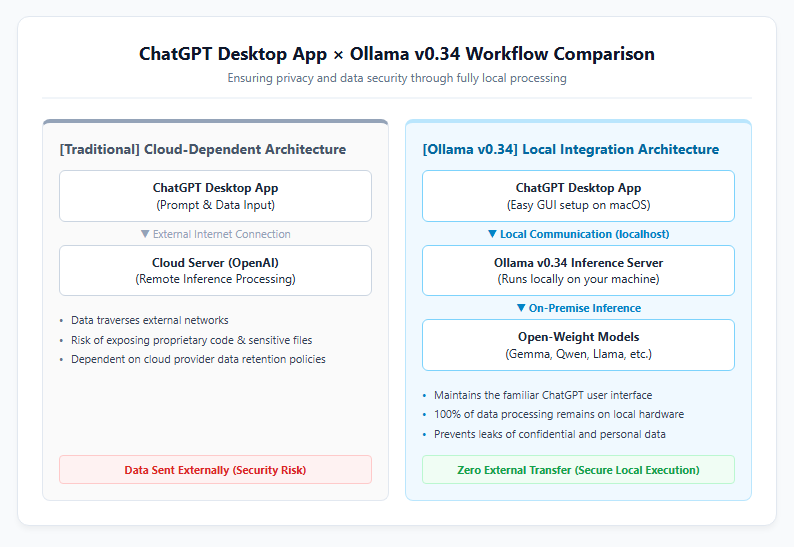
This functionality marks an important milestone in balancing AI usability with stringent data privacy.
Simplified GUI Setup and Enhanced Usability
Ollama originally added support for connecting to the Codex desktop app in version 0.24.0 back in May 2026, maintaining command-line configuration options even after Codex was merged into ChatGPT in July. However, requiring users to open a terminal and run commands like ollama launch chatgpt presented a barrier for non-technical users. Version 0.34.0 solves this by introducing a graphical configuration flow right inside the macOS Ollama desktop application. Mirroring the GUI integration launched for Claude Desktop on August 27, 2026, users can establish a connection with just a few clicks—no complex environment variables or terminal settings required. Profile restoration is equally intuitive, making the integration accessible for general business users and non-engineers. Furthermore, switching between high-performance Ollama Cloud models (such as kimi-k2.6 and glm-5.1) and recommended local models (including nemotron-3-super, gemma4:31b, and qwen3.6) is smooth and effortless. This improved user experience is poised to accelerate the shift of local AI from individual experimentation to enterprise-wide adoption.
Technical Enhancements and Core Upgrades in v0.34
Structured Output and Tool Search Optimization on Apple Silicon
Ollama v0.34.0 goes beyond external desktop app integrations, introducing extensive performance optimizations under the hood. Most notably, structured output generation on Apple Silicon (M-series Macs) sees substantial speed improvements. Tensor computation refinements significantly boost generation speeds and output precision when formatting responses to specific JSON schemas. In addition, official support for OpenAI-compatible client tool search has been introduced. This enables models to discover external functions and APIs to perform automated actions with greater accuracy, simplifying the build process for sophisticated AI agents. When paired with supported models like Qwen3, Gemma 4, or gpt-oss, complex automation workflows run far more reliably. The flowchart below outlines how tool search and structured output operate together.
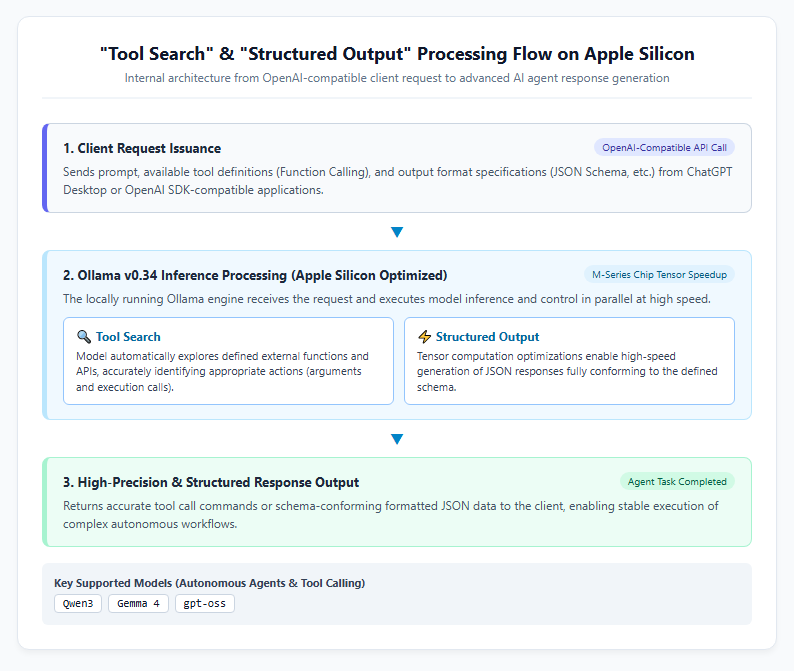
These underlying functional enhancements establish Ollama as a robust foundation for autonomous enterprise productivity tools, extending its value well beyond standard text chat.
Response Compaction and Hardened Multimodal Image Handling
Maintaining lightweight memory usage and stable connections is crucial during long-context sessions and extended interactions. Ollama v0.34.0 introduces response compaction for OpenAI-compatible clients. This technique compresses conversation history and generated text data in memory, lowering token consumption while improving response latency. Previous compaction mechanisms occasionally caused issues with multimodal image inputs; v0.34 fixes this image-handling logic, ensuring image data is properly retained and processed even in compacted responses. Additionally, proxy handling for Codex environments has been strengthened to prevent connection drops during long coding sessions and continuous agent tasks. These memory optimizations and bug fixes dramatically boost reliability when running multimodal models and complex prompts on resource-constrained local hardware.
Evolution of the Local LLM Ecosystem and Future Outlook
Building a Unified Local Backend Across Desktop Interfaces
Looking at Ollama’s broader trajectory, the project is rapidly evolving from a standalone model runtime into a universal local backend for desktop AI applications. Following its August 25, 2026 integration with Anthropic’s Claude Desktop, this new ChatGPT desktop integration completes support for the industry’s two dominant AI platforms. Previously, developers had to manage separate local runtimes or custom API adapters for different frontends. Now, Ollama functions as a unified local gateway and proxy, allowing users to transparently access the same suite of local models across multiple desktop frontends. This standardized ecosystem provides an ideal solution for organizations looking to avoid vendor lock-in. The diagram below shows how Ollama bridges various desktop clients with local LLM models.
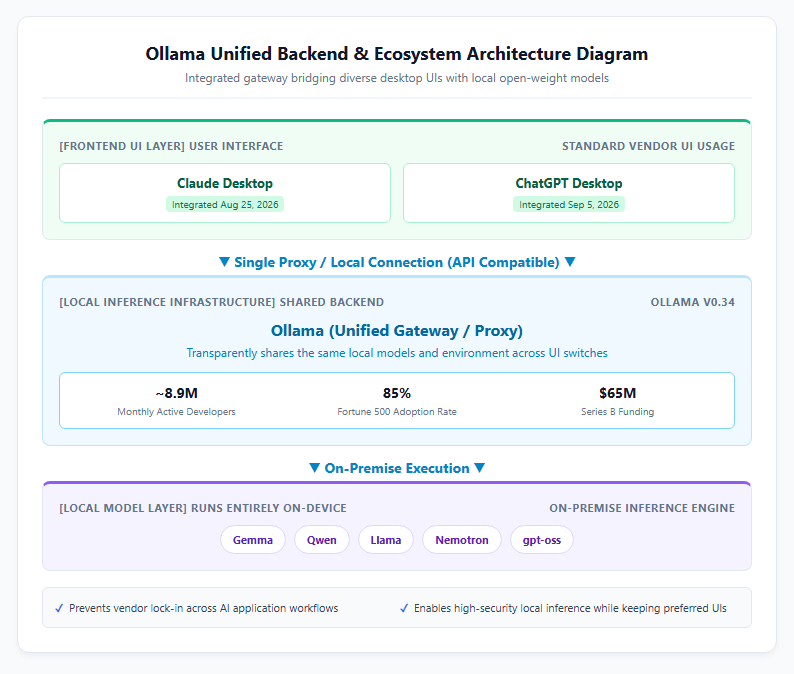
As a result, Ollama’s position as an open-source, community-driven foundation for local AI infrastructure is stronger than ever.
The Horizon for Private AI and Strategic Considerations
Ollama continues its remarkable momentum, having secured \$65 million in Series B funding in July 2026 and reaching nearly 8.9 million monthly active developers. With adoption across roughly 85% of Fortune 500 companies, enterprise demand for privacy-first, on-premise AI infrastructure is unmistakable. Moving forward, a major point of interest is whether the GUI-based setup currently available on macOS will expand to Windows and Linux environments. The industry also expects further advances in hybrid deployments—combining local and cloud inference seamlessly—alongside tighter integration with autonomous agent frameworks. At the same time, practical operational challenges remain, such as implementing strict access controls on local API endpoints, enhancing network security, and ensuring compliance with diverse model licenses. Organizations must craft clear hybrid strategies that pair local and cloud models according to task requirements. As the local LLM ecosystem matures, Ollama’s blend of accessibility and security is set to define the standard for personal and enterprise AI deployment.
Reference Pages
-
[Ollama Official Website] https://ollama.com/
-
[Ollama GitHub Repository] https://github.com/ollama/ollama
-
[Ollama v0.34.0 Release Notes] https://github.com/ollama/ollama/releases/tag/v0.34.0-rc1
[#Ollama #ChatGPT #LocalLLM #OpenSource #AITechnology #Privacy #macOS]

コメント