In its budgetary request for fiscal year 2027, the Ministry of Land, Infrastructure, Transport and Tourism has outlined a policy to establish a new support program aimed at strengthening the supply capacity of the construction industry, called the “Construction Industry Supply Capacity Strengthening Project.” Behind the initiative to provide integrated, hands-on support for DX promotion, reskilling, and working conditions improvement in the construction industry—which is facing a deepening crisis of an aging workforce and a shortage of young workers—lies the urgent need to build a sustainable framework capable of supporting social infrastructure development and disaster prevention and mitigation.
- Key Points of the Supply Capacity Strengthening Project Proposed in the Budget Request
- Structural shortage of successors and a sense of crisis as “guardians of the region”
- Role-Specific Training Programs and Reskilling Support for Skilled Workers
- Digitalization of the Back Office and Promotion of Front-Loading
- Establishment of Fair Trade Practices Based on the Third Revision of the Three Acts for Securing Workers and Labor Cost Standards
- Consolidation of CCUS into a Detailed Framework and Future Key Points to Watch
Key Points of the Supply Capacity Strengthening Project Proposed in the Budget Request
In September 2026, the Ministry of Land, Infrastructure, Transport and Tourism (MLIT) and the Ministry of Health, Labour and Welfare (MHLW) released the outlines of their budget requests for fiscal 2027 (Reiwa 9). In this context, the MLIT revealed its policy to establish a new initiative called the “Construction Industry Supply Capacity Strengthening Project” as a new measure to comprehensively support securing future workers and improving productivity in the construction industry. A major feature of this project is that, rather than simply providing direct subsidies to individual construction companies, it provides hands-on support to small and medium-sized construction enterprises and specialized contractors through industry organizations such as the Japan Federation of Construction Contractors, the National Association of General Contractors, and various specialized construction associations.
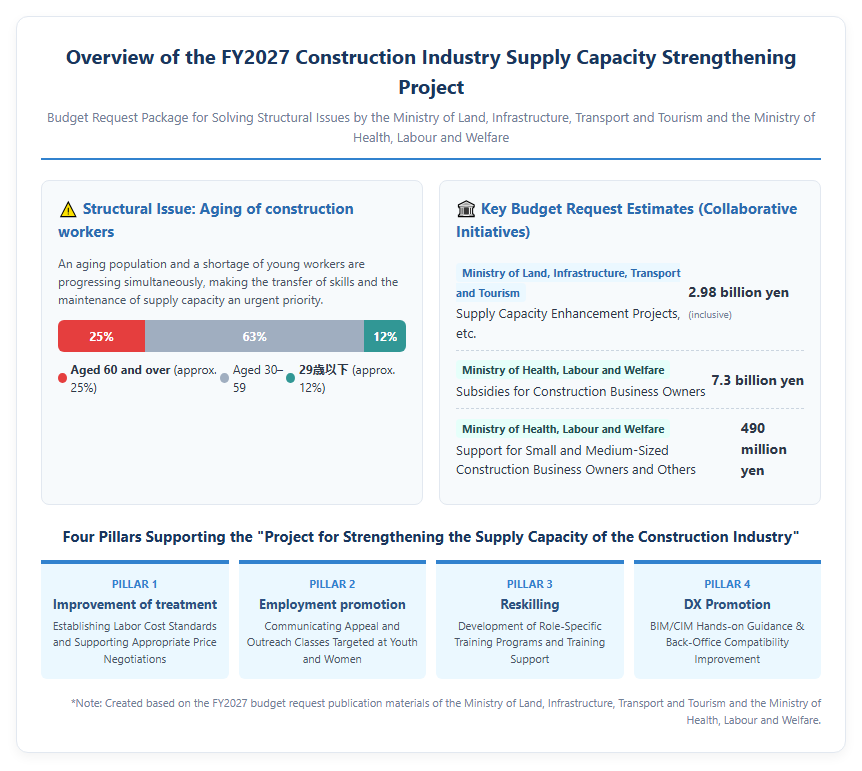
On the budgetary front, the Ministry of Land, Infrastructure, Transport and Tourism has allocated a portion of 2.98 billion yen under initiatives such as “strengthening the supply capacity of the construction industry to support the nation and economic growth.” Furthermore, working in strong collaboration with the Ministry of Health, Labour and Welfare, which is responsible for improving employment management and human resource development, the initiative will deploy a combined package including a 7.3 billion yen subsidy support program for construction business owners and enhanced job matching at Hello Work. The pillars of support consist of four key areas: improving the treatment and working conditions of skilled workers, encouraging younger generations to enter the field, reskilling using digital technology, and promoting DX. By dispatching experts to work sites for guidance and subsidizing the costs of creating occupation-specific educational programs, the efforts aim to achieve structural reform across the entire industry.
Please refer to the following figure.
Structural shortage of successors and a sense of crisis as “guardians of the region”
The background behind the government’s establishment of such robust support programs lies in the extremely severe structural labor shortage and aging population confronting the construction industry. According to data from the Ministry of Land, Infrastructure, Transport and Tourism and the Ministry of Health, Labour and Welfare, workers aged 60 and over currently account for approximately 25 percent (about one-quarter) of all construction skilled workers. Meanwhile, the younger demographic aged 29 and under, who will shoulder the next generation, remains at only about 12 percent of the total, resulting in a striking generational imbalance.
The construction industry plays a crucial role as a “guardian of local communities,” handling the development, maintenance, and management of infrastructure such as roads, water supply systems, and bridges, as well as providing emergency restoration response in the event of increasingly severe natural disasters like earthquakes and typhoons. Furthermore, much of the infrastructure intensively developed during the period of rapid economic growth has now been in place for over 50 years and is aging at an accelerated rate. If the transfer of skills to the next generation and the recruitment of personnel falter, there is a risk that the safety of local communities and economic activities themselves can no longer be maintained. Going beyond mere improvements to corporate working environments, from the perspective of sustaining national supply capacity, it is an urgent priority for the government to take the lead in driving digital transformation (DX) and radically improving working conditions.
Transforming Frontline and Back-Office Operations Through DX Promotion and Reskilling
Role-Specific Training Programs and Reskilling Support for Skilled Workers
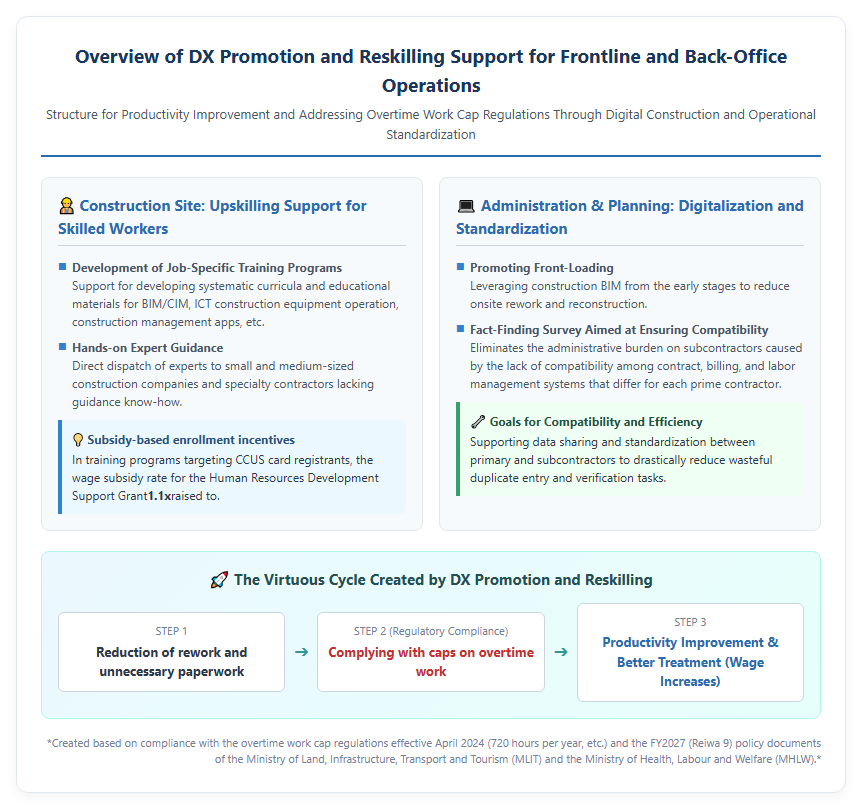
One of the major pillars of the new business is reskilling support aimed at helping construction workers acquire digital skills. Although competency evaluation standards utilizing the Construction Career Up System (CCUS) have already been established, this initiative goes a step further by clarifying the pathway for workers to systematically enhance their skills. Specifically, the government will provide robust support for the creation of education and training programs, teaching materials, and curricula tailored to specific occupations and proficiency levels, as well as the costs of training instructors to lead these sessions.
In actual site operations, there is a growing demand for acquiring digital skills, such as manipulating 3D model data utilizing BIM and CIM, construction techniques for ICT-enabled construction machinery, and utilizing cloud-based construction management applications. Even for small and medium-sized construction companies and specialized contractors that may find it difficult to organize training sessions independently, they can acquire practical skills directly applicable to their work at a low cost by receiving public support and hands-on expert guidance through their respective industry associations. Linked with the Ministry of Health, Labour and Welfare’s Human Resources Development Support Grant, environments are being put in place to encourage course enrollment, such as increasing the wage subsidy rate by 1.1 times for training programs targeting CCUS cardholders.
Digitalization of the Back Office and Promotion of Front-Loading
Not only improving the efficiency of on-site operations, but the digitalization and standardization of back-office operations are also key priorities of this project. Currently, various digital services are being adopted in the construction industry for contract execution, billing, labor management, and other tasks. However, due to poor compatibility between systems, it has been pointed out that subcontractors are required to use different systems and formats for each general contractor, which paradoxically increases their administrative burden. Through this project, the Ministry of Land, Infrastructure, Transport and Tourism (MLIT) will investigate these circumstances in detail and consider measures to ensure system compatibility.
The plan also includes the promotion of “front-loading,” which utilizes 3D data starting from the design and planning stages to anticipate and resolve potential construction issues in advance. By leveraging construction BIM from the early stages, it aims to reduce on-site rework and re-construction, thereby shortening construction periods and improving productivity. Digitization will be used to cut unnecessary overtime, establishing a framework capable of complying with the overtime work limits that came into effect in April 2024. By boosting productivity across both construction sites and administrative departments, the initiative aims to simultaneously achieve higher profitability and shorter working hours.
Please refer to the following figure.
Future Outlook on Improving Treatment and Optimizing Transaction Environments
Establishment of Fair Trade Practices Based on the Third Revision of the Three Acts for Securing Workers and Labor Cost Standards
To strengthen the supply capacity of the construction industry, it is essential to improve the treatment of skilled workers and establish a fair trading environment. The “third set of legislative acts concerning construction workers” (the amended Construction Business Act, the amended Act on Promoting Proper Tendering and Contracting for Public Works, and the amended Act on Ensuring Quality of Public Works), enacted in June 2024, explicitly stipulate the proper allocation of labor costs and the prohibition of below-cost contracts. Under the new initiative, based on these laws, support will be provided to help construction industry associations firmly establish trading practices in line with the “standards for labor costs.”
Specifically, it will support efforts such as providing guidance on creating estimates that appropriately itemize labor costs, sharing know-how on price negotiations with clients and primary contractors, and promoting the practice of appropriate cost estimation. It will establish an environment where material price surges and labor cost increases—which subcontractors have previously had to absorb—can be appropriately reflected in contract amounts. By reliably channeling profits generated through digitalization and productivity improvements into wage increases for on-site skilled workers and the enhancement of social insurance, it aims to transform the workplace into an attractive environment where young people can work with peace of mind far into the future.
Consolidation of CCUS into a Detailed Framework and Future Key Points to Watch
Important system changes are also planned for the Construction Career Up System (CCUS), which is linked to workers’ career paths. According to a decision by the Construction Industry Promotion Organization, starting April 1, 2027, the skilled worker registration system will be consolidated into a single “detailed type” from the current two-tier system (simplified and detailed types). Concurrently, the registration fee for the detailed type will be reduced from the current 4,900 yen to around 4,000 to 4,500 yen for the time being, aiming to promote the adoption of workers’ capability evaluations. New applications and renewals for the simplified type will end at the end of March 2027, and the transition to the detailed type is expected to proceed in stages.
Points to watch going forward include movements toward the Diet deliberation and passage of the FY2027 budget, as well as the release of specific public application guidelines by various construction industry associations and specialized construction contractor organizations. Furthermore, starting in April 2027, the new “Ikusei-shuro” (training and employment) system is scheduled to begin as a replacement for the Technical Intern Training Program, making CCUS level evaluations an important indicator for the career development of foreign workers as well. Close collaboration among the Ministry of Land, Infrastructure, Transport and Tourism, the Ministry of Health, Labour and Welfare, local governments, and various industry associations to enhance the effectiveness of the system will be the key to maintaining and strengthening Japan’s construction supply capacity.
Reference Page
- [Press Release: Advancing Initiatives for Securing and Developing Human Resources in the Construction Industry ~Overview of the FY 2027 Budget Requests from the Ministry of Land, Infrastructure, Transport and Tourism and the Ministry of Health, Labour and Welfare~ – Ministry of Land, Infrastructure, Transport and Tourism] https://www.mlit.go.jp/report/press/tochi_fudousan_kensetsugyo14_hh_000001_00377.html
- 【Third Revision of the Three Acts for Securing Workforce Portal Site – Ministry of Land, Infrastructure, Transport and Tourism】https://ninaite-sanpo.mlit.go.jp/
【#MLIT #ConstructionIndustry #ConstructionDX #Reskilling #BudgetRequests #SecuringWorkforce #CCUS #WorkStyleReform】


コメント