The U.S. 10-year Treasury yield briefly surged to 5.02%, hitting its highest level since 2007. This escalation is driven by rekindled inflation concerns following a hotter-than-expected August CPI report and rising oil prices, alongside structural fiscal risks including a U.S. national debt exceeding \$40 trillion and expanding Treasury issuance.
- Sticky Inflation and Surging Oil Prices Trigger Milestone Breach
- Structural Upward Pressures: National Debt Exceeding $40 Trillion and Supply Overload
- Downward Pressure on Equities: Hit to Growth Stocks and Portfolio Diversification
- Massive Unrealized Losses in Bank Portfolios and Spiking Mortgage Rates
- Re-emergence of “Bond Vigilantes” Demanding Fiscal Discipline and Market Repricing
- The Fed’s Delicate Balancing Act and Key Watchpoints in the Interest Rate Dot Plot
Sticky Inflation and Surging Oil Prices Trigger Milestone Breach
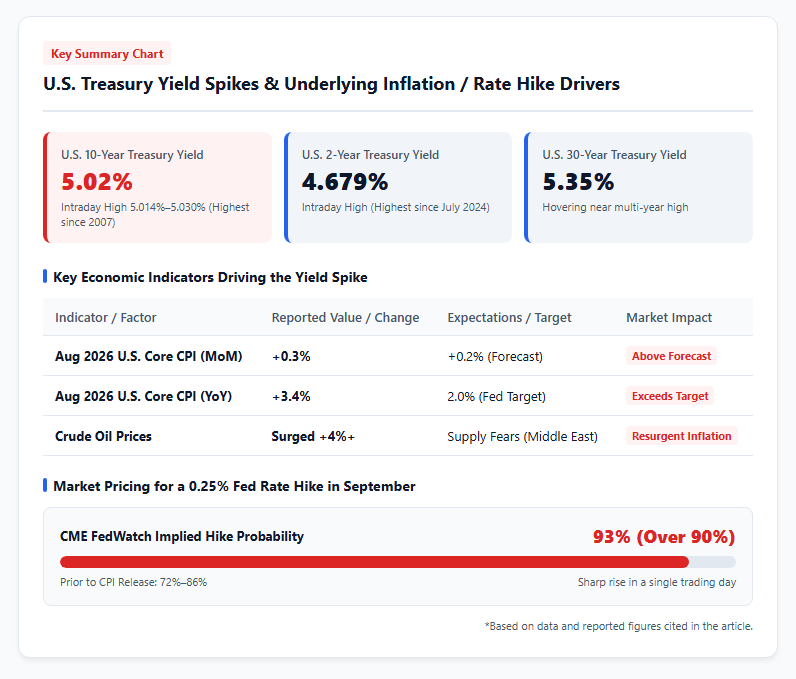
In mid-September 2026, the benchmark U.S. 10-year Treasury yield briefly touched 5.02% (ranging between 5.014% and 5.030%), reaching a milestone high not seen since October 2023 and marking its highest level since the 2007 financial crisis. The immediate catalyst accelerating yield increases across the bond market was a combination of inflation figures that beat forecasts and severe energy price volatility stemming from heightened geopolitical risks. In the August 2026 U.S. Consumer Price Index (CPI) release, core CPI rose 0.3% month-over-month, exceeding market expectations of 0.2%, while advancing 3.4% year-over-year—well above the Federal Reserve’s 2% target. Compounding this sticky inflation, international crude oil prices jumped over 4% due to protracted conflict in the Middle East involving Iran and supply disruption fears, dismantling expectations for a swift return to price stability. Market participants rapidly repriced the probability of a 0.25% interest rate hike by the Federal Reserve at its September 15–16 Federal Open Market Committee (FOMC) meeting, with odds rising above 90% in a single trading day and driving a broad sell-off in Treasuries. The 2-year Treasury yield, which is highly sensitive to monetary policy, also spiked to 4.679%, unsettling global markets alongside long-term rates. Please refer to the figure below.
Structural Upward Pressures: National Debt Exceeding $40 Trillion and Supply Overload
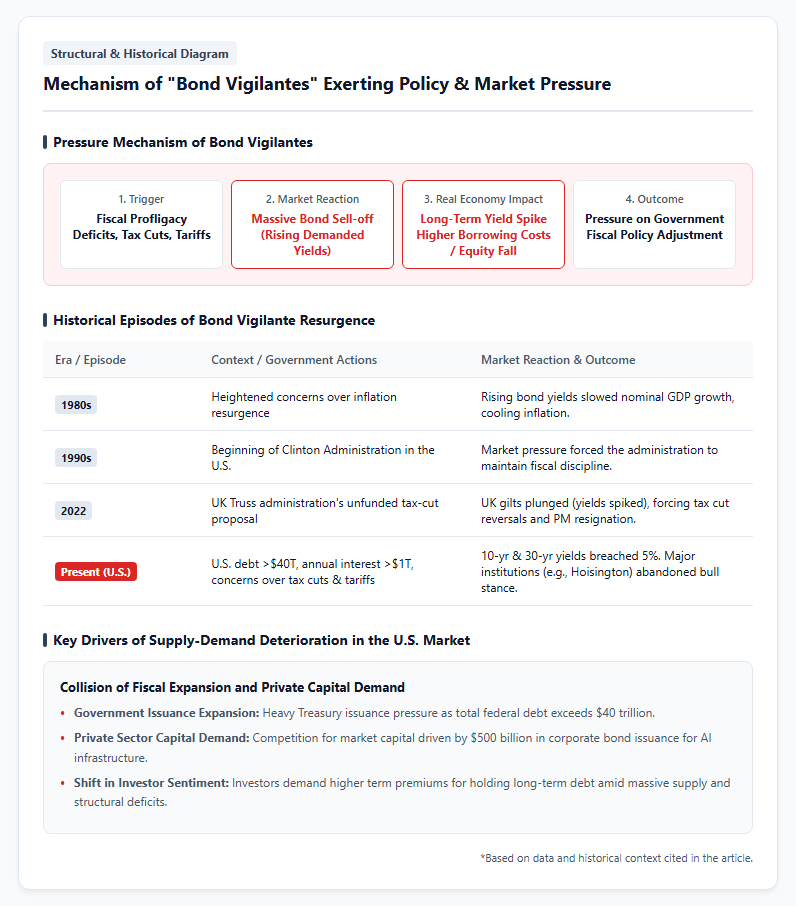
Unlike the yield spike in late 2023, the 10-year yield breaching 5% this time is propelled not only by short-term rate hike expectations, but also by deep structural fiscal challenges. Total U.S. federal debt has crossed the \$40 trillion mark (approx. 6,176.7 trillion yen), pushing the debt-to-GDP ratio beyond 100%. As annual federal budget deficits widen, government bond issuance has expanded to over \$31 trillion annually. Compounding this supply burden, private corporations have issued approximately \$500 billion in corporate debt to fund artificial intelligence (AI) infrastructure buildouts, generating an unprecedented supply overhang in the bond market. Annual interest payments on government debt alone now exceed \$1 trillion (approx. 163.2 trillion yen), turning fiscal expansion itself into an intense competition for market capital. Although U.S. Treasury Secretary Scott Bessent signaled plans to increase long-term bond purchases, these measures have failed to offset the massive issuance volume. Consequently, investors continue to demand a higher yield premium (term premium) to compensate for the risk of holding long-duration U.S. debt. As long as this structural debt accumulation persists, downward pressure on yields will remain severely constrained.
Far-Reaching Impacts on Financial Markets and the Banking System
Downward Pressure on Equities: Hit to Growth Stocks and Portfolio Diversification
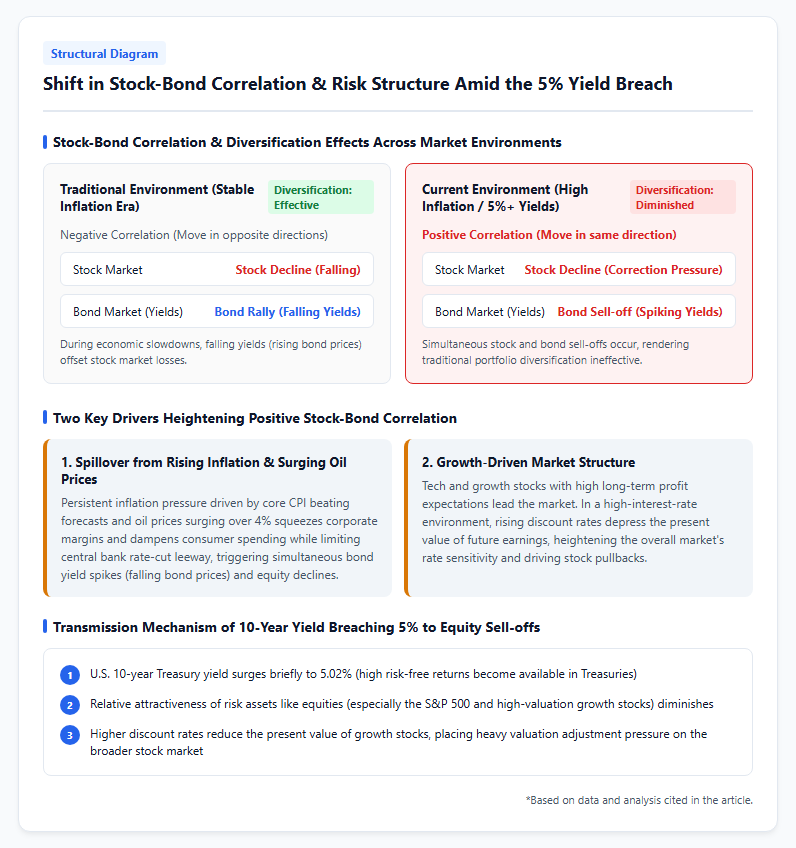
The 10-year yield rising above 5% exerts heavy valuation and adjustment pressure across equity markets and portfolio management strategies. With risk-free U.S. Treasuries offering returns above 5%, the relative attractiveness of equities has diminished substantially. Growth stocks—particularly in the technology sector, which have traded at elevated valuations based on future earnings growth expectations—face acute downside risk as higher discount rates significantly reduce the present value of their future cash flows. Even more critically, the correlation between stock and bond prices has turned increasingly positive. Under elevated inflation pressures, simultaneous “stock-and-bond sell-offs” (rising yields alongside falling equities) become far more frequent. This severely erodes the traditional diversification benefit where bonds typically appreciate during equity pullbacks to buffer portfolio losses. Major stock indices, including S&P 500 futures and the Nikkei 225, experienced heightened volatility following the yield spike, forcing institutional investors to re-evaluate their asset allocation frameworks. Please refer to the figure below.
Massive Unrealized Losses in Bank Portfolios and Spiking Mortgage Rates
Rapidly rising interest rates are also placing severe strains on financial institution balance sheets and real-economy borrowing costs. Fixed-income securities portfolios held by FDIC-insured banks—composed primarily of residential mortgage-backed securities (RMBS) and U.S. Treasuries—continue to harbor elevated unrealized losses totaling \$481 billion (approx. 74 trillion yen). Unrealized losses relative to bank subsidiary equity stand at approximately 19.9%. Should regional banks face compounding pressures such as deposit outflows or commercial real estate (CRE) loan defaults, vulnerabilities within the banking system could quickly re-emerge. Meanwhile, in the real economy, the spike in 10-year Treasury yields has fed directly into consumer borrowing costs. Average 30-year fixed mortgage rates in the U.S. have climbed to 6.55%, straining household housing affordability and cooling residential real estate activity. For businesses, soaring debt financing costs act as a drag on capital expenditure, compounding broader economic slowdown fears.
Resurgence of Bond Vigilantes and Key Focus Areas for Monetary Policy
Re-emergence of “Bond Vigilantes” Demanding Fiscal Discipline and Market Repricing
Financial markets are witnessing a resurgence of the “Bond Vigilantes”—investors who protest loose fiscal policies by dumping government bonds, thereby driving up yields and forcing policymakers to alter course. Prominent in the 1980s and during the Clinton administration in the 1990s—as well as during the UK’s Truss administration crisis in 2022—bond vigilantes are once again exercising formidable power in the heavily indebted U.S. market. In response to massive tax cuts, tariffs, and expanding deficits under the Trump administration, bond investors have pushed yields higher through Treasury sell-offs, effectively signaling a market veto. Even long-standing bond bulls such as Hoisington Investment Management were forced to abandon their decades-long bullish stance, citing persistent fiscal deficits and elevated capital demand. This supply-demand deterioration in the Treasury market represents more than temporary market nervousness; it reflects a stern market-driven repricing of fiscal discipline. Please refer to the figure below.
The Fed’s Delicate Balancing Act and Key Watchpoints in the Interest Rate Dot Plot
The primary focus for financial markets going forward centers on upcoming FOMC rate decisions and the Federal Reserve’s updated summary of economic projections, specifically the interest rate dot plot. Following the August CPI upside surprise and the crude oil rally, market pricing for a September rate hike exceeded 90%. However, investor focus has quickly expanded beyond a single rate move to the ultimate terminal rate for this tightening cycle. Federal Reserve Chair Jerome Powell, while resisting political pressure, is keeping a close watch on Japan’s fiscal deterioration and rising long-term yields as a cautionary tale. He faces an intricate balancing act between reining in inflation and managing sovereign fiscal risks. If a majority of Fed officials endorse additional rate hikes in the updated dot plot, 2-year and 10-year Treasury yields could test higher levels, injecting further volatility into stock and bond markets. Investors continue to navigate this prolonged high-interest-rate regime while monitoring energy prices and federal deficit trajectories.
Reference Pages
- 【The State of Banks’ Unrealized Securities Losses – Office of Financial Research (OFR)】https://www.financialresearch.gov/the-ofr-blog/2025/05/15/the-state-of-banks-unrealized-securities-losses/
【#USTreasuries #YieldSpike #Inflation #FederalReserve #FinancialMarkets #FiscalDeficit #StockMarket #EconomicNews】


コメント