Autodesk has unveiled next-generation agentic AI capabilities across its three industry clouds, establishing an advanced support framework that spans products and entire projects. This initiative aims to expand operational capacity on the ground by integrating generative AI with physical engineering validation, directly addressing labor shortages and data fragmentation in design and manufacturing.
- The Full Scope of Agentic AI Across Three Industry Clouds
- Development Background and Industry Challenges in Design and Make
- Technical Foundation for Understanding Intent and the Three Key Priorities
- Fusing Geometry, Physics Laws, and Deterministic Engineering Validation
- Practical Applications in Construction, Manufacturing, and Ecosystem Integration
- 2027 Delivery Roadmap and Future Outlook
The Full Scope of Agentic AI Across Three Industry Clouds
During Autodesk University 2026, held in Las Vegas on September 15, 2026, Autodesk previewed new agentic AI capabilities across its three primary industry clouds: Autodesk Forma for architecture, engineering, and construction (AEC); Autodesk Fusion for design and manufacturing (D&M); and Autodesk Flow for media and entertainment (M&E). This new suite of features forms the next generation of Autodesk Assistant, extending AI capabilities that were previously confined to individual software applications across products, projects, and teams. While conventional AI tools are limited to answering standalone questions from users, this next-generation experience incorporates connected project data and industry-specific context to understand the broader project environment, allowing it to plan and assist autonomously. The image below illustrates an overview of this announcement.
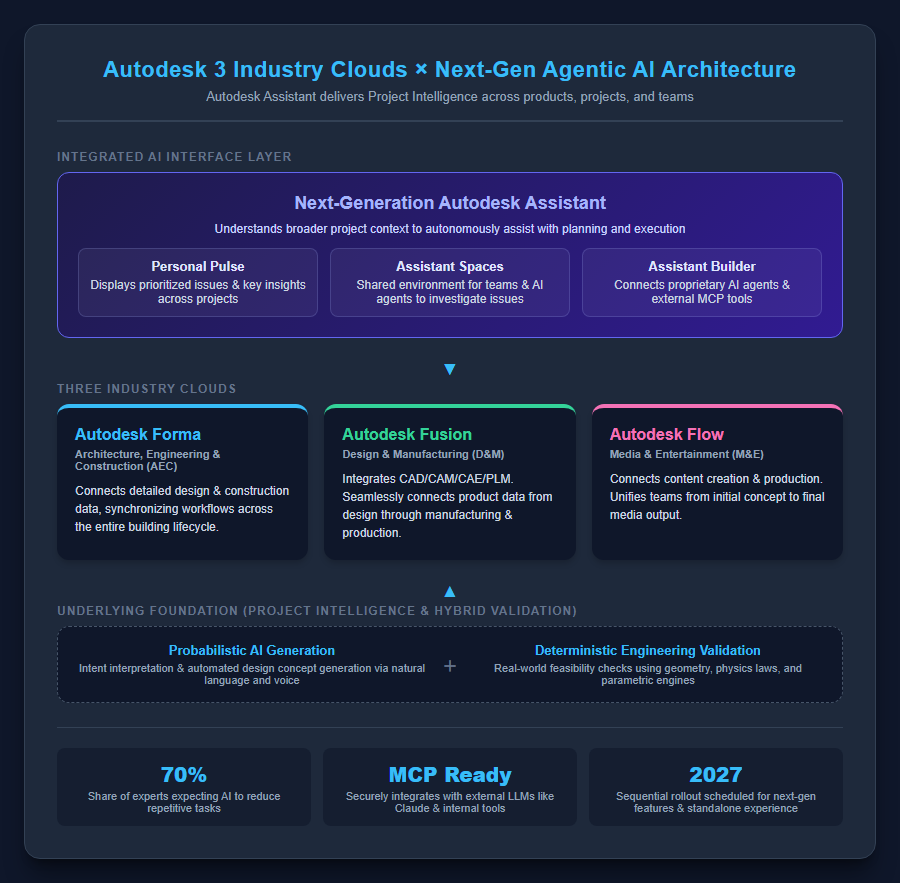
As a result, professionals can receive optimal support starting directly from their project goals without needing to know beforehand which specific tool or AI feature to select.
Development Background and Industry Challenges in Design and Make
The primary driver behind this technological enhancement is a structural capacity constraint facing the Design and Make sector. Andrew Anagnost, President and Chief Executive Officer of Autodesk, emphasized that the fundamental bottleneck in the industry is not a lack of ideas, but a limitation in the capacity required to execute them. Historically, teams have managed increasingly complex projects by layering point solutions and manual coordination, leading to severe inefficiencies caused by fragmented data. According to Autodesk’s 2027 State of Design & Make Report, 70% of surveyed leaders and experts expect AI to reduce tedious, repetitive tasks, freeing up capacity to focus on human judgment, creativity, and domain expertise. Because professional work directly impacts the physical world, “approximately right” reasoning is unacceptable. Building a reliable data foundation connected with over 40 years of deep industry expertise has thus become essential.
Next-Generation Autodesk Assistant and Project Intelligence Architecture
Technical Foundation for Understanding Intent and the Three Key Priorities
The next-generation Autodesk Assistant is built around three core priorities designed to harness Project Intelligence—actionable insights generated from connected project data, industry context, and AI. The first priority centers on understanding where attention is needed, featuring Personal Pulse to highlight high-priority issues across projects, and Assistant Spaces, a shared environment where teams and AI agents collaborate to investigate issues.
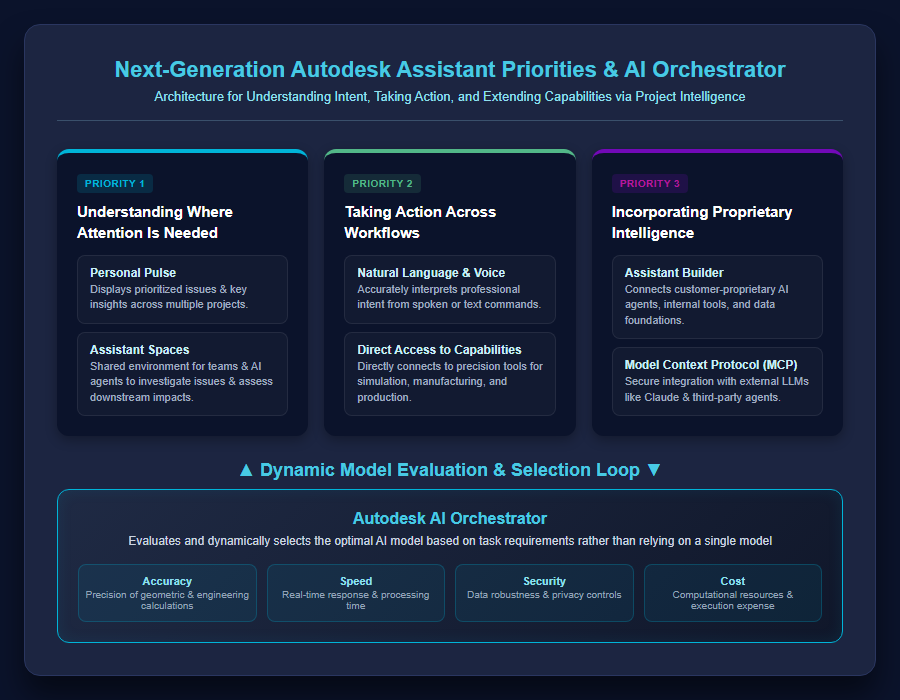
The second priority focuses on taking action across workflows, enabling natural language and voice interactions to directly access precision design, simulation, and manufacturing tools. The third priority allows customers to incorporate their own intelligence using Assistant Builder, which connects proprietary AI agents, internal tools, and open standards such as the Model Context Protocol (MCP). Operating behind these capabilities is the Autodesk AI Orchestrator, which dynamically evaluates and selects the optimal AI model based on required accuracy, speed, security, and cost.
Fusing Geometry, Physics Laws, and Deterministic Engineering Validation
Applying AI to design and architecture presents unique technical challenges compared to general language models, as it requires an exact understanding of real-world constraints such as building structures, product geometry, component shapes, schedules, and technical specifications. The cornerstone of Autodesk’s approach is a hybrid architecture that combines probabilistic AI generation with deterministic engineering validation. When general AI models generate design revisions or concepts, Autodesk’s proven parametric modeling and physics-based engines deterministically verify geometric integrity, manufacturability, constructability, and compliance with industry standards. As AI generates ideas and geometric or physical simulation engines validate their feasibility in real time, the output is guaranteed to be high-precision and directly executable in the real world. Furthermore, each validation loop continuously feeds back into the system, refining model accuracy and quality thresholds over time.
Industry-Wide Impact and the Future of Operations
Practical Applications in Construction, Manufacturing, and Ecosystem Integration
The deployment of agentic AI is poised to transform operational workflows across AEC and manufacturing. For instance, if a building’s structural design is modified, the AI interprets the change within the broader project context, immediately identifying downstream impacts on fabrication, cost, construction sequencing, and facility operations while presenting the appropriate tools to address them. In Japan, Shimizu Corporation has set an ambitious target under its digital transformation strategy to operate ¥2 billion construction projects with just two on-site personnel by fiscal year 2030. To achieve this, Shimizu is training AI agents via MCP using structural revision data and the accumulated expertise of veteran engineers. Similarly, Autodesk Fusion connects with external LLMs such as Anthropic’s Claude via MCP, enabling users to perform CAD geometry operations through a conversational interface while keeping proprietary design data securely inside Fusion. Furthermore, with the pending \$3.6 billion acquisition of MaintainX, Autodesk is expanding into asset management and operations, unlocking a \$40 billion total addressable market that seamlessly connects design and manufacturing to real-world operations.
2027 Delivery Roadmap and Future Outlook
The expanded next-generation Autodesk Assistant capabilities and standalone experiences previewed at AU 2026 are scheduled for sequential rollout beginning in 2027, with detailed commercial terms and regional availability to be announced in 2027. To address ethical and operational risks associated with AI, Autodesk has published AI Transparency Cards detailing data sources, safeguards, and known limitations, ensuring that AI serves as a partner under human supervision and control. Looking ahead, the integration of digital design data with real-world operational and equipment data gathered by platforms like MaintainX will pave the way for true, dynamic digital twins. Establishing a continuous feedback loop where real-world operational performance informs future design and manufacturing will dramatically enhance productivity and sustainability across global industries.
Reference Pages
-
[Autodesk Official Press Release: Autodesk Advances Agentic AI in Its Three Industry Clouds] https://adsknews.autodesk.com/en/pressrelease/autodesk-advances-agentic-ai-in-its-three-industry-clouds/
-
[Autodesk Investor Relations] https://investors.autodesk.com
[#Autodesk #AgenticAI #AutodeskAssistant #IndustryClouds #DigitalTwin #ConstructionDX #Manufacturing]


コメント