In September 2026, Danish pharmaceutical giant Novo Nordisk announced a strategic partnership with AI leader Anthropic to dramatically accelerate drug discovery and research and development (R&D) through generative AI models. As big pharma races to shorten development timelines and curb soaring costs, the battle for AI dominance across the healthcare sector has entered a critical new phase.
- Deploying Claude Science to Supercharge Drug Discovery R&D
- Accelerating Clinical Documentation and Operational Innovation via AI Agents
- The Battle for AI Dominance Against Eli Lilly and Moderna
- Financial Performance, Stock Dynamics, and Sovereign AI Supercomputing
- FDA Guidance on Risk-Based Evaluation and Data Governance
- Market Expansion Toward 2031 and Key Factors to Watch
Deploying Claude Science to Supercharge Drug Discovery R&D
On September 16, 2026, Danish pharmaceutical leader Novo Nordisk unveiled a strategic collaboration with artificial intelligence pioneer Anthropic. Under the agreement, Novo Nordisk will pilot Anthropic’s frontier AI models and its newly launched platform, “Claude Science,” across targeted research and development (R&D) workflows. The initiative aims to enhance complex biological reasoning, elucidate drug mechanisms, and predict cellular responses to candidate molecules using single-cell models—thereby drastically expediting the identification of promising drug targets and compounds. Novo Nordisk President and CEO Mike Doustdar emphasized the strategic weight of the deal, declaring a clear ambition to become “the world’s most AI-driven healthcare company” and noting that joining forces with Anthropic will “supercharge” the company’s R&D organization. Anthropic CEO Dario Amodei echoed this confidence, stating that placing safe, capable, and reliable frontier models directly into the hands of top researchers will compress discovery timelines and improve patient outcomes. While financial details remain undisclosed, the partnership is expected to extend far beyond Novo’s flagship GLP-1 diabetes and obesity portfolio, fostering novel pipelines across chronic diseases to build a foundation for long-term growth.
Accelerating Clinical Documentation and Operational Innovation via AI Agents
AI integration at Novo Nordisk extends beyond early-stage molecular discovery into clinical development and trial operations. The company has already leveraged Claude to automate clinical trial reporting, dramatically reducing the preparation time for patient-facing documentation from months to just minutes. Furthermore, Novo is deploying proprietary AI agents—built using software from Germany’s Celonis integrated with generative AI models—within active clinical trials. These AI agents continuously monitor trial protocols for gaps and flag data entry errors in real time, automatically issuing early warnings for potential schedule delays. Consequently, they have begun replacing complex data analysis tasks previously outsourced to hundreds of external contractors. Stephanie Bova, Novo’s digital transformation officer, highlighted the immense financial stakes involved, noting that bringing a new drug to market just one week earlier can generate tens to hundreds of millions of dollars in peak revenue. Please refer to the diagram below for an overview of this development process.
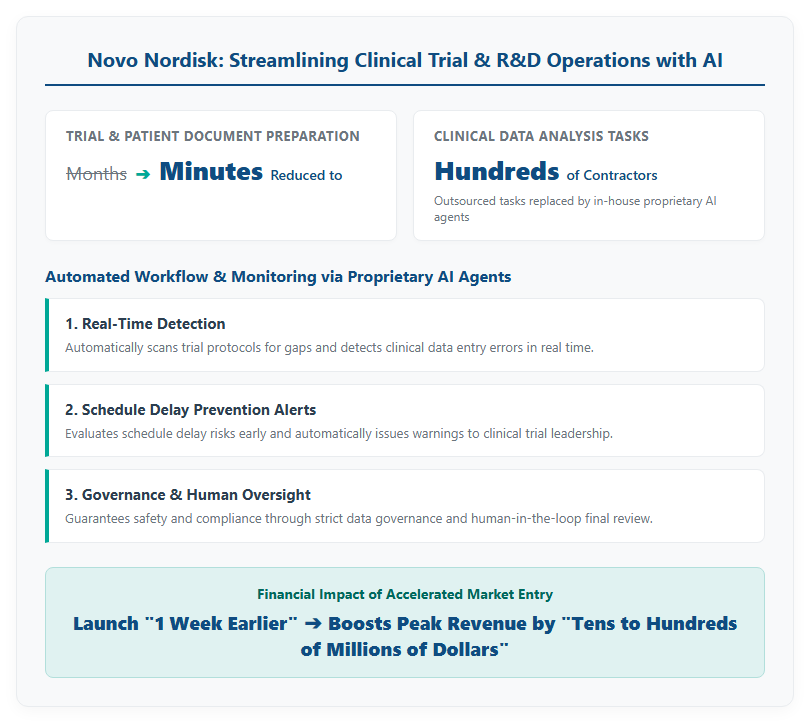
Importantly, Novo has embedded robust data governance and strict human oversight to ensure that AI is applied responsibly, safely, and in alignment with its ethical standards.
Mega-Pharma AI Investments and Escalating Obesity Market Rivalry
The Battle for AI Dominance Against Eli Lilly and Moderna
Across the pharmaceutical sector, investment is surging as mega-pharma firms race to acquire cutting-edge AI technologies to overhaul their drug creation processes. The competition is particularly fierce between Novo Nordisk and U.S. rival Eli Lilly, who are locked in an intense battle for market leadership in anti-obesity and diabetes therapies (GLP-1 receptor agonists). Eli Lilly has deployed massive capital to accelerate its AI initiatives, signing a deal worth up to \$2.75 billion with Hong Kong-based Insilico Medicine in March 2026 to acquire exclusive global rights for candidate molecules developed via Insilico’s “Pharma.ai” platform. Additionally, in January 2026, Lilly partnered with NVIDIA to establish a joint AI drug discovery lab backed by a commitment of up to \$1 billion over five years. Lilly’s GLP-1 treatments—Mounjaro, which generated \$23 billion in revenue, and Zepbound, which reached \$13.5 billion—continue to serve as powerful commercial engines. Elsewhere in the industry, Moderna has partnered with OpenAI to deploy AI across research, clinical operations, and corporate functions, while Bristol Myers Squibb has deepened collaborations with both Anthropic and NVIDIA. Having previously announced a partnership with OpenAI in April 2026, Novo Nordisk is countering with a multi-partner strategy that taps several top-tier AI providers.
Financial Performance, Stock Dynamics, and Sovereign AI Supercomputing
This surge in AI expenditure comes against a backdrop of heightened market scrutiny regarding stock performance and pipeline longevity. Shares of Novo Nordisk have declined approximately 16% to 20% year-to-date in 2026, weighed down by investor concerns over intensifying price competition in the obesity market and aggressive moves by rivals. Trading at a forward price-to-earnings (PER) ratio of roughly 13x, Novo appears undervalued compared to Eli Lilly, which trades above 31x. In response, Novo is aggressively mobilizing Denmark’s flagship sovereign AI supercomputer, “Gefion.” Built on NVIDIA’s DGX SuperPOD architecture, Gefion incorporates NVIDIA BioNeMo for generative AI, NeMo/NIM for agentic AI, and Omniverse for physical simulation, creating an industrial-scale computational lab. Novo is channeling these massive computing resources into key pipeline programs, including Phase 3 clinical trials for “CagriSema,” its next-generation obesity and diabetes combination therapy. Nevertheless, Novo maintains a pragmatic fiscal posture, restricting access to tools when computational costs outpace delivered value to ensure strict return on investment.
Regulatory Frameworks and the Future Outlook for AI Drug Discovery
FDA Guidance on Risk-Based Evaluation and Data Governance
As the adoption of AI in drug discovery and clinical development expands, regulatory authorities are establishing formal frameworks to ensure safety and efficacy. In January 2025, the U.S. Food and Drug Administration (FDA) issued a draft guidance titled “Considerations for the Use of Artificial Intelligence to Support Regulatory Decision-Making for Drug and Biological Products.” The guidance introduces a seven-step, risk-based credibility assessment framework designed to evaluate data and predictions generated by AI models. The model’s risk level is determined by assessing two independent factors: model influence (the relative contribution of AI evidence to the question of interest) and decision consequence (the severity of an adverse outcome resulting from an incorrect decision). Please refer to the diagram below for the foundational concepts of model risk assessment.
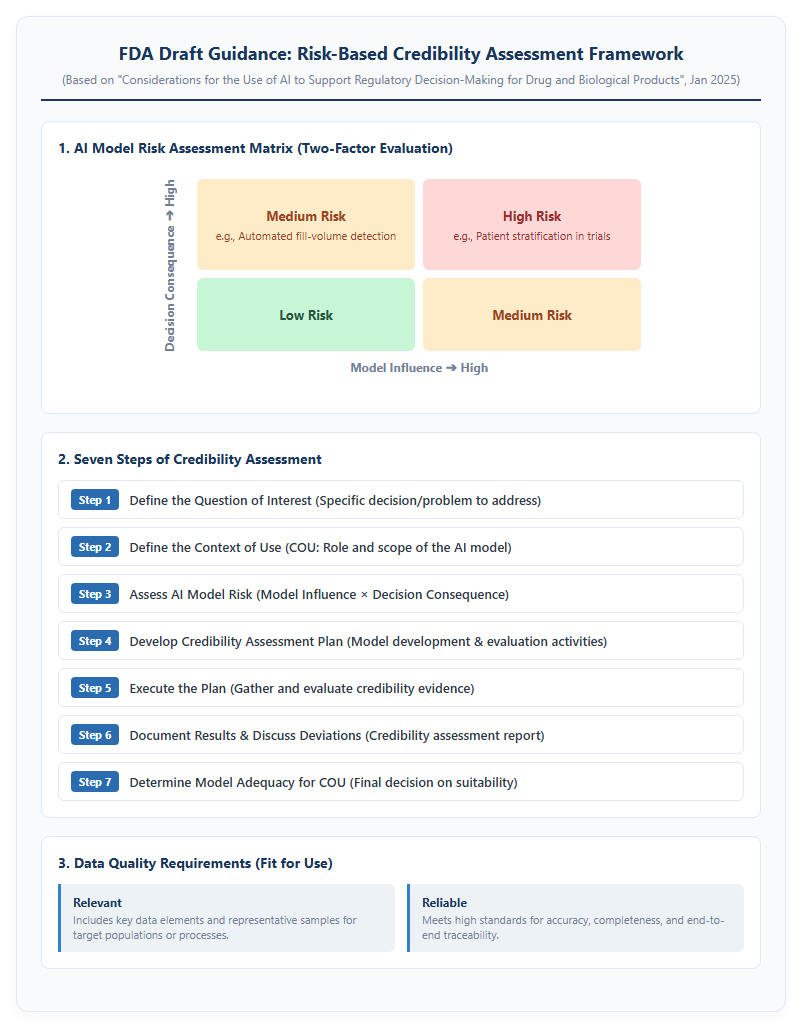
The FDA mandates that training datasets must be “fit for use”—meaning they are relevant, accurate, complete, and traceable. Furthermore, the guidance emphasizes maintaining data independence between development and testing phases, alongside lifecycle management to mitigate data drift over time. The Novo-Anthropic collaboration directly integrates these principles by incorporating rigorous data governance, transparency, and explainability into its operational framework.
Market Expansion Toward 2031 and Key Factors to Watch
The global market for AI in drug discovery is poised for exponential growth over the coming years. According to a market research report by MarketsandMarkets, the global AI in drug discovery market is projected to expand from \$5.09 billion in 2026 to \$17.56 billion by 2031, growing at a compound annual growth rate (CAGR) of 28.1%. Growth is primarily propelled by the integration of multimodal biological datasets, single-cell analysis, and autonomous AI agents across oncology and metabolic disease research. The central question for the pharmaceutical sector is whether AI computational tools can transition from merely accelerating calculations to compressing entire multi-year development cycles into a matter of months. However, persistent challenges remain, including hallucination risks inherent in large language models and the critical necessity of real-world clinical validation. Moving forward, success will depend on building collaborative human-AI workflows while ensuring high-quality datasets that meet stringent regulatory standards. As industry pioneers like Novo Nordisk push the boundaries of computational medicine, the world is closely watching to see if AI will fulfill its promise of higher trial success rates and faster delivery of life-saving therapies to patients.
References
- [Novo Nordisk Official News Release] https://www.novonordisk.com/content/nncorp/global/en/news-and-media/news-and-ir-materials/news-details.html?id=916768
- [FDA Draft Guidance on AI for Regulatory Decision-Making] https://www.fda.gov/drugs/guidance-compliance-regulatory-information/guidances-drugs
- [NVIDIA Newsroom Official Announcement] http://nvidianews.nvidia.com/news/nvidia-partners-with-novo-nordisk-and-dcai-to-advance-drug-discovery
【#NovoNordisk #Anthropic #AIDrugDiscovery #GenerativeAI #Pharma #DrugDevelopment】
コメント