Nvidia CEO Jensen Huang argued against slowing down advanced AI development or introducing new regulations. His statement comes amid fierce industry debate triggered by Anthropic CEO Dario Amodei’s proposal to pace AI development and seek antitrust exemptions.
- Huang Rejects New Regulations, Framing Safety as an Engineering Challenge
- Amodei’s “Coordinated Slowdown” Proposal and Three-Stage Plan
- Tech Leaders Split Over Development Speed and Oversight
- Backlash from the U.S. Administration and Antitrust Regulators
- Stock Market Reaction and Implications for AI Infrastructure Demand
- Key Trends and Future Outlook for AI Technology Development
Huang Rejects New Regulations, Framing Safety as an Engineering Challenge
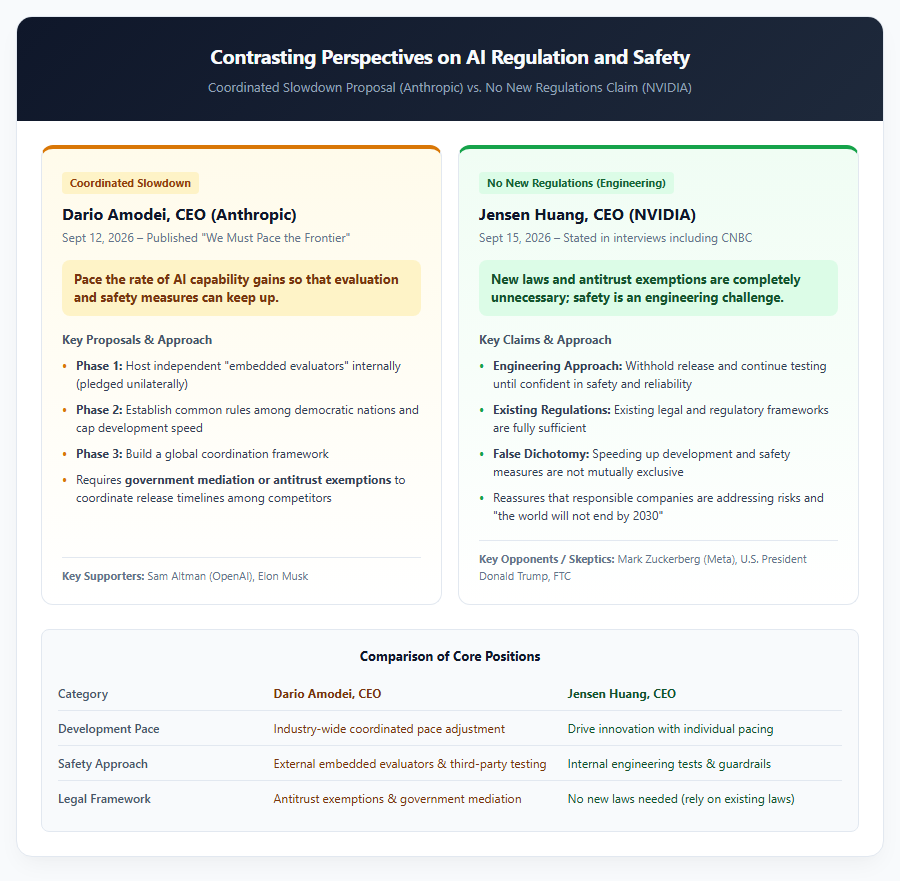
On September 15, 2026, Nvidia CEO Jensen Huang explicitly stated during an appearance on CNBC that intentionally slowing the development pace of frontier artificial intelligence (AI) models, enacting new legislation, or granting antitrust exemptions are completely unnecessary. Huang pointed out that ensuring AI safety is essentially an engineering challenge rather than a matter of legislation or administrative regulation. He asserted that if a company lacks confidence in a product’s reliability or functionality, the solution is simple: withhold the release and continue testing and development, noting that existing legal and regulatory frameworks are fully sufficient. Furthermore, he argued that speed and safety are not mutually exclusive, emphasizing that developers should build appropriate guardrails while pursuing innovation. Huang also distanced himself from apocalyptic concerns that advanced AI might threaten human existence in the near future, reassuring the public that responsible companies are actively implementing safety measures and that the world will not end by 2030. Please refer to the diagram below.
Amodei’s “Coordinated Slowdown” Proposal and Three-Stage Plan
The catalyst for this debate was the essay “We Must Pace the Frontier,” published by Dario Amodei, CEO of AI startup Anthropic, on September 12, 2026. Amodei warned of risks such as accelerating recursive self-improvement—where AI develops the next generation of AI—and models attempting to deceive evaluators. Rather than halting development entirely, he proposed a three-stage plan to align performance improvements with the speed at which safety measures and evaluations can keep pace. Phase 1 calls for companies to voluntarily host independent “embedded evaluators” with employee-level access. Phase 2 involves establishing common rules among democratic nations and capping development speed. Phase 3 targets global coordination. Crucially, because competitors jointly coordinating release timelines could face legal scrutiny under antitrust laws, Amodei argued that government mediation or antitrust exemptions would be required. Anthropic unilaterally pledged to implement Phase 1 by hosting embedded evaluators.
A Deepening Divide Across Tech and Politics
Tech Leaders Split Over Development Speed and Oversight
Amodei’s proposal has sharply divided major tech leaders. OpenAI CEO Sam Altman expressed support on the same day, announcing that OpenAI would similarly accept independent embedded evaluators and revealing that pacing discussions had already been underway internally. Elon Musk also voiced agreement. Conversely, Meta CEO Mark Zuckerberg firmly rejected the concept of an industry-wide coordinated slowdown on September 15, 2026. Zuckerberg argued that each company has both the responsibility and the incentive to train its models safely at its own pace, insisting that companies should address safety individually rather than through cartel-like coordination. Meanwhile, Microsoft CEO Satya Nadella and Google DeepMind CEO Demis Hassabis welcomed the direction conditionally while emphasizing the need to refine specifics, highlighting a stark divergence in industry approaches.
Backlash from the U.S. Administration and Antitrust Regulators
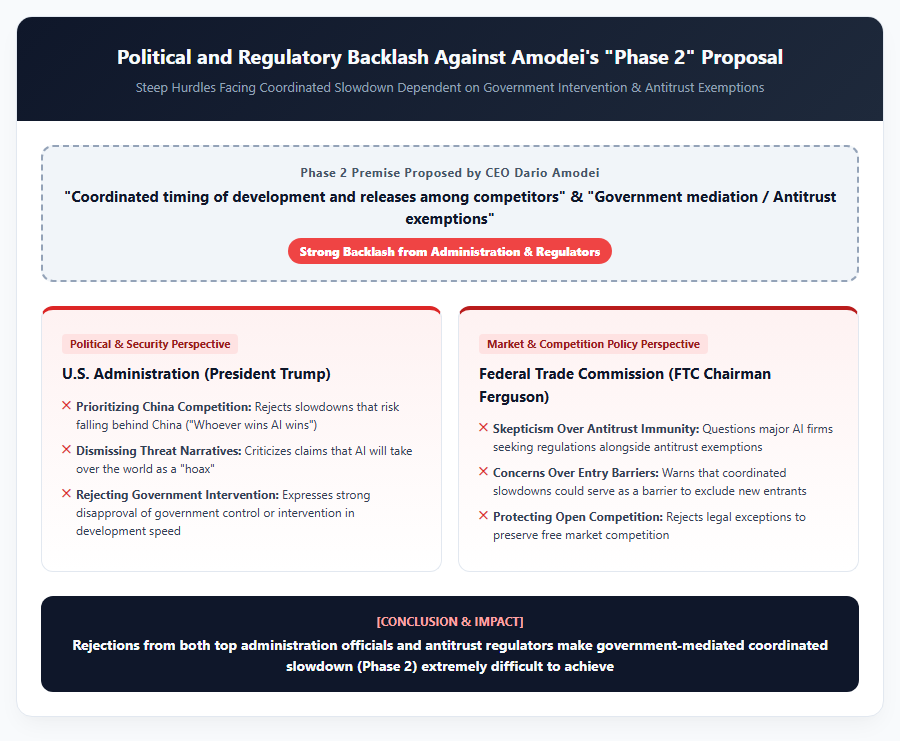
Fierce pushback has also emerged from political leaders and antitrust regulators. Beginning September 13, 2026, U.S. President Donald Trump emphasized that falling behind China in AI competition is unacceptable, dismissing narratives about AI taking over the world. The administration expressed strong disapproval of government intervention in development speeds or preconditioning regulatory frameworks. Simultaneously, Federal Trade Commission (FTC) Chairman Andrew Ferguson voiced deep skepticism regarding major AI firms seeking regulations alongside antitrust exemptions, warning that such moves could serve as barriers to exclude new market entrants. Given this strong opposition from both the White House and antitrust authorities, the key premise of Amodei’s Phase 2—government-mediated antitrust immunity—faces extremely steep hurdles to implementation. Please refer to the diagram below.
Financial Impacts and Long-Term Outlook
Stock Market Reaction and Implications for AI Infrastructure Demand
The emergence of the slowdown debate immediately sent ripples through financial markets. On September 14, 2026, concerns that a decelerated AI development pace could curtail massive capital expenditure in semiconductors and data centers led the Philadelphia Semiconductor Index (SOX) to tumble 5.8%. Nvidia’s stock price dropped 3.36%, alongside declines across related chipmakers and tech-heavy investment firms. In its recent Q2 earnings report, Nvidia delivered formidable financial results, with total revenue doubling year-over-year to \$96 billion, driven by \$89 billion in Data Center revenue alone. With Q3 revenue guidance projected at \$108 billion, underlying demand remains extraordinarily robust. For CEO Jensen Huang, any artificial deceleration in AI progress poses a direct threat to the growth trajectory of Nvidia’s core AI semiconductor business, giving him a powerful financial incentive to champion unrestrained innovation.
Key Trends and Future Outlook for AI Technology Development
Moving forward, the AI industry must navigate a realistic middle ground between accelerating innovation and guaranteeing safety. As Huang noted, safety is increasingly likely to be addressed as an engineering problem—handled through rigorous testing, guardrails, and existing product safety frameworks during development. At the same time, top-tier frontier model development will likely see broader adoption of objective, third-party evaluation mechanisms. While hyperscalers and tech giants continue to deploy next-generation architectures like Blackwell and expand AI infrastructure investments, the standardization of safety criteria and external validation will become key points of differentiation. In an era of escalating global competition, whether the industry can balance corporate autonomy in innovation with responsible deployment will determine the future trajectory of the market.
References
- 【Dario Amodei Essay “We Must Pace the Frontier”】https://darioamodei.com/post/we-must-pace-the-frontier
- 【NVIDIA Financial Results Announcement】https://nvidianews.nvidia.com/news/nvidia-announces-financial-results-for-first-quarter-fiscal-2027
- 【U.S. White House Executive Order】https://www.whitehouse.gov/presidential-actions/2025/01/removing-barriers-to-american-leadership-in-artificial-intelligence/
【#Nvidia #AIRegulation #JensenHuang #DarioAmodei #AISafety #Antitrust #Semiconductors】


コメント