On June 5, 2026, a joint research team from Nihon Hume Co., Ltd., Liberaware Inc., and Nihon University conducted a public experiment of a new technology that uses a small drone to apply pH indicator agents to the walls of sewer pipes and judge deterioration by color. This initiative marks an important step in accelerating measures against the worsening aging of domestic infrastructure and the realization of unmanned inspections called “No Entry” to ensure worker safety.
- New technology demonstration using pH indicator agents conducted in June 2026
- Fusion of Small Drones Supporting Non-Contact and Unmanned Operations and Diagnostic Reagents
- The Limitations of Infrastructure Raised by the Collapse Accident in Yashio City, Saitama Prefecture
- Increase in pipes exceeding their useful life and transformation of inspection systems
- Advanced preventive maintenance through AI analysis and digital twins
- Outlook for Sewerage Maintenance Where “No Entry” is the Standard
New technology demonstration using pH indicator agents conducted in June 2026
On June 5, 2026, a public test of a new inspection technology revolutionizing sewer pipeline maintenance was conducted at Nippon Hume Co., Ltd.’s Kumagaya Plant in Saitama Prefecture. This experiment showcases the results of joint development by Nippon Hume, a leading concrete product company; Liberaware Inc., known for developing drones for confined spaces; and Professor Hiroaki Morita of Nihon University’s College of Industrial Engineering.
In the experiment, a small drone equipped with special equipment flew inside a concrete pipe, directly applying or spraying pH indicators on walls. Specifically, the following three methods are presented.
-
“Top-Applied Type” where indicator is applied to the top of the tube
-
“Side-Coating Type” where indicator is applied to the side of the tube
-
“Spray type” that sprays the solution over a wide area
The following images show the operational footage of the drones demonstrated during the experiment.
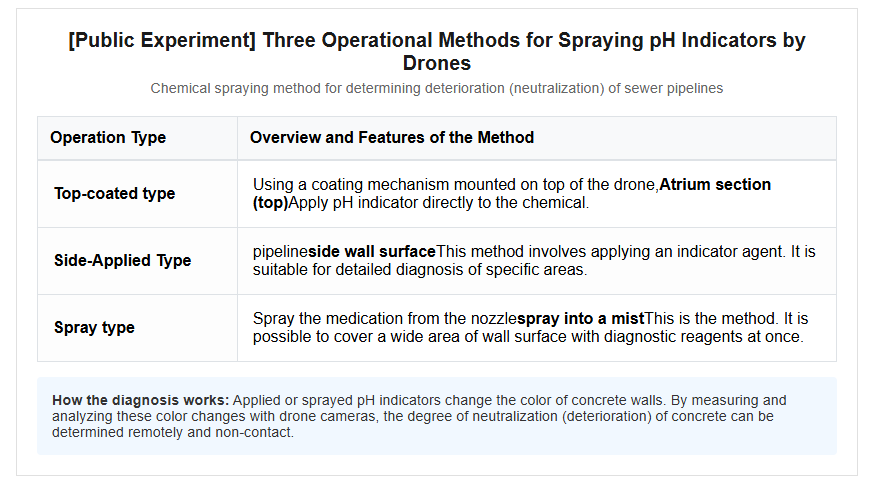
These methods have demonstrated the possibility of fully unmanned diagnostic processes, which previously required workers to enter the tunnel and perform manual tasks. This marks a major turning point from drone inspections, which have only been limited to video recording, to “advanced” diagnostics that enable chemical diagnostics.
Fusion of Small Drones Supporting Non-Contact and Unmanned Operations and Diagnostic Reagents
The core of this technology is to remotely visualize the deterioration phenomenon of concrete using drones, known as ‘neutralization.’ Concrete is usually alkaline, but if it becomes acidic due to factors like hydrogen sulfide generated in sewer pipes, it can cause corrosion of the rebar and a decrease in strength. The greatest feature of this technology is that by spraying pH indicator on walls, the degree of deterioration can be instantly measured as a color change.
The aircraft used were based on ultra-narrow space inspection drones developed by Liberaware, such as the “IBIS2.” Despite its compact size of about 20cm in diameter, it offers the following outstanding features.
-
Non-GPS-compatible technology that enables stable flight even in areas where GPS cannot reach in the dark
-
Clear video recording with a full HD camera and high-brightness LED lighting
-
Dust- and drip-proof design enables adaptability to harsh sewer environments.
Traditional inspections had technical limitations in quantitatively evaluating the progression of deterioration as numerical values, relying heavily on the craftsmen’s experience and qualitative judgment. However, by combining drone-based indicator application with subsequent image analysis technology, it becomes possible to accumulate objective data on deterioration and directly utilize it for repair planning.
Social Background: Aging Sewer Infrastructure and Life-Threatening Conditions
The Limitations of Infrastructure Raised by the Collapse Accident in Yashio City, Saitama Prefecture
Why is this kind of ‘in-the-room’ inspection technology so urgent now? Behind this is the painful lesson of the “Yashio City road subsidence accident in Saitama Prefecture” that occurred on January 28, 2025. In this accident, a massive sewer main line about 4.75 meters in diameter was damaged, causing the road to suddenly collapse, causing a moving truck to fall and resulting in the death of the driver, resulting in the worst possible outcome.
The direct cause of the accident was that hydrogen sulfide generated from the sewage converted into sulfuric acid, which corroded the concrete pipes over many years. The diagram below explains the mechanism of sinkhole accidents.
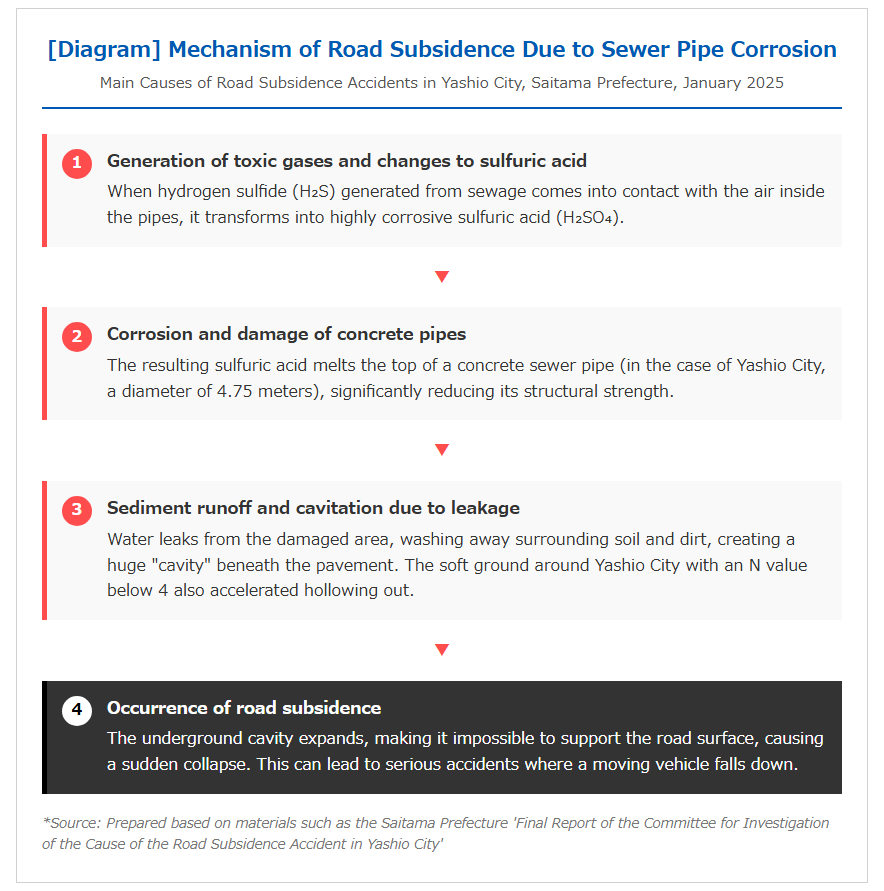
Although the pipeline that became the site of the accident in Yashio City had been inspected in 2021, the accident could not be prevented. This fact highlighted the limitations of inspection frequency and accuracy with conventional methods, and led to the establishment of more advanced and frequently capable automated inspection technologies for Japanese society as a whole.
Increase in pipes exceeding their useful life and transformation of inspection systems
As of the end of fiscal year 2023, the total length of sewer pipelines in Japan has reached approximately 500,000 km, making the maintenance of this vast asset a major challenge. The pipeline that has passed the standard service life of 50 years has already reached about 40,000 km (about 7% of the total), and is expected to surge to about 200,000 km in 20 years.
On the other hand, the situation for those managing infrastructure is becoming increasingly challenging.
-
The number of sewerage staff in local governments has decreased by about 40% since its peak in 1997
-
Due to reduced revenue from sewer usage fees, securing maintenance budgets has become difficult.
-
They dislike harsh sites with toxic gas emissions and risks of oxygen deficiency, making it difficult to secure workers
To resolve the dual challenges of “accelerated aging” and “shortage of personnel,” the Ministry of Land, Infrastructure, Transport and Tourism issued a notice in April 2026 urging all municipalities nationwide to prioritize shifting inspections to “no people entering.” This drone-based pH indicator application technology is expected to serve as a trump card to realize the government’s “No Entry” policy.
Future Developments: Automation of Inspections and the Future of Infrastructure Painted by DX
Advanced preventive maintenance through AI analysis and digital twins
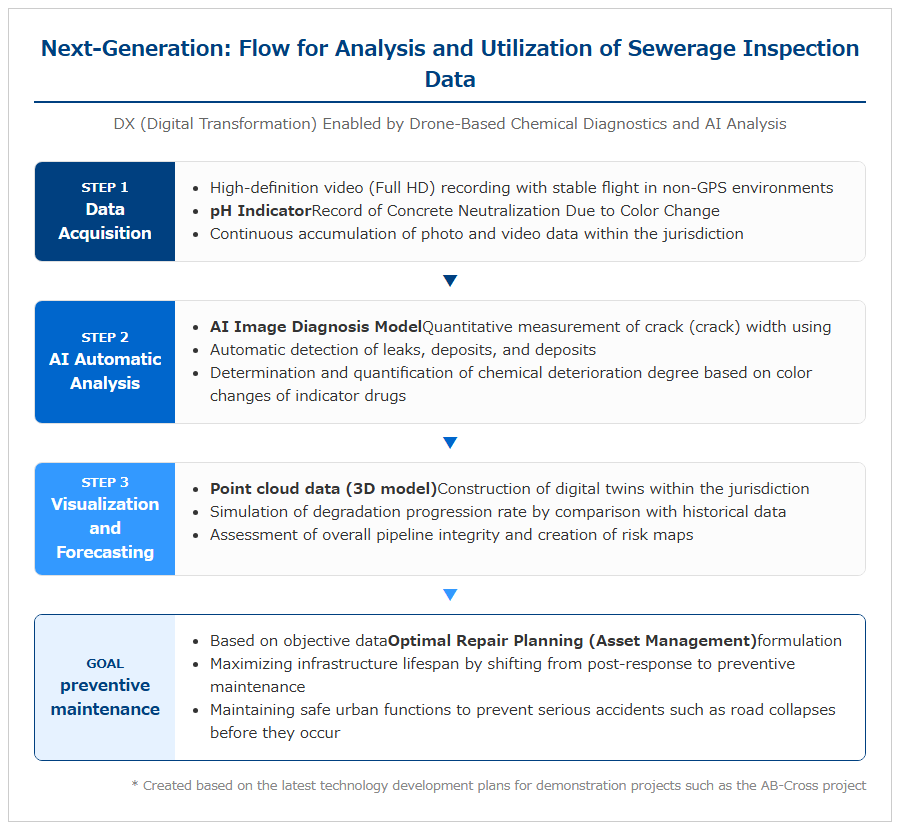
Data collected by drones is not only stored as footage but also creates additional value through the latest digital technologies. In this demonstration project, development of technology that automatically detects crack width, leak locations, and the status of adherent substances using AI image diagnostic models is also progressing in parallel.
Specifically, the following advanced data utilization is envisioned.
-
Point cluster technology to construct 3D models of the jurisdiction from continuous photographs taken
-
“Predictive maintenance” where AI predicts the rate of deterioration by comparing it with past inspection data.
-
A system that accurately plots damaged areas on a map and automatically determines repair priorities.
Please refer to the diagram below. This shows the analysis flow of inspection data.
The domestic drone business market is projected to reach a scale of 954.4 billion yen by fiscal year 2030, with infrastructure inspection serving as the largest growth engine. Going forward, the shift will accelerate from simply “flying drones” to “solution-based” business models that analyze vast amounts of collected data with AI and directly link it to asset management.
Outlook for Sewerage Maintenance Where “No Entry” is the Standard
The most important future outlook is that unmanned drone inspections will not be a “special initiative,” but will become established as a “standard technology” in municipalities nationwide. This demonstration project by Nippon Hume and others has been selected for the Ministry of Land, Infrastructure, Transport and Tourism’s “AB-Cross Project (FY2026 Integrated Water and Sewerage Innovative Technology Demonstration Project)” and has entered the phase of nationwide social implementation.
With unmanned inspections becoming the standard, the following future is envisioned.
-
Workers no longer need to step into dangerous underground spaces, bringing occupational accidents closer to zero.
-
By reducing inspection costs, it becomes possible to conduct regular inspections over shorter intervals, preventing sinkhole accidents before they occur.
-
Gaps in sections where toxic gases such as hydrogen sulfide are generated, or in small-caliber sections where people cannot enter, are eliminated
Of course, technical challenges such as ensuring communication within the complex and winding tunnel and extending battery life still remain. However, this challenge, which involves joint efforts between the public and private sectors, is an essential process for safely passing on Japan’s underground infrastructure, built during Japan’s postwar period of rapid economic growth, to the next generation. The day when drones will play the role of the ‘primary doctor’ for sewers is just around the corner.
[#下水道点検 #ドローン技術 #インフラ老朽化 #DX #国土交通省 #NoEntry #日本ヒューム #Liberaware]


コメント