Following the heavy rain damage caused by Typhoon No. 25 of Reiwa 8, the Kanto Regional Development Bureau of the Ministry of Land, Infrastructure, Transport and Tourism has decided to dispatch TEC-FORCE (Technical Emergency Control Force) to cities such as Yokosuka and Miura, based on a request from Kanagawa Prefecture. Behind this decision are the risk of isolation due to landslides and severed road networks on the Miura Peninsula, as well as the growing need for technical support from local governments.
- Extent of Damage and On-Site Conditions on the Miura Peninsula Caused by Typhoon 25
- Decision to Dispatch by the Ministry of Land, Infrastructure, Transport and Tourism and the On-Site Investigation Structure
- The newly established TEC-FORCE Reserve Personnel System and co-creation support structure
- Structural Challenges of Infrastructure and the Risk of Isolation on the Miura Peninsula
- Disaster Recovery Procedures and Basic Principles for Public Civil Engineering Facilities
- Promotion of Disaster Prevention Infrastructure Development and Future Key Points
Extent of Damage and On-Site Conditions on the Miura Peninsula Caused by Typhoon 25
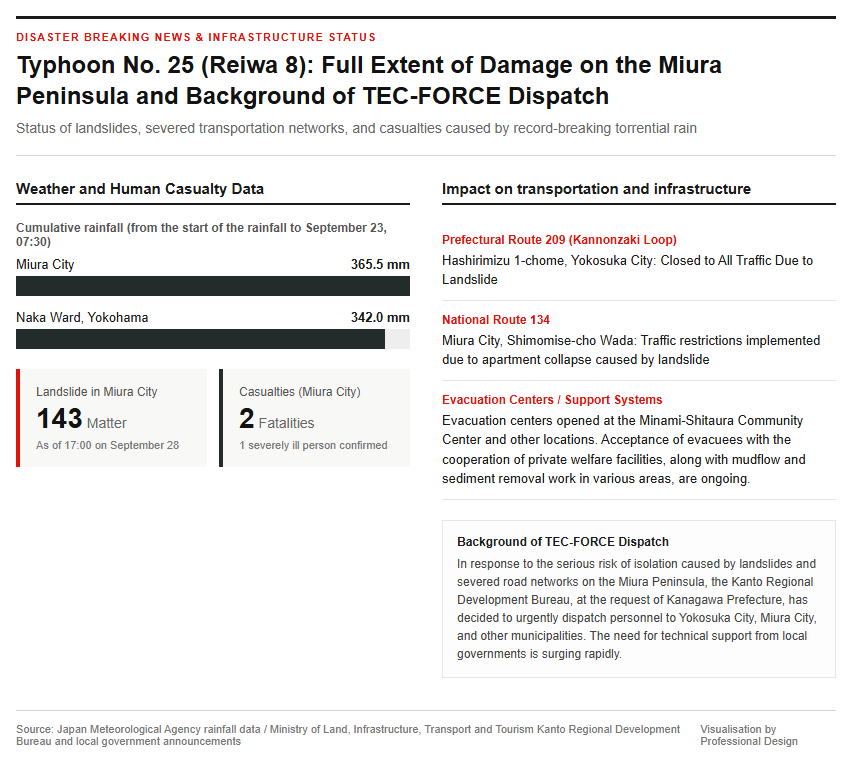
Due to the impact of Typhoon No. 25, which brought torrential rain, severe heavy rain damage occurred across various parts of Kanagawa Prefecture on September 23, 2028. According to rainfall observation data from the Japan Meteorological Agency, cumulative rainfall from the start of the rain until 7:30 a.m. on September 23 reached 365.5 mm in Miura City and 342.0 mm in Naka Ward, Yokohama City. This torrential downpour triggered a series of landslides and sediment runoffs in coastal areas, primarily centered around Yokosuka City and Miura City. As of 5:00 p.m. on September 28, 143 landslides had been reported within Miura City, and tragic casualties were confirmed, including two deaths and one severely injured person. The impact on the transportation network was also extensive, with Prefectural Route 209 (Kannonzaki Ring Road) in Hashirimizu 1-chome, Yokosuka City, being completely closed to traffic due to sediment runoff, while traffic restrictions were also implemented on National Route 134 in Hassecho Wada, Miura City, due to the collapse of an apartment building caused by a landslide. In terms of evacuation efforts, shelters were established at locations such as the Minamiura Community Center, and evacuees were accepted with the cooperation of private welfare facilities. Operations to remove mudflows and sediment are underway at a rapid pace at disaster-stricken sites across the region. The situation at the sites is as follows.
Decision to Dispatch by the Ministry of Land, Infrastructure, Transport and Tourism and the On-Site Investigation Structure
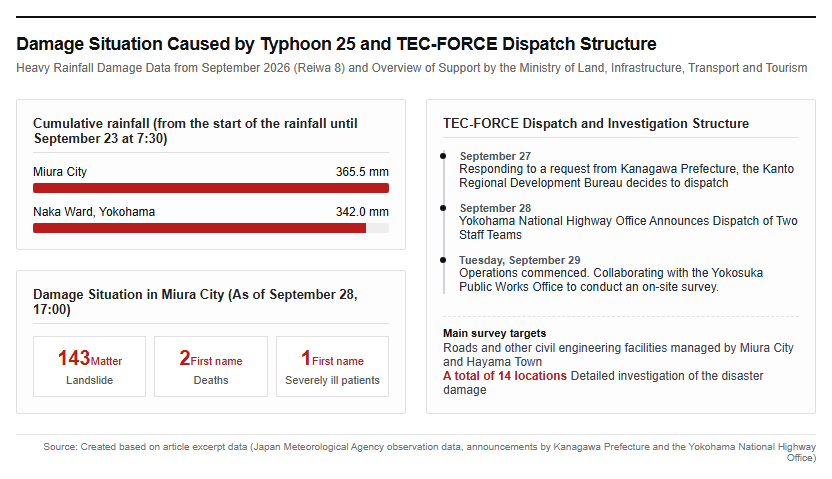
To address the extensive infrastructure damage and sediment disasters, Kanagawa Prefecture requested support from the Ministry of Land, Infrastructure, Transport and Tourism’s Kanto Regional Development Bureau for TEC-FORCE (Emergency Disaster-Response Team) on September 27, 2026, and their dispatch was decided the same day. In response, the Yokohama National Highway Office officially announced on September 28 that it would dispatch two teams of personnel to support the affected areas. Dispatch operations will begin on Tuesday, September 29, and in close cooperation with the Kanagawa Prefectural Yokosuka Public Works Office, they will survey damage to civil engineering facilities such as roads managed by Miura City and Hayama Town. The main survey locations will total 14 sites, aiming to thoroughly assess the damage status of road slopes and structures where landslides have occurred. The specialized data and survey results collected on-site will be directly utilized to consider future emergency measures and full-scale recovery policies. With the entry of the national expert unit equipped with advanced technical capabilities into the area and the prompt commencement of surveys, expectations are high for reducing the burden on the affected local governments and swiftly formulating secondary disaster prevention measures. The dispatch team’s operations on-site are as follows.
Strengthening Response Capabilities to Increasingly Severe Disasters and the Institutional Background
The newly established TEC-FORCE Reserve Personnel System and co-creation support structure
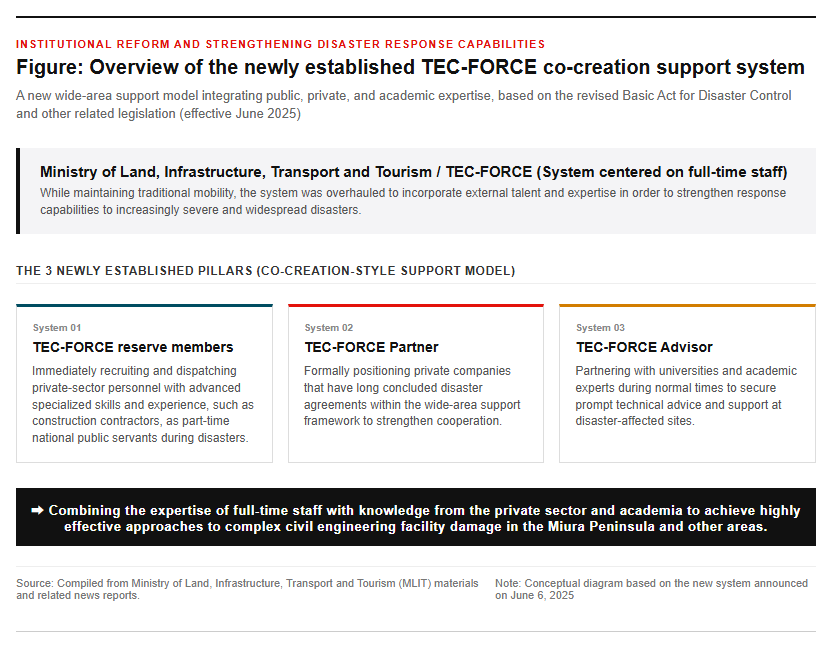
To cope with the increasing severity and wider impact of disasters associated with recent climate change, the Ministry of Land, Infrastructure, Transport and Tourism (MLIT) has been significantly revamping the mobility and structure of TEC-FORCE. Based on the revised Basic Act on Disaster Management and other related laws promulgated and partially enacted on June 4, 2025, the establishment of a new disaster support system was announced on June 6 of the same year. The centerpiece of this reform is the newly created “TEC-FORCE Reserve Member” system. A mechanism has been introduced to immediately recruit and dispatch private-sector personnel with advanced specialized skills and experience—such as those from construction companies—as part-time national public servants in the event of a disaster. Furthermore, new systems have been established: the “TEC-FORCE Partner” system, which positions private companies with which disaster agreements have traditionally been concluded within a wide-area support framework, and the “TEC-FORCE Advisor” system, which collaborates with universities and academic experts from peacetime to quickly obtain technical advice. This has established a co-creation support model that fuses private and academic knowledge into a full-time staff-centric structure, enabling a highly effective approach even in the recent road surveys and restoration support on the Miura Peninsula. A conceptual diagram showing the overall picture of the system is as follows.
Structural Challenges of Infrastructure and the Risk of Isolation on the Miura Peninsula
The recent typhoon damage has once again highlighted the geographical and structural vulnerabilities of the Miura Peninsula. Surrounded by the sea on three sides with a diverse topography, the Miura Peninsula region is an area thriving in primary industries such as agriculture and fishing, as well as tourism. However, due to the limited number of arterial roads, whenever heavy rain or earthquakes cause road flooding or revetment collapses, the transportation network is severed, posing a constant and serious risk of the entire region becoming isolated. To address this challenge, development projects have been underway for the West Coast Line passing through inland areas and the Koajiro Bridge. Meanwhile, across Japan, the aging of infrastructure built during the period of rapid economic growth—such as road bridges and river management facilities—is progressing rapidly. According to an analysis by the Japan Research Institute, while the infrastructure managed by local governments is increasing, maintenance budgets have been cut roughly in half from their peak in fiscal 1993, and local governments are facing a severe shortage of human resources, with municipalities having five or fewer technical staff members accounting for approximately 50% of the total. The road damage on the Miura Peninsula symbolizes the reality of local governments struggling with the preservation of aging infrastructure, depopulation, and staffing shortages.
Challenges for a Swift Recovery and Future Outlook
Disaster Recovery Procedures and Basic Principles for Public Civil Engineering Facilities
To rapidly restore disaster-affected roads and river facilities, a thorough understanding of strict procedures and fundamental principles based on the national government’s Act on State Subsidy for Disaster Restoration Expenses of Public Civil Engineering Facilities is essential. According to the guidelines of the National Disaster Prevention Association, eligibility for disaster restoration projects requires that the facilities are currently maintained and managed by local governments and that the damage was caused by abnormal natural phenomena. Because defects caused by poor maintenance and small-scale damage are subject to disqualification or ineligibility, accurate on-site investigations and cause analysis are required. In addition, the prompt implementation of “pre-assessment construction” (starting work before official disaster assessment) and emergency temporary work is strongly recommended to prevent secondary disasters and secure transportation routes without waiting for a full-scale disaster assessment. To compensate for the shortage of manpower and specialized technical expertise in affected local governments, free support schemes—such as the dispatch of disaster restoration technical experts through the National Disaster Prevention Association in addition to the dispatch of Regional Development Bureaus—are also in operation. In the recent investigations in Yokosuka City and Miura City, the prompt identification of damage factors prior to assessment and the selection of appropriate construction methods will remain the key to early restoration to original conditions and improved reconstruction.
Promotion of Disaster Prevention Infrastructure Development and Future Key Points
The focus moving forward is on how to translate the findings of the emergency investigations into swift road clearance and the development of permanent disaster prevention infrastructure. Amid growing concerns over the increasing frequency of torrential rain disasters driven by climate change, there is an urgent need to shift from traditional reactive maintenance to preventive maintenance, which involves taking measures before faults occur. In regions with a high risk of isolation, such as the Miura Peninsula, medium- to long-term investment is required to strengthen disaster resilience on arterial roads, shift their functions, and consolidate and reorganize existing infrastructure assets. Furthermore, with the promotion of state-led disaster prevention and mitigation measures as well as national resilience initiatives, the roles played by construction consultants and private construction firms are becoming increasingly significant. Close attention is being paid to how public-private partnerships and the utilization of TEC-FORCE reserve personnel can simultaneously achieve the maintenance and management of local infrastructure alongside enhanced disaster resilience. The recovery process on the Miura Peninsula is drawing significant attention as a crucial case study for future nationwide infrastructure disaster resilience and regional revitalization.
- [Ministry of Land, Infrastructure, Transport and Tourism, Kanto Regional Development Bureau, Yokohama National Highway Office] https://www.ktr.mlit.go.jp/yokohama/yokokoku01226.html
- [Kanagawa Prefectural Government Press Release] https://www.pref.kanagawa.jp/docs/p6x/prs/r8502057.html
- [Miura City Press Release] https://www.city.miura.kanagawa.jp/soshiki/seisakuka/seisakuka_hisho/shichonoheya/pressrelease/202609/2026092802.html
[#TyphoonNo25 #TECFORCE #MinistryOfLandInfrastructureTransportAndTourism #MiuraPeninsula #DisasterPreventionInfrastructure #DisasterRecovery]


コメント