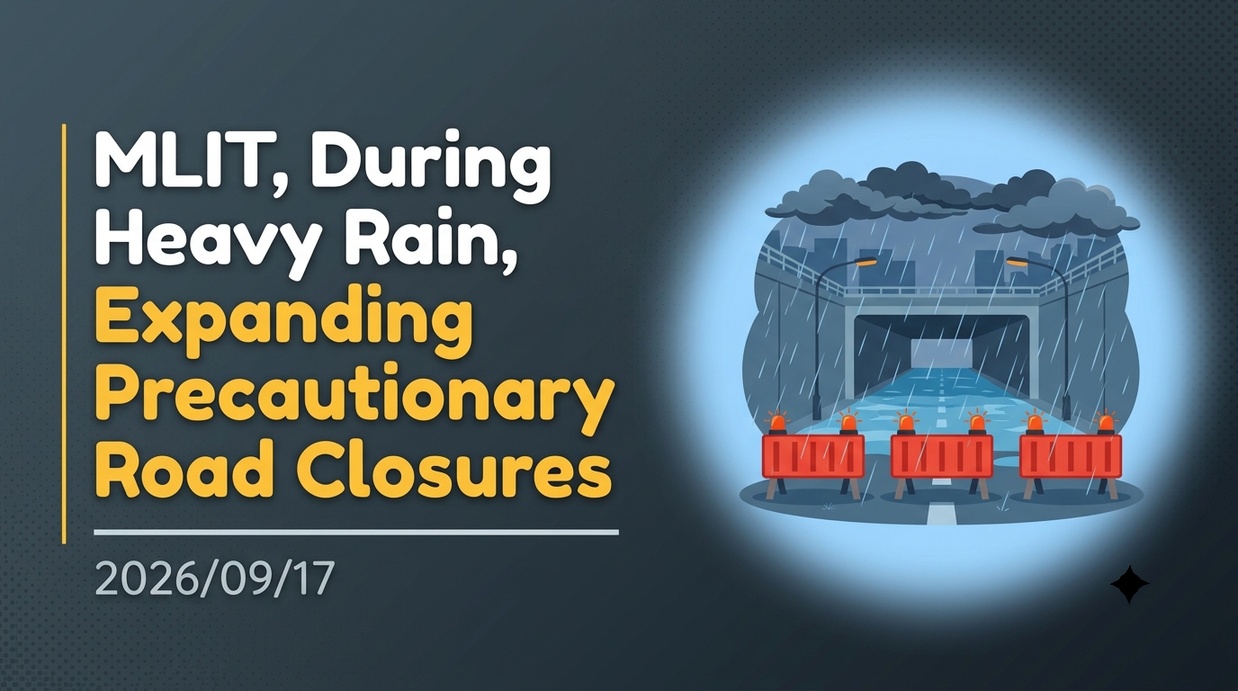
On September 16, 2026, Japan’s Ministry of Land, Infrastructure, Transport and Tourism (MLIT) announced the expansion of proactive road closures for underpasses during heavy rainfall to 22 locations nationwide to prevent submerged vehicle accidents. This initiative responds to increasingly severe torrential rains, such as the August 2026 Chiba torrential rain disaster, and addresses the safety limitations of traditional post-flooding emergency responses.
- Expansion of Preemptive Traffic Restrictions to 22 Locations
- Tragic Fatalities in the Chiba Heavy Rain Disaster: The Catalyst for Reform
- The Critical Limitations of Traditional Post-Flooding Emergency Responses
- Heavy Dependency on Drainage Pumps, Power Outages, and Maintenance Risks
- Misjudging Water Depth and Psychological Factors Influencing Drivers
- Judicial Precedents Establishing Legal Liability for Road Authorities
- Leveraging Advanced Technology and Next-Generation Disaster Infrastructure
- Key Debates and Focus Areas for Future Road Safety
Expansion of Preemptive Traffic Restrictions to 22 Locations
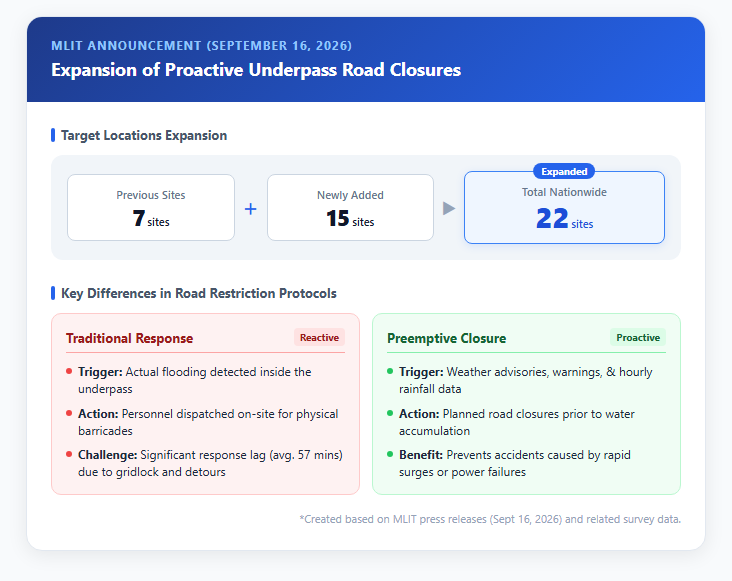
On September 16, 2026, the Ministry of Land, Infrastructure, Transport and Tourism (MLIT) announced a major expansion of its preemptive traffic restriction program for underpasses along directly managed national highways. Previously implemented at seven locations nationwide—including the Murata-cho underpass on National Route 16—the program will now incorporate 15 additional sites, bringing the total to 22 locations based on historical flooding data and recent heavy rainfall trends.
Unlike conventional measures that close roads only after water actually accumulates in an underpass, preemptive closures safely block road access before flooding occurs, triggered by weather warnings and hourly rainfall thresholds. Specific closure criteria are being established by individual regional development bureaus to reflect local meteorological characteristics and historical inundation data, with detailed guidelines to be released sequentially.
Traditionally, road management relied on emergency crews rushing to the scene after water accumulation was detected. However, localized torrential downpours—commonly referred to as “guerrilla rainstorms”—have become increasingly frequent, exposing the critical risks of reactive interventions. Shifting to preemptive closures based on predictive meteorological data represents a proactive risk-management approach designed to protect driver lives.
Tragic Fatalities in the Chiba Heavy Rain Disaster: The Catalyst for Reform
The primary catalyst driving MLIT’s expansion of preemptive road closures was the tragic disaster on August 13, 2026, known as the August 2026 Chiba Torrential Rain. During this severe weather event, rapid water accumulation trapped a vehicle in an underpass along National Route 16 in Murata-cho, Chuo Ward, Chiba City, resulting in the tragic death of the driver.
Although the underpass was equipped with automatic drainage pumps designed to clear rainwater, lightning strikes and power outages caused by the severe storm disabled the entire electrical infrastructure, including emergency backup generators. Furthermore, electronic warning signs displaying “Flooding / Road Closed” ahead of the underpass entrance failed to illuminate due to the power loss, leaving the driver unable to visually identify the hazard before entering the submerged zone.
This fatal incident forced MLIT and road management authorities to recognize critical blind spots in disaster protocols that relied exclusively on physical drainage hardware and automated warnings. The realization that unexpected power disruptions or equipment failures could paralyze automated safety systems accelerated the implementation of preemptive closures as a foolproof, planned mechanism to physically prevent vehicular access before water accumulates.
The Critical Limitations of Traditional Post-Flooding Emergency Responses
Conventional safety measures for underpasses typically relied on water level sensors detecting inundation, after which road management personnel or contractors were dispatched to set up physical barricades or ropes. However, this reactive workflow harbored severe physical and logistical constraints during extreme weather events.
Following the August 2026 Chiba torrential rain disaster, an analysis of 17 flood-prone underpass locations in Chiba Prefecture where emergency responses were deployed revealed that it took an average of 57 minutes from the initial detection of water accumulation to the complete deployment of road closures. In the most severe case, the response time stretched to 105 minutes, while at the site of the fatal accident, completing the road closure required 41 minutes.
The primary delay stemmed from severe traffic congestion on surrounding roadways and necessary detours caused by widespread flooding. Road management personnel frequently became trapped in gridlock en route to disaster sites. This vicious cycle demonstrated that post-detection emergency dispatches were fundamentally incapable of keeping pace with the rapid water level spikes caused by modern torrential downpours.
Structural Vulnerabilities and Management Challenges of Underpasses
Heavy Dependency on Drainage Pumps, Power Outages, and Maintenance Risks
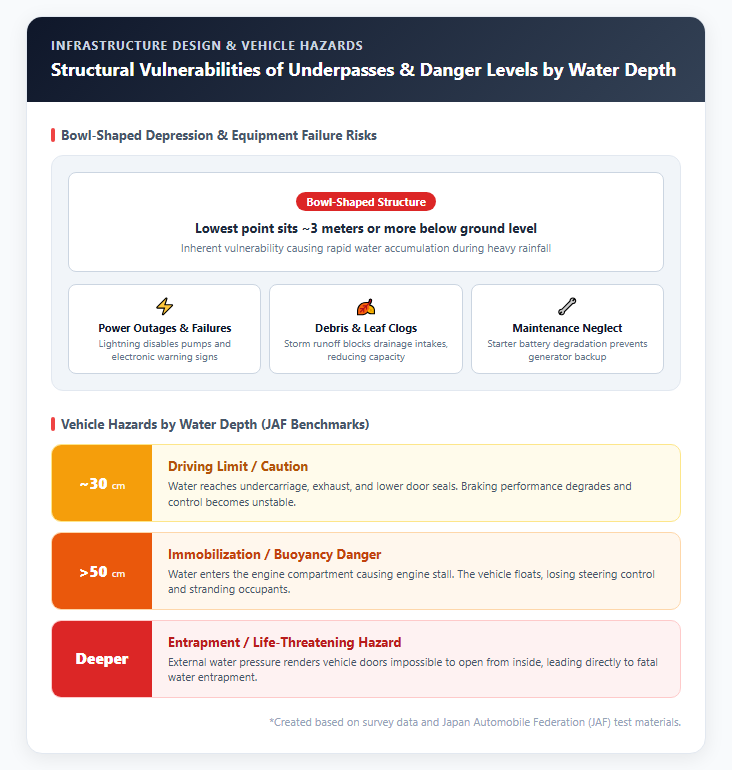
An underpass is a road section constructed by excavating below the surrounding terrain to allow grade-separated crossings under railways or major highways. Structurally, the lowest central point of an underpass often sits 3 meters or more below ground level, creating a bowl-shaped depression where rainwater naturally collects and rapidly accumulates—a fundamental vulnerability inherent to its engineering design.
To mitigate this risk, underpasses are typically equipped with underground retention basins, heavy-duty drainage pumps, and emergency diesel generators to forcibly evacuate water when natural drainage is impossible. However, because these systems rely entirely on electrical power, they remain inherently vulnerable to lightning strikes, intake blockages caused by storm debris or fallen leaves, and mechanical failures resulting from inadequate maintenance or battery degradation.
An analysis of past inundation incidents shows that power supply failures—such as blackout-induced shutdowns or depleted generator starter batteries—occur far more frequently than pump capacity overload. When electrical drainage systems fail, a bowl-shaped underpass can transform into a deep water basin within minutes, highlighting a critical structural vulnerability in transportation infrastructure management.
Misjudging Water Depth and Psychological Factors Influencing Drivers
Another major factor contributing to underpass submergence accidents is driver psychology and the difficulty of accurately assessing water depth. Rainwater accumulating on roads becomes muddy and opaque, obscuring lane markings and asphalt surfaces, making visual depth estimation nearly impossible from inside a vehicle.
According to testing data from the Japan Automobile Federation (JAF), the safe driving threshold for passenger vehicles is limited to water levels that do not submerge the vehicle’s undercarriage or lower door seal—typically around 30 centimeters. At a depth of 50 centimeters or more, water enters the engine compartment, causing engine stall and loss of propulsion, while buoyancy causes the vehicle to float and lose steering control. As water levels rise further, external water pressure prevents doors from opening, creating a life-threatening entrapment scenario.
Despite these hazards, drivers frequently fall victim to cognitive biases, such as normalness bias (“it won’t happen to me”) or herd mentality (“following the car ahead”). Even when warning signs or depth gauges are installed near underpass entrances, reduced visibility during heavy rainfall or nighttime driving impairs risk perception, leading drivers to mistakenly attempt crossing flooded zones.
Legal Accountability and the Future Outlook for Safety Measures
Judicial Precedents Establishing Legal Liability for Road Authorities
When road authorities fail to maintain drainage equipment or implement adequate safety measures, they face severe legal liabilities for underpass submergence accidents. A landmark ruling by the Wakayama District Court on July 16, 2021 (Reiwa 3), addressed a case where a vehicle became submerged in a flooded underpass during a typhoon, leading the vehicle owner to sue the local municipality under Article 2, Paragraph 1 of the State Redress Act.
The court found that the municipality had been repeatedly warned by maintenance contractors over several years regarding faulty charger panels and degraded starter batteries in the underpass’s emergency generator, yet failed to perform necessary repairs. The court ruled that the generator’s failure during the power outage was directly caused by negligent maintenance, rendering the roadway lacking in its “normally required safety.” Consequently, the municipality was held liable for road management defects and ordered to pay damages.
This precedent established that extreme rainfall cannot be routinely dismissed as an unavoidable natural disaster (“act of God”). Instead, courts rigorously evaluate whether road authorities met their duty of care regarding routine equipment maintenance, timely updates, and the implementation of physical entry bans during hazardous conditions.
Leveraging Advanced Technology and Next-Generation Disaster Infrastructure
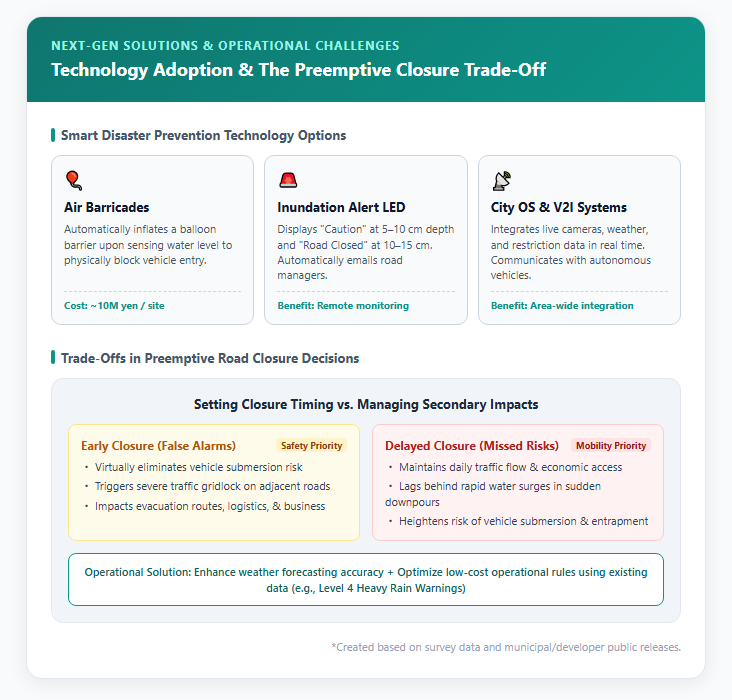
Future underpass safety measures increasingly rely on smart safety and disaster-prevention technologies that transcend traditional physical dispatches and static warning signs. Promising innovations include “air barricades”—inflatable balloon barriers that automatically expand upon sensing specific water levels (e.g., 5–10 cm) to physically block vehicle entry—and automated LED signage systems that transmit real-time alert emails to road managers.
Furthermore, leveraging IoT infrastructure and smart city data-sharing platforms enables the instant distribution of real-time flooding alerts and live camera feeds to navigation apps and connected vehicles. In anticipation of autonomous driving, research is active on vehicle-to-infrastructure (V2I) communication systems that automatically prevent self-driving vehicles from entering submerged zones.
However, deploying cutting-edge hardware often requires substantial capital investments—frequently exceeding 10 million yen per site—presenting financial and administrative hurdles for municipal governments facing budget constraints and labor shortages. Consequently, low-cost operational solutions that combine existing meteorological data with preemptive closure protocols, such as MLIT’s recent initiative, offer an immediate and highly pragmatic strategy.
Key Debates and Focus Areas for Future Road Safety
While MLIT’s expansion of preemptive road closures marks a significant step forward in disaster risk reduction, operational implementation introduces new logistical challenges. The primary focus centers on balancing “false alarms” versus “missed closures,” alongside managing the ripple effects on surrounding traffic networks.
Because underpasses frequently serve as critical arteries passing beneath railway lines or arterial roads, preemptive closures can trigger severe gridlock on adjacent streets or disrupt emergency evacuation routes. Oversensitive closure thresholds risk imposing substantial economic and logistical costs on local logistics and daily commuting, whereas overly lenient criteria fail to prevent fatal accidents.
Moving forward, enhancing weather forecasting precision must be paired with clear operational guidelines integrated into municipal disaster prevention and evacuation planning. Ultimately, driver safety also relies on public awareness: motorists must actively monitor traffic advisories during heavy rainfall and proactively avoid flood-prone underpasses.
Reference Pages
- [Expansion of Preemptive Traffic Restrictions for Underpasses on Directly Managed National Highways – MLIT] https://www.mlit.go.jp/report/press/road01_hh_002147.html
【#Underpass #MLIT #PreemptiveRoadClosure #RoadDisasterPrevention #HeavyRainMeasures #TrafficSafety #NaturalDisasters】


コメント