As the Federal Reserve executed its first rate hike in approximately three years and two months, the foreign exchange market saw a rapid strengthening of the U.S. dollar against the yen. This has intensified pressure on the Bank of Japan to pursue further monetary tightening at its upcoming policy meeting, driven by surging crude oil prices amid Middle East tensions and market fears of a prolonged U.S.-Japan interest rate gap.
- [Key Takeaways] First U.S. Rate Hike in Over Three Years and the Yen’s Sharp Drop
- [Market Spillover] Rising U.S. Yields, Falling Stocks, and Dollar Strength
- [The BOJ’s Dilemma] Fully Priced-In Hikes and the Threat of 160 Yen
- [Real Economy Impact] A Surge in Corporate Insolvencies and Derivative Traps
- [Impact on Households and Businesses] Transmission of Rising Interest Rates
- [Future Outlook and Key Points] Four Elements of Ueda’s Conference and Three Scenarios
[Key Takeaways] First U.S. Rate Hike in Over Three Years and the Yen’s Sharp Drop
On September 16, 2026, the Federal Reserve’s Federal Open Market Committee (FOMC) unanimously voted to raise the target range for the federal funds rate by 0.25 percentage points to 3.75%–4.00%. This marks the Fed’s first rate increase since July 2023, approximately three years and two months ago. Despite intense political pressure from President Trump demanding sub-1% interest rates, Chairman Kevin Warsh prioritized curbing renewed inflationary pressures, taking decisive action toward monetary tightening.
What moved the market most was the upward shift in the dot plot projections. Sixteen of the 18 committee participants anticipated at least one more rate hike within 2026, pushing the median policy rate forecast to 4.1% at the end of 2026 and maintaining it at 4.1% through the end of 2027. This firm stance underscored a prolonged period of elevated interest rates. Following the hawkish decision, the dollar-yen exchange rate plummeted in overseas markets, with the yen briefly hitting 156.42 per dollar. Equity markets reacted sharply, with the Dow Jones Industrial Average dropping 631.21 points (-1.21%) to close at 51,461.90, led by heavy selling in financial stocks.
Please refer to the diagram below.
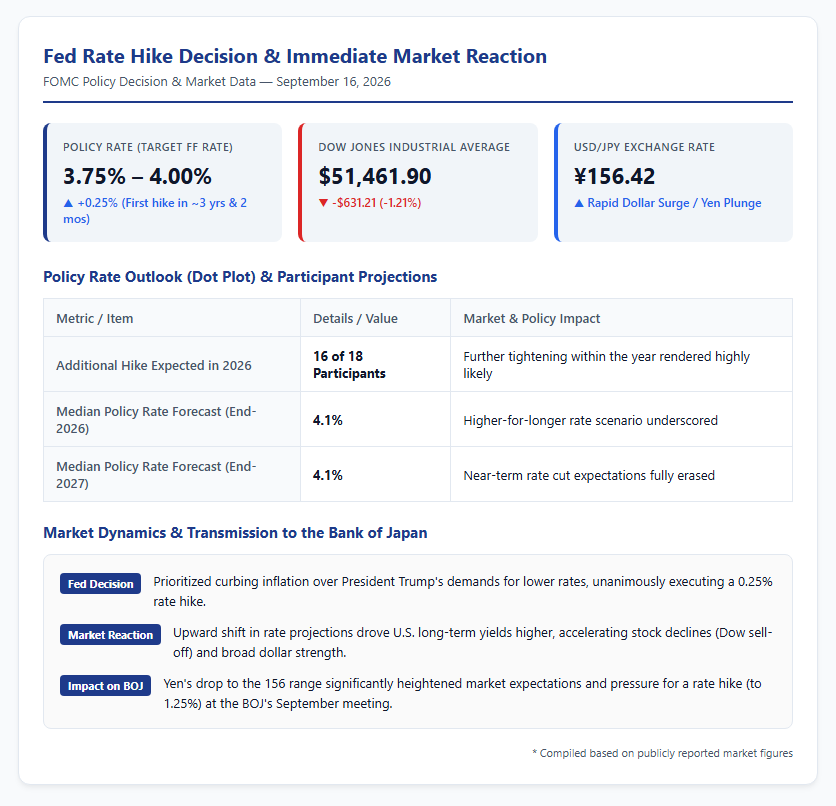
The Fed’s policy decision went beyond a single tightening move; it completely erased market expectations for near-term rate cuts. As energy prices remain elevated due to Middle Eastern tensions, global financial markets find themselves facing a renewed U.S. high-interest-rate shock.
[Market Spillover] Rising U.S. Yields, Falling Stocks, and Dollar Strength
Reflecting the Fed’s hawkish stance, long-term U.S. Treasury yields rose significantly. The benchmark 10-year Treasury yield advanced 1.7 basis points to 5.023%, reaching its highest level in nearly 19 years. Meanwhile, the policy-sensitive 2-year Treasury yield rose to around 4.72%, intensifying a bear-flattening trend where short-term yields rise faster than long-term yields.
Stock indices displayed mixed performance. While the Dow fell 1.21%, the market-cap-weighted Nasdaq Composite closed virtually flat at -0.01%. The Dow’s decline was primarily driven by steep losses in banking stocks, including Citigroup (-2.4%), Bank of America (-2.7%), and Wells Fargo (-3.0%). Although higher yields typically bolster net interest margins, investor sentiment was dampened by rising default risks in auto loans, growing unrealized losses on Treasury holdings, and weakening credit demand.
In currency markets, the U.S. Dollar Index (DXY) climbed to 100.282, marking broad dollar strength across major currencies. Oil markets saw WTI crude futures drop 3.67% to \$101.947 per barrel following reports of a potential restoration of Saudi pipelines; nevertheless, crude remains in an elevated range, up over 77% year-to-date, continuing to pose inflationary risks. Strong U.S. economic indicators, such as August retail sales rising 1.2% month-over-month, reinforced the dollar’s independent rally while amplifying downward pressure on other currencies.
Pressure on the BOJ and Challenges Facing Japan’s Economy
[The BOJ’s Dilemma] Fully Priced-In Hikes and the Threat of 160 Yen
Following the yen’s drop into the 156 range against the dollar after the Fed’s rate hike, attention and pressure surrounding the Bank of Japan’s monetary policy meeting on September 17–18 have reached a peak. In the overnight index swap (OIS) market, a 0.25 percentage point rate increase by the BOJ—raising the policy rate from 1.00% to 1.25%—was almost completely priced in at 98% to 100% probability.
The primary issue is that a 0.25% hike is already fully anticipated by market participants. If the BOJ simply announces the hike without additional guidance, the market may treat it as a sell-the-fact event. Market analysts warn that if Governor Kazuo Ueda fails to deliver a strongly hawkish message during his press conference—such as signaling consecutive rate hikes or raising the estimated terminal rate—disappointment could trigger a rapid re-acceleration of yen depreciation back toward the 160 range.
This pressure is further complicated by unusual political dynamics from late August to early September 2026, during which U.S. Treasury Secretary Bessent repeatedly made remarks hinting at BOJ rate hikes, culminating in his September 8 comment stating “I am the house.” However, as long as the Fed expects additional rate hikes this year, any lagging pace by the BOJ will leave the short-term interest rate differential between the U.S. and Japan largely unhedged at roughly 2.5 percentage points.
Please refer to the diagram below.
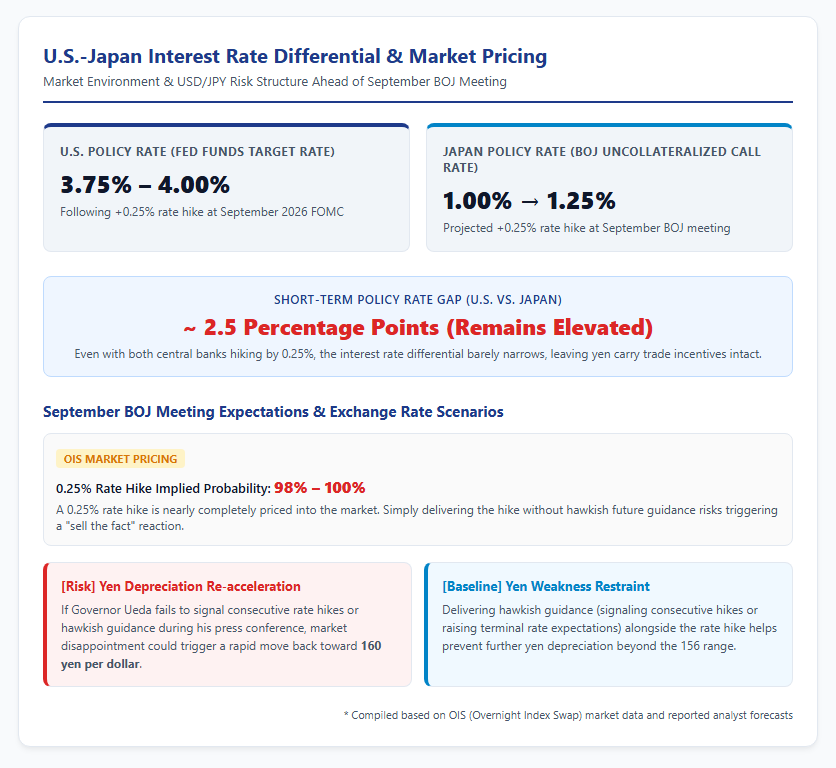
The BOJ finds itself caught between external pressure to curb yen weakness and the necessity to manage market expectations, all while attempting to achieve its inflation target without cooling domestic economic growth.
[Real Economy Impact] A Surge in Corporate Insolvencies and Derivative Traps
The prolonged, historical weakness of the yen is shifting from a balance-sheet metric into visible damage across Japan’s real economy. According to a survey by Tokyo Shoko Research, 45 Japanese companies filed for bankruptcy due to yen depreciation during the first half of 2026 (January–June), a year-over-year increase of more than 30% and the highest level recorded since tracking began in 2022.
The wave of insolvencies has hit mid-sized and small-to-medium enterprises (SMEs) in the wholesale sector particularly hard, as they lack pricing power and struggle to pass rising import costs onto consumers. A notable example is Merry Time Foods, a Tokyo-based food import trading firm specializing in seafood from Asian countries, which filed for bankruptcy in May 2026 due to squeezing profit margins caused by relentless currency weakness and supply chain disruptions.
Adding to the distress is the breakdown of currency derivative products, such as reverse knockout options, previously sold by regional banks to mid-sized importers. These structured products offered fixed exchange rates at low premiums, but once the yen breached preset knockout thresholds (around 163 to 170 yen per dollar), the hedging protection instantly vanished. Unhedged firms were forced to buy dollars on the spot market at unfavorable spot rates, creating a dangerous feedback loop that accelerated yen weakness.
Although Japanese authorities executed large-scale foreign exchange interventions totaling 15.3993 trillion yen from spring to summer 2026, the impact proved temporary, leaving structural capital outflows largely unabated.
Outlook for Monetary Policy and Future Key Focuses
[Impact on Households and Businesses] Transmission of Rising Interest Rates
Fluctuations in foreign exchange markets and interest rate hikes across both the U.S. and Japan are forcing Japanese households and businesses to make difficult adjustments. As the BOJ normalizes monetary policy, raising the policy rate from 1.25% toward 1.50% and potentially 1.75%–1.90% into 2027, households with variable-rate mortgages face direct increases in interest payments. Estimates suggest that a 1% increase in interest rates on a 30-million-yen, 30-year variable mortgage adds approximately 14,000 yen per month (roughly 170,000 yen annually) to mortgage payments, weighing on disposable income.
For corporate management, revising exchange rate assumptions has become essential. Exporters that built business plans around an ultra-weak yen of 160 per dollar risk underperforming expectations if intervention or rate adjustments pull rates back into the low 150s. Conversely, while importers benefit from yen appreciation, global price surges in raw materials and crude oil tend to offset cost reductions. Realistically, companies need a flexible risk management framework that accommodates a 10-yen range between 150 and 160 per dollar.
Furthermore, Japan’s real interest rate remains negative, as inflation (core CPI exceeding 2%) outpaces nominal interest rates. Nominal rate hikes alone do not fundamentally restore the incentive to hold yen assets. Structural yen-selling flows continue through foreign stock investments via New NISA accounts and outward direct corporate investments, meaning higher interest rates will not automatically lead to sustained yen strength.
[Future Outlook and Key Points] Four Elements of Ueda’s Conference and Three Scenarios
The future direction of the exchange rate and Japan’s economy hinges largely on the messaging delivered by BOJ Governor Kazuo Ueda during his post-meeting press conference. Beyond the immediate rate decision, market participants are focused on four critical elements:
- Pace of Rate Hikes: Whether the Governor endorses Policy Board Member Takada’s view regarding flexible, consecutive rate hikes without fixed intervals.
- Guidance on Terminal Rate: How the BOJ views the market-implied terminal rate of around 1.9%.
- Commentary on Foreign Exchange: How explicitly the Governor addresses currency volatility as an upside risk to import inflation.
- Overall Decision Composition: The presence of dissenting votes, revisions to statement wording, and potential upward adjustments in the Outlook Report.
Three main market scenarios emerge moving forward. In Scenario 1 (Yen Appreciation), a proactive BOJ signal regarding consecutive hikes, combined with fiscal discipline, pushes the dollar-yen pair below 150 toward the mid-140s. In Scenario 2 (Range-Bound Trading), a rate hike accompanied by neutral conference commentary leaves the exchange rate fluctuating between the high 150s and 158. In Scenario 3 (Renewed Yen Weakness), cautious remarks by the Governor or expanding fiscal stimulus erode expectations, triggering a sharp decline back toward 160.
For both investors and businesses, building resilience against multi-directional volatility remains far more crucial than betting on a single currency trajectory.
Reference Pages
- [BOJ Governor Press Conference: Aiming to Halt Yen Weakness via Rate Hike Expectations?] https://www.nri.com/jp/media/column/kiuchi/20260319_4.html
【#FedRateHike #BOJPolicy #YenPlunge #FXIntervention #InflationControl #InterestRateTrends】


コメント