In September 2026, Arcfra, an innovator in cloud and AI infrastructure, announced “Neutree 1.2,” the latest version of its enterprise AI platform. Designed to go beyond traditional Large Language Models (LLMs) to deliver unified management and simplified operations across diverse AI models, the release addresses the growing operational complexity and sophistication of enterprise AI infrastructure.
- Key Takeaways and Overview of the Neutree 1.2 Announcement
- Broadening Non-LLM Model Support via Flex Engine
- Streamlining Management with a Unified Model Gateway
- Automated Resource Calculations for Predictable Planning
- Business-Driven Access Control and Governance
- Future Outlook and Key Trends in Enterprise AI
Key Takeaways and Overview of the Neutree 1.2 Announcement
In September 2026 (September 17, Singapore / September 18, JST), cloud and AI infrastructure provider Arcfra unveiled “Neutree 1.2,” the latest release of its enterprise AI platform. As corporate AI initiatives transition from experimental sandboxes to mission-critical production environments, delivering AI models as reliable, governed, and scalable services has become paramount. According to market research by Astute Analytica, the AI infrastructure orchestration platform market is projected to surge from USD 1.5 billion in 2025 to USD 18 billion by 2035, representing a compound annual growth rate (CAGR) of 28.3%. Driving this growth is the rapid proliferation of generative AI and large language models (LLMs), which has exponentially increased the operational complexity of managing GPU compute, storage, and networking resources. Facing fragmented GPU pools and unwieldy deployment workflows, Arcfra developed Neutree 1.2 to provide a unified management layer for private model inference, bridging the production gap between initial model verification and real-world deployment. Neutree is published as an open-source project on GitHub, alongside an Enterprise Edition offering 24/7 professional support and deep integration with the Arcfra Enterprise Cloud Platform (AECP).
Broadening Non-LLM Model Support via Flex Engine
One of the most notable technical breakthroughs in Neutree 1.2 is the introduction of “Flex Engine,” Arcfra’s proprietary inference engine. While conventional AI platforms have primarily catered to text-generating large language models (LLMs), real-world enterprise workflows frequently demand a combination of diverse models, including computer vision and document parsing. Built upon standard inference engines like vLLM and SGLang, Flex Engine significantly expands native support for non-LLM models—such as the MinerU document parsing tool, PaddleOCR optical character recognition engine, and curated machine learning (ML) models. Refer to the figure below.
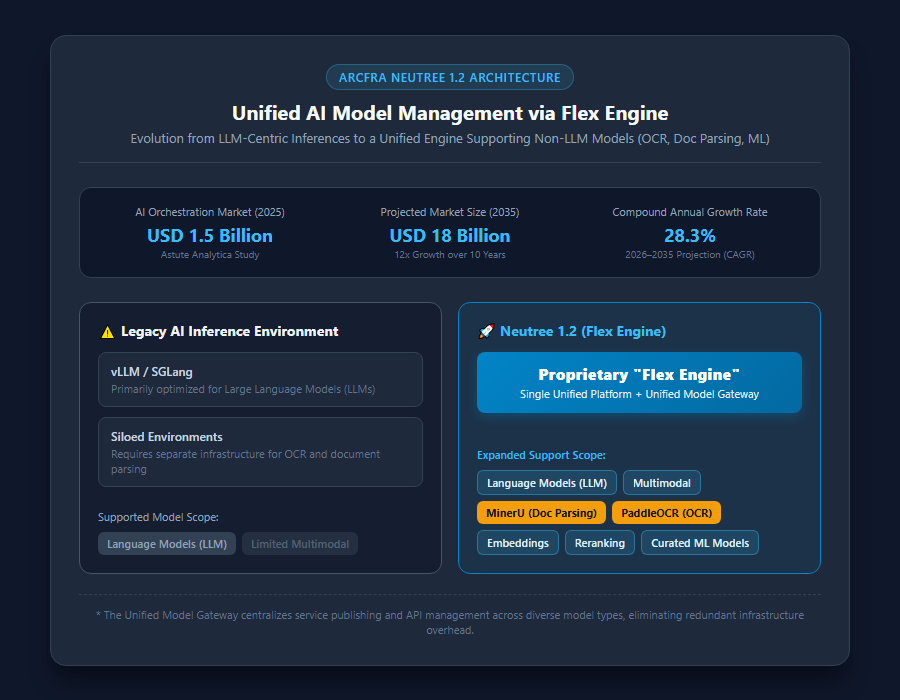
As a result, organizations can now manage their entire model ecosystem—ranging from language and multimodal models to embeddings, reranking, document parsing, OCR, and traditional ML models—within a single platform. Eliminating the need for separate infrastructures for different model types removes redundant platform overhead. This enables enterprises to validate multi-model AI applications rapidly and transition them seamlessly into production environments.
Streamlining Management with a Unified Model Gateway
Once diverse models are deployed, managing service calls from external applications and internal systems while ensuring full visibility becomes a key operational challenge. Neutree 1.2 solves this by centralizing service publishing and access management through a Unified Model Gateway. In addition, the new Visual Model Registry Management feature dramatically enhances visibility across corporate model assets.
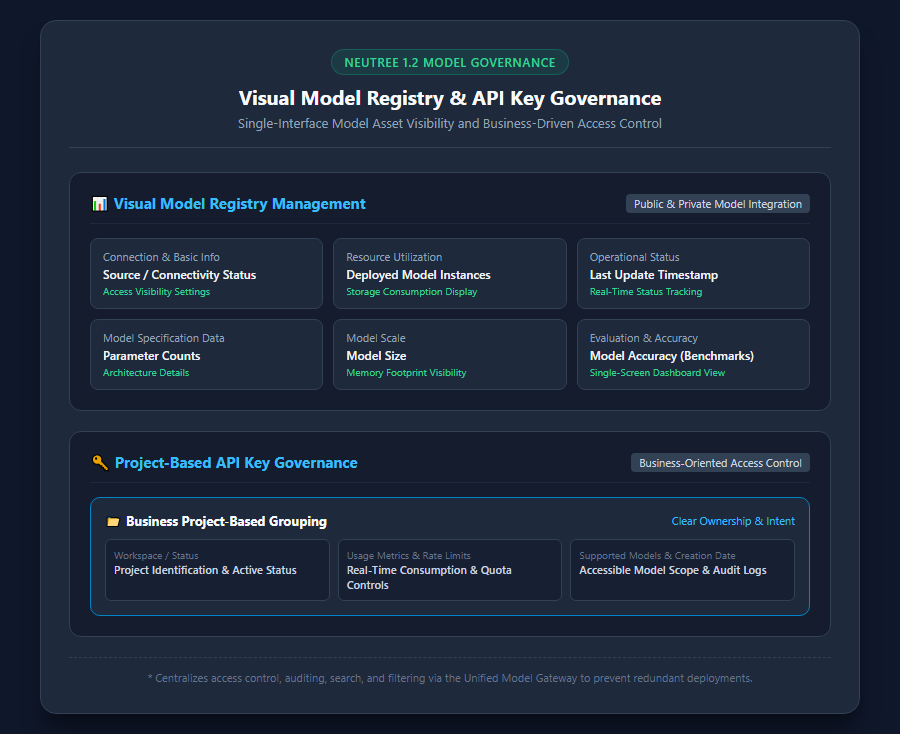
The Visual Model Registry allows administrators to manage both public and private models within a single, intuitive interface. Operational metadata—including model sources, connectivity status, access visibility, total deployed instances, storage consumption, and last update timestamps—is displayed at a glance alongside key model specifications such as parameter counts, model sizes, and accuracy metrics. Providing a real-time, holistic view of distributed model assets prevents redundant deployments while enforcing stringent security and compliance controls. Refer to the figure below.
This centralized access control and observability allow developers and IT operations teams to minimize management overhead while delivering safe, efficient model services.
Advanced Management Features for AI Optimization and Impact
Automated Resource Calculations for Predictable Planning
A major bottleneck in deploying production AI models is accurately estimating compute resources, specifically GPU memory and KV cache requirements. Inaccurate estimates risk out-of-memory (OOM) errors during deployment—causing service outages—or result in over-allocating GPU memory, leading to costly compute waste.
To address this challenge, Neutree 1.2 introduces automated KV cache and GPU memory calculation functionality. The platform analyzes the target model’s internal architecture to calculate the exact KV cache required during inference based on user-defined context window sizes and concurrency settings. It then recommends optimal GPU memory allocations, dramatically increasing deployment predictability. Eliminating guesswork and manual trial-and-error tuning minimizes deployment failure risks and prevents GPU memory waste, enabling enterprises to maximize infrastructure ROI while maintaining stable AI inference performance.
Business-Driven Access Control and Governance
As enterprise AI adoption expands across departments and projects, managing API keys and maintaining strict governance becomes critical. Traditional flat API key lists obscure ownership and intent, introducing security risks and complicating cost attribution.
Neutree 1.2 introduces project-based API key management, allowing administrators to group multiple API keys by business project and assign descriptive project names and descriptions to clarify ownership. The management interface offers clear visibility into workspaces, active statuses, real-time usage metrics, rate limits, supported models, and creation dates, supported by rapid search and filtering. This shifts API key management from a technical list into a business-driven governance model, establishing clear operational accountability across teams while enforcing fine-grained role-based access control (RBAC) and auditability.
Future Outlook and Key Trends in Enterprise AI
With the release of Neutree 1.2, enterprises are transitioning from isolated model execution environments to unified AI governance platforms spanning models, compute, and applications. Industry leaders in manufacturing and shipbuilding are already reaping the benefits of Neutree. For example, a major manufacturer expanded its existing Arcfra infrastructure into a production-ready AI foundation, streamlining model delivery and unifying compute and model resource management. Similarly, a shipbuilding company consolidated compute management, model management, and model gateways onto a single platform, achieving rapid model deployment, centralized access, and visual observability.
As generative AI applications continue to diversify, optimizing AI infrastructure across hybrid environments combining on-premises systems and public clouds will become increasingly vital. Pairing Neutree with the Arcfra Enterprise Cloud Platform (AECP) provides enterprises with high-performance storage and high-utilization GPU orchestration. As competitive advantage shifts from model development to the efficiency and stability of underlying infrastructure, Neutree is poised to play a pivotal role in scaling enterprise AI.
Reference Pages
-
[Neutree Official Website] https://neutree.ai/
-
[Neutree GitHub Repository] https://github.com/neutree-ai/neutree
-
[Arcfra Official Website] https://www.arcfra.com/
[#Arcfra #Neutree #AIInfrastructure #InferenceEngine #LLM #OpenSource #AIGovernance]

コメント