On September 18, 2026, newly appointed Minister of Land, Infrastructure, Transport and Tourism Tatsunori Ibayashi held his inaugural press conference following the formation of the Second Takaichi Cabinet Reshuffle, pledging to accelerate disaster response and infrastructure maintenance. Leveraging his background as a former Ministry official, he articulated a clear commitment to prioritizing pre-disaster prevention, maintaining aging regional infrastructure, and strengthening national resilience.
- Key Points from the Inaugural Press Conference and Ibayashi’s Background
- “Protecting Lives and Livelihoods”: Three Policy Pillars
- Specific Directives from Prime Minister Takaichi and Priority Initiatives
- Pre-Disaster Prevention and Response to Increasingly Severe Natural Disasters
- Aging Infrastructure Measures and the Transition to Preventive Maintenance
- Re-designing Regional Transport and Accelerating Digital Transformation (DX)
- Key Points of Contention and Future Points of Focus
Key Points from the Inaugural Press Conference and Ibayashi’s Background
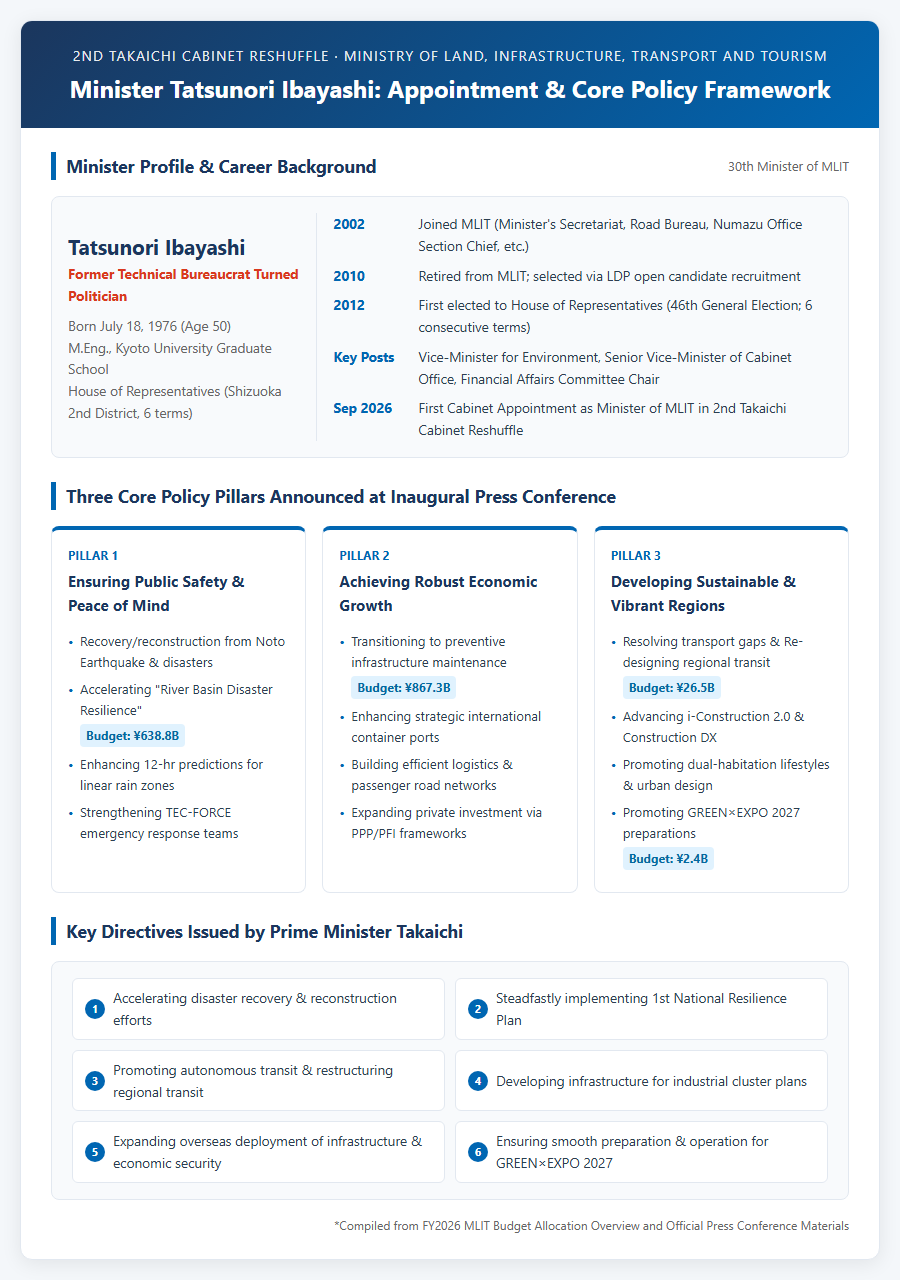
On September 18, 2026, following the official formation of the Second Takaichi Cabinet Reshuffle on the previous day, Tatsunori Ibayashi, a member of the House of Representatives, assumed office as the 30th Minister of Land, Infrastructure, Transport and Tourism. During his inaugural press conference at the ministry headquarters, Minister Ibayashi emphasized that the Ministry of Land, Infrastructure, Transport and Tourism (MLIT) is a critical institution responsible for safeguarding public lives and livelihoods while directly supporting the national economy and regional communities. He expressed his firm determination to accelerate disaster prevention, mitigation, and anti-aging infrastructure initiatives as top administrative priorities.
Minister Ibayashi, born on July 18, 1976, is a 50-year-old politician with a distinguished background as a technical bureaucrat. After earning his master’s degree from the Kyoto University Graduate School of Engineering, he joined MLIT in 2002. During his tenure as an official, he served in key positions, including the Minister’s Secretariat, the Road Bureau, Head of the Second Investigation Section at the Numazu River and National Highway Office, and Head of the Regional Road Division at the Chubu Regional Development Bureau. After leaving public service in 2010, he won an open candidate selection process organized by the Liberal Democratic Party (LDP) and was first elected to the House of Representatives from Shizuoka’s 2nd District in 2012, subsequently securing six consecutive terms. He has previously held notable posts such as Parliamentary Vice-Minister for the Environment, Senior Vice-Minister of the Cabinet Office, and Chairman of the House Committee on Financial Affairs. His deep expertise in both practical administration and policy formulation is highly regarded across the political spectrum.
Returning as minister to the agency where he began his career, Ibayashi reaffirmed his founding dedication to public service while underscoring his resolve to tackle formidable challenges, including increasingly frequent large-scale natural disasters and the rapid aging of public infrastructure built during Japan’s high-growth economic era. The following image captures scenes from the inaugural press conference.
“Protecting Lives and Livelihoods”: Three Policy Pillars
During his press conference, Minister Ibayashi outlined three foundational pillars to guide future land and transport administration:
-
- Ensuring public safety and peace of mind
-
- Achieving robust economic growth
-
- Developing sustainable, vibrant regional communities that leverage local distinctiveness
Under the first pillar, “Ensuring public safety and peace of mind,” the primary focus centers on proactive pre-disaster measures against water and sediment disasters intensified by climate change, as well as impending major earthquakes such as the Nankai Trough and Tokyo Metropolitan earthquakes. In the FY2026 MLIT budget request and allocation overview, the total general account national expenditure stands at 6.0749 trillion yen (1.02 times the previous fiscal year’s initial budget), with 5.295 trillion yen dedicated to public works.
Regarding the second pillar, “Achieving robust economic growth,” MLIT will advance smooth logistics and human mobility through functional enhancements of strategic international container ports and the early completion of high-efficiency road networks. The ministry will also encourage expanded private sector investment through Public-Private Partnerships (PPP) and Private Finance Initiatives (PFI).
Under the third pillar, “Developing sustainable, vibrant regional communities,” the administration aims to address population decline and aging in regional areas by executing the “Re-design of Regional Public Transport” to enhance service convenience and viability. Additional priorities include promoting dual-habitation lifestyles and advancing universal urban design. Minister Ibayashi stated his intention to drive these three pillars in an integrated manner to protect public life and property while revitalizing regional economies.
Specific Directives from Prime Minister Takaichi and Priority Initiatives
Along with the cabinet reshuffle, Prime Minister Sanae Takaichi issued specific policy directives to Minister Ibayashi across multiple administrative domains:
- Accelerating disaster recovery and reconstruction efforts, including those for the Noto Peninsula Earthquake
- Steadfastly implementing the First National Resilience Implementation Medium-Term Plan
- Restructuring regional public transport, including the early social implementation and adoption of autonomous driving
- Developing foundational infrastructure necessary for industrial cluster plans under regional future strategies
- Expanding the overseas deployment of high-quality infrastructure systems and securing economic security
- Advancing sound water cycle policies in accordance with the Basic Plan on Water Cycles
- Ensuring smooth preparations and operations for the International Horticultural Exhibition 2027 Yokohama (GREEN×EXPO 2027)
Prime Minister Takaichi advocates a dual approach combining “crisis management investment” and “growth investment” to simultaneously secure public safety and foster a strong economy. In particular, for GREEN×EXPO 2027 scheduled for autumn 2027 in Yokohama, national funding of 2.4 billion yen (1.24 times the previous fiscal year) has been allocated to support venue construction, security, and international participation invitations. Responding to these mandates, Minister Ibayashi stated, “The scope of land, infrastructure, and transport policy is immensely broad. I will mobilize the full capacity of the ministry to faithfully execute the Prime Minister’s directives.”
Advancing Disaster Response and “Reiwa National Resilience”
Pre-Disaster Prevention and Response to Increasingly Severe Natural Disasters
In recent years, natural disasters have grown increasingly diverse and severe, as evidenced by the January 2024 Noto Peninsula Earthquake and frequent torrential rainfalls caused by linear precipitation zones. Minister Ibayashi highlighted the necessity of devoting full energy to rapid recovery and reconstruction in affected areas while fundamentally reinforcing “pre-disaster prevention” to minimize potential damage before disasters strike.
A core initiative in this effort is the acceleration and deepening of “River Basin Disaster Resilience and Control,” an integrated approach combining river channel excavation, dam upgrading, erosion control, sewage system management, and flood storage basins across entire river basins. The FY2026 budget allocates 638.8 billion yen to river basin flood management measures. To improve forecasting capabilities for linear precipitation zones—aiming for predictions 12 hours in advance and precise warnings 2 to 3 hours prior—the government is deploying next-generation geostationary meteorological satellites and leveraging supercomputing technology.
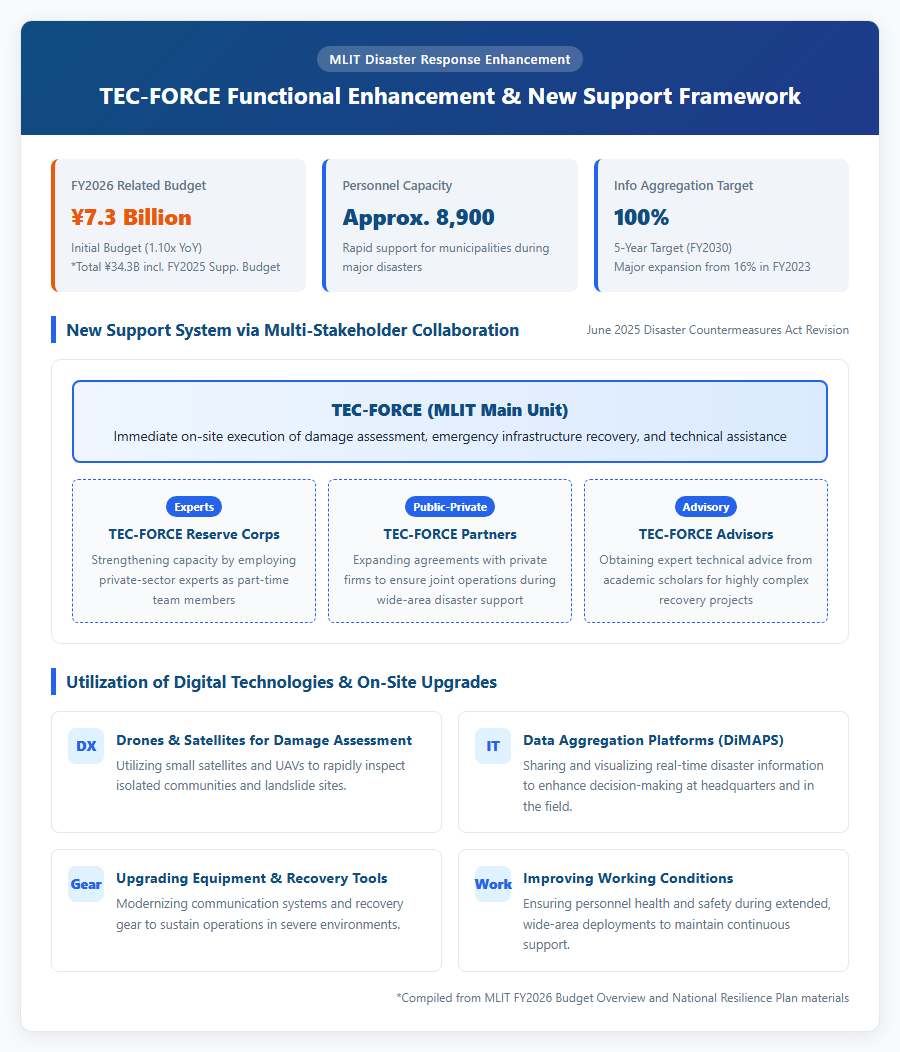
Furthermore, to maintain emergency transport routes and prevent community isolation during major disasters, MLIT is prioritizing the creation of redundant highway and national route networks (“double networks”) and converting provisional two-lane highway segments into four-lane expressways. On-site response capacities are also being upgraded through the expansion of the Technical Emergency Control Force (TEC-FORCE) and the enhancement of real-time data aggregation systems such as DiMAPS. The diagram below illustrates the functional enhancement model for TEC-FORCE.
Aging Infrastructure Measures and the Transition to Preventive Maintenance
Social infrastructure across Japan—including bridges, tunnels, water supply, and sewerage systems constructed heavily during the high-growth era—is aging rapidly, with many structures exceeding 50 years of service. The vulnerability of unseen underground infrastructure was acutely demonstrated by the large-scale road collapse in Yashio City, Saitama Prefecture, in January 2025.
On June 6, 2025, the Cabinet approved the First National Resilience Implementation Medium-Term Plan (FY2026–FY2030), establishing a project scale of over 20 trillion yen over five years. Approximately 10.6 trillion yen of this allocation is designated for strengthening lifelines, marking an accelerated transition from traditional reactive maintenance to proactive “preventive maintenance.”
In the FY2026 budget, MLIT allocated 867.3 billion yen specifically for preventive maintenance. Key performance indicators (KPIs) under this framework include:
- Increasing the soundness rate of large-diameter sewer pipes (diameter of 2 meters or more, operational for 30 years or more) from 0% in FY2024 to 100% by FY2030.
- Raising the repair completion rate for bridges requiring urgent or early remediation under national and local government management from 55% in FY2023 to 80% by FY2030, and achieving 100% by FY2051.
Minister Ibayashi aims to drive strategic, broad-area “Regional Infrastructure Group Management,” alleviating technical and financial burdens on local municipalities while extending the operational lifespan of vital public assets.
Regional Revitalization, Transport Infrastructure, and Future Outlook
Re-designing Regional Transport and Accelerating Digital Transformation (DX)
Depopulation and demographic aging in regional Japan have led to declining ridership and severe driver shortages across local bus and rail networks. To resolve transportation gaps in approximately 2,500 areas nationwide, MLIT is fully deploying the “Re-design of Regional Public Transport” based on its 2025 action guidelines. The FY2026 budget incorporates 26.5 billion yen to support on-demand transit, public ride-sharing, and operational consolidation among transport providers.
Concurrently, driving digital transformation (DX) across the construction and transport sectors remains a vital objective. Under “i-Construction 2.0,” MLIT aims to achieve a 30% reduction in construction site labor requirements and a 1.5-fold increase in productivity by 2040 through automated construction machinery, remote operation, and Building Information Modeling / Construction Information Modeling (BIM/CIM). A budget of 10.1 billion yen has been designated for infrastructure DX in FY2026.
Advanced technological implementations are moving forward rapidly, including Project PLATEAU for 3D urban digital twins, real-estate ID integration, autonomous freight transport trials on expressways, and autonomous ship navigation. Minister Ibayashi reiterated his commitment to connecting these technological innovations directly to improved regional convenience and industrial productivity.
Key Points of Contention and Future Points of Focus
As land, infrastructure, and transport administration begins under Minister Ibayashi, several critical points of focus will determine future progress:
- Budgetary Execution and Financial Resource Allocation: Whether MLIT can smoothly execute the FY2026 budget (6.0749 trillion yen) and the 20-trillion-yen National Resilience Plan while absorbing rising material costs and labor expenses to reach local contractors effectively.
- Hands-on Support for Municipalities: Whether the ministry can provide adequate technical and financial assistance to small local governments that lack specialized engineering personnel for infrastructure inspections and preventive maintenance.
- Securing Labor in Construction and Transport: Whether proper wage standards, two-day weekend schedules, and structured acceptance of foreign workers can be realized under stricter overtime regulations following the “2024 problem.”
- Regulatory Adaptation for Emerging Technologies: Whether legal frameworks and safety standards for Level 4 autonomous driving (1-to-N remote monitoring), drone delivery, and AI-driven infrastructure inspections can be updated with sufficient speed.
Minister Ibayashi combines hands-on engineering experience from his career as an MLIT official with an extensive legislative track record. How effectively he integrates technological innovation with structural policy reform to achieve sustainable national development will remain a major focal point for Japan’s infrastructure strategy.
References
- [Cabinet Secretariat: 1st National Resilience Implementation Medium-Term Plan] https://www.cas.go.jp/jp/seisaku/kokudo_kyoujinka/dai1_chuukikeikaku/index.html
- [MLIT: Overview of FY2026 Budget] https://www.mlit.go.jp/report/press/content/001994705.pdf
- [Prime Minister’s Office: List of Ministers of the Second Takaichi Cabinet (Reshuffled)] https://www.kantei.go.jp/jp/105/meibo/index.html
- [Tatsunori Ibayashi Official Website] http://t-ibayashi.com/
【#TatsunoriIbayashi #MLIT #NationalResilience #InfrastructureMaintenance #DisasterPrevention #TakaichiCabinet】

コメント