On September 18, 2026, Minister of Agriculture, Forestry and Fisheries Kazuhide Yana, during his inaugural press conference, reaffirmed the government’s longstanding “no-opening” policy regarding the sea gates of the national Isahaya Bay land reclamation project. With years of judicial conflict now resolved, the Japanese government plans to focus on implementing sea revitalization initiatives and relief measures funded through a dedicated foundation that do not rely on opening the gates.
- Minister Yana’s Inaugural Statement Reaffirming the No-Opening Policy
- Historical Ministerial Statements and the Framework of “Revitalization Without Opening”
- Judicial Background and the Resolution of Legal Conflicts
- Practical Impact on Disaster Prevention and Farming in Reclaimed Lands
- Consequences for Ariake Sea Fisheries and Challenges in Water and Sediment Environment
- The 10 Billion Yen Foundation Proposal and Progress in Support Measures
- Science-Based Approaches to Long-Term Ecological Revitalization
Minister Yana’s Inaugural Statement Reaffirming the No-Opening Policy
During his inaugural press conference on September 18, 2026, Minister of Agriculture, Forestry and Fisheries Kazuhide Yana addressed the long-standing issue surrounding the drainage gates of the national Isahaya Bay land reclamation project, explicitly confirming that the government will maintain its established “no-opening” stance. The Isahaya Bay reclamation project has been a subject of intense controversy for decades, driving deep divisions and protracted legal battles between local fishermen advocating for the opening of the gates and local farmers and residents opposing it. Minister Yana explained that his administration intends to honor past judicial rulings and ministerial statements, upholding the policy of restoring the Ariake Sea without opening the dike’s sluice gates. Along with core agricultural priorities such as securing food security and enhancing agricultural productivity, the minister reiterated the government’s commitment to ensuring regional stability and establishing sustainable operations for both farming and fishing communities. Going forward, the government plans to work in harmony with local stakeholders to steadily advance infrastructure management and environmental improvement projects within the established policy framework.
Historical Ministerial Statements and the Framework of “Revitalization Without Opening”
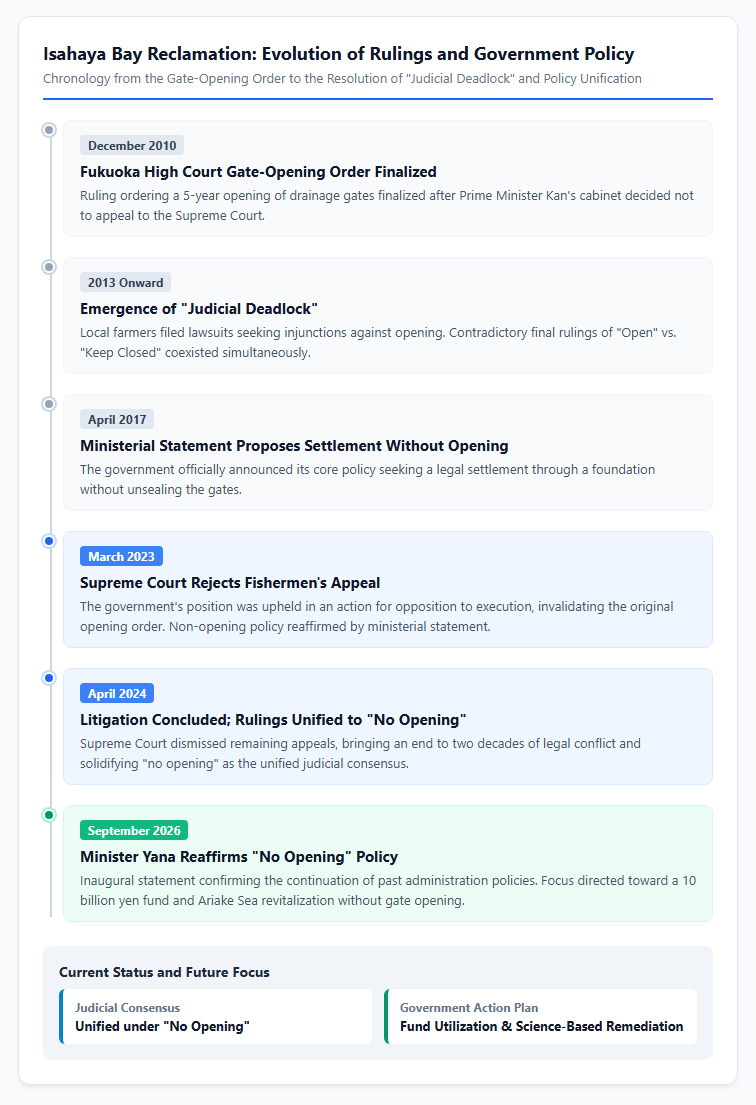
The Ministry of Agriculture, Forestry and Fisheries (MAFF) solidified its stance against opening the sea gates based on key policy statements issued by past ministers. On April 25, 2017, an official ministerial statement outlined the government’s intention to seek a legal settlement through a fund without unsealing the gates. This foundational approach was subsequently reaffirmed in another ministerial statement on March 2, 2023, remaining a consistent cornerstone of national policy to this day. Keeping the gates closed has been deemed necessary due to serious concerns that introducing seawater into the dike’s regulating reservoir would cause severe salt damage to reclaimed farmlands and jeopardize local agricultural operations that rely on the reservoir’s freshwater. Furthermore, experts and local authorities highlighted the risk of diminishing the dike’s disaster prevention capabilities during typhoons and torrential rainstorms. In response to these concerns, the government decided against a permanent gate opening, concluding that the best path forward is to address the decline in Ariake Sea fisheries through targeted environmental measures while simultaneously protecting the livelihoods and safety of both agricultural and fishing communities.
Judicial Background and the Resolution of Legal Conflicts
The litigation surrounding the Isahaya Bay project grew exceedingly complex following a December 2010 ruling by the Fukuoka High Court, which ordered the government to keep the drainage gates open for five years. The ruling became final after the administration under then-Prime Minister Naoto Kan decided not to appeal to the Supreme Court. Soon after, local farmers and residents filed counter-lawsuits seeking an injunction to keep the gates closed, fearing severe agricultural damage. Beginning in 2013, Japanese courts issued conflicting final rulings—some ordering the opening of the gates and others prohibiting it—creating an unprecedented “judicial deadlock” that left the federal government facing indirect enforcement penalties from both opposing sides. However, in March 2023, the Supreme Court rejected an appeal by the fishermen’s group in an action for opposition to execution, invalidating the legal enforceability of the original opening order. Subsequently, in April 2024, the Supreme Court dismissed remaining appeals, unifying judicial decisions under the stance of keeping the gates closed. This definitive legal resolution officially brought an end to more than two decades of legal entanglement.
Comprehensive Evaluation of the Isahaya Bay Project and Its Regional Impact
Practical Impact on Disaster Prevention and Farming in Reclaimed Lands
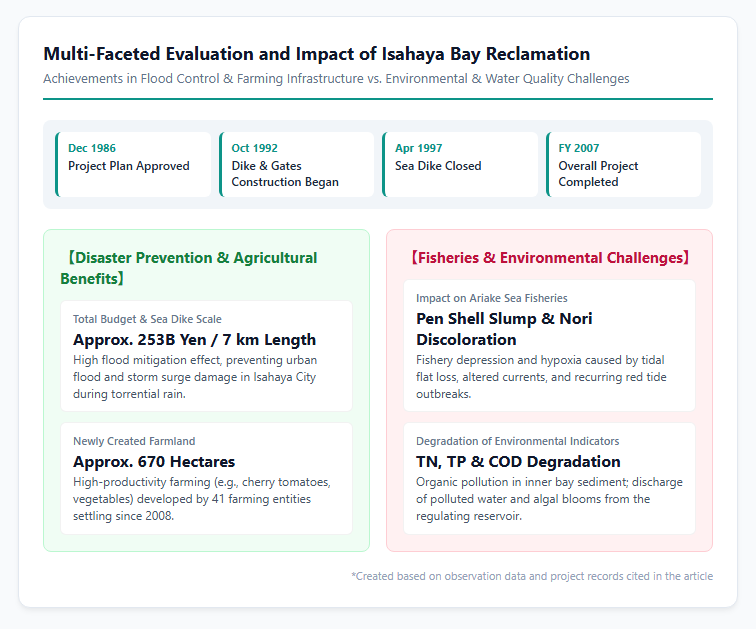
The national Isahaya Bay land reclamation project was officially approved in December 1986, with construction of the sea dike and drainage gates beginning in October 1992. In April 1997, the inner section of Isahaya Bay was sealed off by a 7-kilometer dike, and the entire project was completed in fiscal year 2007 with a total budget of approximately 253 billion yen. The primary objectives of this massive public works initiative were to strengthen regional flood defenses and create new agricultural land. The area around Isahaya City had historically suffered from severe flood and storm surge damage caused by torrential rains and typhoons; however, since the completion of the sea dike, major flood damage in urban areas has been effectively prevented even during heavy rainfall events. Additionally, on the approximately 670 hectares of newly reclaimed farmland, advanced agricultural operations have taken root. Since 2008, when 41 farming entities initially settled in the area, farmers have successfully cultivated high-value crops such as cherry tomatoes and various vegetables. The vast farmland and freshwater regulating reservoir created by the project continue to serve as vital agricultural infrastructure supporting local productivity.
Consequences for Ariake Sea Fisheries and Challenges in Water and Sediment Environment
Conversely, the closing of Isahaya Bay led to dramatic environmental changes in the broader Ariake Sea ecosystem. Prior to the dike’s construction, the bay contained vast tidal flats that supported thriving marine life and lucrative fisheries, particularly for pen shells (tairagi) and nori seaweed cultivation. Following the closure, however, local fisheries faced severe setbacks, including catastrophic drops in pen shell harvests and widespread discoloration of nori. Environmental surveys and long-term water quality data collected by the Kyushu Regional Agricultural Administration Office revealed a degrading trend in sediment quality, particularly near the inner bay, marked by elevated levels of total nitrogen (TN), total phosphorus (TP), and chemical oxygen demand (COD). Discharges of polluted water and algal blooms from the regulating reservoir into the sea have also been cited as contributing factors. As a result, local fishermen have persistently called for gate-opening surveys to restore marine habitats. While the reclamation project achieved significant success in flood mitigation and agricultural development, restoring the ecosystem and water quality of the Ariake Sea remains a critical regional challenge.
Challenges and Prospects for the Revitalization of the Ariake Sea
The 10 Billion Yen Foundation Proposal and Progress in Support Measures
Following the resolution of the judicial deadlock, the government has accelerated concrete revitalization and support initiatives for Ariake Sea fishermen predicated on keeping the sea gates closed. Federal authorities proposed establishing a 10 billion yen fund to provide comprehensive assistance to fishing operators and industry associations across the region. This financial framework encompasses expanding seed production and release programs for pen shells and nori, introducing equipment to improve seabed sediment, streamlining fishing operations, and assisting with processing and distribution to increase product value. In February 2024, representatives from fishing associations in Saga, Fukuoka, and Kumamoto prefectures met with the Minister of Agriculture, Forestry and Fisheries and submitted a document expressing formal agreement with the government’s non-opening revitalization policy. This landmark development established a cooperative foundation between the state and local fishing organizations after years of stalemate. With this consensus in place, the government is moving from past conflict toward the swift execution of practical marine restoration programs.
Science-Based Approaches to Long-Term Ecological Revitalization
With the legal dispute settled, the central focus has shifted toward restoring the Ariake Sea’s ecosystem and water quality without opening the sea gates. During his press conference, Minister Yana emphasized his commitment to implementing environmental remediation measures guided by the latest scientific research and continuing investigations into the root causes of fishery declines. Local governments, including Nagasaki Prefecture and Isahaya City, have called on the federal government to maintain the dike’s disaster prevention capabilities while establishing new aquaculture technologies and meeting water quality targets for the regulating reservoir. Given the complex tidal and sediment dynamics of the semi-enclosed Ariake Sea, continuous monitoring and multifaceted interventions are essential to prevent red tides and mitigate hypoxic water masses. Working in close partnership with local farmers, fishermen, and academic institutions, the Japanese government is expected to execute long-term, comprehensive policies that safeguard community security while fulfilling the vision of true ecological restoration for the Ariake Sea.
Reference Pages
- [Ministry of Agriculture, Forestry and Fisheries] Summary of Minister Yana’s Inaugural Press Conference

- [Nagasaki Prefecture] Q. Why are fishermen and farmers in conflict? – Nagasaki Prefectural Government

- [House of Representatives] Written Inquiry Regarding Government Stance on Resolving Isahaya Bay Opening Issue and Revitalizing the Ariake Sea

[#IsahayaBayReclamation #MAFF #MinisterYana #AriakeSeaRevitalization #NoOpeningPolicy #FisheriesPromotion #AgriculturalPolicy #DisasterPrevention]


コメント