In September 2026, Japan’s Ministry of Land, Infrastructure, Transport and Tourism (MLIT) launched a new weekly reporting system for foreign trade container volumes across the nation’s six major ports, including Tokyo and Yokohama. By drastically cutting the data release lag from roughly two months under previous monthly reports down to just two weeks, the initiative aims to enable earlier tracking of international logistics trends and faster formulation of port policies.
- Key Highlights: Weekly Releases of Foreign Trade Container Volumes for 6 Major Ports
- First Data Release: Realities of Japan’s Foreign Trade Logistics
- Institutional & Technological Context: Moving Beyond 2-Month Lags via Data Visualization
- The Platform: Expanding Cyber Port Capabilities and Integrating with NACCS
- Operational Impact: Shifting Truck Dispatching and Inventory Strategies
- Future Outlook & Key Focus Areas: Expanding to Regional Ports and Integrating Operational Data
Key Highlights: Weekly Releases of Foreign Trade Container Volumes for 6 Major Ports
On September 18, 2026, the Ministry of Land, Infrastructure, Transport and Tourism (MLIT) Port and Harbour Bureau announced the launch of the “Weekly Container Freight Flow Report.” Utilizing Cyber Port, a dedicated data platform for port logistics, the report aggregates and publishes foreign trade container cargo volumes (measured in TEU) across six of Japan’s key commercial ports:
-
Port of Tokyo
-
Port of Kawasaki
-
Port of Yokohama
-
Port of Nagoya
-
Port of Osaka
-
Port of Kobe
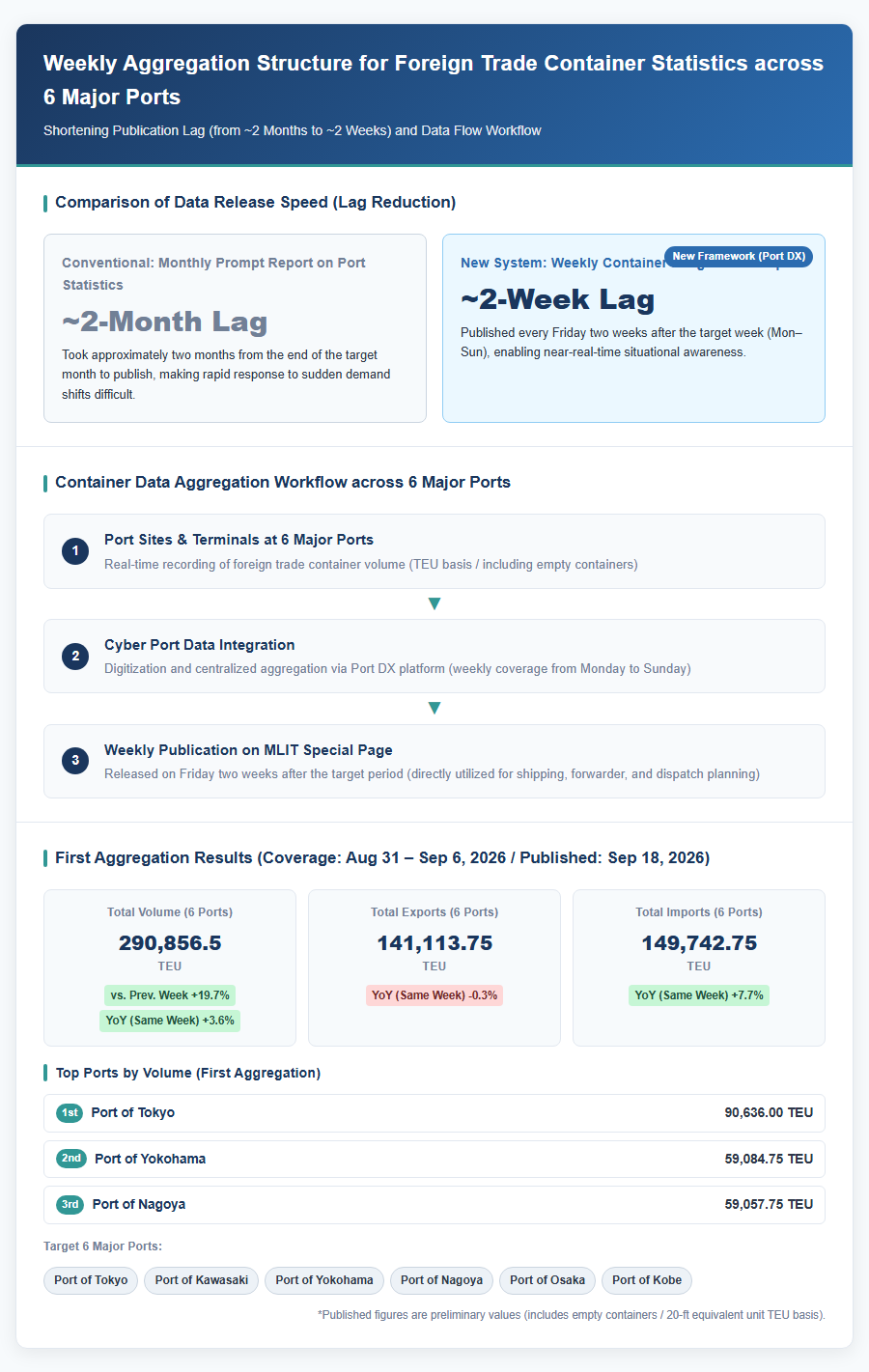
The report covers containerized foreign trade cargo measured in 20-foot equivalent unit (TEU) equivalents. Volume for each week (Monday through Sunday) is aggregated and published on the Friday of the second following week on a regular weekly basis. The data is accessible to the public via a newly established section on MLIT’s official website.
Historically, the primary benchmark for Japanese port logistics was the “Prompt Report on Port Statistics (Monthly Report),” based on the government’s official Port Survey. However, this monthly report suffered from a significant reporting lag of approximately two months following the end of the target month. In an environment where logistics operations face rapid demand fluctuations and global supply chain disruptions, this data delay served as a major bottleneck for timely situational awareness and agile decision-making. By shortening the publication window to approximately two weeks, the new weekly report establishes an environment where industry stakeholders can track container movements at key ports almost in real time.
The following graphic illustrates the container aggregation workflow across these major ports.
First Data Release: Realities of Japan’s Foreign Trade Logistics
The inaugural Weekly Container Freight Flow Report, published on September 18, 2026, revealed container traffic across the six major ports for the week of August 31 to September 6, 2026. During this period, total container volume reached 290,856.5 TEU across the six ports, representing a 19.7% increase from the previous week and a 3.6% gain year-over-year.
A closer look at the breakdown clearly reflects Japan’s trade structure and immediate demand trends:
-
Total exports (6 ports): 141,113.75 TEU (down 0.3% year-over-year)
-
Total imports (6 ports): 149,742.75 TEU (up 7.7% year-over-year)
While export volumes remained virtually flat with a minor dip, imports posted strong growth exceeding 7%, pointing toward a recovery in domestic consumer demand and industrial component procurement.
Comparing volume across ports highlights regional economic scale and gateway prominence. The Port of Tokyo handled the largest share at 90,636 TEU, accounting for over 30% of the total. Yokohama followed with 59,084.75 TEU, and Nagoya closely behind at 59,057.75 TEU, quantitatively demonstrating how major ports in the Keihin (Tokyo/Yokohama) and Chukyo (Nagoya) regions continue to drive Japan’s container shipping. Although these initial numbers are preliminary and subject to future revision, weekly tracking offers a powerful tool for catching short-term volume shifts and regional variations that were previously obscured by monthly reporting.
“Cyber Port” and Port DX Powering Weekly Statistics
Institutional & Technological Context: Moving Beyond 2-Month Lags via Data Visualization
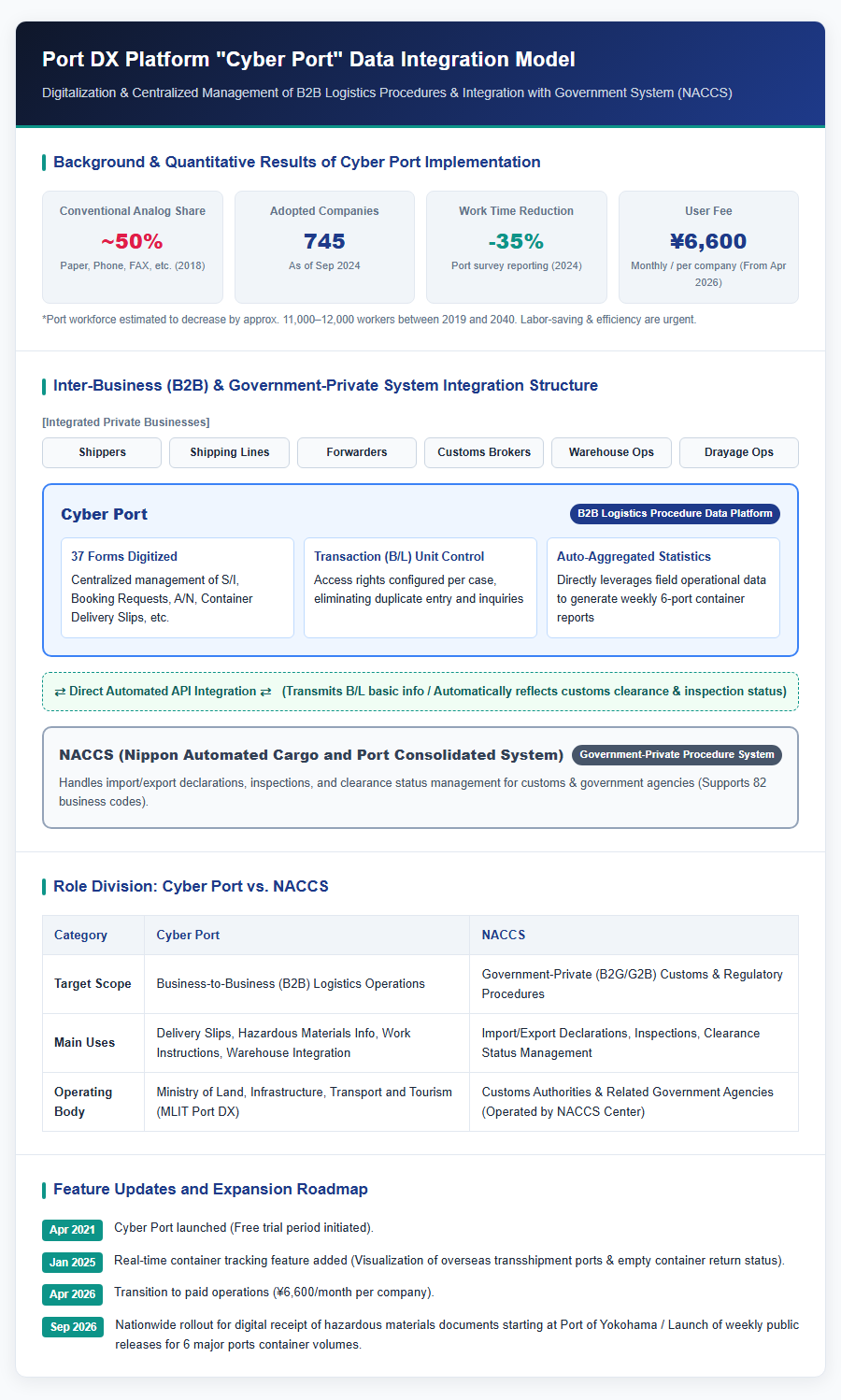
Digitizing and accelerating port statistics forms a core pillar of MLIT’s broader “Port Digital Transformation (Port DX)” initiative. For decades, Japanese port operations suffered from fragmented administrative procedures dispersed among shipping lines, forwarders, port authorities, and government agencies. A 2018 MLIT survey revealed that approximately 50% of container logistics procedures were still handled via analog methods such as paper documents, phone calls, and faxes, creating massive operational burdens through redundant data entry and manual verification.
Compounding this issue is the severe labor shortage driven by Japan’s declining and aging population. Estimates indicate that the port workforce will shrink by 11,000 to 12,000 workers between 2019 and 2040, making labor-saving digital solutions urgent to maintain port efficiency.
In response, MLIT developed “Cyber Port,” a centralized digital infrastructure designed to digitize and manage port information. Launched in April 2021, Cyber Port was adopted by 745 companies as of September 2024. Surveys indicate that implementing Cyber Port cut reporting time for port statistics by 35% compared to conventional methods. The launch of weekly container reporting was made possible directly by leveraging the digitized data accumulated within Cyber Port.
The diagram below illustrates the data integration framework enabled by Cyber Port.
The Platform: Expanding Cyber Port Capabilities and Integrating with NACCS
Cyber Port’s role as the centerpiece of Port DX stems from its rich functionality and seamless interoperability with existing systems. Cyber Port primarily targets business-to-business (B2B) logistics procedures while integrating directly via API with NACCS (Nippon Automated Cargo and Port Consolidated System), the government-private system handling customs clearance and regulatory filings.
When a transaction is created in Cyber Port, core data required for import/export declarations is automatically synced to NACCS. Once customs clearance is granted in NACCS, the updated status immediately reflects back in Cyber Port, eliminating duplicate entries and dramatically reducing input errors.
MLIT continues to expand Cyber Port’s capabilities:
-
January 2025: Added real-time container tracking, covering transshipment status at overseas ports.
-
September 2026: Launched nationwide rollout for digital receipt and processing of hazardous materials documentation, beginning at the Port of Yokohama.
By digitizing documentation and status updates, the platform has sharply reduced on-site driver wait times and manual confirmation calls. While the initial free trial period offered since 2021 concluded in March 2026—transitioning to a monthly fee of 6,600 yen per company starting April 2026—the platform’s growing operational value continues to drive adoption across the industry.
Impact on the “2024 Problem” and Supply Chain Resilience
Operational Impact: Shifting Truck Dispatching and Inventory Strategies
Transitioning to weekly container statistics delivers far-reaching benefits beyond administrative transparency, directly impacting corporate logistics and supply chain strategies. Tightening labor regulations for truck drivers—commonly referred to as the “2024 Problem” and “2026 Problem”—have constrained domestic freight capacity, making drayage (port-to-inland container transport) management increasingly tight.
Gaining visibility into container flows at major ports with only a two-week lag offers concrete advantages for private enterprises:
-
Shippers (Importers/Exporters): Early identification of port volume fluctuations and seasonal swings enables timely adjustments to production schedules, order timing, and warehouse inventory planning.
-
Drayage Operators & Forwarders: Tracking volume trends by port acts as a leading indicator, allowing operators to optimize driver scheduling, fleet assignment, and terminal cargo handling in advance.
Amid ongoing geopolitical risks and ocean freight rate volatility, data-driven decision-making is vital for maintaining corporate competitiveness. The industry is rapidly shifting away from intuition-based dispatching reliant on delayed monthly figures toward data-driven demand forecasting and proactive risk management.
Future Outlook & Key Focus Areas: Expanding to Regional Ports and Integrating Operational Data
While weekly container reporting marks a major milestone, the journey toward comprehensive Port DX and supply chain resilience is ongoing. Looking ahead, a primary area of focus is expanding coverage beyond the current six major ports (Tokyo, Kawasaki, Yokohama, Nagoya, Osaka, and Kobe) to include regional container ports. Regional ports face unique challenges, such as growing reliance on overseas feeder transshipments via Asian hubs like Busan, and would benefit greatly from broader logistics visibility.
A second critical focus is integrating statistical volume data with real-time operational metrics. While the Weekly Container Freight Flow Report currently tracks container volume (TEU), the next frontier involves combining these figures with terminal gate wait times, empty container supply-demand balances, and gate automation systems like CONPAS.
Under Japan’s revised Logistics Efficiency Improvement Act, specified large shippers face mandatory appointments of Chief Logistics Officers (CLOs) and mid-to-long-term planning requirements. Connecting ocean port data seamlessly with inland transportation metrics will be essential to building sustainable, end-to-end logistics networks.
References
-
[Ministry of Land, Infrastructure, Transport and Tourism – Port and Harbour Bureau] https://www.mlit.go.jp/kowan/kowan_00002.html
-
[Ministry of Land, Infrastructure, Transport and Tourism – Press Release] https://www.mlit.go.jp/report/press/port05_hh_000355.html
-
[Ministry of Land, Infrastructure, Transport and Tourism – Logistics News & Updates] https://www.mlit.go.jp/seisakutokatsu/freight/news.html
[#MLIT #PortDX #CyberPort #ContainerShipping #Logistics2024Problem #SupplyChain #SixMajorPorts]


コメント