au Jibun Bank announced a major 0.6% increase in its variable base mortgage rate, raising it to 3.741% per annum effective October 1, 2026. This decision reflects market interest rate fluctuations following successive policy rate hikes by the Bank of Japan, alongside efforts to restructure funding costs in response to an overheating loan-to-deposit ratio.
- Specifics of the 0.6% Rate Hike and Its Unprecedented Scale
- Bank of Japan Policy Rate Hikes and Short-Term Prime Rate Trends
- Overheating Loan-to-Deposit Ratio Exceeding 110% and Savings Deposit Strategy
- Telecom-Finance Ecosystem Competition and Net Banks’ Profitability Strategies
- Pitfalls of the 5-Year and 125% Rules and Unpaid Interest Risks
- Key Considerations for Prepayment and Switching Rate Types
Specifics of the 0.6% Rate Hike and Its Unprecedented Scale
au Jibun Bank announced on the evening of September 18, 2026, that it will raise its variable base interest rate for all-period discount mortgage plans by 0.600%, from the previous 3.141% per annum to 3.741% per annum, effective October 1, 2026. Because previous interest rate increases by online banks had mostly hovered around 0.25%, a single jump of 0.6% has sent shockwaves throughout the industry. Since actual borrowing rates are determined by deducting individual interest rate discounts (typically around 2.5% to 3%) from the base rate, actual borrowing rates for consumers are expected to rise significantly from around 1.0% per annum to approximately 1.6% per annum.
Key highlights of this revision include:
- Effective Date of Base Rate Revision: October 1, 2026
- Variable Base Rate: Raised from 3.141% to 3.741% per annum (+0.600% increase)
- Primary Impact: New mortgage applicants and existing variable-rate borrowers
As a major online bank known for aggressively acquiring market share with industry-lowest interest rates shifts to a clear rate-hiking stance, it has become evident that the residential mortgage market has officially entered an era of rising interest rates.
Bank of Japan Policy Rate Hikes and Short-Term Prime Rate Trends
The primary driver behind au Jibun Bank’s rate hike is the normalization of monetary policy and subsequent policy rate increases by the Bank of Japan (BOJ). Since ending its negative interest rate policy in March 2024, the BOJ implemented sequential rate hikes in July 2024, January 2025, December 2025, and June 2026, pushing the policy rate to around 1.00%. In September 2026, the BOJ decided on an additional rate hike to approximately 1.25% per annum, reaching its highest level in nearly 31 years.
Variable mortgage rates in Japan typically track the short-term prime rate set by commercial banks for short-term corporate lending. However, au Jibun Bank’s revision consolidated and reflected the impact of the BOJ’s last two rate hikes at once. While competitors such as docomo SMTB Net Bank limited their short-term prime rate increase to 0.25%, au Jibun Bank made an independent decision to implement a 0.6% increase, underpinned by its proprietary base rate setting mechanism that operates independently of the standard short-term prime rate.
The diagram below illustrates how this interest rate hike is reflected in actual repayment schedules.
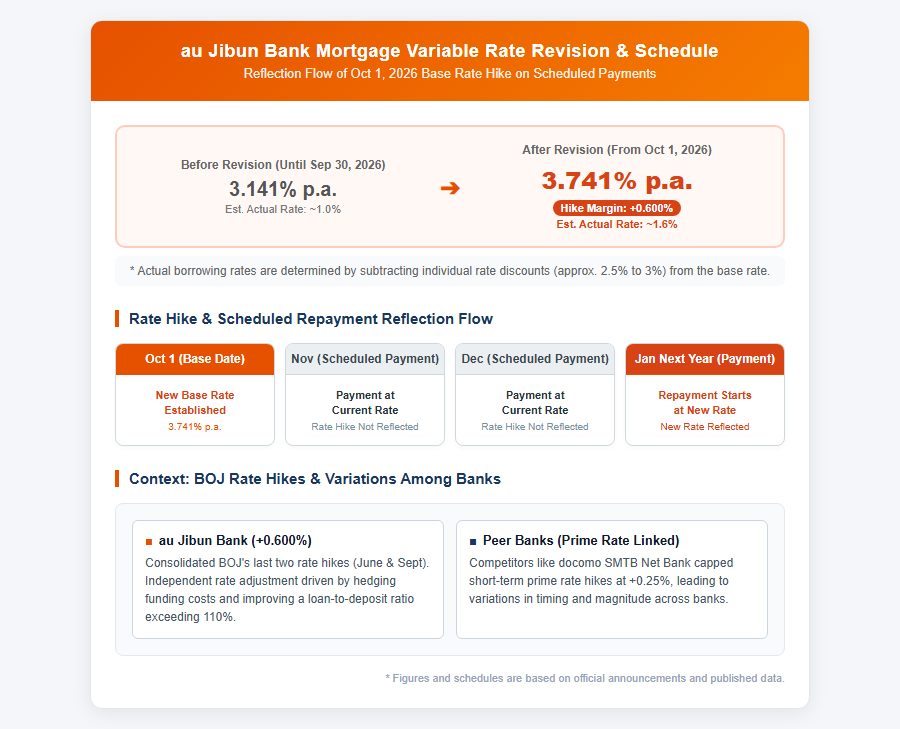
With the BOJ’s policy rate hikes expected to persist over the long term, the mortgage market has entered a non-uniform era where rate hike timing and magnitudes vary significantly among individual banks.
Bank Management Dynamics and Financial Market Shifts Behind Rising Rates
Overheating Loan-to-Deposit Ratio Exceeding 110% and Savings Deposit Strategy
From a managerial perspective, au Jibun Bank’s decision to hike mortgage rates stems from a severely overheated loan-to-deposit ratio. While the bank’s loan balance reached approximately 5.1 trillion yen, its deposit balance remained at roughly 4.6 trillion yen, driving the loan-to-deposit ratio past 110% toward 115%. When outstanding loans exceed total deposits, banks are forced to secure shortfall funding from wholesale markets at higher costs, putting severe pressure on profitability.
To address this structural challenge, au Jibun Bank is rapidly reinforcing its funding base:
- Revision of Ordinary Savings Rate: Raised ordinary savings deposit rates to 0.65% per annum (with qualifying discounts)
- Customer Base Retention: Encouraging primary account adoption via payroll deposits and automatic utility bill payments
- Hedging Funding Costs: Securing net interest margins by raising mortgage rates
The bank has pivoted toward absorbing individual liquid assets through high-yield savings deposits while maintaining its massive volume of mortgage loans. By increasing mortgage rates by 0.6%, au Jibun Bank clearly aims to hedge against rising market funding costs and preserve financial soundness.
Telecom-Finance Ecosystem Competition and Net Banks’ Profitability Strategies
This interest rate adjustment goes beyond an isolated yield optimization by a single bank; it represents a major front in the broader battle for personal financial assets among telecom giants and mega financial groups. In recent years, competition to lock in customers within digital ecosystems has intensified dramatically across various players, including au Jibun Bank (KDDI Group), docomo SMTB Net Bank (NTT Docomo), Olive (Sumitomo Mitsui Financial Group), M-ut (Mitsubishi UFJ Financial Group), and Rakuten Bank.
In telecom-led financial integration, deposit balances and mortgage loans serve as the bedrock of the entire digital ecosystem. Following its transition into a wholly owned subsidiary of KDDI, au Jibun Bank gained structural flexibility to pursue multi-faceted customer engagement strategies:
- Reducing churn by bundling mobile subscriptions (au) with mortgage rate discounts
- Stimulating cross-service engagement with online brokerages and payment platforms
- Transitioning from an expansion phase focused on volume acquisition via low rates to a profit-harvesting phase focused on securing interest margins
Having expanded rapidly during the ultra-low interest rate era, online banks are now transitioning from quantitative expansion to qualitative profitability as the market enters a rate-hiking cycle.
Practical Impacts on Mortgage Borrowers and Strategic Defenses
Pitfalls of the 5-Year and 125% Rules and Unpaid Interest Risks
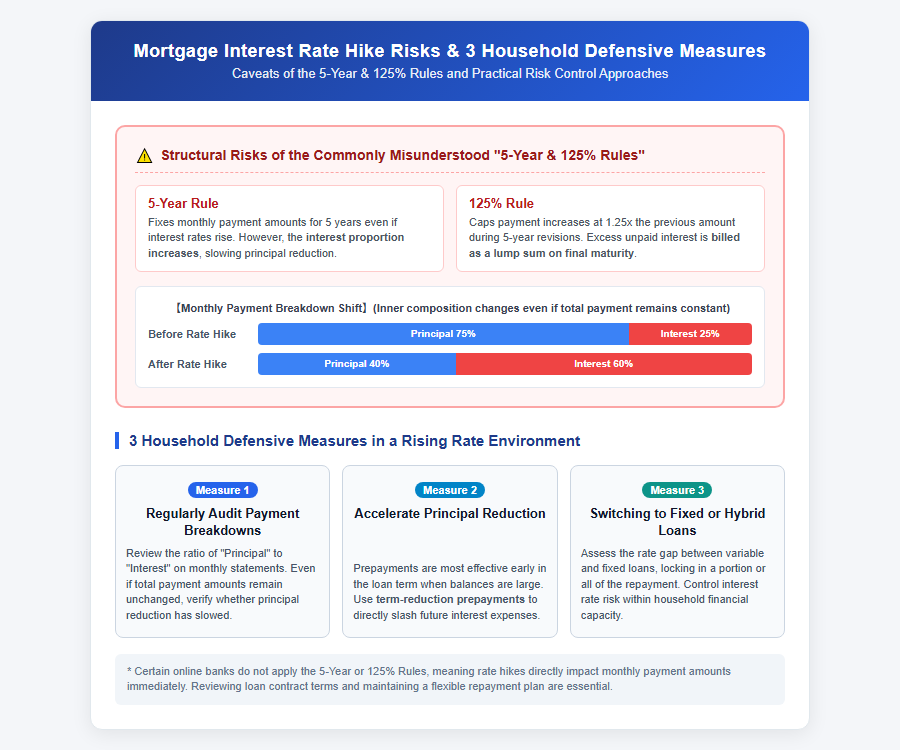
Many borrowers with variable-rate mortgages assume they are fully protected against rising rates by safety nets known as the 5-Year Rule and the 125% Rule. The 5-Year Rule keeps monthly repayment amounts fixed for five years even if interest rates rise, while the 125% Rule caps repayment increases at 1.25 times the previous amount during the 5-year recalculation. However, these mechanisms do not waive accrued interest; they merely defer payment.
When interest rates rise sharply, borrowers face serious underlying risks:
- Even if the monthly payment amount remains unchanged, the proportion allocated to interest increases substantially.
- Principal reduction slows dramatically, and in extreme cases, monthly interest exceeds the total payment amount, generating unpaid interest.
- Any unpaid interest that remains uncollected during the term is billed as a lump sum on the final loan maturity date.
Furthermore, several major online banks do not employ the 5-Year Rule or 125% Rule. For borrowers at these institutions, interest rate hikes translate directly into immediate increases in monthly payment obligations. It is essential for borrowers to regularly audit their monthly payment statements to track the breakdown between principal and interest.
Key Considerations for Prepayment and Switching Rate Types
As interest rate increases become fully entrenched, borrowers can adopt three practical defensive measures. First, audit monthly payment breakdowns. Reviewing bank statement details provides clear visibility into whether principal reduction is slowing down under rising interest costs.
Second, accelerate principal reduction through prepayments. Prepayments made early in the loan term—when principal balances are largest—yield the highest savings, directly slashing total future interest expenses. Utilizing term-reduction prepayments significantly enhances a household’s financial resilience against rate volatility.
Third, evaluate switching to fixed rates or utilizing hybrid loans. As the spread between variable and fixed rates narrows, locking in a portion of the interest rate risk provides a structured buffer against further rate hikes. The image below illustrates strategic risk management and repayment planning in a rising rate environment.
Furthermore, financial regulators like the Japan Financial Services Agency (FSA) are tightening oversight of 40-year and 50-year ultra-long-term mortgages to prevent over-extension. Establishing realistic repayment plans matched to household income capabilities remains indispensable.
Reference Pages
- [Revision of Base Mortgage Interest Rates – au Jibun Bank] https://www.jibunbank.co.jp/
【#MortgageRates #auJibunBank #VariableRates #BOJRateHike #RisingInterestRates #HomeOwnership #FinancialPlanning #EconomicNews】
コメント