On September 17, 2026, the Second Takaichi Reshuffled Cabinet officially took office, with Representative Tatsunori Ibayashi, a former technical official at the Ministry of Land, Infrastructure, Transport and Tourism (MLIT), appointed as the new Minister. This appointment marks a concerted effort to tackle pressing national challenges, including disaster response to increasingly severe natural hazards and rising construction material costs.
- Key Highlights of the Cabinet Reshuffle Formed on September 17, 2026
- Tatsunori Ibayashi’s Background as a Technical Official and Reasons for His Appointment
- Ensuring Safety and Public Peace of Mind through “Reiwa National Resilience”
- Economic Growth through Infrastructure and Restructuring Regional Public Transit
- Rapid Response to Escalating Disasters and Strengthening Urban Flood Defenses
- Mitigating Construction Material Costs and Unifying Departmental Culture
Key Highlights of the Cabinet Reshuffle Formed on September 17, 2026
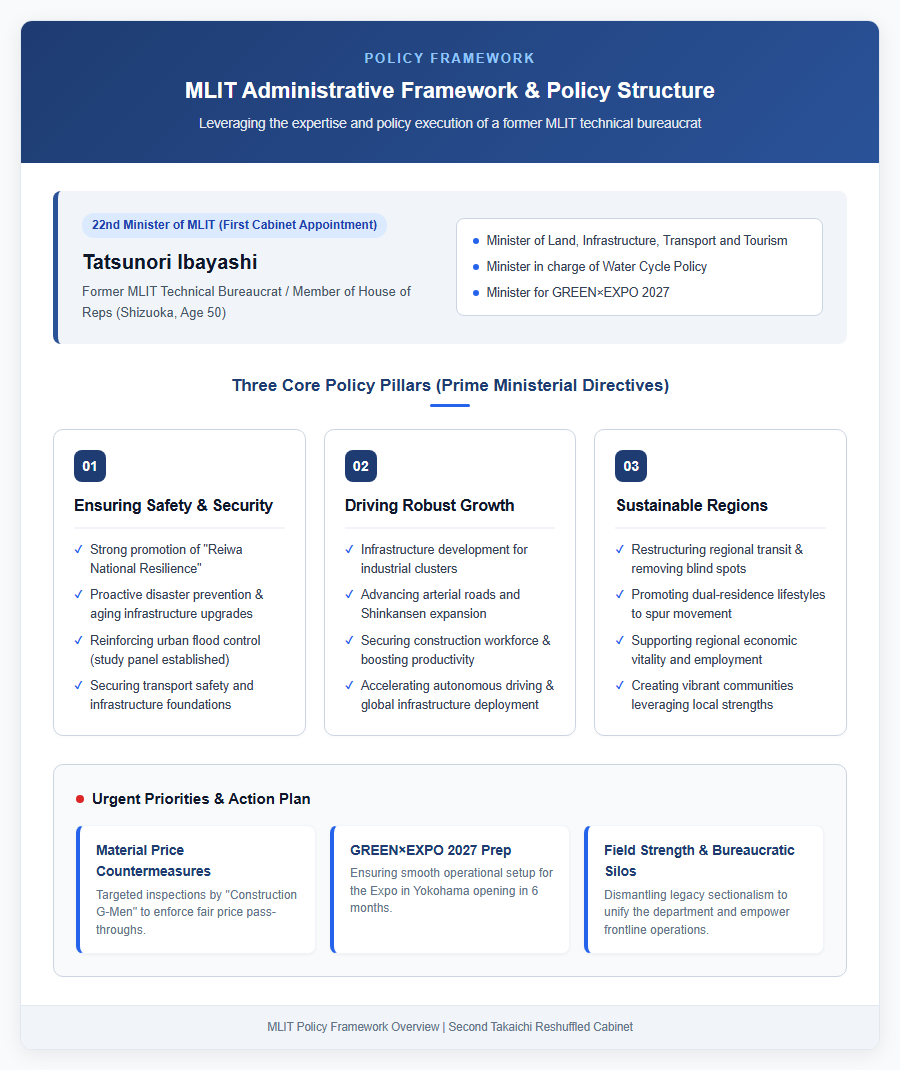
On September 17, 2026, the Second Takaichi Reshuffled Cabinet was officially launched. While maintaining the core framework of the administration, the reshuffle introduced seven first-time cabinet members, establishing a refreshed lineup to advance key government policies. Among these appointments, the leadership of the Ministry of Land, Infrastructure, Transport and Tourism (MLIT) attracted significant attention. Tatsunori Ibayashi, a member of the House of Representatives from the Liberal Democratic Party (LDP) belonging to the Aso faction, was appointed as the 22nd Minister of MLIT, succeeding former Minister Yasuyuki Kaneko. Born on July 18, 1976, the 50-year-old lawmaker represents Shizuoka Prefecture. Alongside his role as MLIT Minister, Ibayashi concurrently serves as Minister in charge of Water Cycle Policy and Minister for the 2027 International Horticultural Expo. MLIT oversees a wide range of responsibilities vital to protecting public life and property, maintaining infrastructure and transportation networks, and invigorating regional economies. With a new minister at the helm, the ministry is expected to drive administrative efforts to address immediate societal challenges and build sustainable infrastructure.
The diagram below provides an overview of the key policy framework under the Second Takaichi Reshuffled Cabinet.
Tatsunori Ibayashi’s Background as a Technical Official and Reasons for His Appointment
Tatsunori Ibayashi completed his graduate studies at the Kyoto University Graduate School of Engineering in March 2002 and joined the Ministry of Land, Infrastructure, Transport and Tourism in April of the same year. During his career as a bureaucrat, he served in various technical and managerial roles, including the Minister’s Secretariat Technical Investigation Division, Head of the Second Investigation Section at the Numazu River and National Highway Office, and Head of the Regional Road Division at the Chubu Regional Development Bureau. Through these positions, he gained extensive hands-on experience in infrastructure development, river administration, and road governance. After leaving the ministry in June 2010 to pursue a political career, he won his first seat in the House of Representatives in the December 2012 general election through an LDP open recruitment process. In Parliament, Ibayashi built a strong track record in policy and finance, serving as Parliamentary Vice-Minister for the Environment and Cabinet Office, Vice-Minister of the Cabinet Office (for Economic, Fiscal, and Financial Policy) under the Second Kishida Second Reshuffled Cabinet, Chairman of the House Committee on Financial Affairs, and Manager of the LDP Tax System Research Commission. His appointment reflects high expectations for his dual expertise: a deep technical understanding of infrastructure operations and the political acumen needed for legislative strategy and policy execution.
Three Main Policy Pillars and Prime Ministerial Directives for Minister Ibayashi
Ensuring Safety and Public Peace of Mind through “Reiwa National Resilience”
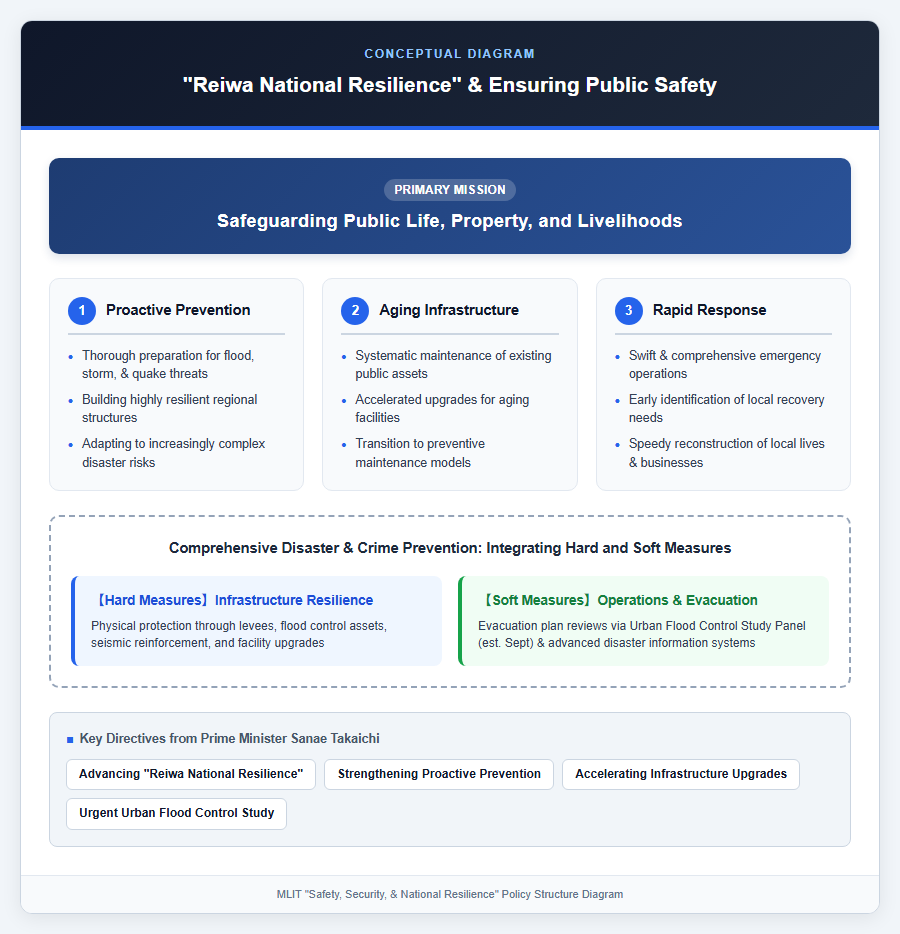
Upon taking office, Minister Ibayashi outlined three core pillars for transport and infrastructure administration: “Ensuring Safety and Peace of Mind for the Public,” “Achieving Robust Economic Growth,” and “Building Sustainable and Vibrant Regions by Capitalizing on Local Strengths.” In his inaugural press conference, Ibayashi reaffirmed his long-held belief since his days as a young bureaucrat that MLIT plays a crucial role in safeguarding public lives and livelihoods while supporting regional economies. Prime Minister Sanae Takaichi directly tasked Ibayashi with advancing “Reiwa National Resilience,” strengthening proactive disaster prevention, and accelerating measures against aging infrastructure. Specifically, MLIT aims to move beyond routine maintenance by systematically upgrading infrastructure and forging disaster-resilient regional structures to withstand unforeseen catastrophic events. Furthermore, by reinforcing defenses against increasingly severe floods and large-scale earthquakes through a dual approach combining structural engineering and community preparedness, the ministry seeks to fundamentally elevate regional safety across Japan.
The figure below illustrates the core concept of National Resilience and public safety measures.
Economic Growth through Infrastructure and Restructuring Regional Public Transit
Regarding economic growth and regional development, the ministry’s priorities align closely with Prime Minister Takaichi’s growth strategy. The Prime Minister instructed Ibayashi to focus on the concentrated development of arterial roads and Shinkansen bullet train lines needed for industrial cluster plans under the Regional Future Strategy, the overseas deployment of Japanese infrastructure systems, and the restructuring of regional public transit, including the promotion of autonomous driving technology. In rural areas facing demographic decline and depopulation, the shrinking of public transit networks such as buses and railways has led to severe “transportation voids.” To address this, Minister Ibayashi pledged to eliminate transit blind spots and promote dual-residence lifestyles to spur population movement, local vibrancy, and employment in regional communities. Furthermore, to overcome acute labor shortages in the construction sector, the ministry plans to harness ICT technology and improve working conditions to boost productivity, positioning technological innovation like automated driving as a central engine for future policy execution.
Addressing Immediate Industry Challenges and the Future Focus of MLIT Administration
Rapid Response to Escalating Disasters and Strengthening Urban Flood Defenses
As an immediate priority, Minister Ibayashi stressed the need for a swift and comprehensive response to increasingly frequent and diverse natural disasters. During his press conference, he cited recent disasters such as the 2026 Kumamoto Earthquake and the August 2026 torrential rains in Chiba, emphasizing the qualitative shifts and growing complexity of modern natural hazards. He expressed particular concern regarding urban flooding, describing it as an ever-present threat that can occur “anytime and anywhere.” To address this, MLIT established a dedicated study group in September 2026 to expedite both structural (hard) infrastructure upgrades and non-structural (soft) emergency evacuation strategies. Additionally, with only six months remaining until the GREEN×EXPO 2027 (International Horticultural Exhibition in Yokohama), Ibayashi designated the event as a top-priority national project vital to public life and regional vitality, pledging full governmental support for its successful operation. Moving forward, MLIT aims to accelerate water cycle management and sustainable urban development through close collaboration with local governments and private enterprises.
Mitigating Construction Material Costs and Unifying Departmental Culture
Another major challenge confronting infrastructure administration is the steep rise in construction material prices, exacerbated by instability in the Middle East. Acknowledging that rising material costs are squeezing the management of construction firms, Minister Ibayashi announced targeted investigations by “Construction G-Men” inspectors to ensure fair price pass-throughs across supply chains. He emphasized a commitment to listening closely to industry feedback to create an environment where small and medium-sized enterprises (SMEs) can operate with confidence. In his inaugural address to ministry staff, Ibayashi encouraged employees to “enhance the inherent strengths of field operations,” promising that he would act as a “shield” by taking full political responsibility for bold policy decisions. Touching upon his own background of entering the ministry in 2002 shortly after the central government reorganization, Ibayashi instructed staff to refrain from using legacy terms like “former Ministry of Transport” or “former Ministry of Construction” within the Minister’s office, stressing the importance of breaking down departmental silos to achieve true organizational unity.
References
- 【Financial Services Agency: Monitoring Report on Securities Investments by Regional Banks】https://www.fsa.go.jp/news/r5/ginkou/20230908-02/20230908-02.html
【#SecondTakaichiReshuffledCabinet #MLIT #TatsunoriIbayashi #NationalResilience #DisasterPrevention #ConstructionIndustry #InfrastructureDevelopment #Politics】

コメント