In September 2026, the Bank of Japan decided to raise its policy interest rate to around 1.25%, a move endorsed by Keizai Doyukai (Japan Association of Corporate Executives) as an appropriate step toward economic normalization. This rate hike aims to counter historic yen weakness and upside inflation risks, driving a structural shift in the Japanese economy away from low-rate dependency toward a “world with interest rates.”
- The Bank of Japan’s Additional Rate Hike to 1.25%—The Highest Level in 31 Years
- The True Intent Behind Keizai Doyukai and Chairman Niinami’s Support for Rate Hikes
- SME Debt Burdens and the Weeding Out of Zombie Companies
- Positive Views Among Large Enterprises and Expectations for Economic Normalization
- Three Key Actions for Value Creation and Productivity Growth
- Future Outlook and Key Factors Shaping the Terminal Rate
The Bank of Japan’s Additional Rate Hike to 1.25%—The Highest Level in 31 Years
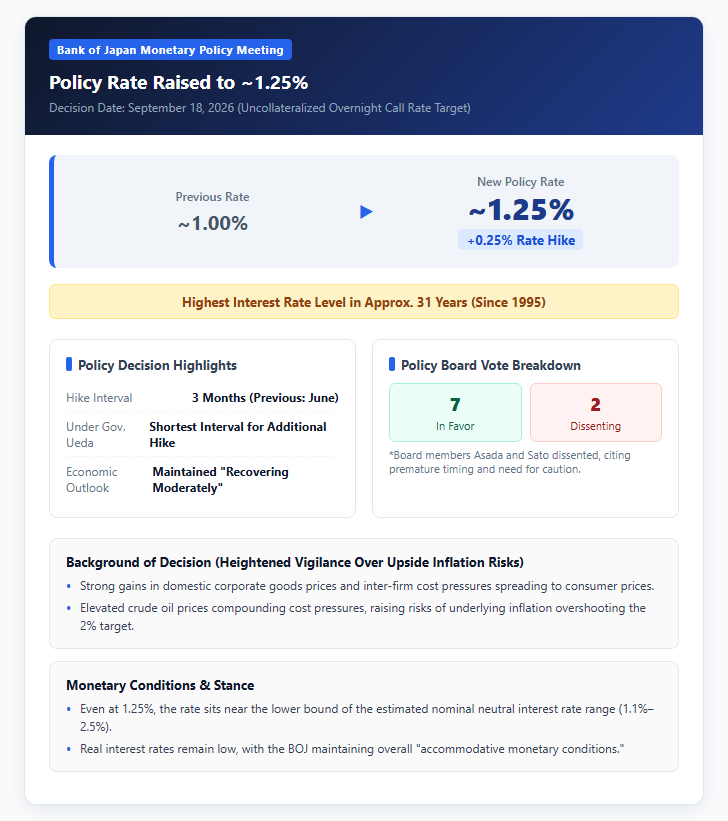
At its Monetary Policy Meeting held on September 17–18, 2026, the Bank of Japan (BOJ) decided to raise its policy target for the uncollateralized overnight call rate by 0.25 percentage points, bringing it from around 1.00% to approximately 1.25%. This rate hike marks the first in three months since the June 2026 meeting and pushes the policy rate to its highest level in roughly 31 years, dating back to 1995. The decision passed by a 7–2 majority vote, with board members Asada and Sato dissenting out of caution. Although the BOJ maintained its overall economic assessment that the economy “is recovering moderately,” growing vigilance over upside inflation risks—driven by strong gains in domestic corporate goods prices, the spreading pass-through of cost increases, and elevated crude oil prices pushing underlying inflation above 2%—served as the primary catalyst for the hike. Even at 1.25%, real interest rates remain low and lie near the lower bound of the estimated nominal neutral interest rate range, reflecting the central bank’s strategy to adjust monetary accommodation early while preserving favorable financial conditions. Please refer to the following figure.
The True Intent Behind Keizai Doyukai and Chairman Niinami’s Support for Rate Hikes
Takeshi Niinami, Chairman of Keizai Doyukai, expressed strong support from the business community for the BOJ’s series of policy revisions and rate hike stance, describing them as highly appropriate. Keizai Doyukai previously commended the BOJ’s March 2024 exit from negative interest rates and the termination of yield curve control (YCC) as vital milestones toward normalizing financial markets. Chairman Niinami characterized the yen’s historic drop past 161 yen per dollar not merely as “yen weakness” but as “hyper-weakness,” firmly identifying it as a harmful side effect of prolonged ultra-loose monetary policy. Viewing a fair exchange rate as roughly 130 to 140 yen per dollar, he consistently urged the government and the central bank to signal an early push for rate hikes to rectify excessive yen depreciation, which inflates import costs and squeezes living standards. For both corporate governance and household planning, he emphasizes that shedding the traditional deflationary mindset reliant on ultra-low rates and preparing for a “world with interest rates” is essential for sustainable growth in the Japanese economy.
How a “World with Interest Rates” Impacts Corporate Management
SME Debt Burdens and the Weeding Out of Zombie Companies
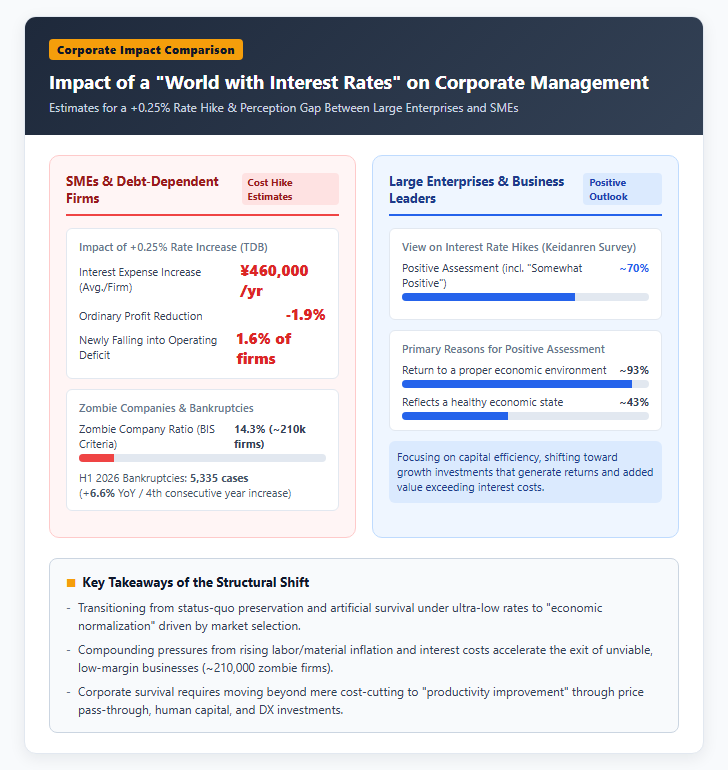
Higher policy rates represent a major cost shock for small and medium-sized enterprises (SMEs) and heavily indebted companies reliant on bank borrowings. According to a September 2026 study published by Teikoku Databank, a 0.25-percentage-point rise in corporate borrowing rates increases interest expenses for the average SME by approximately 460,000 yen annually, reducing ordinary profit by an average of 1.9%. Consequently, an estimated 1.6% of firms could fall into operating deficits. Furthermore, “zombie companies”—defined under Bank for International Settlements (BIS) criteria as firms operating for 10 years or longer with an interest coverage ratio (ICR) below 1 for three consecutive years—numbered roughly 210,000 in fiscal 2024, accounting for 14.3% of all businesses in Japan. Corporate bankruptcies reached 5,335 cases in the first half of 2026, up 6.6% year-on-year and marking the fourth consecutive annual increase. While zero-rate environments allowed marginal businesses to survive through continuous bank loan rollovers, compounding pressures from wage hikes, raw material inflation, and rising interest charges are forcing a market selection phase where unviable firms must exit. Please refer to the following figure.
Positive Views Among Large Enterprises and Expectations for Economic Normalization
While SMEs express growing alarm over heavier repayment obligations, major corporations and business leaders overwhelmingly view the return of interest rates as a positive development. In a December 2024 survey conducted by Keidanren (Japan Business Federation), roughly 70% of member companies responded that a “world with interest rates” is positive or somewhat positive. Among the main reasons cited, approximately 93% of respondents pointed to a “return to a proper economic environment,” while about 43% associated it with “a healthy economic state.” During decades of zero-interest deflation, the “time value of money” effectively vanished, prompting firms to suppress risky capital investments and business transformations in favor of maintaining the status quo. Reintroducing interest rates forces companies to rigorously evaluate their capital efficiency—specifically whether their core business generates returns exceeding borrowing costs. Major enterprise executives interpret this as a signal of economic health, taking it as an opportunity to accelerate growth investment focused on capital efficiency and portfolio restructuring.
Corporate Strategies and Outlook for Thriving in the Post-Deflation Era
Three Key Actions for Value Creation and Productivity Growth
Higher interest rates do not automatically translate into declining performance; with appropriate management adjustments, they present genuine opportunities for expansion. According to analysis in the 2025 White Paper on Small and Medium Enterprises, even if the policy interest rate rises to 1.5%, SMEs that successfully pass through costs and improve productivity will generate sales and margin gains that outweigh higher interest expenses, lifting aggregate SME ordinary profits by approximately 28% over four years. To achieve this, experts outline three key management actions. First is “Price Pass-Through”—moving away from cost-plus pricing to establish value-based pricing that reflects product quality. Second is “Productivity Improvement”—combining human capital investments in wage increases and workforce development with digital transformation (DX) investments for automation, targeting macroeconomic productivity gains above 1% and value creation exceeding 3%. Third is “Financial Strengthening”—raising the proportion of fixed-rate debt and diversifying funding sources to buffer against interest rate volatility.
Future Outlook and Key Factors Shaping the Terminal Rate
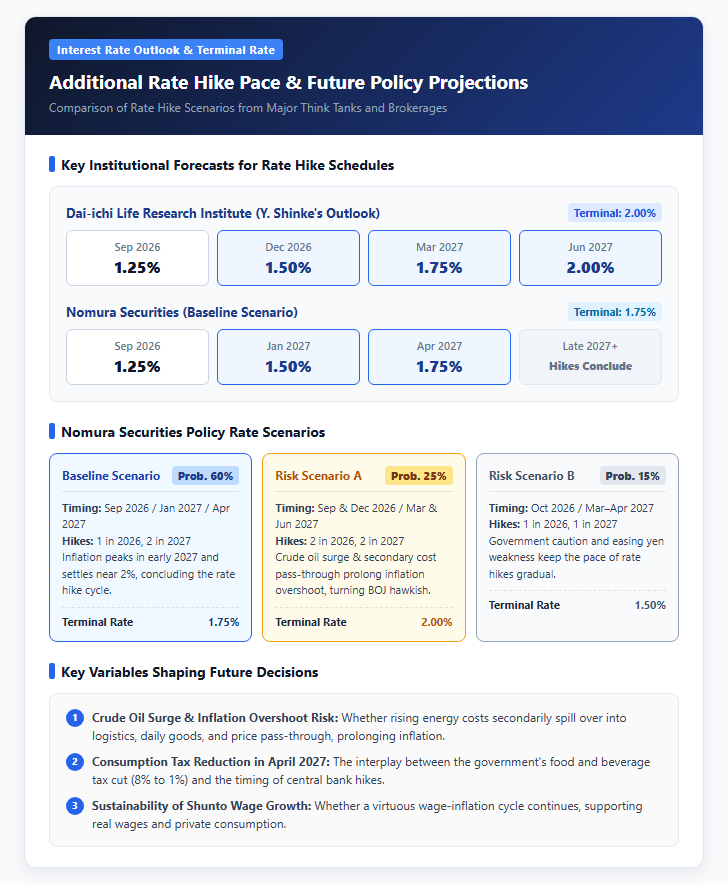
The central question facing markets is the pace of subsequent BOJ rate hikes and the eventual terminal rate level. The Dai-ichi Life Research Institute projects a phased tightening path, forecasting rate hikes to 1.50% in December 2026, 1.75% in March 2027, and 2.00% in June 2027. This path reflects expectations that secondary cost pressures from elevated oil prices and yen weakness, combined with aggressive corporate price-setting, will keep upside inflation risks active over an extended period. Meanwhile, Nomura Securities’ baseline scenario anticipates rate hikes to 1.50% in January 2027 and 1.75% in April 2027 following the September 2026 move. However, with major policy shifts scheduled—including a temporary consumption tax reduction on food and beverages slated for April 2027—the government’s policy stance and the momentum of wage growth in upcoming Shunto (spring labor negotiations) will serve as critical determinants of the BOJ’s timing. Please refer to the following figure.
Reference Pages
- 【Keizai Doyukai (Japan Association of Corporate Executives)】https://www.doyukai.or.jp/
- 【Keizai Doyukai Policy Proposals】https://www.doyukai.or.jp/policyproposals
【#KeizaiDoyukai #BankOfJapan #PolicyRate #RateHike #WorldWithInterestRates #SMEs #PostDeflation #JapaneseEconomy】


コメント