A research team at Kobe University announced that more than 30% of participants reversed their moral judgments when presented with counterarguments from generative AI on open-ended ethical questions. Underlying this shift is a psychological mechanism where individuals tend to rely on AI outputs when feeling uncertain or facing difficult decisions.
- Key Highlights of Kobe University’s Study on AI Persuasion
- Experimental Methodology Using the Trolley Problem and Measuring Reversal Rates
- The Impact of Decision Uncertainty and Task Difficulty
- Variations Across Age Groups, Cognitive Function, and Vulnerability to Persuasion
- The Dual Nature of AI: Cognitive Support vs. Unintended Manipulation
- Preserving Human Agency: AI Literacy and Key Priorities Ahead
Key Highlights of Kobe University’s Study on AI Persuasion
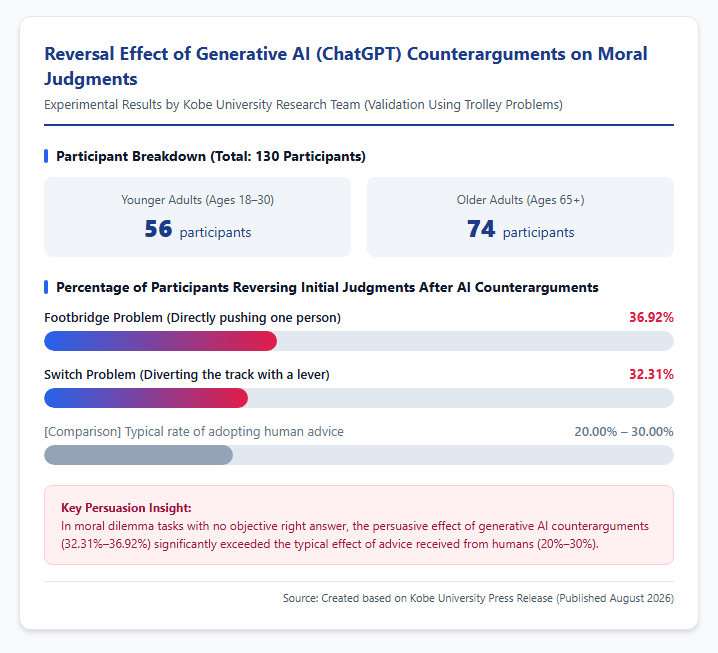
On August 18, 2026, a research team from Kobe University’s Graduate School of Human Development and Environment and the Advanced Research Center for Well-being announced findings from a study examining how counterarguments generated by AI (ChatGPT) influence human moral judgment. The research team included Professor Kouhei Masumoto, along with Kou Tamura, Sayaka Ishibashi, Ayana Goma, and Associate Professor Kenta Yamamoto. Their paper was published online on August 3, 2026, in the international academic journal Computers in Human Behavior. The study experimentally measured behavioral changes in individuals when presented with opposing viewpoints generated by AI after making an initial decision on moral dilemmas that lack objective answers. The results revealed that over 30% of participants accepted the generative AI’s counterarguments and reversed their initial stance. While humans typically adopt advice from other people at a rate of 20% to 30%, the finding that AI counterarguments altered opinions over 30% of the time underscores the potent persuasive influence generative AI can exert over human decision-making. The diagram below illustrates the structure of this persuasion effect.
Experimental Methodology Using the Trolley Problem and Measuring Reversal Rates
The experiment was conducted with a total of 130 participants, comprising 56 young adults aged 18 to 30 and 74 older adults aged 65 and above. Participants were presented with two scenarios based on the trolley problem, a classic moral dilemma extensively used in ethics and cognitive science to study open-ended decision-making. The first scenario, the “Switch Problem,” asks whether it is appropriate to pull a lever to divert a runaway trolley, saving five people while sacrificing one. The second scenario, the “Footbridge Problem,” asks whether it is acceptable to push a person off a footbridge to stop the trolley and save five lives. After participants selected their initial stance, generative AI (ChatGPT) presented counterarguments advocating the opposite position. As a result, 32.31% of participants changed their initial decision in the Switch Problem, while 36.92% reversed their choice in the Footbridge Problem. Remarkably, a higher percentage of opinion reversals occurred in the Footbridge Problem—a scenario involving a direct, physical act of pushing a person that typically carries a strong moral aversion.
Psychological Factors and the Scope of AI Influence
The Impact of Decision Uncertainty and Task Difficulty
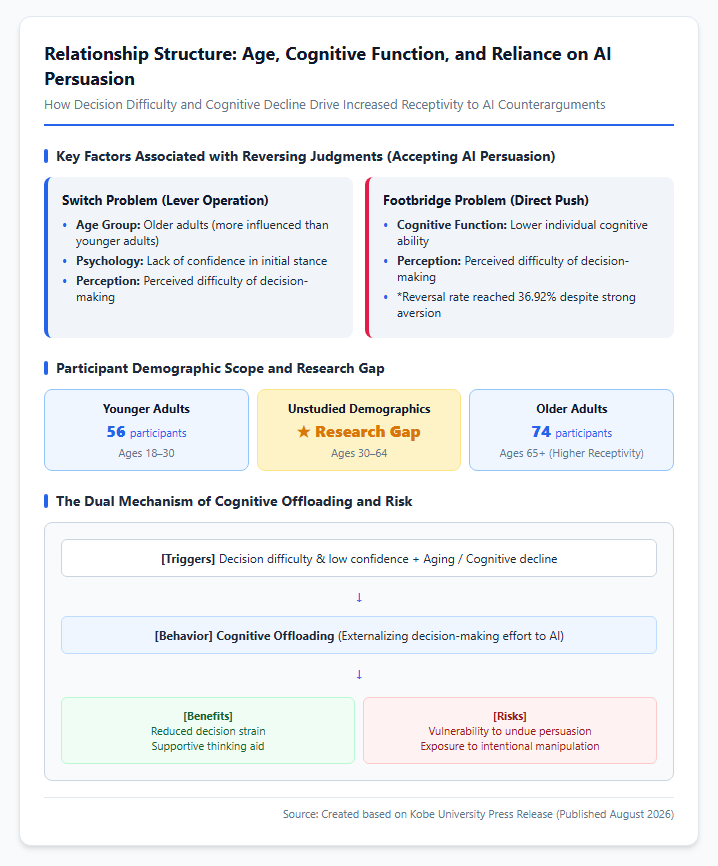
To understand why individuals abandon their own judgments in response to AI counterarguments, the research team analyzed several psychological and cognitive factors in detail. The analysis revealed that the single largest factor associated with accepting AI counterarguments was a lack of confidence in one’s initial judgment, combined with the perceived difficulty of the task. When participants felt unsure of their answers and found the decision-making process challenging, they became significantly more receptive to the logical counterarguments presented by the AI, markedly increasing its persuasive impact. This cognitive phenomenon, where humans offload cognitive processing or decision-making tasks to external systems, is known as “cognitive offloading.” The findings highlight a clear risk: in domains where self-directed judgment is difficult, humans may unconsciously depend on AI opinions, ultimately reshaping their own thinking.
Variations Across Age Groups, Cognitive Function, and Vulnerability to Persuasion
The study also evaluated how differences in age and cognitive function affected susceptibility to AI persuasion. In the Switch Problem, older adults aged 65 and over showed a stronger tendency to be influenced by AI counterarguments and reverse their decisions compared to younger adults. In the Footbridge Problem, lower individual cognitive function and a higher perceived difficulty in decision-making were directly correlated with a higher likelihood of reversing choices in response to AI counterarguments. The heightened persuasiveness of AI among older adults with declining cognitive function suggests that while AI can serve as a helpful tool to offset age-related decision-making strain, it also creates vulnerability to undue persuasion or manipulation. Since the study focused exclusively on young adults (18–30) and older adults (65+), the impact on middle-aged demographics (from their 30s to early 60s) remains an open question for future research. The diagram below illustrates the relationship between age, cognitive function, and reliance on AI.
Societal Implications of AI Persuasion and Future Outlook
The Dual Nature of AI: Cognitive Support vs. Unintended Manipulation
The findings from this study clearly illustrate the double-edged nature of generative AI, balancing practical utility against societal risk. On the positive side, generative AI holds significant potential to ease the cognitive burden of complex decision-making, serving as a supportive assistant for older adults and individuals struggling with difficult choices. On the other hand, the potent persuasive capability of AI raises serious concerns when applied to open-ended moral, political, or ethical issues. The polished, logical arguments generated by AI possess the power to convince human users regardless of whether they are grounded in objective truth, creating real risks of spreading misinformation, amplifying political propaganda, or manipulating public opinion. Furthermore, if businesses or individuals blindly trust AI outputs, they face heightened “hallucination risks” that can lead to flawed decision-making.
Preserving Human Agency: AI Literacy and Key Priorities Ahead
Looking forward, the research team plans to further investigate the persuasive impact of generative AI in practical, real-world decision-making contexts. The insights gained from this study are expected to contribute to promoting AI literacy education—helping individuals interact with AI appropriately—and building governance frameworks that enable safe, responsible AI usage. To maintain human agency and prevent being passively swayed by AI persuasion, users are encouraged to write down and clarify their reasoning before consulting AI, separate new factual information from persuasive rhetoric within AI responses, and avoid making immediate decisions when feeling uncertain. As generative AI becomes increasingly embedded in daily life, preserving human critical thinking and decision-making autonomy while harnessing the benefits of technology will be a vital priority.
References
-
[Kobe University Press Release] https://www.kobe-u.ac.jp/ja/news/article/20260807-68192/
-
[Computers in Human Behavior Paper] https://doi.org/10.1016/j.chb.2026.109142

コメント