A new study by the U.S. Government Accountability Office (GAO) reveals that unpaid household work—including cooking, cleaning, and caregiving—reached an estimated economic value of up to \$6 trillion (approximately ¥960 trillion) in 2024. By quantifying this massive volume of labor excluded from official Gross Domestic Product (GDP) metrics, the investigation aims to inform key policy decisions on issues ranging from caregiver support to retirement security.
- $6 Trillion in Annual Economic Value and the $70 Daily Estimate
- Breakdown of Domestic Tasks vs. Caregiving: What 20% of GDP Means
- Daily Realities: 87% of Americans Spend Nearly 4 Hours on Unpaid Labor
- Gender Imbalances and Differences in Childcare vs. Adult Caregiving
- Supplementing GDP and Cushioning Economic Shocks
- Safeguarding Caregivers’ Retirement Security and Future Policy Avenues
$6 Trillion in Annual Economic Value and the $70 Daily Estimate
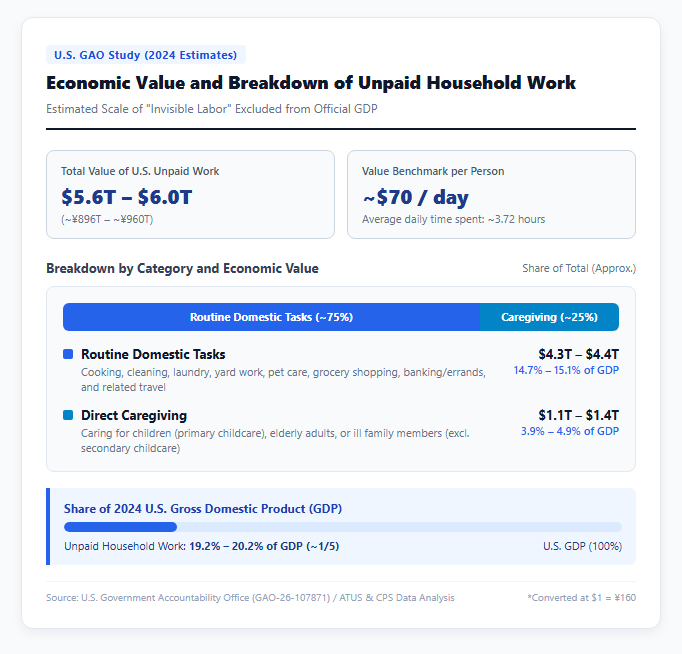
The U.S. Government Accountability Office (GAO), a nonpartisan congressional agency, has published a comprehensive report examining the unpaid household labor performed daily by Americans. The study defines unpaid household work as tasks performed by family members that could otherwise be hired out to others for pay. Analyzing data from the American Time Use Survey (ATUS) spanning 2021 to 2024 alongside the 2024 Current Population Survey (CPS), the GAO estimated the national market value of unpaid household work in 2024 to be between \$5.6 trillion and \$6.0 trillion (roughly ¥896 trillion to ¥960 trillion). This translates to an estimated average value of about \$70 per day per person engaged in this work. Because these activities involve no monetary transactions, they have traditionally been excluded from economic accounting. However, when benchmarked against Gross Domestic Product (GDP)—the standard indicator of national economic output—this unpaid labor represents between 19.2 percent and 20.2 percent of U.S. GDP in 2024, or roughly one-fifth of the nation’s entire economic capacity. Please refer to the figure below.
This staggering valuation clearly illustrates how invisible labor serves as a bedrock supporting the entire economic foundation of the country.
Breakdown of Domestic Tasks vs. Caregiving: What 20% of GDP Means
The vast majority of the total value estimated by the GAO stems from routine domestic tasks. Specifically, this category encompasses daily cooking, cleaning, laundry, yard work, and pet care, as well as grocery shopping, banking, contacting service contractors, and associated travel. The market value generated by these domestic tasks was calculated at \$4.3 trillion to \$4.4 trillion in 2024 (equivalent to 14.7 percent to 15.1 percent of 2024 GDP). Meanwhile, unpaid caregiving—primarily caring for children, elderly relatives, or ill family members—was valued at \$1.1 trillion to \$1.4 trillion, accounting for 3.9 percent to 4.9 percent of GDP. Importantly, these estimates exclude secondary child care, defined as supervising children while engaged in other activities; incorporating secondary child care would push the estimated value of caregiving and overall unpaid labor even higher. The reality that activities equivalent to 20 percent of GDP take place entirely outside market transactions underscores the fundamental limitations of relying solely on traditional market statistics to measure overall economic output.
Structural Disparities in Time Use and Gender
Daily Realities: 87% of Americans Spend Nearly 4 Hours on Unpaid Labor
According to the GAO’s analysis of ATUS data, an overwhelming majority of American adults—87.3 percent—engage in some form of unpaid household work on a typical day. Among those who perform these tasks, the average time spent reaches approximately 3.72 hours (nearly 4 hours) per day, representing a major allocation of personal time resources. For most people, chores such as cooking, cleaning, and shopping are not occasional obligations but essential daily routines necessary to sustain household functioning. Yet, because no wages are exchanged in the market, this substantial investment of time has long lacked formal economic measurement and social visibility. By assigning a concrete monetary value of roughly \$70 per person per day, the GAO highlights the sheer magnitude of labor provided within the home. When accumulated across millions of households, a few hours of daily domestic labor aggregate into an economic force matching the output of a major national industry.
Gender Imbalances and Differences in Childcare vs. Adult Caregiving
The GAO’s data analysis confirms a pronounced gender disparity among those bearing the burden of unpaid household labor. While women make up approximately 51.2 percent of the total U.S. population, they account for 53.9 percent of all individuals performing unpaid household work, indicating an overrepresentation beyond demographic baselines. This gender gap is especially pronounced in primary child care, where women and married individuals spend significantly more time assisting children compared to men and unmarried individuals. Please refer to the figure below.
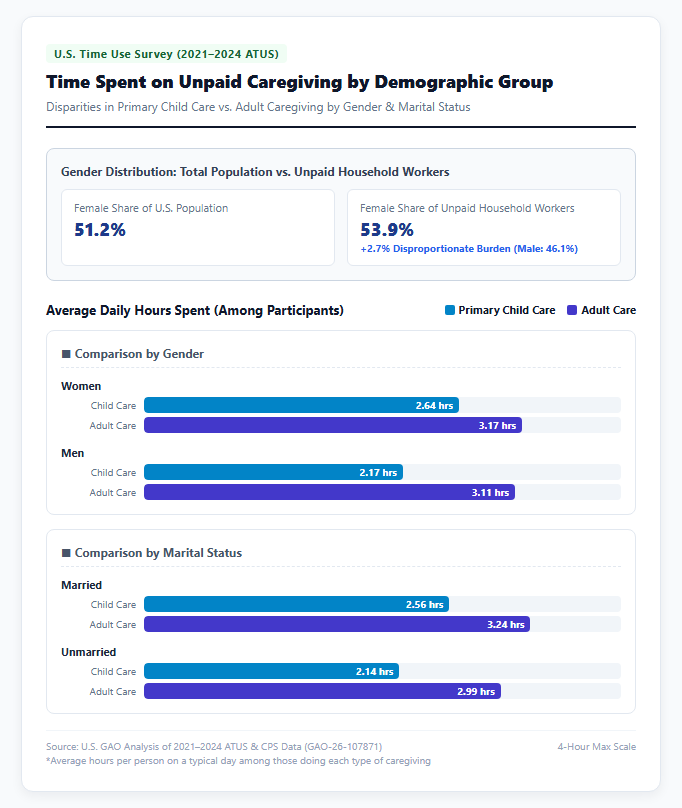
In contrast, when it comes to adult caregiving—such as caring for elderly parents or sick relatives—time spent is virtually identical between men and women, as well as between married and unmarried individuals. Nevertheless, the ongoing concentration of overall domestic and childcare burdens on women continues to hamper female labor force participation, career advancement, and long-term earning potential.
Implications for Macroeconomic Metrics and Policy Formation
Supplementing GDP and Cushioning Economic Shocks
Economists and policy experts emphasize that supplementing official GDP statistics with the monetary value of unpaid household work provides a far more accurate picture of a nation’s total economic activity and overall well-being. For example, research demonstrates that during the COVID-19 pandemic recession, the drop in national economic output appeared significantly smaller when unpaid household work was factored in alongside market-based GDP. During economic downturns or societal crises, household production often expands as families substitute market services with self-provided domestic work and informal care, effectively serving as a vital macroeconomic cushion. The GAO report underscores the imperative of integrating satellite accounts and alternative valuation models to capture the true breadth of economic activity beyond traditional market boundaries.
Safeguarding Caregivers’ Retirement Security and Future Policy Avenues
Quantifying unpaid household work is far more than an academic exercise; it provides essential empirical evidence to guide policies aimed at protecting caregivers. Individuals who devote substantial time to domestic caregiving frequently reduce paid work hours or exit the workforce entirely, exposing them to long-term financial risks such as reduced Social Security benefits and retirement insecurity. Economists advocate for integrating unpaid labor metrics into social safety net design—such as introducing caregiver retirement credits and expanding public care infrastructure—to ensure financial stability in old age. Rather than treating an estimated \$6 trillion in unpaid labor as a private family obligation, reframing caregiving as critical public infrastructure with appropriate policy backing is essential for building a sustainable economy.
Reference Pages
- 【Unpaid Household Work: Estimated Value and Time Spent on Domestic Tasks and Caregiving | U.S. GAO】https://www.gao.gov/products/gao-26-107871
【#USFinance #UnpaidLabor #HouseholdWork #GAOReport #GDP #Caregiving #GenderGap】
コメント