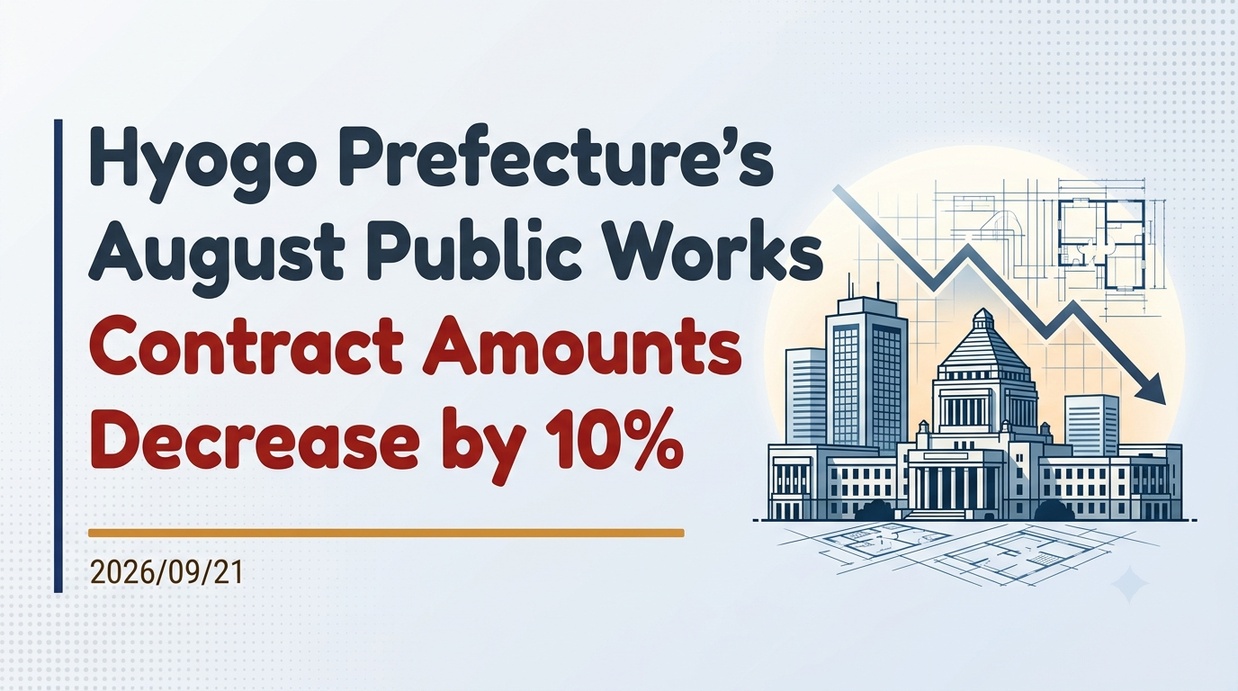
In August 2026, the total contract value for public works in Hyogo Prefecture fell 10% year-on-year to 23.792 billion yen, dropping below previous-year levels for the first time in two months. This decline is driven by rising material costs, severe labor shortages, and the prefectural government’s policy to cut public investment as part of its fiscal consolidation efforts.
- Contract Values Drop 10% in August 2026
- Fiscal Strain and Transition to Bond-Issuance Approval Status
- Capital Expenditure Cuts and Municipal Budget Pressure
- Mismatch Between Soaring Material Prices and Rising Costs
- Overtime Work Caps and Worsening Labor Shortages
- Transforming Public Facilities Through Hyogo Infrastructure DX
- Strengthening Public-Private Dialogue and Key Trends to Watch
Contract Values Drop 10% in August 2026
According to data released by the Hyogo Branch of the West Japan Construction Guarantee Co., Ltd., public works activity in Hyogo Prefecture during August 2026 saw total contract values decline by 10% year-on-year to 23.792 billion yen. The total number of contracted projects also decreased by 12.5% compared to the same month last year, marking a simultaneous downturn in both monetary value and volume for the first time in two months.
Underlying this downward trend is a combination of local municipalities holding back or rescheduling project orders, alongside widespread delays in starting construction on-site. While parts of the broader Kinki region are experiencing growth driven by semiconductor-related capital investments, public investment within Hyogo Prefecture remains visibly stagnant. According to Teikoku Databank’s Monthly Business Conditions Survey for August 2026, the Business Conditions Index (DI) for Hyogo’s construction sector fell by 0.8 points from the previous month to 38.5, deteriorating for the second consecutive month. Local contractors have voiced growing concern over shrinking project volume and fear the negative ripple effects that reduced bidding opportunities could have on the regional economy. Because public works serve as a primary revenue stream for regional firms, a 10% reduction in contract value directly threatens their financial stability.
Fiscal Strain and Transition to Bond-Issuance Approval Status
A major direct factor behind the reduction in public works orders is the severe fiscal strain facing Hyogo Prefecture. In its fiscal 2025 financial settlement, the prefecture’s real debt service ratio—which measures the burden of debt repayments relative to standard revenue—exceeded the national threshold of 18%. As a result, Hyogo is expected to transition into a designated “bond-issuance approval prefecture.” Once a local government surpasses the 18% mark, it can no longer issue new prefectural bonds without explicit central government approval, severely restricting its discretionary fiscal spending.
Furthermore, projections for the fiscal 2026 initial budget indicate a substantial revenue shortfall, with the total deficit estimated at approximately 53 billion yen over the three-year period from fiscal 2026 to 2028. Compounding these budget pressures is a broader rise in long-term interest rates, as the yield on 10-year Japanese Government Bonds recently surged past 3%, increasing the prefecture’s future debt-servicing costs. At a press conference in September 2026, Governor Motohiko Saito stressed his commitment to balancing fiscal consolidation with future-oriented investments, while clearly signaling a plan to overhaul administrative operations. The prefectural government has already accelerated a 10% reduction in administrative overhead and reduced official travel expenses, demonstrating how tightening public finances lead directly to cutbacks in public works procurement.
Capital Expenditure Cuts and Municipal Budget Pressure
A central pillar of Hyogo Prefecture’s fiscal consolidation plan is a fundamental reduction in capital expenditure, particularly regarding public works projects. The prefecture has established a guideline to cut its capital expenditure budget by more than 10% compared to previous allocation levels. Fiscal authorities consider this an indispensable measure to control prefectural bond debt accumulated during past reconstruction efforts following the Great Hanshin-Awaji Earthquake and years of high-level public investment, thereby stabilizing debt service costs over the long term.
This overarching policy has sent shockwaves through local municipalities and the broader construction sector across Hyogo. Municipalities that rely heavily on prefectural subsidies and commissioned projects are being forced to revise their maintenance and replacement schedules for roads, bridges, and public facilities. As illustrated in the diagram below, municipal budget constraints and reduced construction procurement are closely linked.
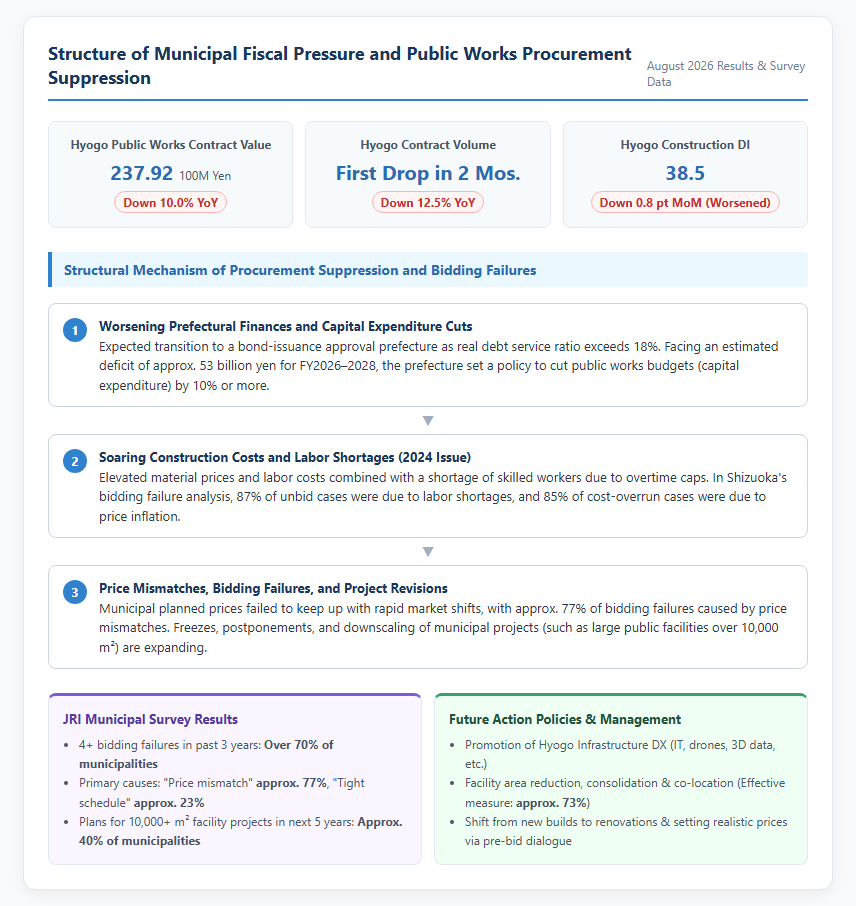
Many local governments face impending decisions regarding the replacement or large-scale renovation of major public facilities exceeding 10,000 square meters. However, faced with soaring construction costs and the prefecture’s austerity policy, local authorities have little choice but to freeze projects, downscale developments, or postpone construction timelines. This deferral of critical infrastructure maintenance has sparked intense debate over potential risks to public safety and disaster preparedness.
Structural Pressures and Bidding Failures Crippling Contractors
Mismatch Between Soaring Material Prices and Rising Costs
The drop in public works contract values and project volume stems not only from government budgetary constraints but also from the harsh operating environment confronting the construction industry. Over recent years, persistent inflation driven by elevated energy costs, a weak yen, and geopolitical tensions has kept the price of essential construction materials, including structural steel and ready-mix concrete, at record highs.
A nationwide survey conducted by the Japan Research Institute targeting local municipal governments revealed that virtually all local authorities recognize that construction costs have skyrocketed. More than 80% of respondents reported feeling the impact sharply within the last five years. However, the official “planned prices” set by municipalities for public tenders often fail to keep pace with rapid market price fluctuations and real-time material cost increases. As a result, tenders frequently end in bidding failures where no contractor can offer a bid within the government’s ceiling price. More than 70% of surveyed municipalities reported experiencing four or more bidding failures over the past three years, with approximately 77% citing price mismatches as the primary cause. This structural gap in pricing prevents contracts from being awarded, driving down total contract values and completion numbers.
Overtime Work Caps and Worsening Labor Shortages
In addition to inflation, structural labor shortages and shifting labor regulations are placing immense pressure on construction management and site operations. Following a transition period, legal caps on overtime work under the Work Style Reform legislation became fully applicable to the construction sector in April 2024. Under these regulations, overtime is capped in principle at 45 hours per month and 360 hours per year, with penal sanctions for non-compliance.
Research published by the Japan Institute for Labour Policy and Training (JILPT) indicates that while the cap has successfully reduced the proportion of workers enduring extreme overtime, completing the same volume of work within restricted hours has proven increasingly difficult. Furthermore, the aging of skilled tradespeople and a chronic shortage of younger workers entering the industry have exacerbated site-level labor scarcity. Unable to secure sufficient personnel or qualified engineers, an increasing number of construction firms are actively choosing to decline or refrain from bidding on public projects. Analysis from other regions, such as Shizuoka Prefecture, reveals that 87% of unbid project tenders stemmed from a shortage of engineers and skilled workers. A similar dynamic in Hyogo Prefecture is driving down contract counts and delaying project completion.
Outlook for Sustainable Infrastructure Management
Transforming Public Facilities Through Hyogo Infrastructure DX
Faced with shrinking public investment and prolonged cost inflation, Hyogo Prefecture and its local municipalities must fundamentally transform how regional infrastructure is developed and maintained. To address these operational challenges, the prefecture formulated and is actively implementing the “Hyogo Infrastructure DX Action Plan,” designed to establish a sustainable management framework leveraging digital technologies.
The action plan incorporates measures such as digitizing construction administration, promoting CALS/EC systems, expanding electronic bidding, and utilizing drones and 3D geospatial data to streamline site inspections. The primary goal is to boost productivity under strict overtime regulations, enabling high-quality construction and inspection with a smaller workforce. Simultaneously, as highlighted in policy recommendations by the Japan Research Institute, public facility management must shift from new construction to life-extension renovations while reducing overall facility footprint through consolidation and co-location. Rather than defaulting to new builds, local governments are adopting strategies to prolong the lifespan of existing structures and merge multiple public functions into single, multi-use facilities to minimize floor area and control maintenance liabilities.
Strengthening Public-Private Dialogue and Key Trends to Watch
Maintaining sustainable regional infrastructure while preventing bidding failures and costly project delays requires establishing structured, ongoing dialogue between public agencies and private contractors. To avoid issuing tenders at planned prices detached from market realities, authorities must consult with industry representatives prior to official announcements to set realistic budget ceilings that reflect actual material prices and labor rates on the ground.
Local authorities are also evaluating alternative project delivery models, such as Public-Private Partnerships (PFI), Design-Build-Operate (DBO) contracts, and Early Contractor Involvement (ECI), where contractors participate during the design phase. Properly applying inflation-adjustment clauses (escalation clauses) that allow contract prices to be adjusted flexibly if material costs spike post-signing is equally essential to mitigate private-sector risk. The recent contraction in Hyogo’s public works sector reflects a broader structural transition occurring at the intersection of municipal fiscal reform and infrastructure preservation. Moving forward, observers will closely watch how local authorities balance fiscal discipline with the imperative to maintain public safety and preserve industry viability.
Reference Pages
- 【Hyogo Prefecture / Hyogo Infrastructure DX Action Plan】https://web.pref.hyogo.lg.jp/ks04/infra-dx-ap.html
- 【Hyogo Prefecture / Governor Press Conference (September 2, 2026)】https://web.pref.hyogo.lg.jp/governor/g_kaiken20260902.html
- 【Hyogo Prefecture / Hyogo Budgeting Concepts and Daily Life】https://web.pref.hyogo.lg.jp/kk03/dayori2604/2026yosan.html
- 【Japan Research Institute / Municipal Survey on Public Facility Development Amid Soaring Construction Costs】https://www.jri.co.jp/
【#HyogoPrefecture #PublicWorks #PublicInvestment #FiscalConsolidation #DebtServiceRatio #ConstructionIndustry #BiddingFailure #InfrastructureDX】

コメント