On September 21, 2026, Uravation Inc. launched its “Local LLM Implementation Support” service designed for enterprises facing restrictions on cloud-based AI usage due to strict security requirements. This initiative comes in response to a growing number of companies postponing generative AI adoption over data leakage risks, as well as the rapid performance advancements of open-weight models that can operate securely on in-house servers.
- Key Announcements of Uravation’s Local LLM Implementation Support
- Three Deployment Models for Cloud-Restricted Enterprises
- Security Concerns and Data Leakage Risks in Generative AI Adoption
- Evolving Market Landscape Driven by MoE Technology and Open-Weight Models
- Cost Structure and ROI Optimization in Closed-Network Infrastructure
- The Future of Hybrid Operations: Balancing Cloud and Local Execution
Key Announcements of Uravation’s Local LLM Implementation Support
On September 21, 2026, Uravation Inc., a provider of generative AI training, consulting, and development services, launched its “Local LLM Implementation Support” service tailored for companies unable to adopt cloud-based AI solutions. Founded in February 2024, the company has trained over 4,000 individuals and assisted more than 100 enterprise clients. Under this new offering, Uravation designs on-premise architectures that deploy Graphics Processing Unit (GPU) servers within an organization’s internal network to operate Large Language Models (LLMs) entirely in an isolated, closed-network environment. This setup allows enterprises to process highly sensitive data—such as customer records, contracts, and proprietary engineering designs—without transferring any information outside their network. Implementation follows a phased roadmap: an initial two- to four-week requirements assessment and Proof of Concept (PoC) phase, a one- to two-month GPU environment setup and model deployment phase, and a one- to three-month operational AI construction and handoff phase. To ensure seamless long-term adoption, Uravation delivers comprehensive operational manuals covering model update procedures, monitoring protocols, and troubleshooting workflows. Furthermore, Uravation draws on its own internal experience of managing 62 daily active AI agents, incorporating real-world safety guardrails—such as mandatory human approval before transmitting data externally—into the system architecture.
Three Deployment Models for Cloud-Restricted Enterprises
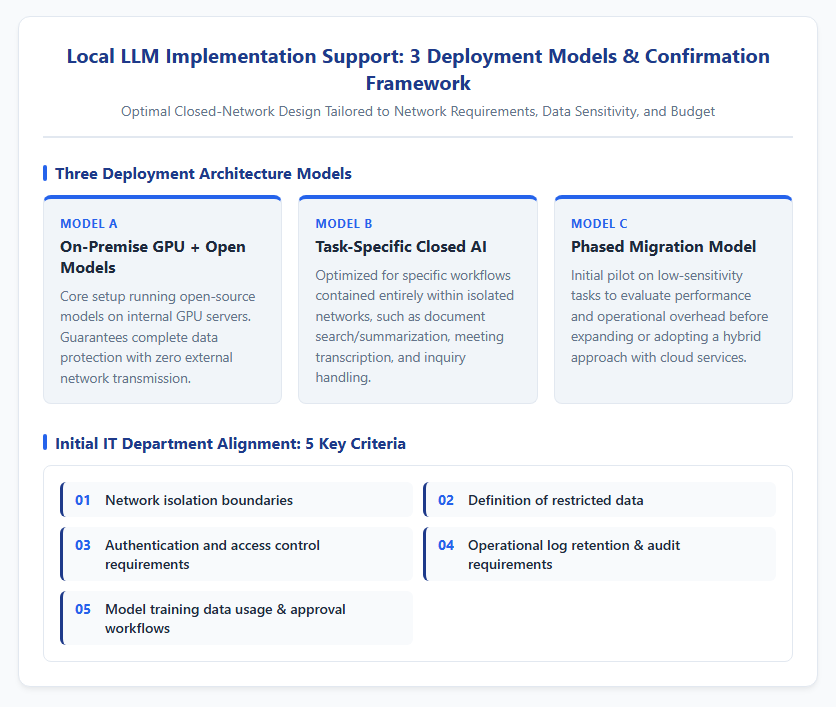
Uravation’s support service offers three distinct architecture models tailored to an enterprise’s network constraints, data sensitivity, and budget. Model A represents a core setup featuring an on-premise GPU server hosting open-source models, guaranteeing that data never leaves the internal network. Model B focuses on constructing task-specific AI workflows designed to run entirely within closed environments, covering applications such as document search and summarization, meeting transcription, and first-line customer inquiry handling. Model C employs a phased migration strategy, enabling organizations to test local deployments on low-sensitivity workflows first to evaluate performance and operational overhead before adopting a hybrid approach with cloud services where permissible. To streamline collaboration with IT departments, project initiations focus on aligning across five critical criteria: network isolation boundaries, definitions of restricted data, authentication and access controls, operational log retention policies, and data usage/approval workflows for model training. Please refer to the diagram below.
For tasks where local processing capabilities are deemed insufficient, Uravation conducts preliminary PoCs using real data, adhering to an operational transparency policy that candidly reports any performance limitations before contract execution.
Background and Technological Advancements Driving Demand for Local LLMs
Security Concerns and Data Leakage Risks in Generative AI Adoption
The primary catalyst driving enterprise interest in local LLMs is the growing concern over security risks and governance challenges associated with cloud-based AI services. According to a survey of 4,705 companies conducted by Teikoku Databank, only 17.3% of enterprises actively utilize generative AI, while 26.8% are considering its adoption. Fear of data leakage remains the single largest barrier preventing wider deployment. In 2023, Samsung Electronics restricted ChatGPT usage after employees accidentally leaked confidential semiconductor source code and internal meeting minutes by pasting them into prompts. Security vulnerabilities have further heightened caution, such as the 2025 discovery of a zero-click vulnerability in Microsoft 365 Copilot that allowed malicious email instructions to execute automatically. Additionally, a guide published by the Information-technology Promotion Agency, Japan (IPA) in July 2026 highlighted emerging threats stemming from “shadow AI”—unauthorized employee use of AI tools—and excessive system privilege assignments. In highly regulated sectors such as finance, healthcare, and manufacturing, establishing data sovereignty by keeping sensitive information strictly under internal control has become an urgent priority to comply with guidelines issued by the Personal Information Protection Commission and the Digital Agency.
Evolving Market Landscape Driven by MoE Technology and Open-Weight Models
Historically, locally hosted LLMs running on internal servers lagged behind state-of-the-art cloud models in terms of raw capabilities. However, this assumption has been overturned in 2026 due to the rapid maturation of Mixture of Experts (MoE) architecture and the arrival of high-performance open-weight LLMs. MoE technology dynamically routes inputs to activate only a subset of expert parameters per token, enabling exceptionally high inference speeds with significantly reduced GPU memory requirements. In July 2026, the release of “Kimi K3″—a frontier-class open-weight model featuring 2.8 trillion parameters—marked a major milestone, achieving benchmark scores on AI evaluation indices that closely rival top-tier proprietary closed models. Market infrastructure is expanding in tandem; in August 2026, DigiRise Inc. launched its “Toride AI” local LLM construction service, leveraging experience from over 600 corporate AI deployments to deliver fully verified, zero-external-transmission systems supported by audit-ready network logs. Please refer to the diagram below.
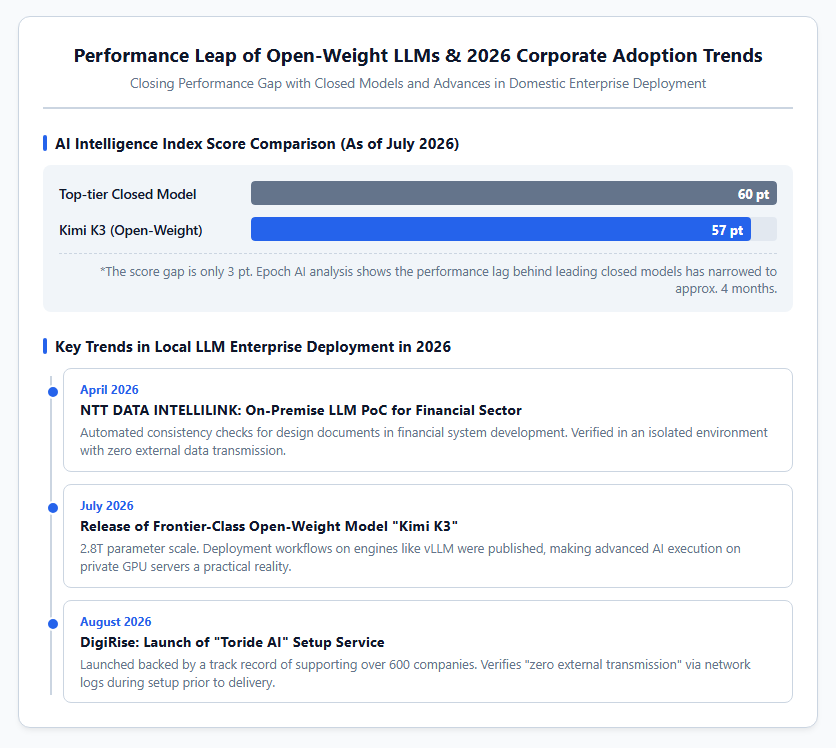
Furthermore, in April 2026, NTT DATA INTELLILINK completed a joint PoC with NTT DATA Financial Technology, automating design document consistency checks for financial institutions using on-premise LLMs. These developments highlight how cutting-edge AI deployed on private infrastructure is rapidly transitioning from experimental testing to mainstream enterprise adoption.
Practical Application and Future Outlook of Local LLM Deployment
Cost Structure and ROI Optimization in Closed-Network Infrastructure
Deploying local LLMs offers a compelling financial advantage by eliminating the unpredictable pay-as-you-go pricing models inherent to cloud APIs. Because cloud services charge based on token volume, costs escalate rapidly when scaling AI across an entire organization or automating large-scale data processing. In contrast, while on-premise GPU deployments require upfront capital expenditure for hardware procurement, post-deployment operational costs remain largely fixed to electricity and ongoing maintenance fees. For high-volume workloads, local infrastructure reaches a financial break-even point quickly, driving substantial long-term cost reductions. Hardware availability has also improved dramatically; by mid-2026, compact systems equipped with 128GB of unified memory—such as those powered by the AMD Ryzen AI Max+ 395—have emerged, allowing enterprises to run sophisticated quantized models at accessible price points between \$1,800 and \$2,000. Coupled with the rise of specialized SIers and implementation partners, companies without in-house AI engineering talent can now outsource deployment and achieve operational status within weeks.
The Future of Hybrid Operations: Balancing Cloud and Local Execution
Enterprise AI strategies are increasingly moving away from binary “cloud versus local” choices toward hybrid operational frameworks that allocate tasks based on data sensitivity and computational needs. Under this model, sensitive tasks—such as reviewing confidential contracts, analyzing proprietary engineering schematics, processing customer records, or summarizing internal documentation—are handled exclusively by local LLMs. Conversely, general tasks requiring complex reasoning or real-time internet search are routed to secured cloud AI endpoints. This division of labor is facilitated by semantic routing technology integrated into container platforms and AI gateways, which automatically evaluates prompt intent and data sensitivity to direct queries to the appropriate engine. Furthermore, as emphasized in the IPA guidelines, establishing robust AI governance remains essential; organizations must enforce the principle of least privilege, integrate human-in-the-loop approval workflows for critical actions, and maintain active audit logging. To maximize productivity while safeguarding data sovereignty, enterprises must establish clear security perimeters and adopt flexible architecture designs capable of adapting to evolving AI models and infrastructure.
Reference Pages
- 【Uravation Inc. Local LLM Implementation Support】https://uravation.com/local-llm/
- 【DigiRise Inc. Toride AI】https://toride.digirise.ai/
- 【IPA Guide for Safe Utilization of Generative AI and AI Agents】https://www.ipa.go.jp/jinzai/ics/core_human_resource/final_project/2024/f55m8k0000003spo-att/f55m8k0000003svn.pdf
- 【Qwen3.6 GitHub】https://github.com/QwenLM/Qwen3.6
- 【Gemma 4 Model Card】https://ai.google.dev/gemma/docs/core/model_card_4
【#LocalLLM #GenerativeAI #Security #OnPremise #DataSovereignty #AIImplementationSupport #InformationSecurity】

コメント