The Osaka Civil Aviation Bureau of the Ministry of Land, Infrastructure, Transport and Tourism has officially launched a public tender for operators to construct a multi-story parking facility at Kagoshima Airport, aiming to increase capacity by over 900 vehicles. This initiative comes in response to severe congestion during peak seasons, driven by a growing reliance on private cars following airport bus service reductions.
- Official Public Bidding and Comprehensive Expansion Objectives
- Project Schedule and Phased Construction Strategy
- Reduced Bus Service and High Reliance on Private Vehicles
- Impact of Free Initial Parking and Disparities in Usage Patterns
- Repurposing Employee Parking and Short-Term Initiatives
- Construction Safety and Key Points Moving Forward
Official Public Bidding and Comprehensive Expansion Objectives
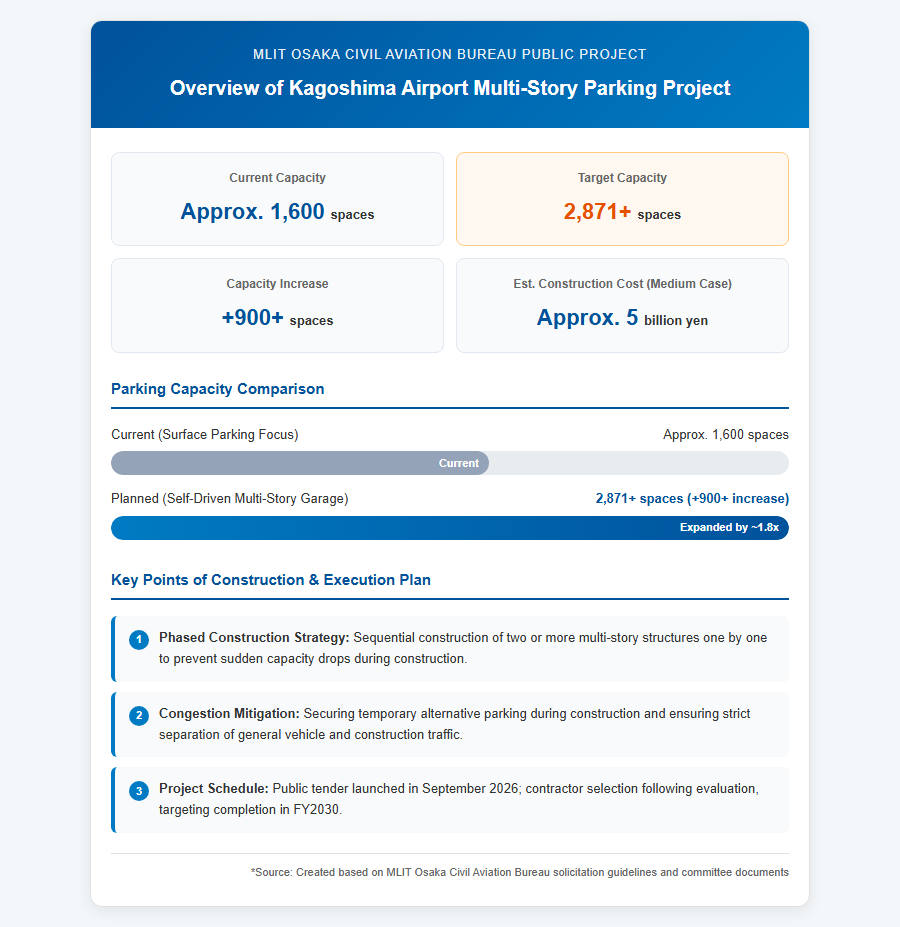
On September 18, 2026, the Osaka Civil Aviation Bureau of the Ministry of Land, Infrastructure, Transport and Tourism officially opened public bidding for the construction and operation of a new multi-story parking facility at Kagoshima Airport. The airport’s parking facilities have long suffered from severe capacity shortages during peak travel periods, including summer holidays, New Year breaks, and major consecutive holidays, resulting in lengthy traffic queues at entrance gates and spillover congestion onto nearby public roads. To address these persistent bottlenecks, the project transitions the current surface-level parking layout to a self-driven, multi-story structure that will significantly expand overall capacity. Specifically, the plan aims to increase parking spots by over 900 vehicles, scaling up the total capacity from the current level of approximately 1,600 spaces to at least 2,871 spaces for general and monthly parkers. The project is expected to leverage private-sector capital and operational expertise, with estimated construction costs hovering around 5 billion yen under a medium-demand scenario. By establishing robust infrastructure, authorities aim to accommodate future growth in passenger demand while fundamentally enhancing convenience for airport visitors. The figure below illustrates the airport parking layout plan.
Project Schedule and Phased Construction Strategy
According to the published solicitation guidelines, a detailed timeline has been established for selecting the operating contractor. Following the official announcement on September 18, 2026, an on-site briefing is scheduled for October 1, with inquiries accepted through October 5. Formal application submissions will be accepted from October 13 to November 13. A selection committee will evaluate proposals through a two-stage review process, assessing business strategies, construction plans, financial projections, and safety protocols before designating the winning operator. Construction of the multi-story structure is scheduled for completion as early as fiscal year 2030. Because a large-scale construction project spanning several years could drastically reduce available parking spaces and exacerbate congestion, the plan calls for a phased construction strategy where two or more parking structures will be built sequentially rather than simultaneously. Furthermore, to compensate for lost parking capacity during construction, operators are required to secure temporary alternative parking spaces on or near the airport grounds and strictly separate construction traffic from general vehicle and pedestrian routes.
Root Causes Behind Chronic Parking Congestion
Reduced Bus Service and High Reliance on Private Vehicles
The worsening parking congestion at Kagoshima Airport stems from structural shifts in regional access transportation. Following the COVID-19 pandemic and worsening driver shortages, local bus operators such as Kagoshima Transportation and Nankoku Transportation significantly reduced or eliminated airport feeder routes. Total daily airport bus trips dropped from 266 before the pandemic to 156—a reduction of over 100 trips—with little prospect of an immediate service recovery due to driver retention challenges. As public transport options diminished, passengers shifted overwhelmingly to private automobiles. Local data indicates that private vehicles now account for 86.9% of all ground transport access to Kagoshima Airport, highlighting an extreme regional dependence on cars. Consequently, the number of days the airport parking lot reached full capacity rose from 63 days in fiscal 2019 to 83 days in fiscal 2024—a 1.3-fold increase. During three-day weekends and major holiday periods, parking lots routinely fill up early in the morning, disrupting overall airport access and underscoring the urgent need for fundamental infrastructure upgrades.
Impact of Free Initial Parking and Disparities in Usage Patterns
In addition to shifting transport habits, the airport’s fee structure has contributed to parking congestion. A comparison of two-hour parking fees across major airports in Kyushu shows that Kumamoto Airport and Miyazaki Airport charge 300 yen, Naha Airport charges 500 yen, and Fukuoka Airport charges 1,000 yen, whereas Kagoshima Airport offers the first two hours completely free of charge. This high level of affordability has encouraged a surge in short-term parking for pick-ups, drop-offs, and visits to terminal shops, with stays under two hours accounting for roughly 70% of total parking volume. When these short-term visitors overlap with long-term travelers parking their cars for multi-day trips, available spaces saturate quickly during peak hours. Furthermore, multi-day overnight parking has increased roughly 1.1-fold in recent years. Effectively managing and separating short-term visitor traffic from long-term traveler parking remains a central challenge in both facility design and operational policy revisions.
Step-by-Step Mitigation Measures and Future Outlook
Repurposing Employee Parking and Short-Term Initiatives
Because the completion of a multi-story garage requires several years, a joint committee comprising the Osaka Civil Aviation Bureau, Kagoshima Prefecture, airport administration, and parking operators is pursuing immediate short-term measures alongside the medium-to-long-term construction plan. Central to these interim efforts is the relocation of employee parking spaces previously situated within the main airport perimeter. By moving staff parking to off-site locations, authorities successfully freed up 353 parking spaces for public use in stages through May 2026. On the operational and system front, electronic message boards along National Route 504 have been upgraded, and real-time status updates for temporary parking overflow areas have been integrated into the airport website. Additionally, increased security personnel have been deployed during peak holiday periods to guide traffic smoothly, while revised parking fee structures—including a peak-season rate of 1,200 yen per 24 hours starting in April 2026—have been introduced to encourage demand smoothing. The diagram below illustrates the implementation framework of these combined measures.
Construction Safety and Key Points Moving Forward
The enhancement of Kagoshima Airport’s parking infrastructure serves as a notable benchmark for access management at regional airports across Japan. Moving forward, attention centers on the specific proposals submitted by private bidders and their ability to maintain smooth daily operations during the construction phase. Because surface parking spaces will be temporarily reduced during construction, securing sufficient alternative parking capacity and maintaining seamless access to the passenger terminal will be paramount. Furthermore, stakeholders anticipate long-term enhancements, such as digital transformation (DX) initiatives for advance reservations and automated payments, improved integration with rental car and car-sharing services, and carbon-reduction measures aligned with modern infrastructure standards. How effectively the central government, local authorities, and private operators collaborate on this landmark project to elevate the airport’s role as a regional gateway will remain a key focus for local economic and tourism development.
References
- [Kagoshima Airport Building Co., Ltd. Official Website] https://www.koj-ab.co.jp/
[#KagoshimaAirport #MLIT #ParkingCongestion #MultiStoryParking #AirportAccess #RegionalAirports #InfrastructureDevelopment]


コメント