The Ministry of Land, Infrastructure, Transport and Tourism (MLIT) has released the results of a targeted investigation conducted by its “Construction G-Men” task force into surging construction material prices and related practices. The report revealed improper bidding and contracting practices at approximately 80% of the surveyed companies. Behind this lies a pervasive industry reality where material and labor cost breakdowns in estimates are insufficiently itemized, leaving contractors unable to present objective evidence during price pass-through negotiations with project owners.
- Bidding Challenges On-Site Highlighted by Middle East Impact Survey
- Breakdown and Causes Behind Non-Compliance at 80% of Businesses
- How Unitemized Estimates Trigger Refusal of Price Negotiations
- Detailed Estimation and Statutory Contract Items Mandated by the Revised Construction Business Act
- Rigorous Oversight by Construction G-Men and the Role of the “Trade Case Studies”
- Key Future Issues and Practical Responses to Establish Price Pass-Through
Bidding Challenges On-Site Highlighted by Middle East Impact Survey
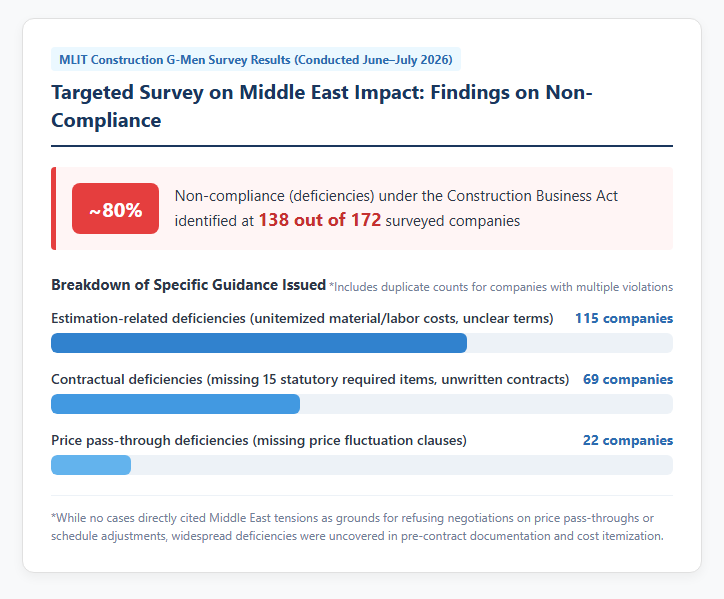
On September 16, 2026, the Ministry of Land, Infrastructure, Transport and Tourism (MLIT) announced the findings of a targeted investigation conducted by its “Construction G-Men” task force on the impacts of procurement difficulties and surging construction material prices triggered by instability in the Middle East. Initiated through leads such as the Regional Development Bureaus’ hotline, the investigation was conducted in June and July 2026 via in-person interviews with 172 construction companies. The investigation found no explicit violations directly citing Middle East tensions as grounds for refusing negotiations on price pass-throughs or schedule adjustments. However, it laid bare widespread flaws in pre-negotiation processes, specifically regarding cost estimation and contract drafting. The transaction status at construction sites is shown below.
In recent years, the construction industry has faced relentless price increases for raw materials and fuel. For contractors responsible for execution, passing these rising costs onto contract prices is essential to securing fair profit margins. However, the survey results underscore a harsh reality: many construction companies stumble at the foundational stages of price negotiations—namely, formal documentation and presenting clear financial justification.
Breakdown and Causes Behind Non-Compliance at 80% of Businesses
According to the aggregated findings, 138 companies—roughly 80% of the surveyed total—were found to have engaged in improper practices under the Construction Business Act, regardless of whether Middle East tensions directly contributed. The detailed breakdown of administrative guidance issued (including multiple violations per company) is as follows:
- Estimation-related deficiencies (insufficient itemization of material costs, inadequate terms, etc.): 115 companies
- Contractual deficiencies (inadequate inclusion of 15 statutory required items, unwritten contracts, etc.): 69 companies
- Price pass-through deficiencies (deficiencies in price adjustment clauses among statutory contract terms, etc.): 22 companies
Deficiencies in estimation were the most common issue, showing that more than half of surveyed companies failed to prepare proper cost estimates. A deeply entrenched industry habit of submitting lumped estimates—charging a flat fee for “materials and labor combined” without itemizing individual material costs, labor costs, or statutory welfare expenses—remains widespread. This lack of itemization directly weakens contractors’ leverage when negotiated price pass-throughs become necessary later on.
Structural Deficiencies in Estimates and Contracts Impeding Price Pass-Through and the Revised Construction Business Act
How Unitemized Estimates Trigger Refusal of Price Negotiations
When construction material prices surge, contractors seeking price adjustments from project owners or main contractors must provide objective proof of the costs originally allocated to specific materials when the contract was signed. However, if initial estimates fail to clearly separate and specify material and labor costs, quantifying and proving how much specific cost items have inflated after price hikes becomes exceedingly difficult.
Consequently, a vicious cycle ensues: project owners reject negotiations claiming “unclear grounds,” forcing contractors into accepting unfair price cuts. MLIT emphasizes that sharing risk information prior to contract signing and itemizing material and labor costs in estimates are mandatory prerequisites for smooth price pass-through negotiations. An illustration of pre-contract negotiations is shown below.
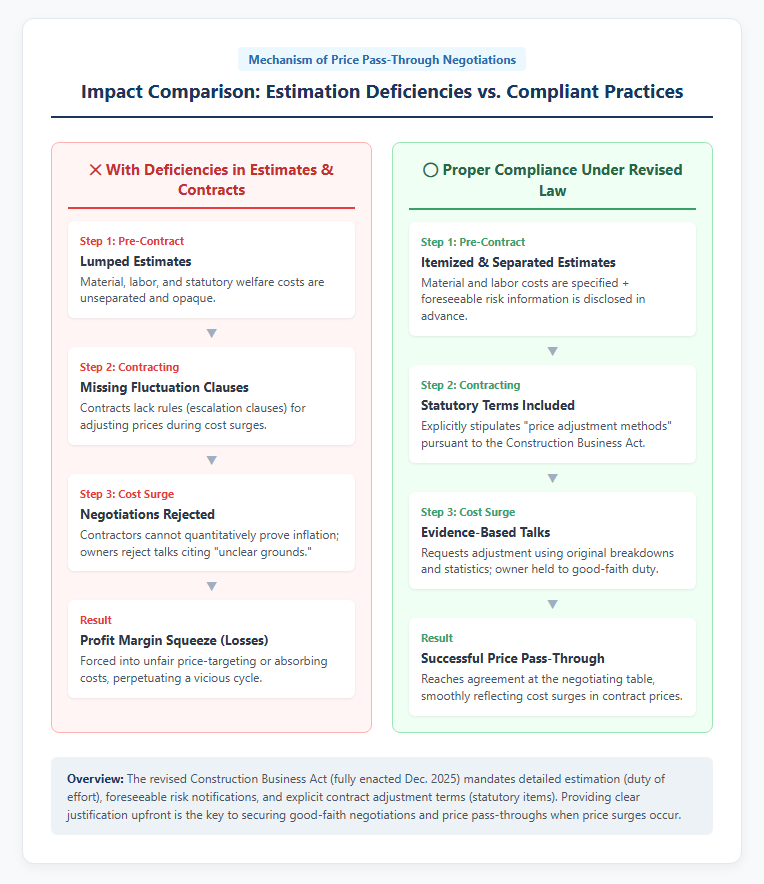
Establishing clear benchmark criteria in advance enables both parties to come to the negotiating table in good faith, even when unpreventable material price surges occur.
Detailed Estimation and Statutory Contract Items Mandated by the Revised Construction Business Act
The revised Construction Business Act, fully enacted in December 2025, aims to ensure fair transactions and improve working conditions for skilled workers. It established an obligation of effort for detailed estimation (separate listing of material costs, labor costs, and overhead). Although legally framed as an obligation of effort, failing to align with the spirit of the law effectively equates to waiving one’s right to negotiate price pass-throughs.
Furthermore, Article 19 of the Construction Business Act mandates 15 statutory items to be included in written contracts upon execution. This includes “methods for adjusting contract prices or construction periods due to price surges,” requiring price fluctuation clauses in all contracts. Nevertheless, the recent survey identified contract deficiencies at 69 companies and missing price adjustment clauses at 22 companies, highlighting instances where work commenced under flawed contracts. Despite the time passed since the legislative revision, it is clear that compliance has yet to fully permeate daily field operations.
Strengthening Oversight for Fair Trade and Industry-Wide Ripples
Rigorous Oversight by Construction G-Men and the Role of the “Trade Case Studies”
To eliminate unfair trading practices in construction projects, MLIT significantly expanded its team of Construction G-Men (Inspectors for Proper Construction Transactions) from 72 to 135 personnel, stepping up on-site inspections and interviews. Furthermore, in January 2026, MLIT published “Case Studies of Transactions Posing a Risk of Setting Labor Costs Significantly Below Standard Levels,” categorizing improper practices—such as excessive price-targeting and uniform cuts—into six distinct types to raise awareness among both project owners and contractors.
The findings of this survey were also presented at the government’s “Working Group on Vitalizing SMEs for Wage Growth” on September 10, 2026. During the meeting, directives were issued to relevant ministries to dismantle outdated trade practices obstructing price pass-throughs and to strengthen guidance in cooperation with construction industry associations. With a tighter surveillance network of Construction G-Men and stricter administrative guidance, the regulatory framework against aggressive price-squeezing and unreasonable price freezes is growing increasingly robust.
Key Future Issues and Practical Responses to Establish Price Pass-Through
Going forward, the primary challenge lies in whether construction companies, as contractors, can develop proper cost-estimation capabilities and consistently practice providing necessary “risk information (foreseeable risk disclosures)” to project owners prior to contracting. MLIT advises contractors to attach objective statistical data and news reports when submitting estimates whenever material surges or delivery delays are anticipated.
Concurrently, project owners are under an obligation of effort to respond in good faith without refusing negotiation requests without reasonable grounds. Across the entire supply chain—from major general contractors down to subcontractors and sub-subcontractors—establishing the practice of itemized estimation and strict adherence to statutory contract terms will be the decisive factor in sustaining wage increases and securing future labor across the construction industry.
Reference Pages
【#ConstructionBusinessAct #PricePassThrough #MLIT #ConstructionGMen #ItemizedEstimates #FairTrade #MaterialPriceSurges】
コメント