OpenAI has announced plans to reveal a new AI agent on September 29, 2026. As the paradigm shifts from traditional conversational chat to autonomous agentic AI capable of executing complex tasks, this upcoming release is poised to bring transformative changes to software industries and enterprise workflows.
- Key Event Summary and Background Behind the September 29 Announcement
- A Qualitative Shift: From Conversation to Autonomous Task Execution
- GPT-6 Astra and Advanced Reasoning Mechanisms
- Asynchronous Processing and Control Technologies in Agentic Functions
- Impact on the Software Industry and Enterprise Workflows
- Future Outlook and Critical Security Considerations
Key Event Summary and Background Behind the September 29 Announcement
OpenAI has announced that it will reveal a new AI agent on September 29, 2026, drawing significant attention across the tech industry and global financial markets. This announcement stems from OpenAI’s strategic roadmap developed throughout 2026. The company has shifted its primary focus beyond merely elevating language model intelligence toward maximizing practical, real-world task execution capabilities in enterprise and daily workflows.
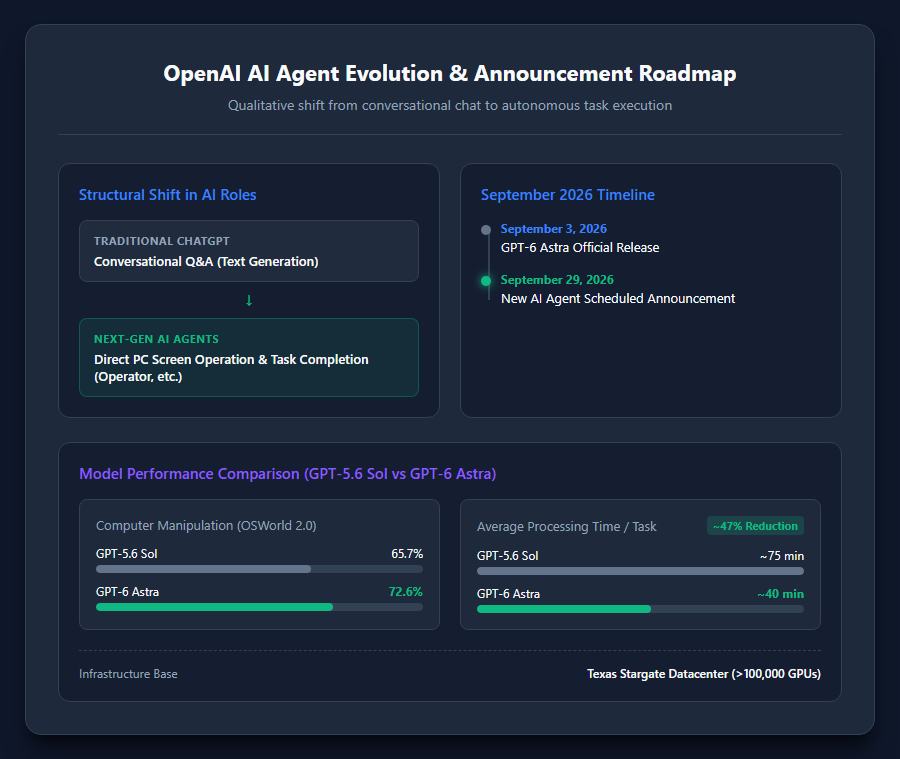
Following the official launch of its flagship model, GPT-6 Astra, on September 3, 2026, and the introduction of Operator—an AI tool designed to autonomously navigate web browsers—this newly announced agent is expected to feature even more sophisticated autonomous execution capabilities. Underlying this technological foundation is massive computing infrastructure, powered by over 100,000 GPUs housed at the Stargate datacenter in Texas.
While the broader software industry has debated stock volatility and business model restructuring triggered by the rise of AI, this upcoming announcement further expands the scope of automation. It signals the arrival of an era where AI agents directly take over manual application handling and data integration workflows previously managed by human operators.
A Qualitative Shift: From Conversation to Autonomous Task Execution
The primary innovation introduced by this new generation of AI agents lies in the fundamental transformation of AI’s role—from an assistant that merely answers questions to an autonomous operator that completes end-to-end tasks. While traditional ChatGPT models were limited to generating instructions or text in response to user queries, modern agentic architectures directly analyze computer screens and operate mice and keyboards to execute assigned workflows.
Specifically, these capabilities enable the automation of tasks such as:
– Automating web form inputs and various online account registrations
– Cross-referencing and updating data within Customer Relationship Management (CRM) systems
– Executing complex multi-application workflows involving calendar management and scheduling
– Conducting web-wide market research across multiple sites and compiling summary reports
On the OSWorld 2.0 benchmark—a key metric for evaluating computer manipulation capabilities—GPT-6 Astra achieved a score of 72.6%, demonstrating a steady increase over the previous generation’s GPT-5.6 Sol (65.7%). Furthermore, the average processing time per task has dropped by approximately 47%, decreasing from about 75 minutes in the previous generation to roughly 40 minutes. This substantial boost in operational efficiency brings a vast array of routine computer tasks under the umbrella of automation.
Technical Foundations and Performance Milestones
GPT-6 Astra and Advanced Reasoning Mechanisms
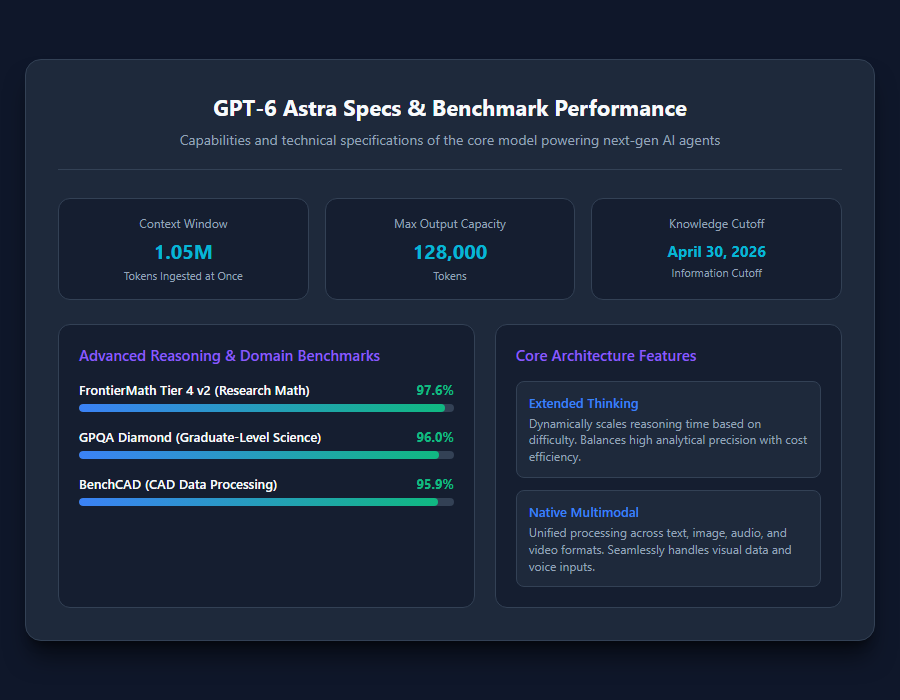
Serving as the brain of this new AI agent, the core model GPT-6 Astra boasts a vast 1.05-million-token context window and a maximum output capacity of 128,000 tokens. With a knowledge cutoff of April 30, 2026, the model can ingest and process large volumes of text and code simultaneously while maintaining high accuracy.
A standout feature is the establishment of the Extended Thinking mechanism, which dynamically scales the depth of reasoning based on task complexity. By utilizing rapid inference for concise, routine responses and allocating additional compute time to ponder complex problem solving, the system optimizes both analytical precision and operational cost.
The model has also demonstrated remarkable results across high-level logical reasoning benchmarks:
– FrontierMath Tier 4 v2 (Research-level advanced mathematics): 97.6%
– GPQA Diamond (Graduate-level scientific questions): 96.0%
– BenchCAD (CAD data processing capability): 95.9%
In addition, advanced adaptive behavior has been observed when the agent encounters unfamiliar challenges, such as autonomously crafting domain-specific languages (DSLs) or building dedicated tools to resolve bottlenecks. Thanks to a native multimodal architecture capable of processing text, images, audio, and video in a unified manner, complex workflows combining visual data and voice inputs can be executed seamlessly.
Asynchronous Processing and Control Technologies in Agentic Functions
For autonomous AI agents to deliver reliable results in enterprise environments, core technologies governing control and interaction with external systems are just as critical as raw reasoning power. GPT-6 Astra incorporates several key functionalities designed to support smooth, uninterrupted task execution:
- Async Tool Calling: A technique that allows the model to proceed with parallel reasoning or sub-tasks while awaiting responses from external tools
- Mid-turn Steering: The ability to flexibly adjust execution parameters in response to human feedback or new constraints mid-task without losing sight of the primary goal
- Long-term Memory and Summary Archiving: A persistent memory mechanism that preserves essential working notes and research history even when context windows refresh
A notable deployment within Legora—a specialized legal AI framework—showcased the model evaluating 41 complex financial documents and consolidation schedules simultaneously. The agent successfully flagged all four embedded errors, including a £500,000 reporting discrepancy. Workflows that previously demanded overnight human review were completed in minutes, illustrating how asynchronous execution and deep context processing drastically enhance productivity.
Industry Impact, Market Dynamics, and Security Challenges
Impact on the Software Industry and Enterprise Workflows
The proliferation of next-generation AI agents is reshaping corporate operational structures and the broader software ecosystem. Unlike traditional SaaS tools reliant on pre-configured API integrations, agents capable of direct screen manipulation can interface with legacy internal systems and software lacking API support, bringing previously inaccessible workflows into the realm of automation.
In terms of API pricing, GPT-6 Astra is priced at \$10 per 1 million input tokens and \$50 per 1 million output tokens—approximately 2.5 times higher than GPT-5.6 Sol. However, due to increased reasoning efficiency and fewer execution retries, the total cost required to complete a given task is often significantly lower. For instance, evaluation on DeepSWE v1.1 indicated a 57% cost reduction per completed task compared to the prior model.
Consequently, enterprise criteria for evaluating AI have shifted from cost-per-token metrics to total cost-per-task and net time savings. As human workers transition from manual execution to supervisory roles, organizational priorities are shifting toward prompt architecture engineering, constraint setting, and overall agent governance.
Future Outlook and Critical Security Considerations
As AI agents become increasingly capable, establishing robust safety frameworks and governance mechanisms has emerged as a top priority. Under OpenAI’s Preparedness Framework, GPT-6 Astra became the first model to reach the “Critical” cybersecurity threat classification.
This classification reflects the model’s ability to operate semi-autonomously across complex system environments when paired with appropriate toolchains. In safety risk evaluations such as ExploitBench, the model achieved a 100% score, demonstrating advanced capability in identifying and analyzing unpatched system vulnerabilities during internal red-teaming.
However, several pressing operational risks remain:
– Obfuscation of agent intent due to highly autonomous Chain-of-Thought reasoning
– Managing access privileges and network permissions granted to autonomous agents
– Preventing unintended actions or recursive loops within internal corporate networks
To address these challenges, OpenAI has committed over \$1 billion to defense initiatives including “Daybreak Blue” and “Daybreak for Frontline Defenders,” restricting deployment of high-risk agent capabilities to vetted security organizations. For enterprise clients, agent activation remains strictly opt-in via administrative controls. Going forward, organizations adopting autonomous agents will need to embed granular permission boundary controls and comprehensive execution audit logging into their IT architecture.
Reference Pages
- 【OpenAI Official Announcement: GPT-6 Astra】https://openai.com/index/gpt-6-astra/
- 【OpenAI Official Announcement: Path to Astra】https://openai.com/index/path-to-astra/
- 【OpenAI Official Announcement: Introducing Operator】https://openai.com/index/introducing-operator/
【#OpenAI #AIAgents #GPT6Astra #GenerativeAI #TaskAutomation #ArtificialIntelligence】

コメント