
On September 22, 2026, Prime Minister Sanae Takaichi and U.S. President Donald Trump held a summit meeting, agreeing on comprehensive cooperation in economic security, including artificial intelligence, semiconductors, and critical minerals. Against the backdrop of escalating U.S.-China competition for technological supremacy and supply chain vulnerabilities caused by over-reliance on specific nations, the agreement aims to elevate the U.S.-Japan alliance to a new dimension.
- Summit Convening and Unifying on Economic Security
- AI and Next-Generation Semiconductor Collaboration Alongside the Strategic Investment Initiative
- Critical Mineral Supply Chains and Joint Energy Initiatives
- U.S. National Security Strategy and Geoeconomic Vulnerabilities
- Amendments to Japan’s Foreign Exchange Act and the Establishment of JFIC
- Impact on the Japanese Equity Macro Market and Related Industries
- Key Focus Areas and the Future of the U.S.-Japan Alliance
Summit Convening and Unifying on Economic Security
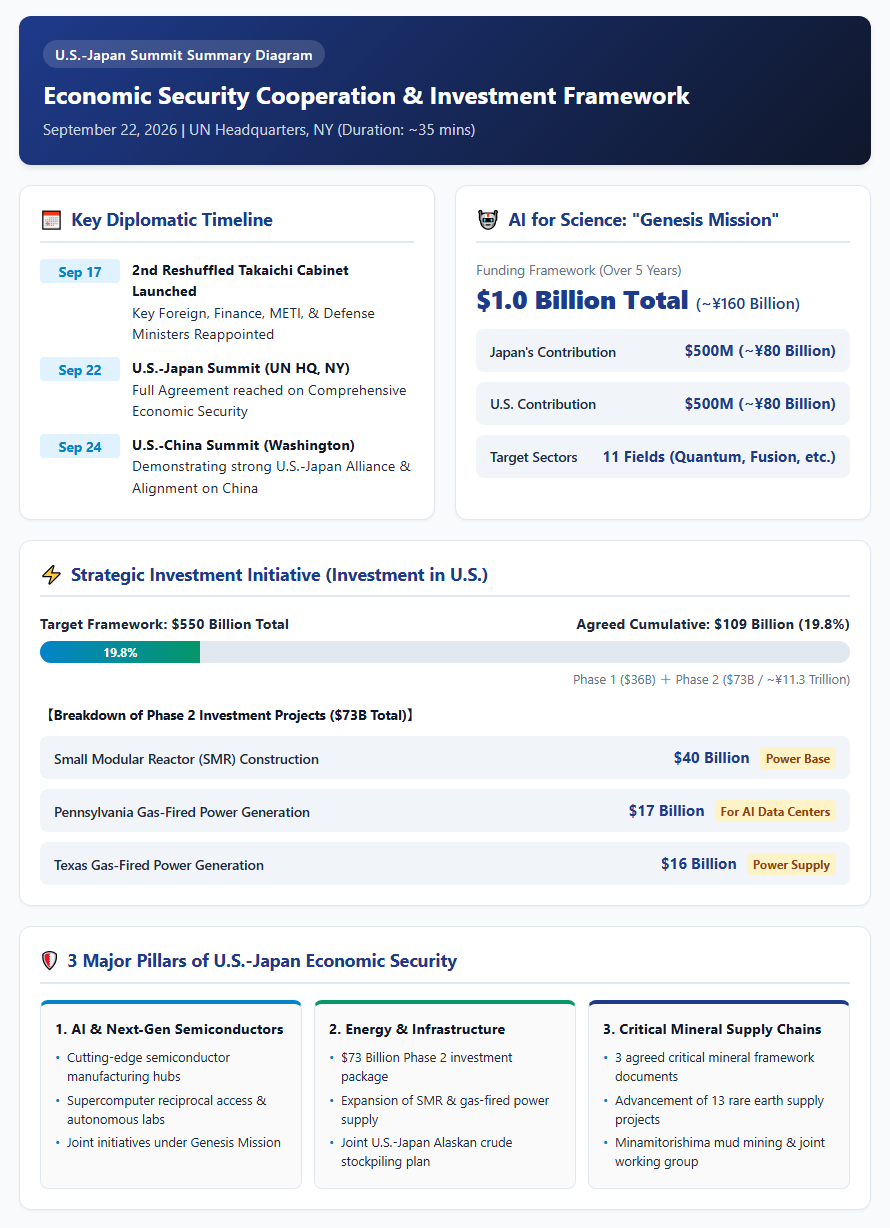
On September 22, 2026 (local time), Japanese Prime Minister Sanae Takaichi and U.S. President Donald Trump held a 35-minute bilateral summit at the United Nations Headquarters in New York. Following the launch of the second reshuffled Takaichi Cabinet on September 17, 2026, key diplomacy and defense ministers—including Foreign Minister Toshimitsu Motegi, Finance Minister Satsuki Katayama, Minister of Economy, Trade and Industry Ryosei Akazawa, and Defense Minister Shinjiro Koizumi—were reappointed, highlighting policy continuity and strong interpersonal ties. Occurring right before the high-stakes U.S.-China summit scheduled for September 24 in Washington, the agreement came at a crucial and strategically opportune time to demonstrate complete alignment on China and showcase the strength of the U.S.-Japan alliance to the world.
Both leaders reached complete agreement on establishing a comprehensive economic security partnership spanning cutting-edge technologies and resource supply chains, moving beyond traditional military defense cooperation. This alignment is grounded in a shared understanding that technological leakage and excessive reliance on specific countries can become critical national security vulnerabilities. The diagram below illustrates the scene at the United Nations Headquarters where the summit took place.
During the meeting, the leaders reaffirmed the importance of the rule of law based on international law, clearly defining a new era of bilateral relations where security and economy are inextricably linked.
AI and Next-Generation Semiconductor Collaboration Alongside the Strategic Investment Initiative
A central pillar of economic security cooperation is securing leadership in AI and next-generation semiconductors. The U.S. and Japanese governments agreed to accelerate the development of a cutting-edge semiconductor ecosystem and manufacturing hubs led by both nations. As part of these efforts, on June 4, 2026, both governments signed a Letter of Intent to cooperate on the “Genesis Mission,” a U.S. national initiative leveraging AI for scientific research. Japan became the first international partner, with each country contributing \$500 million (approximately 80 billion yen) over five years for a combined total of \$1 billion (about 160 billion yen). This joint research will span 11 critical sectors, including quantum technology, nuclear fusion, and biotechnology. Institutions like RIKEN and the University of Tokyo will collaborate with U.S. national laboratories to develop autonomous laboratories powered by AI and robotics, while enabling reciprocal access to supercomputing facilities.
Under the “Strategic Investment Initiative,” which focuses on investment in the United States by Japanese companies, a second phase of projects totaling \$73 billion (approximately 11.3 trillion yen) was presented out of a total \$550 billion framework. This package includes \$40 billion for small modular reactor (SMR) construction, \$17 billion for gas-fired power generation in Pennsylvania, and \$16 billion for gas-fired power generation in Texas. Combined with the initial phase of \$36 billion, cumulative investments reached \$109 billion (19.8% of the target), aiming to secure the essential power infrastructure required for massive AI data centers.
Critical Mineral Supply Chains and Joint Energy Initiatives
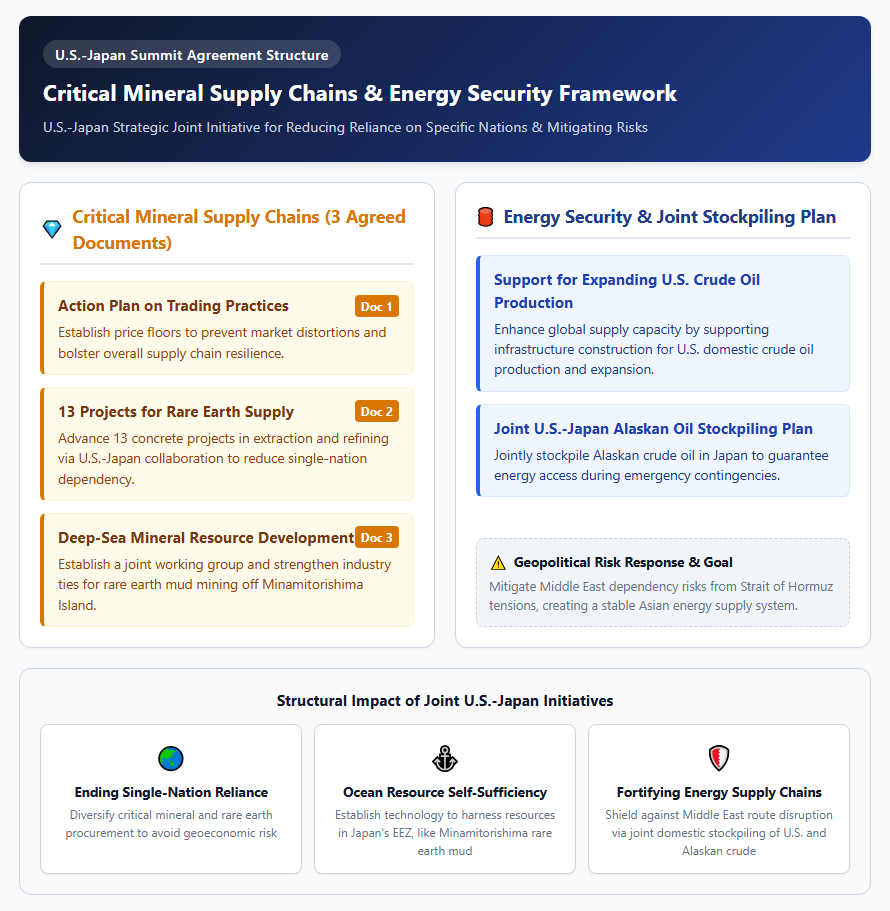
To eliminate resource risks associated with reliance on specific countries, the U.S. and Japanese governments finalized three documents regarding critical minerals: the “Action Plan on Critical Mineral Trading Practices,” “13 Projects for Rare Earth Supply,” and “Cooperation on Deep-Sea Mineral Resource Development.” The Action Plan aims to prevent market distortions and strengthen supply chain resilience by establishing price floors for transactions. Furthermore, the agreements explicitly outline plans to deepen industry collaboration and establish a joint U.S.-Japan working group focused on rare earth mud mining and resource development near Minamitorishima Island.
In energy security, alongside supporting expanded U.S. crude oil production, both governments discussed a proposal for a joint U.S.-Japan strategic crude oil reserve stored in Japan using Alaskan oil. This initiative aims to mitigate negative impacts on oil supply stemming from heightened tensions in the Strait of Hormuz, building a stable energy supply system across the Asia region. The diagram below depicts the framework for resource supply chains and strategic collaboration driven by Japan and the U.S.
Background and Regulatory Frameworks of Economic Security Reinforcement
U.S. National Security Strategy and Geoeconomic Vulnerabilities
Economic security became the central core of the U.S. National Security Strategy (NSS) due to lessons learned from severe vulnerabilities caused by over-reliance on foreign sources. Following the inauguration of the second Trump administration in 2025, trade tensions escalated as tariffs on Chinese goods were gradually raised under the rationale of combating illicit drug trafficking, culminating in reciprocal tariff rates reaching 145%. In response, China implemented retaliatory measures leveraging the “weaponization of indispensability,” restricting rare earth exports and shifting soybean procurement to Brazil. This exposed the U.S. defense industry’s and advanced manufacturing sector’s critical reliance on Chinese minerals, demonstrating that tariff policies alone are insufficient to maintain geoeconomic power.
To address these vulnerabilities, the U.S. shifted its strategy toward leveraging investment and trade agreements with allies like Japan and South Korea. Projects such as power plant construction in Ohio, attracting diamond semiconductor factories, and diversifying critical mineral procurement between Japan and the U.S. carry strong political and economic significance as joint efforts to build deterrence against China and establish supply chain autonomy.
Amendments to Japan’s Foreign Exchange Act and the Establishment of JFIC
The Japanese government is also significantly upgrading its economic security regulatory framework to address risks concerning sensitive technology leakage and threats to critical infrastructure. Under the Foreign Exchange and Foreign Trade Act (FEFTA), prior notification is required for inward direct investment in designated industries. A 2020 amendment broadened oversight by lowering the stock acquisition threshold for listed companies from 10% to 1%. Furthermore, ministerial order revisions effective May 2025 introduced restrictions preventing “Specified Foreign Investors”—entities obligated to cooperate with foreign government intelligence-gathering activities—from utilizing prior notification exemption schemes.
On May 29, 2026, an amended FEFTA was enacted, leading to the creation of the Japan Foreign Investment Committee (JFIC) on June 29, 2026, as an interagency investment screening body. Co-chaired by the Ministry of Finance and the National Security Secretariat (NSS), JFIC coordinates among the Ministry of Foreign Affairs, Ministry of Economy, Trade and Industry, and Ministry of Defense to holistically assess foreign investor risk profiles and supply chain impacts. While striving to expand healthy foreign direct investment in Japan to 120 trillion yen by 2030 and 150 trillion yen in the early 2030s, the Japanese government applies a balanced policy that rigorously screens out security-sensitive investments.
Impact on Markets and Industry, and Future Outlook
Impact on the Japanese Equity Macro Market and Related Industries
The economic security agreements reached at the U.S.-Japan summit provide a major structural tailwind for Japan’s macroeconomy and stock market. Progress on the \$550 billion Strategic Investment Initiative and confirmed agreements totaling \$109 billion (16.9 trillion yen) generate significant growth opportunities for infrastructure, energy, shipbuilding, and defense sectors. Direct beneficiaries are expected to include companies involved in small modular reactors (SMRs) and large-scale nuclear reactors, plant manufacturers handling crude oil transportation infrastructure, and defense contractors expanding interceptor missile (SM-3 Block IIA) production capacity fourfold.
Additionally, policies aimed at securing domestic critical minerals and advanced materials enhance the value of Japanese non-ferrous metal and materials producers. For instance, major non-ferrous metal firms like JX Nippon Mining & Metals are accelerating shifts toward high-value-added materials such as sputtering targets for AI data centers and semiconductors, as well as indium phosphide (InP). Supported by government supply chain resilience subsidies and the U.S.-Japan agreements, these companies are positioned for sustained profit growth.
Key Focus Areas and the Future of the U.S.-Japan Alliance
Moving forward, the primary focus will be on how swiftly and concretely the initiatives and action plans agreed upon by Japan and the U.S. are implemented. As the United States prepares to mark its 250th anniversary of independence on July 4, 2026, expectations are high for a third phase of investment project agreements and the full activation of the joint working group for rare earth development near Minamitorishima Island. Additionally, streamlining investment screenings and improving predictability under the Japan Foreign Investment Committee (JFIC), established in June 2026, will be key to sustaining healthy capital inflows from home and abroad.
Diplomatically, amid rising interest in easing U.S.-China friction and establishing international governance for AI safety, Japan faces the challenge of serving as a bridge between the U.S. and China while maintaining its technological indispensability. Crucially, Japan must steadily advance domestic legislation during the autumn extraordinary Diet session, such as energy procurement diversification bills, translating diplomatic achievements into sustainable domestic economic growth and public welfare.
Reference Pages
-
[Japan-U.S. Summit Meeting and Working Dinner] https://www.mofa.go.jp/mofaj/na/na1/us/pageit_000001_00014.html
-
[Foreign Exchange and Foreign Trade Act / Investment Screening System] https://www.mof.go.jp/policy/international_policy/gaitame_kawase/gaitame/recent_revised/gaitamehou_20200508.htm
-
[Japan Foreign Investment Committee (JFIC)] https://www.mof.go.jp/policy/international_policy/gaitame_kawase/fdi/20260618215004.html
[#JapanUSSummit #EconomicSecurity #Semiconductors #ArtificialIntelligence #SupplyChain]

コメント