Anthropic has launched the beta release of “Claude Code Projects” and cloud session capabilities for its AI coding agent, “Claude Code,” enabling tasks to execute directly in the cloud. This initiative aims to support the autonomous completion of complex software development tasks through parallel thread execution and persistent computing environments.
- 1.1 Key Highlights of the Claude Code Projects Announcement
- 1.2 Technical Architecture: Cloud Parallel Threading and the Two-Tier System
- 2.1 Persistent Execution and Automated Branching and Pull Requests
- 2.2 Context Sharing Through Shared Project Memory and 16,000-Character System Instructions
- 3.1 Prerequisites, Cost Structure, and Local Environment Constraints
- 3.2 Human-Led Governance and the Roadmap for Autonomous AI Agents
1.1 Key Highlights of the Claude Code Projects Announcement
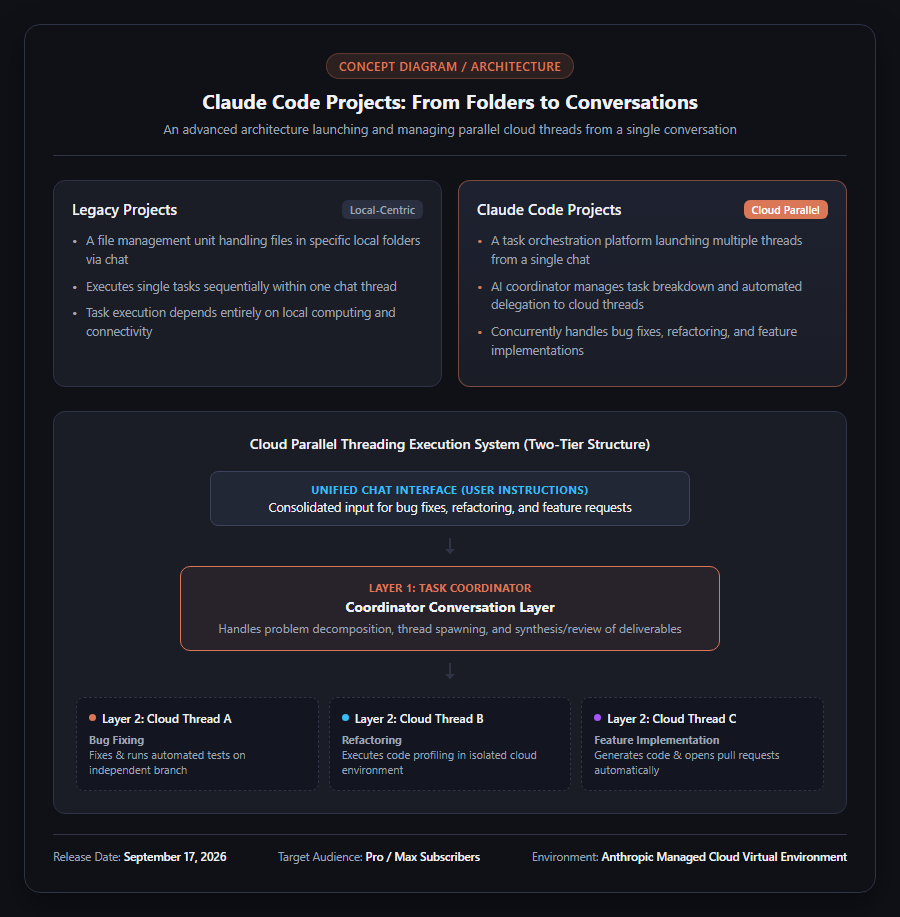
On September 17, 2026, AI development platform provider Anthropic unveiled the beta version of “Claude Code Projects,” introducing cloud session capabilities to its AI coding agent, “Claude Code.” While traditional project features served primarily as local file management units within a chat interface, this new iteration embraces a “from folders to conversations” philosophy, evolving into a sophisticated task orchestration platform that launches and manages multiple cloud threads from a single conversation. Developers can submit complex multi-part requests—such as concurrent bug fixes, code refactoring, and new feature implementations—directly into a unified chat interface, allowing the AI to handle everything from task prioritization to automated delegation. The initial beta rollout is expanding progressively to select Pro and Max tier subscribers. It has captured significant industry attention as a bold demonstration of a modern workflow where AI autonomously grasps the big picture of software engineering and drives development forward. Please refer to the concept diagram below.
1.2 Technical Architecture: Cloud Parallel Threading and the Two-Tier System
At the core of this capability lies a sophisticated two-tier system architecture that decouples task orchestration from execution. The first layer functions as the coordinator conversation layer, managing the overarching project. It ingests high-level user instructions, breaks down complex problems, spawns individual threads, and synthesizes and reviews completed deliverables. The second layer consists of the cloud thread layer responsible for hands-on execution, running within isolated virtual environments on Anthropic’s managed cloud infrastructure. Each thread is assigned a cloned Git repository and an independent working branch, allowing it to autonomously handle code generation, profiling, and test execution in parallel without interfering with concurrent processes. This design eliminates the need for developers to manually allocate sessions or track granular progress, empowering the model itself to determine optimal parallelization and resource distribution. By shifting computation to cloud infrastructure, teams gain high-speed, flexible execution unconstrained by local hardware resources.
Transforming Development Workflows via Autonomous Control and Shared Memory
2.1 Persistent Execution and Automated Branching and Pull Requests
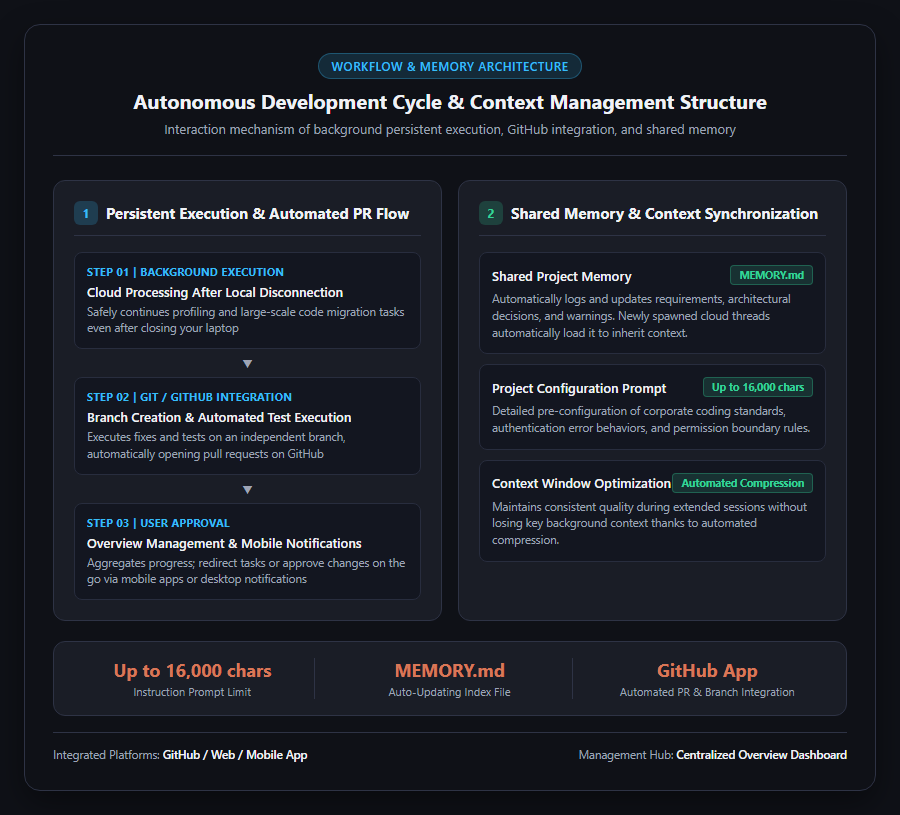
The introduction of cloud sessions fundamentally redefines continuity in software engineering. Because each thread continues executing on cloud servers even after a developer closes their local laptop, time-consuming activities like code profiling or large-scale codebase migrations can run safely in the background. Once a task is complete, the thread automatically opens a pull request on GitHub, summarizing its changes alongside test results. Real-time progress and pending pull requests are aggregated in a centralized “Overview” dashboard, enabling developers to redirect tasks or approve changes on the go via desktop notifications and mobile applications. For instance, in an API endpoint optimization task, cloud threads automatically perform profiling, execute parallel refactoring across multiple repositories, and submit clean pull requests for human review. Please refer to the structural diagram below for an overview of the development process.
2.2 Context Sharing Through Shared Project Memory and 16,000-Character System Instructions
To maintain consistency across multiple concurrent threads, Claude Code Projects incorporates shared project memory and customized prompt instruction frameworks. The shared memory centers around an index file named MEMORY.md, where the AI automatically logs and updates project requirements, architectural decisions, and edge-case warnings. Whenever a new cloud thread initializes, it reads this memory file at startup, ensuring it immediately inherits full context and project-specific guidelines before writing a single line of code. Furthermore, project configurations support system prompt instructions up to 16,000 characters, allowing teams to specify granular rules regarding corporate coding conventions, authentication error handling, and permission boundaries. Context window management is further optimized using automated compression techniques, ensuring the AI maintains focus and delivers consistent quality during extended development sessions without losing key background context.
Enterprise Deployment Requirements, Future Outlook, and Key Challenges
3.1 Prerequisites, Cost Structure, and Local Environment Constraints
Deploying cloud session capabilities requires fulfilling specific operational prerequisites and navigating notable constraints. Currently, the feature is accessible via the web interface (claude.ai/code), desktop applications, and mobile apps, but it does not yet support CLI terminal usage or third-party cloud integrations. Additionally, source code management depends strictly on GitHub integration, requiring organizations to install the official Claude GitHub App across their repositories. From a pricing perspective, the feature is included within existing subscription tiers (up to 200 new threads per day), though running high-performance models like Opus or Claude Fable 5.1 concurrently in the background can rapidly consume daily usage allowances. Furthermore, because tasks execute entirely within cloud sandboxes, threads cannot directly access local networks or local file systems. Consequently, security-conscious enterprises must carefully evaluate Managed Settings or self-hosted deployment alternatives to meet compliance standards.
3.2 Human-Led Governance and the Roadmap for Autonomous AI Agents
While AI agents are acquiring unprecedented autonomy, human oversight remains indispensable for quality assurance and system security. When dozens of parallel threads finish simultaneously, the resulting influx of pull requests can easily create a bottleneck in human code review, merge conflict resolution, and security verification. In response, Anthropic offers enterprise-grade defense-in-depth measures, including OS-level sandboxing, granular permission controls via Managed Settings, and centralized audit logging powered by OpenTelemetry. Looking ahead, planned updates include direct execution in local environments and more granular permission management, paving the way for a hybrid engineering model where repetitive tasks are delegated to AI while engineers focus on high-level architecture and governance. Effectively orchestrating and safeguarding autonomous AI agents will ultimately serve as a defining factor in corporate competitiveness for modern software engineering.
Reference Pages
-
[Claude Code Official Security Documentation] https://code.claude.com/docs/en/security
-
[Claude Code Official Settings Examples] https://github.com/anthropics/claude-code/tree/main/examples/settings
-
[Claude GitHub App] https://github.com/apps/claude
[#ClaudeCode #Anthropic #AIDevelopment #CloudSessions #AIAgents #SoftwareEngineering #GenerativeAI]
コメント