At his inaugural press conference, Minister of Land, Infrastructure, Transport and Tourism Tatsunori Ibayashi announced plans to eliminate operational bottlenecks and labor shortages in the logistics sector, emphasizing the powerful, on-the-ground implementation of key policies. This initiative comes as full enforcement of the Amended Logistics Efficiency Act approaches in April 2026, following the 2024 Problem, making structural supply chain reform an urgent imperative for shippers and carriers alike.
- Core Priorities and Field-Oriented Leadership in Minister Ibayashi’s Inaugural Address
- Leveraging “Logistics G-Men” to Eliminate On-the-Ground Operational Bottlenecks
- Clarifying Shipper Responsibility Under the Amended Logistics Efficiency Act
- Appointing Chief Logistics Officers (CLOs) and Drafting Mid-to-Long-Term Plans
- Standard Freight Rate Acceptance Rates and Challenges in Trade Normalization
- Shared Transportation Resources and Future Logistics Priorities
Core Priorities and Field-Oriented Leadership in Minister Ibayashi’s Inaugural Address
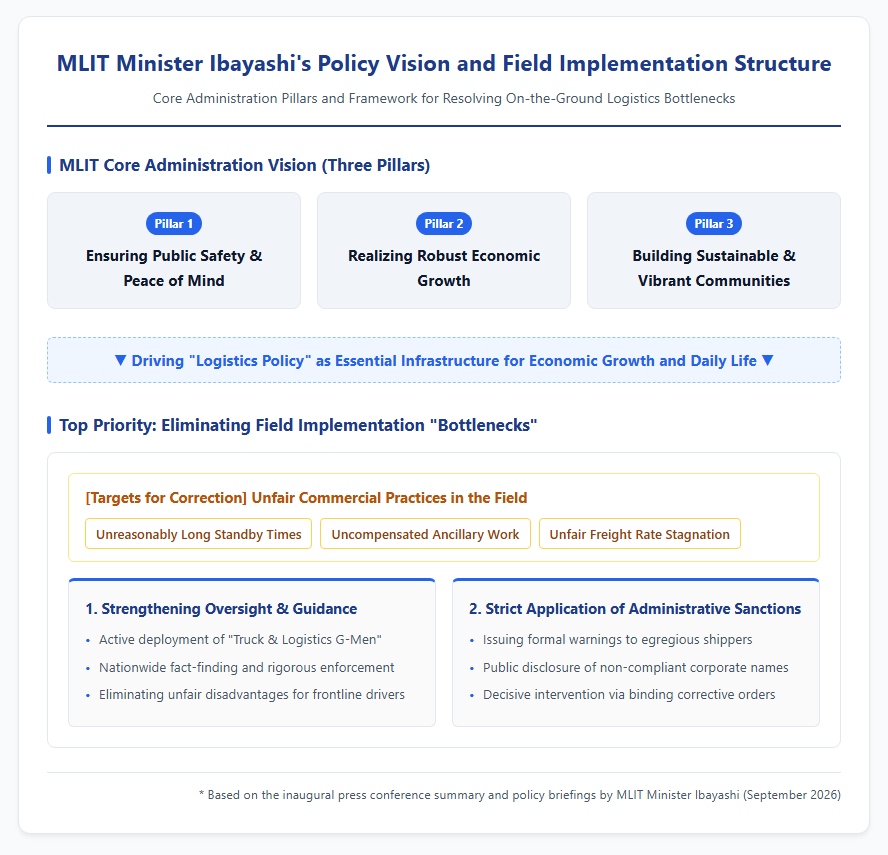
On September 18, 2026, following the formation of the Takaichi Cabinet, Tatsunori Ibayashi assumed office as Japan’s 27th Minister of Land, Infrastructure, Transport and Tourism (MLIT) and outlined his core administration policy during his inaugural press conference. Minister Ibayashi articulated a three-pillar vision: ensuring public safety and peace of mind, realizing robust economic growth, and building sustainable, vibrant communities tailored to local strengths. He particularly emphasized logistics as an indispensable social infrastructure vital for maintaining regional daily life and national economic vitality. Having previously chaired the ruling party’s logistics research committee, Minister Ibayashi brings extensive expertise to the role and expressed his intent to maximize the ministry’s field-level execution and integrated capabilities. During the conference, he made it his top priority to effectively embed existing measures into daily operations to prevent field disruption caused by rapid regulatory changes. Addressing concerns that policy momentum has failed to reach actual operations amid a wave of major legislative revisions and regulations, he signaled a steady leadership style focused on continuity and stability. The following image illustrates the press conference room at the Ministry of Land, Infrastructure, Transport and Tourism where the briefing took place.
Moving forward, he aims to carefully gather feedback from frontline workers while delivering tailored support and policy deployment responsive to the specific circumstances of each region and enterprise.
Leveraging “Logistics G-Men” to Eliminate On-the-Ground Operational Bottlenecks
Maintaining transport capacity has become a critical challenge for Japan’s logistics sector since April 2024, when a statutory annual cap of 960 overtime hours was imposed on truck drivers. While legal and institutional frameworks are being established, persistent feedback from diverse logistics operations suggests that tangible improvement remains scarce. In response, Minister Ibayashi announced plans to strengthen the monitoring and enforcement system operated by “Truck and Logistics G-Men” to correct unfair commercial practices, such as excessive unpaid waiting times forced by shippers and prime contractors, uncompensated ancillary work, and frozen freight rates. By actively deploying Logistics G-Men nationwide, the ministry aims to rectify abusive commercial behaviors and rapidly clear implementation bottlenecks. The top priority is creating an environment where frontline drivers and operators do not suffer unfair disadvantages, rather than simply adding new layers of regulation. MLIT will maintain rigorous oversight, keeping administrative sanctions in view—including formal warnings, public disclosure of non-compliant corporate names, and corrective orders against egregious shippers. Through this decisive field-level intervention, the government explicitly demonstrates its commitment to swiftly establishing fair trade practices and improving working conditions for truck drivers.
Legal and Regulatory Evolution: From the “2024 Problem” to the “2026 Problem”
Clarifying Shipper Responsibility Under the Amended Logistics Efficiency Act
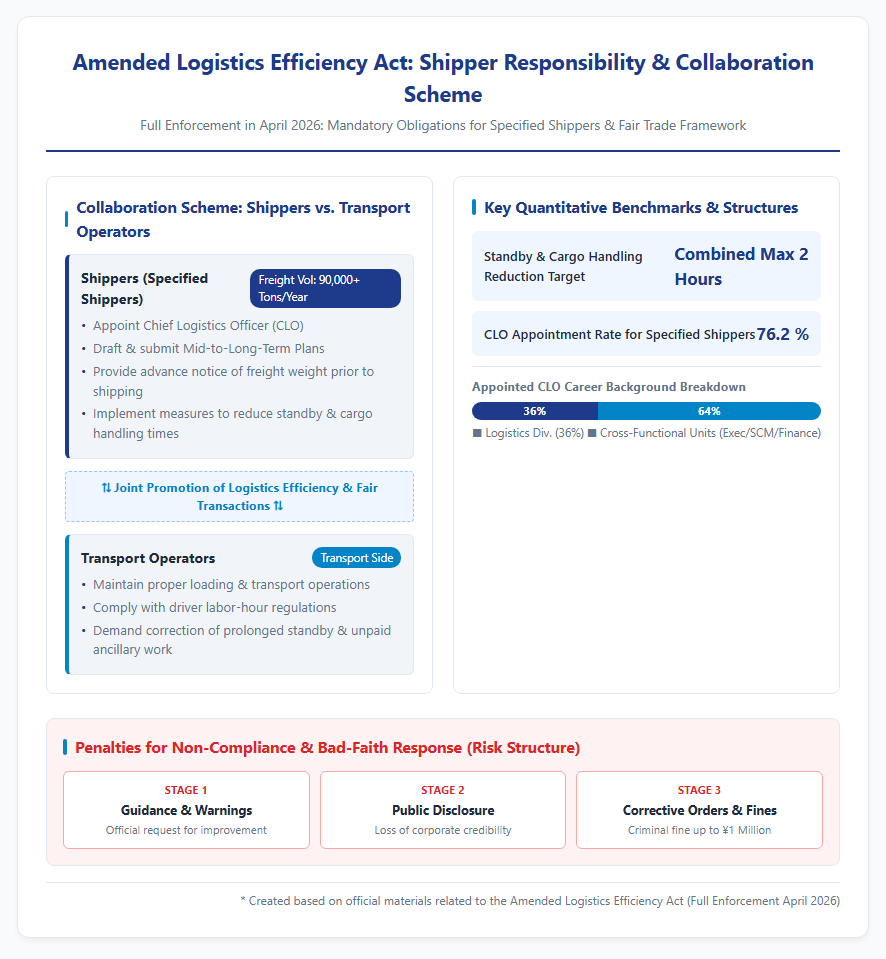
While the 2024 Problem focused primarily on carrier-side reforms centered on labor-hour caps for “the transport side,” the Amended Logistics Efficiency Act—set for full enforcement in April 2026—is fundamentally distinguished by imposing direct legal obligations on “the shipping side.” Consequently, logistics optimization is shifting from voluntary corporate effort to corporate governance and executive-level supply chain management. Enterprises transporting 90,000 tons or more of freight annually are designated as “Specified Shippers” and legally mandated to implement logistics efficiency measures. Specific obligations include capping truck driver standby and loading/unloading times to a combined maximum of two hours per visit, as well as providing advance notice of cargo weight prior to dispatch. Shippers that fail to fulfill these duties and ignore administrative guidance or corrective orders face strict penalties, including public disclosure of company names and criminal fines of up to 1 million yen. The following diagram illustrates the collaborative scheme between shippers and transport operators.
Today, logistics efficiency has become an essential compliance and governance mandate for corporate shippers.
Appointing Chief Logistics Officers (CLOs) and Drafting Mid-to-Long-Term Plans
Under the Amended Logistics Efficiency Act, Specified Shippers are legally required to appoint an executive-level Chief Logistics Officer (CLO) and submit mid-to-long-term operational plans. According to a survey conducted in March 2026, 76.2% of target Specified Shippers reported having already appointed or scheduled the appointment of a CLO. Regarding career backgrounds, while 36% of appointed CLOs hail from traditional logistics divisions, an increasing proportion is being selected from cross-functional corporate units such as executive planning, supply chain management (SCM), and finance. This trend reflects the realization that logistics optimization requires executive-level strategic decisions, such as revising contract terms and altering ordering practices, rather than simple operational tweaks. Specified Shippers must formulate and submit mid-to-long-term plans featuring concrete quantitative targets for reducing driver wait times, increasing load ratios, and promoting modal shifts. Preparations are well underway, including the distribution of industry-specific template guidelines for sectors like construction ahead of the initial filing deadline. Companies are urgently required to analyze their operational realities and execute data-driven strategic plans.
Freight Rate Realities and the Outlook for Sustainable Logistics
Standard Freight Rate Acceptance Rates and Challenges in Trade Normalization
To secure financial resources for truck driver wage increases and establish a sustainable transport framework, MLIT published revised “Standard Freight Rates” in March 2024, raising benchmark rates by an average of approximately 8%. According to a survey released in August 2026, 90% of transport operators engaged in rate negotiations with shippers—a substantial rise from 74% in the previous fiscal year. Among those who negotiated, approximately 78% (representing around 70% of all operators) reported obtaining a degree of understanding from shippers. However, only about 35% of carriers successfully secured 80% or more of the updated standard rates, exposing a clear gap between verbal understanding and actual cost passthrough. Key factors behind this discrepancy include the weak bargaining position of sub-contracted and sub-sub-contracted carriers within multi-tiered subcontracting structures, alongside the inability to bill separately for ancillary services like waiting and handling fees. Under amended legislation enacted in June 2025, MLIT is advancing regulations to restrict transactions below fair cost thresholds required for legal compliance, making the enforcement of viable freight rate levels a central focus moving forward.
Shared Transportation Resources and Future Logistics Priorities
To mitigate worsening driver shortages, the Japanese government is actively promoting integrated utilization of transport resources across modes and sectors. In March 2026, the Cabinet approved amendments to the Regional Public Transport Activation Act (the “Vehicle Sharing Bill”), creating a framework to jointly deploy local vehicle resources—such as school buses, welfare vehicles, and taxis—for both local freight delivery and passenger transport. Furthermore, integration between regional transport and logistics is advancing through Japanese-style public ride-sharing operating in over 775 areas nationwide, as well as combined passenger-cargo transport models in depopulated regions. Efforts to achieve the “Physical Internet” by 2040 are also accelerating, with roadmap revisions focusing on cross-industry commercial and logistics data sharing, pallet standardization, and joint transportation. As Minister Ibayashi emphasized, it is vital to translate new legal frameworks into tangible improvements felt on the ground rather than leaving them as mere paper concepts. Building a sustainable logistics ecosystem requires seamless, unified collaboration among government authorities, shippers, and transport operators.
Reference Pages
- [Minister Press Conference Summary – Ministry of Land, Infrastructure, Transport and Tourism] https://www.mlit.go.jp/report/interview/daijin260918.html
【#MinisterIbayashi #Logistics2024Problem #Logistics2026Problem #AmendedLogisticsEfficiencyAct #LogisticsGMen #MLIT #StandardFreightRates】


コメント