It has been revealed that Vietnamese companies closely linked to a sanctioned Chinese cotton giant have continued exporting garments to brands like MUJI U.S. This situation highlights the growing challenges of supply chain origin tracking and intensifying regulatory scrutiny under the Uyghur Forced Labor Prevention Act (UFLPA).
- Transshipment Allegations Surface Amid UFLPA Sanctions
- Entangled Ownership, Personnel, and Financing Structures
- Supply Chain Realities for MUJI U.S. and Major Apparel Retailers
- Human Rights Due Diligence and Audit Frameworks at Ryohin Keikaku
- Industry Blending Practices and Technical Challenges in Origin Tracking
- Regulatory Outlook and Strategic Imperatives for Global Businesses
Transshipment Allegations Surface Amid UFLPA Sanctions
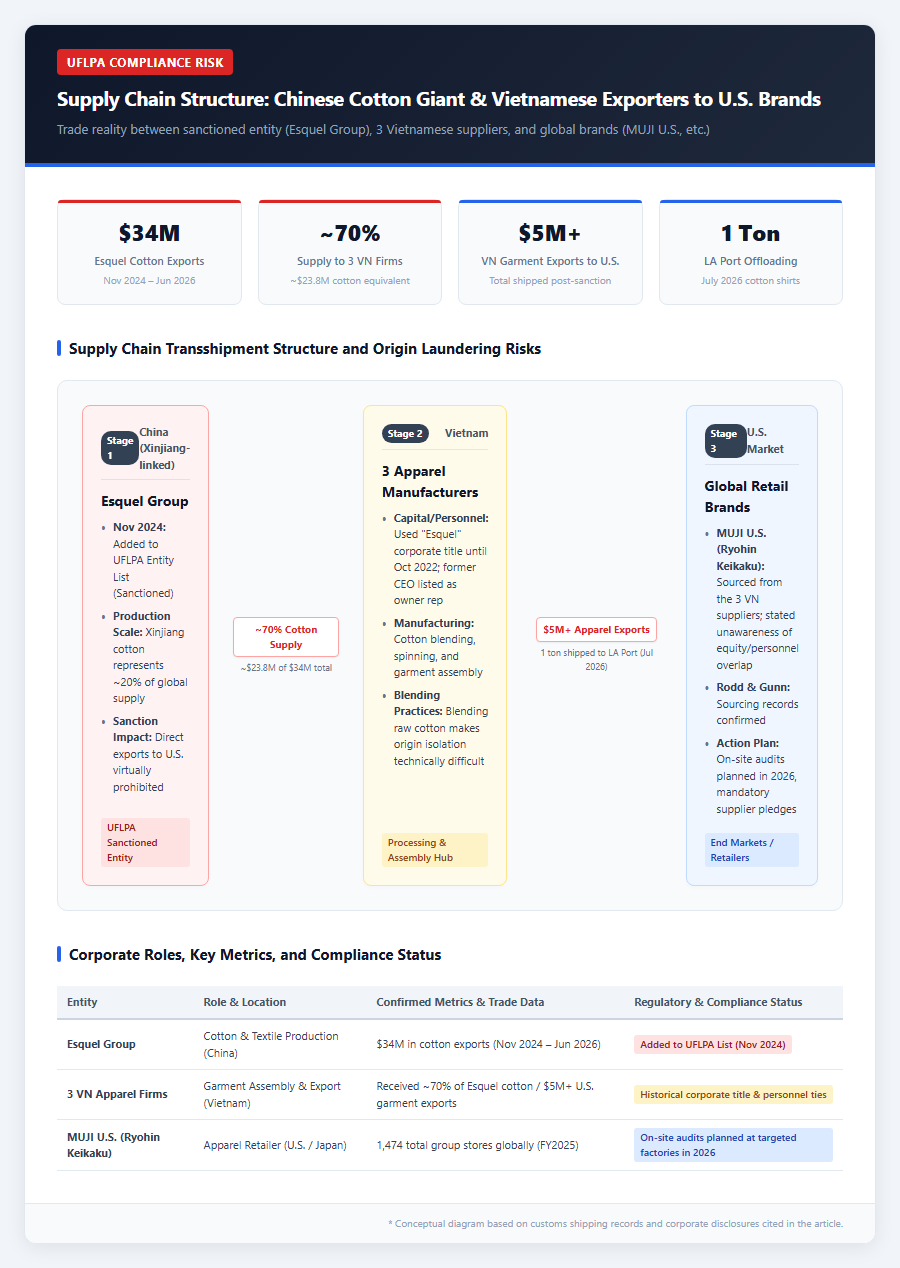
In September 2026, a Reuters investigation revealed that Vietnamese garment manufacturers with deep commercial ties to Esquel Group—a Chinese textile giant sanctioned under the U.S. Uyghur Forced Labor Prevention Act (UFLPA)—have been exporting apparel to the U.S. market. Enacted in 2021, the UFLPA effectively bars goods linked to the Xinjiang Uyghur Autonomous Region from entering the United States. Esquel, implicated in forced labor concerns within a region that accounts for roughly 20% of global cotton production, was added to the UFLPA Entity List in November 2024, virtually prohibiting its direct sales to U.S. customers. However, customs shipping records indicate that even after Esquel was sanctioned, three closely affiliated Vietnamese apparel manufacturers continued sourcing substantial volumes of cotton from Esquel while exporting at least \$5 million worth of cotton products to the United States. Furthermore, records show that in July 2026, one ton of cotton shirts unloaded at the Port of Los Angeles originated from these Vietnamese facilities.
Entangled Ownership, Personnel, and Financing Structures
The relationship between the three Vietnamese manufacturers in question and Esquel Group extends far beyond routine raw material transactions. Customs data shows that between November 2024 and June 2026, Esquel exported \$34 million worth of cotton from China, with approximately 70% directed to these three Vietnamese firms. Additionally, all three companies operated under the “Esquel” brand name in their corporate titles until October 2022. Executive ties also run deep: Edgar Tung, who served as CEO of Esquel until 2022, was listed in corporate filings as the owner’s representative for the three Vietnamese companies. Although the Vietnamese suppliers maintain alternative sourcing channels, Esquel has long been their primary buyer and supplier. Because blending cotton from multiple sources during the spinning process is standard industry practice, scientifically isolating or proving whether finished garments shipped from Vietnam to the U.S. contain Xinjiang or Esquel cotton remains technically daunting.
Sourcing Risks and Corporate Responses Across Global Brands
Supply Chain Realities for MUJI U.S. and Major Apparel Retailers
The final destinations for apparel shipped by these three Vietnamese suppliers included the U.S. entity of Ryohin Keikaku, the global brand behind Japan’s MUJI, as well as the New Zealand menswear retailer Rodd & Gunn. Shipping records indicate that MUJI U.S. maintained sourcing relationships with these Vietnamese manufacturers for years, dating back to when they openly incorporated “Esquel” into their corporate names. MUJI stated that it was unaware of any equity or personnel overlaps between the suppliers and Esquel. The company emphasized that it requires suppliers to sign pledges against forced labor and announced plans to conduct on-site audits at the relevant facilities within 2026. Rodd & Gunn also acknowledged sourcing from two of the factories while denying any direct involvement, illustrating the formidable challenge global brands face in monitoring lower-tier supply chains. This case underscores the urgent need to manage hidden risks not only at Tier-1 direct suppliers, but across secondary and raw material supply networks.
Human Rights Due Diligence and Audit Frameworks at Ryohin Keikaku
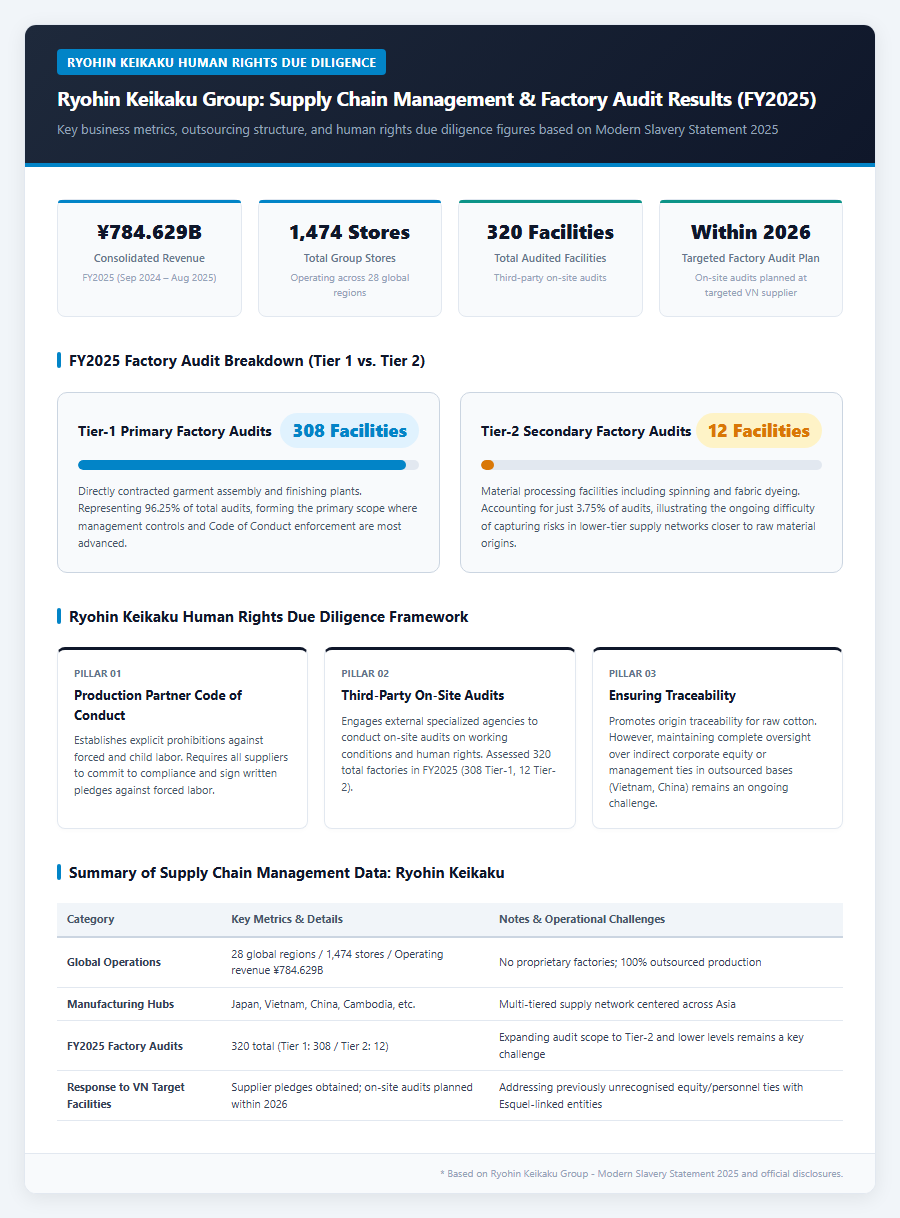
Ryohin Keikaku Group has established a human rights due diligence system aimed at preventing modern slavery and forced labor across its end-to-end supply chain, aligned with the UN Guiding Principles on Business and Human Rights. According to its Modern Slavery Statement 2025, the group achieved consolidated operating revenues of 784.629 billion yen during FY2025 (September 1, 2024 – August 31, 2025) and operates 1,474 stores across 28 global regions. Owning no proprietary manufacturing plants, the company fully outsources production to partner factories in Japan, Vietnam, China, Cambodia, and elsewhere. To oversee this network, Ryohin Keikaku enforces a Production Partner Code of Conduct and conducts periodic third-party on-site audits. In FY2025, the group audited 320 facilities, comprising 308 Tier-1 primary factories and 12 Tier-2 secondary factories, assessing them against strict performance metrics. While the group strives to ensure traceability for its primary raw material, cotton, maintaining total transparency across complex, multi-layered global supply chains presents an ongoing hurdle.
Impact on Vietnam’s Textile Industry and Global Supply Chains
Industry Blending Practices and Technical Challenges in Origin Tracking
This incident lays bare the technical and structural limitations of supply chain traceability within the global textile and apparel industry. In raw cotton trading, mixing cotton from diverse geographical sources during spinning is standard operating practice to ensure uniform quality and cost efficiency. Consequently, international concerns over “cotton laundering”—rerouting and disguising Xinjiang or sanctioned cotton through third countries to evade import bans—have intensified. Vietnam’s garment sector, heavily reliant on Chinese raw material imports while exporting finished apparel to Western and Japanese markets, is particularly vulnerable to trade policy shocks. While U.S.-bound factories are expected to furnish exhaustive documentation covering every phase from cotton farming to spinning, dyeing, and garment assembly, proving compliance becomes increasingly complex and costly as transshipment channels grow sophisticated.
Regulatory Outlook and Strategic Imperatives for Global Businesses
Looking ahead, U.S. Customs and Border Protection (CBP) and the Department of Homeland Security are expected to expand the UFLPA Entity List and strictly enforce detention rules against transshipment through third countries. For Japanese, Western, and global apparel brands relying on Vietnam as a primary manufacturing hub, conducting rigorous due diligence—scrutinizing supplier equity links, historical name changes, and ultimate raw material sources—is now mandatory. Trade investigations by Vietnam’s Ministry of Industry and Trade, alongside lingering origin uncertainties, pose direct operational risks to order confirmations and production timelines for upcoming fashion seasons. Going forward, brands must move beyond self-certified supplier pledges toward scientific origin verification technologies, such as DNA testing and isotopic analysis, while restructuring supply networks to secure resilient alternative sourcing bases. Balancing regulatory compliance with human rights mandates will remain the defining priority for global supply chain strategy.
Reference Pages
- [Statement Regarding U.S. Import Detention Reports | FAST RETAILING CO., LTD.] https://www.fastretailing.com/jp/sustainability/news/2105251100.html
【#UFLPA #SupplyChain #RyohinKeikaku #HumanRightsDueDiligence #VietnamApparel #GlobalTrade】
コメント