Thomson Reuters has unveiled “Thomson,” a proprietary large language model tailored specifically for specialized fields such as law and taxation. This move signals a strategic shift from renting massive general-purpose models to owning and controlling cost-effective, domain-specific AI trained on high-value proprietary data.
- The Arrival of Thomson Reuters’ In-House LLM “Thomson”
- Cost Efficiency via $40 Million Investment and Open-Source Foundation
- Specialized Training Driven by Vast Proprietary Data Assets
- Integration into CoCounsel Legal and Task-Based Model Delegation
- Elevating Legal Trust Through Data Security and “Sovereign AI”
- Global Expansion and the Future of Industry-Specific AI
The Arrival of Thomson Reuters’ In-House LLM “Thomson”
On August 24, 2026, global information services leader Thomson Reuters announced “Thomson,” a proprietary large language model (LLM) built specifically for professional workflows in legal, tax, and regulatory compliance. As enterprise AI adoption has historically relied heavily on general-purpose models hosted by big tech providers, Thomson Reuters’ approach of building and controlling its own dedicated model has drawn significant industry attention. High-stakes professional work demands precise, verifiable outputs rather than the surface-level answers typical of consumer-facing conversational AI. By combining decades of trusted information assets in law and accounting with advanced AI technology, Thomson Reuters aims to construct an AI foundation capable of upholding strict fiduciary standards.
Please refer to the following diagram.
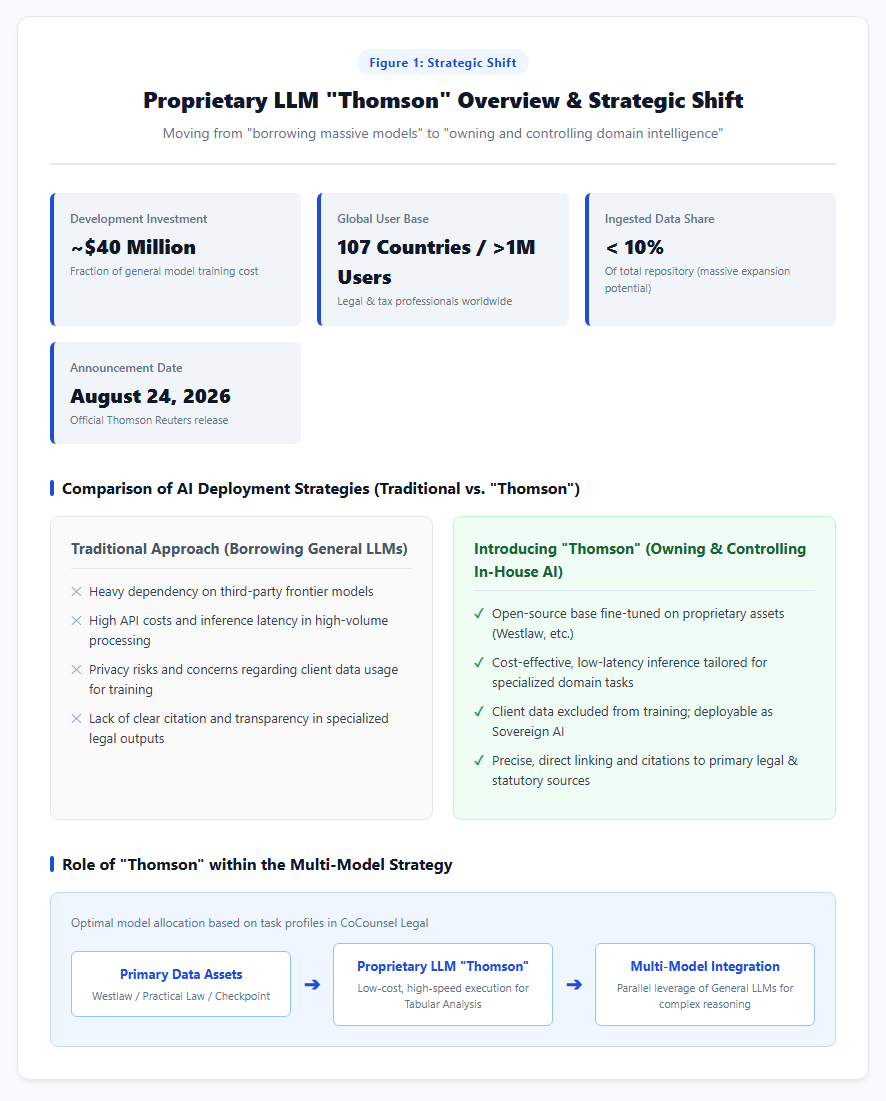
With over one million professional users across 107 countries, this announcement marks a pivotal milestone in transitioning enterprise AI strategy from “borrowed intelligence” to “owned and controlled sovereign intelligence.”
Cost Efficiency via $40 Million Investment and Open-Source Foundation
A defining feature of the “Thomson” model is its remarkable development efficiency and return on investment. Thomson Reuters leveraged a state-of-the-art open-source foundation model and fine-tuned it with its proprietary domain data. The total development investment reached approximately \$40 million, representing a small fraction of the cost required to train a general-purpose frontier model from scratch.
Restraining development overhead translates directly into significant operational savings, particularly regarding API fees and inference costs. Compared to massive general-purpose AI models that consume vast compute resources, a domain-specialized model delivers low-latency processing and rapid response times at a much lower cost. An independent evaluation conducted by Professor Jonathan H. Choi of the University of Washington School of Law confirmed that “Thomson” achieved response accuracy comparable to or exceeding the latest general-purpose frontier models, demonstrating superior performance in accurately referencing legal precedents and statutory data. This approach proves that a sustainable, economically viable development model can compete effectively against mega-AI vendors without sacrificing performance.
Technical Features and Multi-Model Strategy of “Thomson”
Specialized Training Driven by Vast Proprietary Data Assets
The true competitive advantage of “Thomson” lies not merely in its architecture or cost structure, but in the exceptional quality and depth of its training data. Thomson Reuters possesses decades of world-class content repositories, including case law and headnotes from Westlaw, legal practice commentary from Practical Law, tax and accounting guidance from Checkpoint, and news reporting from Reuters. “Thomson” underwent meticulous fine-tuning using these authoritative primary sources alongside expert-curated editorial data.
Currently, less than 10% of Thomson Reuters’ total content library has been ingested into the model, leaving substantial room for future expansion in precision and capability. To mitigate hallucinations—a primary concern with general-purpose generative AI—the model is engineered to directly cite and link to authoritative primary sources. As the source of value in AI shifts from raw parameter count to data trustworthiness and uniqueness, Thomson Reuters’ exclusive data moat serves as a powerful differentiator.
Integration into CoCounsel Legal and Task-Based Model Delegation
Thomson Reuters is not positioning “Thomson” to completely replace general-purpose models. Instead, the company continues to champion a “multi-model strategy” within its flagship legal platform, CoCounsel Legal, routing tasks to whichever model is best suited for the specific workload.
“Thomson” was first deployed within CoCounsel Legal’s “Tabular Analysis” feature, which extracts and compares data across large volumes of legal documents. By assigning a specialized model to repetitive, high-volume document reviews, the platform achieves both faster processing speeds and reduced compute costs. Conversely, for tasks requiring complex conceptual reasoning or multi-angled legal interpretations, CoCounsel Legal seamlessly leverages external state-of-the-art frontier models in parallel.
Please refer to the following diagram.
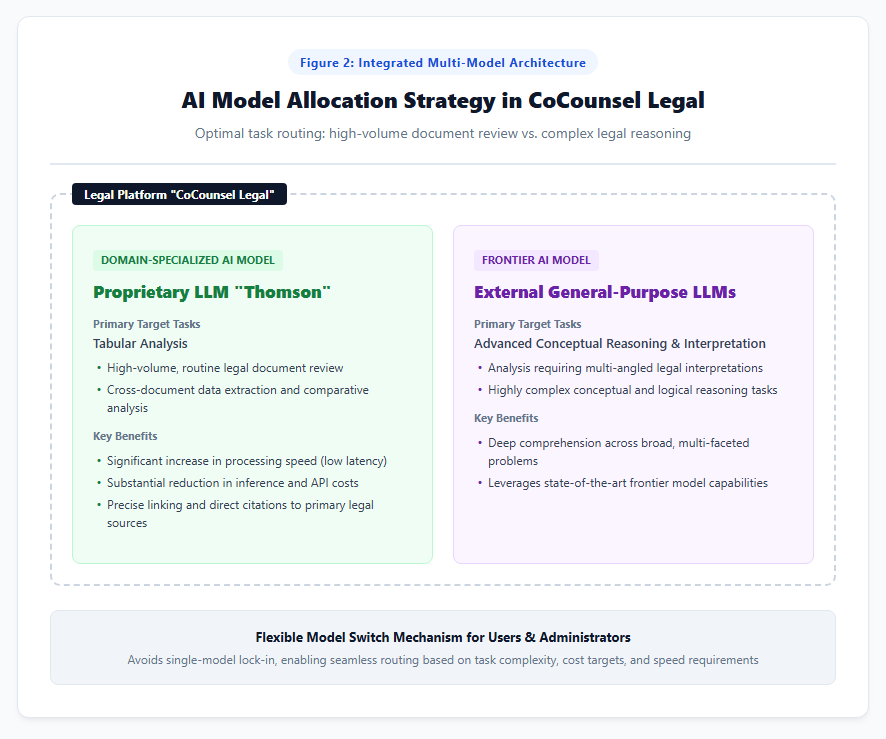
This flexible architecture allows users and administrators to switch between models as needed, creating an adaptable AI infrastructure that avoids reliance on any single model provider.
Market Impact and Future Outlook for Specialized AI
Elevating Legal Trust Through Data Security and “Sovereign AI”
Data privacy and security remain the most formidable hurdles for law firms and corporations considering enterprise AI integration. Legal practitioners handling sensitive client information harbor deep-seated concerns regarding data leakage via cloud networks or the unauthorized re-use of inputs for model training.
The deployment of “Thomson” offers a decisive answer to these security challenges by allowing Thomson Reuters to own and manage the underlying model infrastructure. Thomson Reuters maintains a strict policy ensuring client data is never used for model training without explicit consent. Furthermore, this proprietary framework paves the way for “Sovereign AI” deployments, allowing major law firms to run the model within private or on-premises environments. Enabling organizations to perform sophisticated legal analysis under their own administrative control—without sending data to external cloud APIs—provides an invaluable asset for professionals bound by fiduciary obligations.
Global Expansion and the Future of Industry-Specific AI
The release of “Thomson” signals a broader paradigm shift across B2B enterprise AI. The market is transitioning from an era of borrowing a single, massive third-party AI toward an era of owning and controlling specialized intelligence optimized around proprietary core data.
While initial rollouts focus on English-language legal and tax markets, upcoming integrations with regional platforms—such as Westlaw Japan and CoCounsel Japanese Edition—are expected to drive significant innovation in legal research and contract review in international jurisdictions. For enterprise clients previously hesitant to adopt generative AI due to accuracy concerns, a specialized model featuring verifiable citations and direct links to primary sources offers a compelling catalyst for adoption. By pairing proprietary data moats with operational cost efficiency, the “Thomson” model serves as a vital blueprint for the future of enterprise AI strategy.
References
- [Thomson Reuters Official Press Release] https://www.thomsonreuters.com/en/press-releases/2026/august/thomson-reuters-leverages-its-world-class-data-assets-to-launch-its-own-frontier-model
- [Thomson Reuters CoCounsel Legal Announcement] https://www.thomsonreuters.com/en/press-releases/2026/august/thomson-reuters-launches-next-generation-of-cocounsel-legal-the-ai-ecosystem-built-for-legal-professionals
【#Thomson #ThomsonReuters #GenerativeAI #LegalTech #LLM #SovereignAI】
コメント