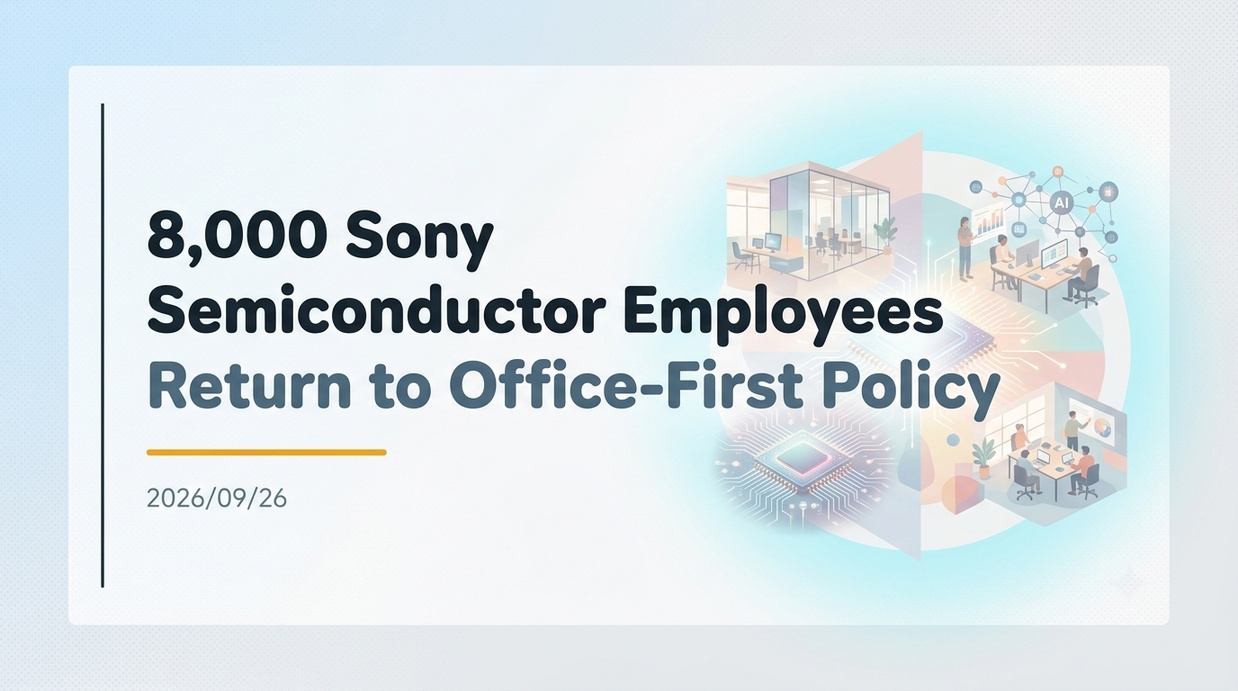
Sony Group’s semiconductor subsidiary has announced a policy to transition approximately 8,000 employees back to mandatory in-office work starting in October 2026. This decision aims to accelerate development speed in emerging fields like physical AI and strengthen strategic partnerships with external partners.
- Return-to-Office Policy for 8,000 Employees and Workplace Enhancement Initiatives
- The Dawn of Physical AI and Accelerating Cross-Functional R&D
- Close Collaboration Demanded by Major Joint Ventures with TSMC and Mitsubishi Electric
- The Global and Domestic Return-to-Office Wave and the Preference Gap
- Academic Insights on In-Person Value and Talent Retention Challenges
- Future Trajectory and Key Indicators for Business Growth
Return-to-Office Policy for 8,000 Employees and Workplace Enhancement Initiatives
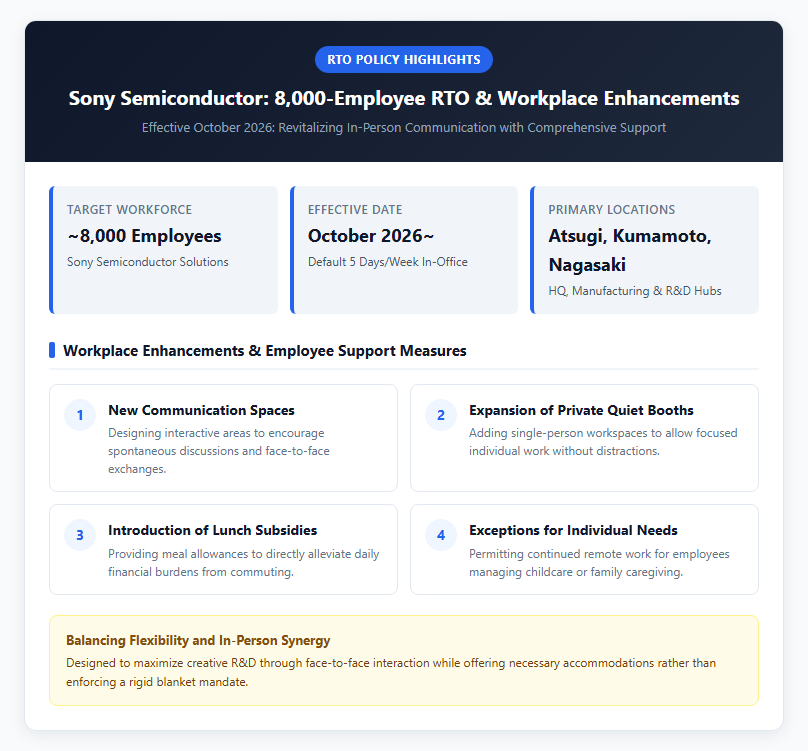
Sony Semiconductor Solutions, the semiconductor arm of Sony Group, has decided to transition approximately 8,000 employees to a default in-office work schedule starting in October 2026. The policy applies to personnel working at the company’s headquarters in Atsugi, Kanagawa Prefecture, as well as manufacturing and R&D facilities in Kumamoto and Nagasaki Prefectures. Moving away from the existing remote work framework, employees will generally be expected to work from the office five days a week. Notably, this decision extends beyond a simple attendance mandate by incorporating a comprehensive overhaul of the workplace environment alongside robust employee support measures. Specifically, the company is building new communication spaces to encourage spontaneous discussions while expanding single-person quiet booths to preserve individual focus. To alleviate the daily financial impact of commuting, a new lunch subsidy program is also being introduced. Additionally, exception provisions remain in place for employees facing personal circumstances such as childcare or family caregiving, ensuring flexibility while shifting toward an in-person-centric working model. For a visual overview of these workplace changes, please refer to the diagram below.
The Dawn of Physical AI and Accelerating Cross-Functional R&D
The primary driver behind Sony Semiconductor’s return-to-office push is its full-scale entry into the field of physical AI—where artificial intelligence controls robots and industrial machinery—and the accompanying need to restructure its development framework. Shinji Sashida, President of Sony Semiconductor Solutions, explained that achieving higher levels of speed and creativity is essential to maintaining leadership in an increasingly fierce global semiconductor market. While traditional image sensor development relied heavily on functional specialization across pixel and circuit design, physical AI demands an integrated approach that merges AI software, mechanical control, and manufacturing technology. While solo tasks with pre-defined scopes can maintain efficiency under remote arrangements, exploratory phases that involve negotiating specifications from scratch often suffer from slower decision-making when conducted solely via video conference. By prioritizing tacit knowledge sharing and creative sparks born from casual office chats and hallway encounters, the company aims to convert face-to-face interaction into a strategic competitive advantage.
Accelerating External Partnerships and Macro Workplace Trends
Close Collaboration Demanded by Major Joint Ventures with TSMC and Mitsubishi Electric
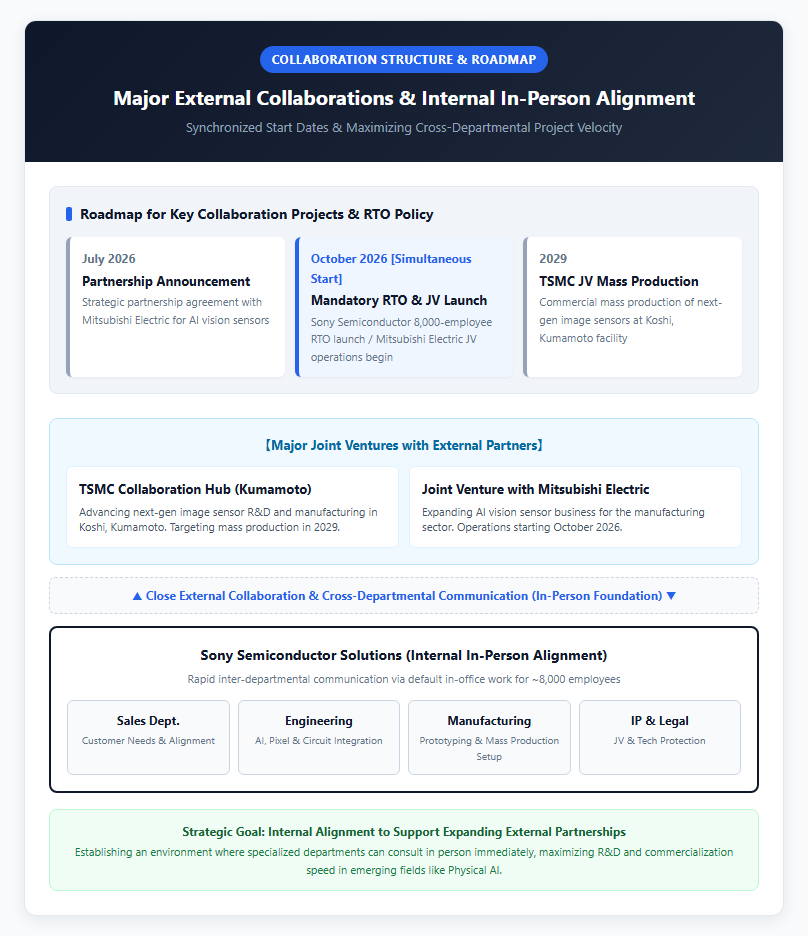
The background of this return-to-office shift is also deeply tied to the ramp-up of major strategic collaborations with global enterprises and domestic industry leaders. Sony Semiconductor has established a joint venture with Taiwan Semiconductor Manufacturing Company (TSMC) in Koshi, Kumamoto Prefecture, to develop and manufacture next-generation image sensors, embarking on a massive project targeting commercial production in 2029. Furthermore, in July 2026, the company announced a strategic partnership with Mitsubishi Electric for AI vision sensors aimed at the manufacturing sector, establishing a joint venture scheduled to launch operations in October 2026. Crucially, the October 2026 start date for the Mitsubishi Electric joint venture coincides exactly with Sony Semiconductor’s transition to default in-office work. Large-scale external collaborations carry the risk of project bottlenecks unless internal departments—such as sales, engineering, manufacturing, intellectual property, and legal—maintain seamless alignment. By standardizing internal communications around an in-person model right as external collaboration volume increases, the company seeks to maximize project momentum. The structural alignment between external partnerships and internal operations is illustrated in the diagram below.
The Global and Domestic Return-to-Office Wave and the Preference Gap
Sony Semiconductor’s mandate aligns with a broader trend toward in-person work accelerating across Japan and global markets. According to a July 2026 survey by Persol Research and Consulting, the telework adoption rate among full-time employees in Japan dropped for the second consecutive year to 21.4%, while the proportion of companies instituting default in-office policies rose to 24.6%, marking a reversal where office mandates surpassed remote work rates. In Japan, GMO Internet Group ended its work-from-home recommendation, while Obayashi Corporation and LINE Yahoo moved to increase required office attendance. Overseas, major technology firms are similarly retreating from full-remote models, exemplified by Amazon’s transition back to a mandatory five-day office schedule in January 2025. However, sentiment surveys reveal that 81.6% of current remote workers wish to maintain flexible arrangements, highlighting a persistent disconnect between the in-person value sought by management and the flexibility desired by employees.
Impact of In-Office Mandates and Key Future Outlook
Academic Insights on In-Person Value and Talent Retention Challenges
The rationale for return-to-office policies receives backing from recent academic research on organizational behavior and productivity. A study analyzing data from approximately 61,000 Microsoft employees revealed that firm-wide remote work reduced cross-departmental collaboration time by nearly 25%, causing internal communication networks to become more siloed and static. Further research indicates that remote teams spread across different locations are less likely to produce breakthrough innovations that refresh existing knowledge bases, demonstrating that physical presence supports innovation and early-career mentorship. At the same time, full office mandates carry distinct risks. Experimental research from Stanford University showed that hybrid models permitting two remote days per week reduced turnover rates by approximately one-third. Imposing unilateral office mandates risks triggering employee attrition and recruitment friction among highly sought-after AI researchers and semiconductor engineers.
Future Trajectory and Key Indicators for Business Growth
Whether Sony Semiconductor’s return to a five-day office model succeeds will serve as a crucial bellwether for the future of work across Japanese industry. For investors and business observers tracking upcoming developments, several key milestones warrant close attention. First, whether transitioning to an in-person framework actually accelerates the commercialization of innovative products and new ventures in physical AI and industrial vision sensing. Second, whether joint ventures with TSMC and Mitsubishi Electric achieve their planned strategic benchmarks. Third, whether the company can minimize turnover spikes and continue recruiting top-tier technical talent amid intense competition for semiconductor and AI expertise. Simply gathering workers in physical facilities will not automatically generate value; success hinges on converting office time into high-impact collaboration through thoughtful workspace design and supportive perks. Close monitoring of subsequent financial performance and organizational dynamics remains essential.
References
- [Sony Semiconductor Solutions News Release] https://www.sony-semicon.com/ja/news/2026/2026081101.html
- [Mitsubishi Electric News Release] https://www.mitsubishielectric.co.jp/ja/pr/2026/pdf/0722_fa.pdf
- [Persol Research and Consulting 11th Telework Survey] https://rc.persol-group.co.jp/thinktank/data/telework-survey2026/
- [Ministry of Land, Infrastructure, Transport and Tourism FY2025 Telework Survey] https://www.mlit.go.jp/report/press/toshikankyoteleworkr7.html
【#Sony #ReturnToOffice #WorkplaceTransformation #PhysicalAI #Semiconductor #RemoteWork】
コメント