China continues to import Iranian crude oil despite U.S. secondary sanctions, maintaining its supply through extensive evasion networks and yuan-denominated settlements. Driven by geopolitical and economic motives, Beijing seeks to secure low-cost energy resources while countering American pressure.
- The Reality of Iranian Oil Imports Bypassing U.S. Sanctions
- Shadow Fleets and Rerouting: The Origin-Falsification Mechanism
- U.S. OFAC Sanctions on Hengli Petrochemical and Operation Economic Outcast
- Expansion of Yuan Settlement (CIPS) and China’s Anti-Foreign Sanctions Law
- Multilateral Impacts on Global Energy Markets and Oil Prices
- Structural Shifts in China and Future Outlook
The Reality of Iranian Oil Imports Bypassing U.S. Sanctions
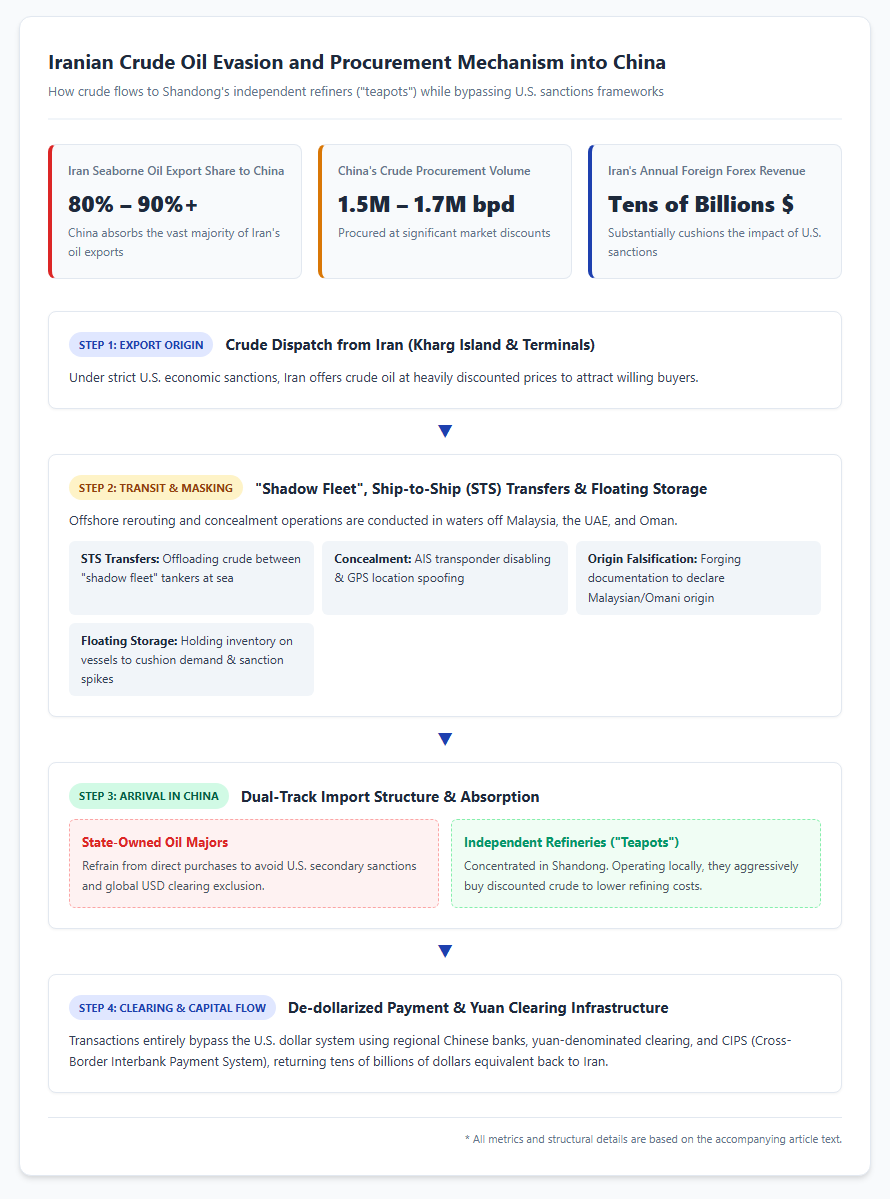
As the United States reinstates its “maximum pressure” campaign against Iran’s oil industry and warns of secondary sanctions against trading entities, China continues its steady procurement of Iranian crude. While most major nations halted or reduced their Iranian oil purchases to zero, China has consistently bought 80% to over 90% of Iran’s seaborne crude exports. With volumes reaching between 1.5 million and 1.7 million barrels per day (bpd), this trade has established an entrenched mechanism providing Tehran with tens of billions of dollars in vital annual foreign exchange revenue. Driving this massive import volume are small, independent refineries—commonly known as “teapots”—concentrated primarily in China’s Shandong province. While major state-owned oil enterprises refrain from direct purchases due to compliance fears regarding U.S. sanctions, these teapots operate locally and remain isolated from the international dollar-based financial architecture, allowing them to aggressively purchase heavily discounted, sanctioned crude. This affordable supply significantly lowers China’s refining costs while serving as a crucial buffer that mitigates the economic impact of U.S. sanctions on Tehran. The following diagram illustrates the structure of China’s crude oil intake.
Shadow Fleets and Rerouting: The Origin-Falsification Mechanism
China’s ability to procure Iranian crude while circumventing the U.S. sanctions framework relies on a sophisticated and intricate smuggling network established between the two nations. The majority of the oil is shipped from Iran’s Kharg Island before traveling to offshore transit hubs in Southeast Asia and the Persian Gulf, including waters off Malaysia, the United Arab Emirates, and Oman. There, a “shadow fleet” of sanctions-evading tankers conducts ship-to-ship (STS) transfers at sea. By combining these transfers with the disabling of Automated Identification Systems (AIS), location spoofing, and the falsification of customs documentation and certificates of origin, the crude arrives at Chinese ports disguised as Malaysian or Omani origin. Furthermore, oil that cannot be immediately delivered is held in floating storage aboard tankers. This floating inventory acts as a buffer when U.S. enforcement temporarily tightens and delays unloading, ensuring supply flexibility as it can be rapidly drawn down when demand surges. Through these multi-layered rerouting tactics and concealment technologies, a stable oil flow has been sustained while evading tracking by the U.S. Treasury’s Office of Foreign Assets Control (OFAC).
Escalating U.S.-China Friction and Financial-Legal Countermeasures
U.S. OFAC Sanctions on Hengli Petrochemical and Operation Economic Outcast
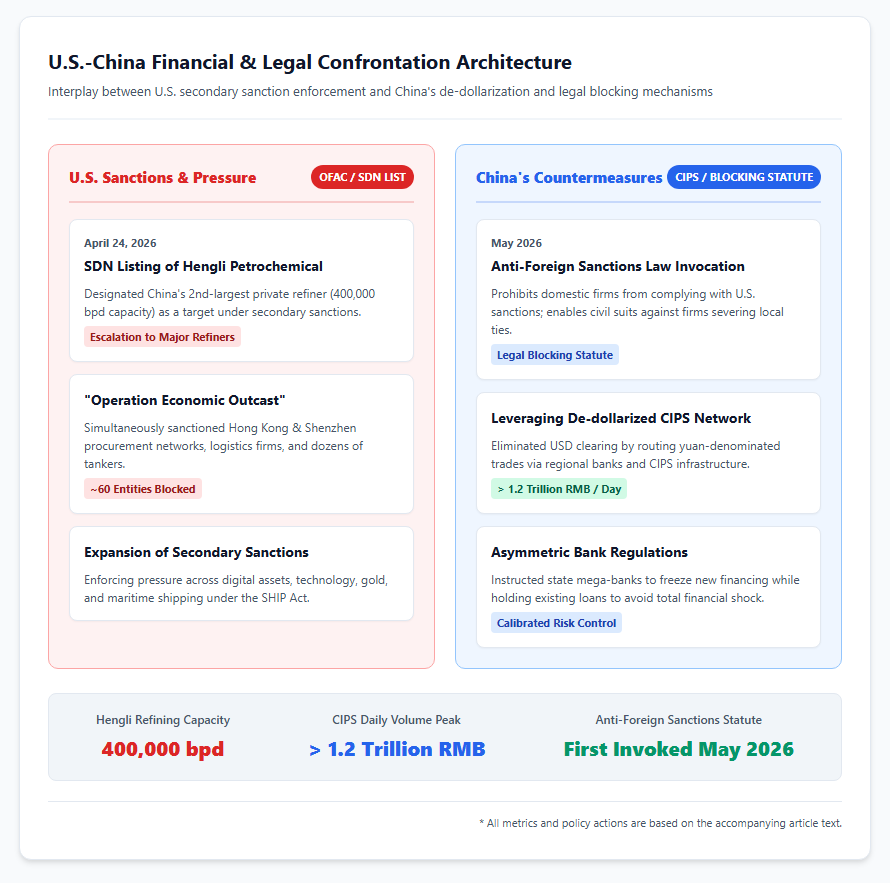
To sever Iran’s financial lifelines, the Trump administration has rapidly escalated enforcement under the legal framework of the Stop Harboring Iranian Petroleum (SHIP) Act. On April 24, 2026, the U.S. Department of the Treasury’s Office of Foreign Assets Control designated Hengli Petrochemical—China’s second-largest private refiner—on the Specially Designated Nationals (SDN) list. Targeting a major private refiner with a processing capacity of 400,000 bpd, rather than relying solely on individual enforcement against small independent teapots, marks a major escalation in geopolitical conflict between Washington and Beijing. Additionally, the U.S. government launched “Operation Economic Outcast,” a financial disruption strategy that simultaneously sanctioned procurement networks, logistics firms, and dozens of tankers based in Hong Kong and Shenzhen. Secondary sanctions have also expanded to cover digital assets, technology, gold, and maritime shipping, intensifying pressure on the peripheral support system of Iran’s oil ecosystem. The Treasury Department’s actions are mapped out in the diagram below.
Expansion of Yuan Settlement (CIPS) and China’s Anti-Foreign Sanctions Law
In response to financial sanctions rooted in U.S. dollar hegemony, China has deployed its domestic legal arsenal and proprietary payment infrastructure to execute robust countermeasures. In oil transactions with sanctioned Iran, dollar-denominated clearing has been completely eliminated in favor of yuan-denominated trades routed through small-to-medium Chinese banks and the Cross-Border Interbank Payment System (CIPS). Daily transaction volume on CIPS has surged past 1.2 trillion yuan, reaching an all-time high and accelerating global de-dollarization. Furthermore, in May 2026, China’s Ministry of Commerce invoked the country’s Anti-Foreign Sanctions Law (blocking statute) for the first time since its enactment. This legal mechanism prohibits domestic enterprises and financial institutions from complying with U.S. extraterritorial sanctions, enabling Chinese courts to order compensation from entities that sever business ties in accordance with American directives. Simultaneously, Chinese financial regulators have issued asymmetrical instructions to state-owned mega-banks, directing them to halt new financing to targets like Hengli Petrochemical while freezing existing loans rather than recalling them—a calibrated risk management strategy designed to prevent catastrophic exclusion from the global dollar clearing system.
Impact on Oil Markets and Medium-to-Long-Term Outlook
Multilateral Impacts on Global Energy Markets and Oil Prices
China’s ongoing importation of Iranian crude exerts a highly complex influence on global oil market dynamics and price formation. The continuous supply of Iranian oil through informal channels partially relieves global supply tightness. However, as military friction between the U.S. and Iran escalates and the risk of operational disruptions in the Strait of Hormuz rises, a geopolitical risk premium has been priced into the market, keeping WTI and Brent crude elevated in the \$90 to \$100 per barrel range. For the U.S. government, imposing full secondary sanctions that completely cut off China’s major state-owned banks from dollar clearing represents a double-edged sword: it risks triggering a global financial crisis while driving oil prices sharply higher, ultimately causing a domestic backlash from rising U.S. gasoline prices. As a result, Washington is compelled to hold its most potent financial nuclear option as negotiating leverage, leaving the market in a precarious state characterized by high oil prices and lingering sanction risks.
Structural Shifts in China and Future Outlook
Looking ahead, key developments will hinge on two primary factors: potential political compromises at U.S.-China summit meetings and structural shifts within China’s domestic energy landscape. In direct talks between President Trump and Chinese President Xi Jinping, cracking down on Iranian oil trade is expected to be a top agenda item alongside trade negotiations and Taiwan. Yet beyond external sanction pressure, fundamental changes in China’s internal oil demand could reshape the Iranian supply chain. Accelerated adoption of electric vehicles (EVs), the rapid transition to LNG-powered commercial trucks, and moderating economic growth are projected to cause China’s oil demand to peak well before 2030. In anticipation of declining demand, the Chinese government plans to consolidate and decommission smaller independent teapots, potentially shrinking the primary domestic absorption capacity for Iranian crude. Moving forward, alongside U.S. diplomatic and sanctions risks, China’s own decarbonization momentum and industrial restructuring will serve as the pivotal variables dictating the survival of Iran’s oil supply network.
References
-
【JOGMEC JOURNAL】https://journal.jogmec.go.jp/oilgas/info-reports/info-reports_02086.html
-
【Shin & Kim Trade & Industrial Policy Newsletter】https://www.shinkim.com/jpn/media/newsletter/3372
[#IranianCrude #ChineseEconomy #USSanctions #EnergySecurity #YuanSettlement #TeapotRefining #OilMarket]

コメント