US-based Cloudflare has released a closed beta of “Monetization Gateway,” which enables API access to be directly sold and settled on a per-request basis for AI agents. The background to this is the current reality where traditional subscription and prepaid methods cannot accommodate the fine-grained, pay-as-you-go consumption by AI agents, and the economic model of the web is facing a period of transformation.
- Key Points of Cloudflare’s Announcement on Single-Request Payment Feature
- The Technical Mechanism of the Resurrected Web Standard “HTTP 402” and the “x402” Protocol
- Effects in Implementing Companies and Demonstration of Conversion Improvements
- The Limitations of the Subscription Model and the Superiority of Micro-payments
- Security Risks and Facilitator Verification Challenges
- The Future Vision and Key Focus Areas of Agent Commerce
Key Points of Cloudflare’s Announcement on Single-Request Payment Feature
On September 30, 2026, US-based Cloudflare announced the closed beta release of “Monetization Gateway,” a new feature that allows APIs, data, and web content to be sold to AI agents on a per-request basis. The feature has started rolling out to sellers and buyers in the United States, enabling the instant monetization of digital resources such as websites, APIs, MCP (Model Context Protocol) tools, and datasets. When using the service, AI agents do not need to complete prior account registration, sign advance contracts, or obtain API keys. Necessary conditions are presented instantly upon request, allowing payments to be completed on the spot to receive data. The “x402” machine-to-machine payment protocol is adopted as the payment infrastructure, with instant settlement processed via the US dollar-pegged stablecoin “USDC” on Ethereum’s Layer 2 blockchain “Base” through Coinbase’s “x402 Facilitator.” Pricing can be freely controlled by sellers, supporting not only fixed prices but also flexible settings based on variables, with a minimum payment threshold starting at $0.001 (approx. 0.15 yen). By eliminating the hassle of credit card registration, the foundation has been established for a programmable web economy where programs can autonomously make purchases.
The Technical Mechanism of the Resurrected Web Standard “HTTP 402” and the “x402” Protocol
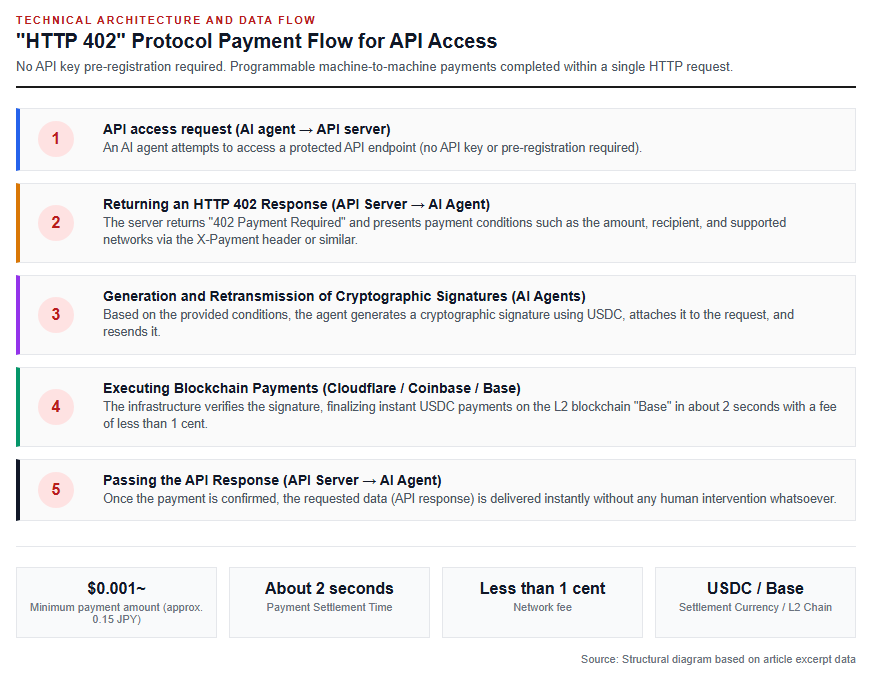
At the technological core of the Monetization Gateway is the combination of the HTTP status code “402 Payment Required” and the payment protocol “x402.” Although HTTP 402 was reserved for “future payment systems” when the HTTP/1.0 specification was established in the 1990s, it remained unused for many years due to the lack of practical micropayment methods. However, with the advent of cryptocurrency technology and Layer 2 blockchains, extremely low fees and fast finality have been achieved, enabling its technical revival. In an actual communication flow, when an AI agent attempts to access a protected API endpoint, the server responds with an HTTP 402 response along with payment conditions such as the payment amount, destination address, and supported networks (via the X-Payment header, etc.). Based on the presented conditions, the agent generates a cryptographic signature, attaches it to the request, and resends it. After Cloudflare and Coinbase infrastructure verifies this signature and settles the payment on the Base chain in approximately 2 seconds with a fee of less than 1 cent, the desired API response is delivered. Because it is completed within a single HTTP request-response cycle without any redirection to a checkout screen or manual card input operations by a human, it is optimized for automated programs.
Comparison between Early Adoption Cases and Traditional Payment Models
Effects in Implementing Companies and Demonstration of Conversion Improvements
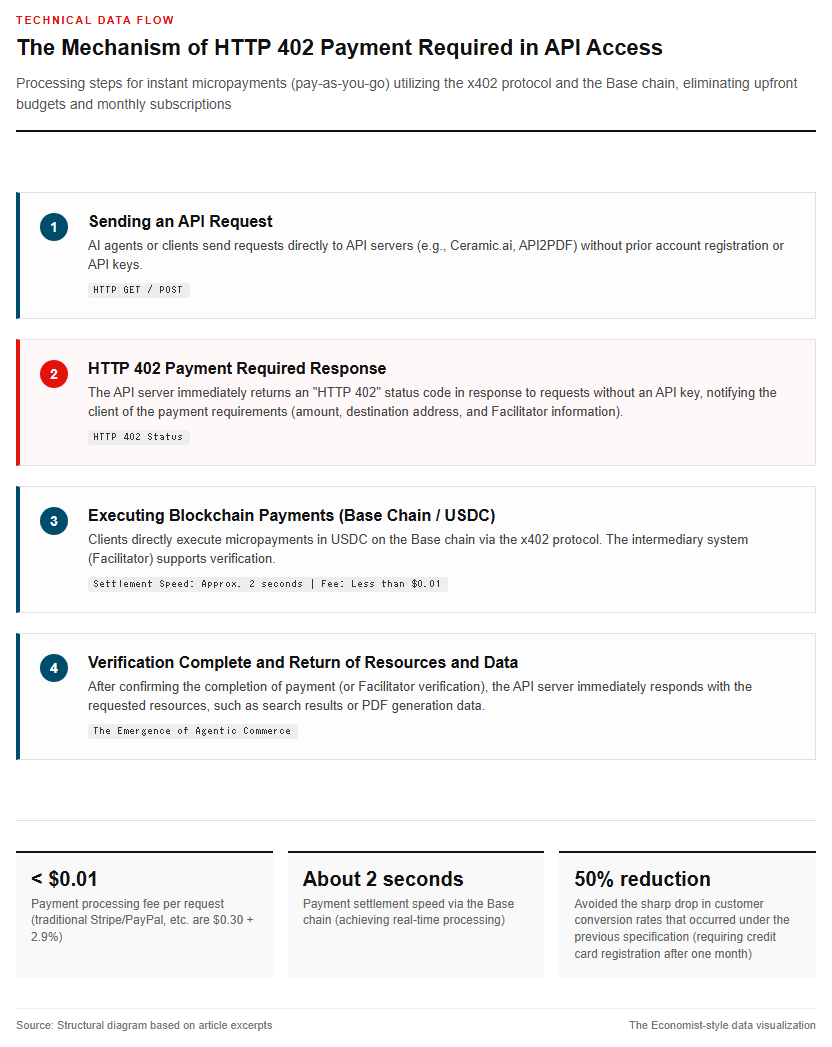
As an early adoption case study of Monetization Gateway, several services are already operating this feature in production. “API2PDF,” a provider of a PDF generation API, had adopted a pay-as-you-go pricing model, but previously used a specification that required users to register credit card information one month after starting use. At that point, they faced the issue of customer conversion rates plummeting by over 50 percent. By implementing Monetization Gateway, API2PDF switched to a method where requests without an API key return an HTTP 402 response and are billed directly in USDC for each PDF generation, successfully preventing customer churn. Additionally, “Ceramic.ai,” a search engine for agents that boasts a proprietary index of over 40 billion pages, built a system to instantly settle payments for each search request without an API key. Search is the most frequently called function for AI agents, and the flexibility to purchase only what is needed without being constrained by upfront budgets has been well received. The diagram below shows the data flow for HTTP 402 payments in API access.
Additionally, the investor social network “Stocktwits” has started providing market signals on demand, and Cloudflare’s own “AI Gateway” now enables payment per model inference without upfront credits.
The Limitations of the Subscription Model and the Superiority of Micro-payments
Major payment services such as Stripe and PayPal, which have traditionally handled internet payments, operate on a fee structure that incurs a fixed fee of about $0.30 (approx. 45 yen) per transaction, plus a percentage fee of around 2.9 percent. Under this fee structure, if charges are applied to micro-payments for API access such as $0.01 (approx. 1.5 yen) or $0.001, the payment fees exceed the transaction amount, making the business unviable. Consequently, traditional Web APIs have had to rely on monthly flat-rate subscriptions or prepaid credit models where a lump sum is purchased in advance. However, autonomously operating AI agents temporarily explore and utilize thousands of different web services and APIs to complete tasks. Creating an account and signing a monthly contract for every single service is not realistic. The combination of the x402 protocol and the Base chain keeps payment fees below $0.01 and achieves a settlement speed of about 2 seconds, making complete pay-per-use billing on a per-request basis economically viable. This can be described as a definitive technological breakthrough that shifts from the traditional human-centric payment model to “Agentic Commerce,” where machines trade directly with one another.
Ripple Effects on the Web Economy and Facing Challenges and Prospects
Security Risks and Facilitator Verification Challenges
While the integration of HTTP 402 and blockchain payments is innovative, it also highlights operational security risks and implementation challenges. According to research presented at USENIX Security ’26 and other sources, vulnerabilities stemming from the verification logic and timing of Facilitators, which mediate between verification and settlement, have been reported. In particular, a “Free Shopping” risk has been pointed out, where the server relies solely on the temporary verification success (Verify) by the Facilitator to return resources, and if the subsequent payment settlement on the blockchain (Settle) fails, the service is utilized without payment. The diagram below shows the processing procedures and security boundaries for verification and settlement via a Facilitator.
Additionally, other threats being examined include “Gas Abuse,” in which attackers flood the system with invalid payment proofs to indefinitely inflate the Facilitator’s gas fee burden, and relay attacks exploiting Nonce (sequence number) conflicts. In response to these, the server side is strongly required to implement strict measures—such as releasing resources only after confirming that payments are fully finalized on-chain (Server-SR1/SR2)—and to tighten validation checks in smart contract signature verification functions (such as ERC-3009 and ERC-1271).
The Future Vision and Key Focus Areas of Agent Commerce
US-based Cloudflare is going beyond the deployment of its Monetization Gateway by expanding partnerships with major global payment companies such as Visa, Mastercard, and American Express. Through Web Bot Auth (an authentication standard for web bots) and the Trusted Agent Protocol, the company is building a foundation of trust for agent commerce, where AI agents complete purchasing procedures on behalf of consumers. Furthermore, it is diversifying its content monetization frameworks through initiatives like “Pay Per Crawl,” which charges for website browsing and crawling stages, and “Pay Per Use,” which requires payment based on actual content utilization in AI searches and other services. Moving forward, the key points of focus will be when the closed beta currently limited to the United States will expand globally, including to Japan, and how interoperability will be maintained with existing payment platforms such as Visa Intelligent Commerce and Mastercard Agent Pay. As bot traffic is projected to dwarf human access, there is intense interest in future trends to see whether instant payment capabilities utilizing HTTP 402 will become established as a new economic standard for the entire web.
Reference page
- Cloudflare Blog – Monetization Gateway beta: charge AI agents for consumption with HTTP 402
- 【Cloudflare Press Release – Cloudflare Collaborates with Leading Payments Companies】https://www.cloudflare.com/press/press-releases/2025/cloudflare-collaborates-with-leading-payments-companies-to-secure-and-enable-agentic-commerce/
- [USENIX Security ’26 – When HTTP 402 Meets the Blockchain: Risks on Emerging x402 Payments]https://www.usenix.org/conference/usenixsecurity26/presentation/wang-qinying
[#Cloudflare #HTTP402 #x402 #AIAgents #Blockchain #Micropayments #AgentCommerce]
コメント