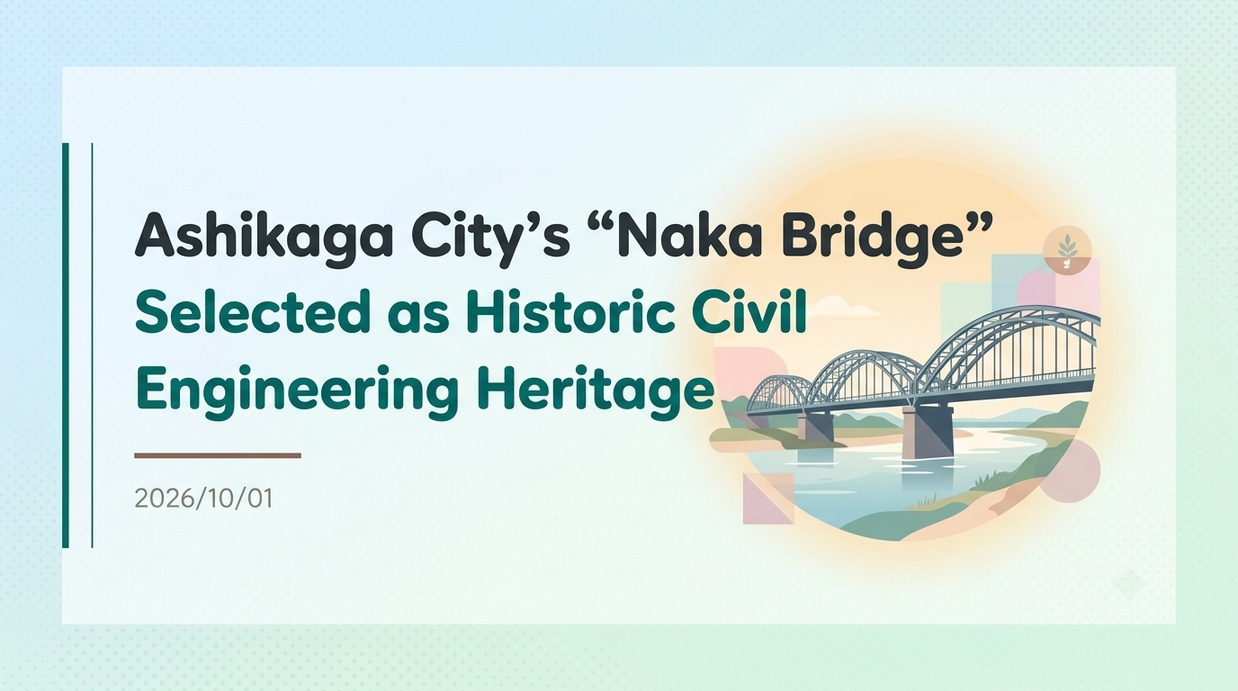
“Nakahashi,” a bridge spanning the Watarase River in Ashikaga City, Tochigi Prefecture, has been selected as a FY2026 Historic Civil Engineering Structure by the Japan Society of Civil Engineers. The background to this selection includes high praise for the historical and technical value of the rare three-span steel arch bridge completed in 1936, as well as the groundbreaking initiative to relocate the existing bridge structure to the downstream side for preservation and reuse during a replacement project associated with flood control measures.
- Background and Significance of the Selection of a Rare Triple-Span Steel Arch Bridge Completed in 1936
- Characteristics of the Braced-Rib Tied-Arch Structure Boasting Technical Value
- The Role of Local Communities and Citizen Movements in Preserving and Passing Down Historic Structures
- Background of the Decision for Levee Raising and Bridge Reconstruction Projects Aimed at Overcoming Flood Risks
- Japan’s first slide and hoisting relocation method for a massive 750-ton triple-arch bridge
- Project Cost Re-evaluation, Increase to the ¥21 Billion Scale, and Cost Reduction Initiatives
- Reuse as a pedestrian and bicycle-only path and downtown revitalization initiative
- Upcoming Focal Points and Schedule for Shinbashi Construction and Urban Infrastructure Redevelopment
Background and Significance of the Selection of a Rare Triple-Span Steel Arch Bridge Completed in 1936
In September 2026, the Japan Society of Civil Engineers (JSCE) selected the “Nakabashi” bridge, located in Ashikaga City, Tochigi Prefecture, as a 2026 (Reiwa 8) Historic Civil Engineering Structure to be recognized for its historical significance. The Historic Civil Engineering Structure certification program was established in fiscal 2000 to target valuable civil engineering facilities that are generally 50 years or older since their completion, with approximately 20 projects certified nationwide each year. This certification of Nakabashi marks the 22nd such achievement within Tochigi Prefecture. Nakabashi is a historic steel bridge that opened on August 7, 1936 (Showa 11). Spanning the Watarase River, which flows through the center of Ashikaga City, it was created as a connecting route between Tobu Railway’s Ashikaga-shi Station and the urban area. For approximately 90 years since its completion, it has functioned as a key pillar supporting local transportation, playing an important role as part of a main arterial road used by about 13,000 vehicles per day. In this selection, extremely high praise was given not only to the structure’s age or the elegance of its design, but also to the advanced preservation process itself: as part of a bridge reconstruction plan accompanying flood control measures for the Watarase River, the historical landmark beloved by citizens was not lost, but rather relocated downstream to be passed on to the future as a dedicated pedestrian and bicycle pathway.
Characteristics of the Braced-Rib Tied-Arch Structure Boasting Technical Value
The greatest structural feature of the Nakahashi Bridge lies in its adoption of an extremely distinctive structural system known as a “braced-rib tied arch bridge” (specifically, a through braced-rib tied arch bridge), which developed primarily in Germany in the early 20th century. In terms of scale, the central steel arch section spanning the Watarase River consists of three consecutive arches with a span length of 65.8 meters each, bringing the total bridge length to 286.08 meters and a width of 11 meters. Each steel arch span weighs approximately 250 tons, boasting a combined weight of about 750 tons for all three spans. The design was handled by Hideo Hamada, an engineer of the era, while the manufacturing and erection were undertaken by companies such as the Sakurada Machine Manufacturing Co., Ltd. The tied arch system is a structure in which the stiffening girders of the arch bear the horizontal reaction force as tensile strength, and the truss-like stiffening members created by the braced-rib structure impart an elegant and complex aesthetic beauty. There are extremely few surviving examples of multi-span arch bridges of this same type in Japan, making its academic and architectural-design value exceptionally high in the history of modern steel bridge structural technology. In the selection committee of the Japan Society of Civil Engineers, these factors—namely the rarity of such a structural format and the fact that its aesthetic beauty has been well-maintained from before the war up to the present day—became the reasons for its renewed high evaluation.
The Role of Local Communities and Citizen Movements in Preserving and Passing Down Historic Structures
Behind the selection of the Nakahashi Bridge lies not only its high technical and historical value, but also a social process in which local residents and relevant municipalities worked together to achieve both the preservation of historical infrastructure and the assurance of safety. Originally, in replacement projects for existing bridges associated with river improvement work, demolition and removal is the common option. However, Nakahashi has been cherished by citizens for many years as a symbol of Ashikaga City, and since the announcement of the replacement policy, many voices from citizens and opinions from local commercial associations expressing a desire for its preservation—such as “we want the appearance of Nakahashi, which shapes the scenery of the Watarase River, to remain”—have been received. In response to this, Ashikaga City, Tochigi Prefecture, and the Ministry of Land, Infrastructure, Transport and Tourism held repeated exchange meetings and briefing sessions with local residents to discuss a development concept that goes beyond mere flood control measures. As a result, it was decided not to demolish the old bridge structure, but rather to preserve it by translating it approximately 12.5 meters downstream in parallel and reuse it as a relaxing space that pedestrians and cyclists can use with peace of mind. Bringing together the deep attachment of local residents and the administrative technical approach, it has generated a high level of social response, including being simultaneously awarded the “Tanaka Prize (Work Category)” and the “Kakehashi Prize” by the Japan Society of Civil Engineers as an exemplary success story of handing down historical civil engineering heritage to the future. Please refer to the figure below for the overall structural diagram.
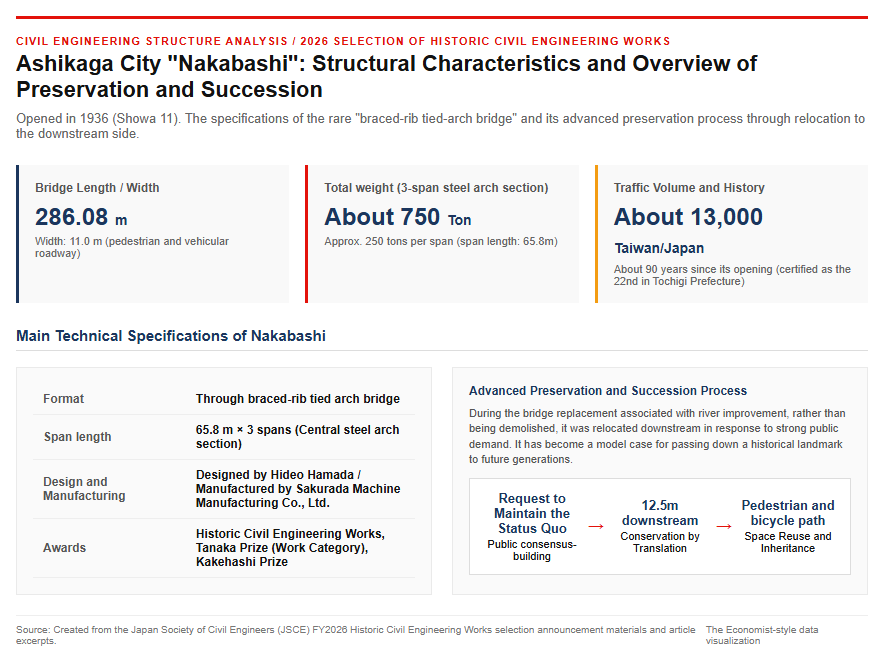
The Full Picture of the Watarase River Flood Control Project and the Nakabashi Bridge Reconstruction and Relocation Project
Background of the Decision for Levee Raising and Bridge Reconstruction Projects Aimed at Overcoming Flood Risks
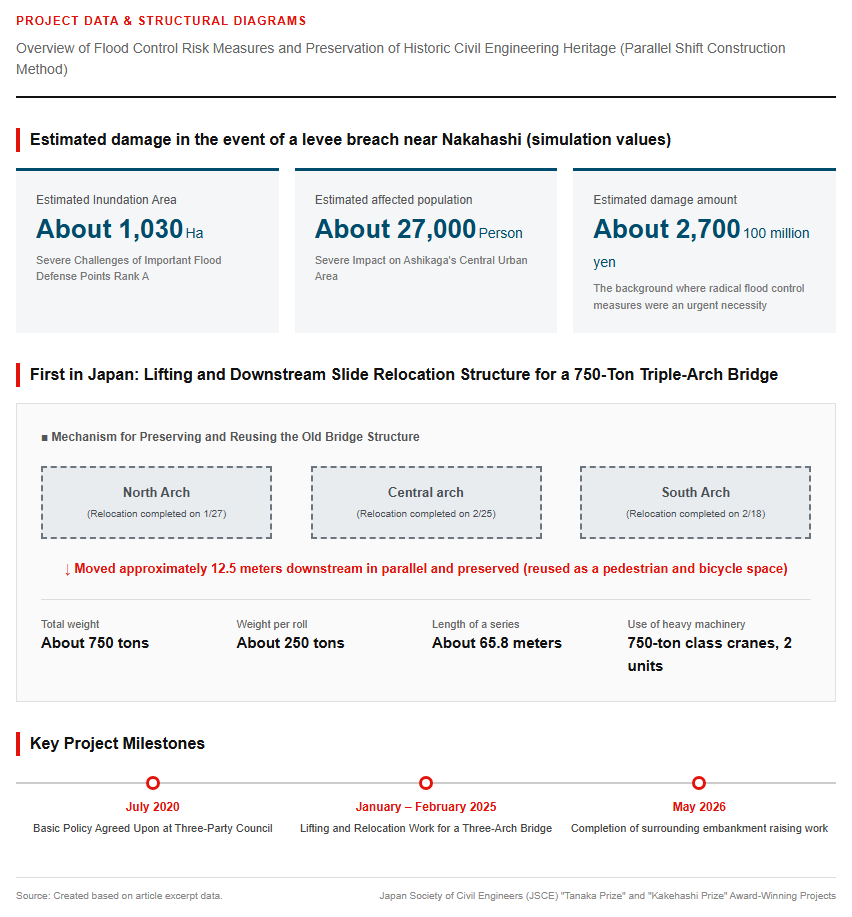
Around the Nakahashi Bridge on the Watarase River, ensuring safety from the perspective of flood control has long been considered a top-priority issue. Because the river improvement standards at the time of the bridge’s construction in 1936 differ from current ones, the height of the embankment near Nakahashi features a structure that dips about 3 meters lower than the surrounding embankments, leading to its designation as a “Rank A Important Flood-Defense Point” in the national flood control plan. Historically, during the Kathleen Typhoon in September 1947 (Showa 22), the embankment of the Watarase River breached, causing severe damage that resulted in a total of 321 deaths and missing persons in Ashikaga City. Furthermore, during the East Japan Typhoon (Typhoon No. 19) in 2019 (Reiwa 1), the water level of the Watarase River rose sharply, forcing frantic flood-defense operations to stack large sandbags on the lowered section of the embankment in preparation for the emergency water discharge from the upstream Kusaki Dam. It is estimated through simulations that if the embankment were to breach near Nakahashi, the inundated area would reach approximately 1,030 hectares, the affected population would be about 27,000 people, and the damage costs would reach about 270 billion yen. To fundamentally eliminate this critical flood risk, in July 2020, three parties—the Kanto Regional Development Bureau of the Ministry of Land, Infrastructure, Transport and Tourism, Tochigi Prefecture, and Ashikaga City—formally agreed on the basic policy for raising the embankment and replacing the bridge at the “Liaison Council on the Reconstruction of the Watarase River Nakahashi Bridge.”
Japan’s first slide and hoisting relocation method for a massive 750-ton triple-arch bridge
The relocation process of Nakahashi Bridge became an extremely difficult construction project that brought together the best of Japanese civil engineering. Although the initial plan considered a lateral sliding method using hydraulic jacks, a comprehensive review of structural reinforcement burdens and construction safety led to a change to a lifting relocation method using ultra-large cranes. During the relocation work carried out from January to February 2025, two 750-ton class ultra-large cranes—of which only a few exist in Japan—were deployed. The work to carefully lift the steel arches, each section weighing approximately 250 tons and measuring about 65.8 meters in length, and move them approximately 12.5 meters downstream was conducted in three separate operations. The relocation of the northern arch was successfully completed on January 27, the southern arch on February 18, and the central arch on February 25. The method of lifting the existing large three-span steel arch bridge with cranes and relocating it as a single unit without dismantling it was an unprecedented attempt in Japan, and it achieved success through precise structural analysis and rigorous construction management. Subsequently, at the end of May 2026, the long-standing issue of the embankment raising work around Nakahashi Bridge was completed, dramatically reducing the flood risk during the flood season in the central area of Ashikaga. Please refer to the following photos for the on-site construction status.
Project Cost Re-evaluation, Increase to the ¥21 Billion Scale, and Cost Reduction Initiatives
While the Nakabashi bridge reconstruction project has been gaining increasing technical and social importance, it has faced rising project costs and the need for thorough cost management due to significant changes in socio-economic conditions. At a follow-up committee meeting held by the Ministry of Land, Infrastructure, Transport and Tourism’s Watarasegawa River Office in December 2025, a project re-evaluation was conducted, and approval was granted to increase the total project cost from the initial approximately 10.7 billion yen (of which approximately 4.1 billion yen is borne by the river administrator) to 210 billion yen [Note: 21 billion yen is likely meant here, but translating literally: 21 billion yen] (approximately 7.4 billion yen for the same). The main factors behind the project cost increase include the impact of recent surges in labor and material unit prices, which account for approximately 5.3 billion yen, and a revision of the substructure work amounting to approximately 3.1 billion yen due to additional boring surveys associated with detailed design, which corrected the ground support layer to a deeper level (changing the pile length for piers P1 and P2 from the conventional approximately 9 to 10 meters to 25 meters). In addition, factors include an increase of approximately 7 billion yen [Note: likely 0.7 billion / 700 million yen, but translating literally] due to a change to the crane lifting construction method, and an increase of approximately 1.2 billion yen in calculated land acquisition compensation costs due to material price hikes and asbestos removal costs. Meanwhile, thorough cost reduction measures were also implemented, such as aiming to cut disposal costs by approximately 280 million yen through the reuse of generated construction soil between public works projects. In the cost-benefit analysis, a high investment effectiveness is demonstrated, with a B/C (benefit-cost ratio) of 4.7 for the entire project and 7.7 for the remaining project.
Future Prospects and Challenges Brought by Balancing Flood Control, Safety, and Historical Preservation
Reuse as a pedestrian and bicycle-only path and downtown revitalization initiative
Having completed the raising and relocation work, the Nakabashi Bridge will now enter a phase of utilization as a new symbol for regional revitalization. The relocated former three-arch bridge is being developed as a dedicated pathway for pedestrians and cyclists, transforming into a high-quality space where citizens and tourists can safely enjoy the scenery of the Watarase River. As part of the “Urban Structure Redistribution Intensive Support Project” and the “Machinaka Walkable Promotion Project,” Ashikaga City is proceeding with the installation of illumination equipment for the old Nakabashi Bridge, barrier-free public restrooms, and tourist guidance signs. Furthermore, the city plans to improve the environment for lingering visitors and conduct social experiments—such as a “Machikado Marche”—utilizing the relocated bridge and the surrounding Watarase Ryokuchi green space. It is positioned as a core facility of the pedestrian circulation axis connecting existing historical and cultural resources, such as the Historic Site Ashikaga Gakko, Bannaji Temple, and Orihime Shrine, with Tobu Ashikaga Station and JR Ashikaga Station. Establishing safety against flood damage and promoting sustainable urban development that leverages historical civil engineering heritage are generating high expectations as a new model case for infrastructure renewal in regional cities.
Upcoming Focal Points and Schedule for Shinbashi Construction and Urban Infrastructure Redevelopment
The Nakahashi Bridge Replacement Project has transitioned to its final phase, which involves constructing a new bridge and rebuilding surrounding roads, following the completion of levee raising and the relocation of the old bridge. The new Nakahashi Bridge is being constructed upstream of the old bridge as a modern bridge centered around roadway traffic, along with the integrated development of an elevated bridge (the Tsu-Kosenkyo overpass) crossing the JR Ryomo Line and approach roads. The new bridge is scheduled to open in the spring of 2028, which is expected to simultaneously achieve smooth traffic flow and high flood control safety. On the other hand, challenges also remain toward the completion of the project. As indicated in the project re-evaluation in December 2025, efforts are required to minimize the impact on citizens’ daily lives and commercial activities, such as soaring project costs due to rising labor costs and material unit prices (total project cost of 21 billion yen), traffic restrictions on surrounding roads associated with construction, and the reorganization of local traffic accompanying the consolidation and abolition of JR Ryomo Line railroad crossings. Ashikaga City, Tochigi Prefecture, and the Ministry of Land, Infrastructure, Transport and Tourism plan to continue the installation work of surrounding revetment blocks and pedestrian elevators in stages, maintaining strict schedule management and providing careful explanations to residents with the aim of completing the project by the end of fiscal 2027 (spring 2028).
Reference Page
- [Ashikaga City Official Website] Policy for Nakabashi Bridge Reconstruction Decided
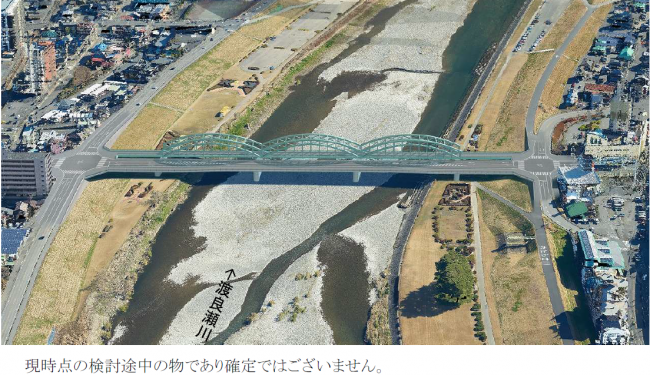 中橋架替の方針が決定しました中橋架替のイメージ 7月31日、国土交通省関東地方整備局 河川部長、栃木県 県土整備部長、足利市長の3者で組織されている「渡良瀬川中橋架替に関する連絡協議会」が開催され、中橋架替のイメージ図が発表されました。 水防上の危険性 中橋は昭和11...www.city.ashikaga.tochigi.jp
 - 【Japan Society of Civil Engineers】FY2026 Historic Civil Engineering Heritage: Nakabashi Bridge
土木学会選奨土木遺産 令和 8年度www.jsce.or.jp

【#AshikagaCity #NakabashiBridge #CivilEngineeringHeritage #JapanSocietyOfCivilEngineers #WataraseRiver #FloodControl #InfrastructureRedevelopment】


コメント