The Financial Services Agency has entered final coordination to issue a partial business suspension order against Prudential Life Insurance. In response to an unprecedented scandal in which 107 sales representatives and others defrauded and improperly received approximately 3.1 billion yen, the collapse of governance and internal control deficiencies were taken very seriously.
- Overview of Business Suspension Orders Issued by the Financial Services Agency and the Background of Administrative Disciplinary Actions
- A 34-Year Span of Financial Fraud and the Reality of 3.1 Billion Yen in Damages
- The Management Vacuum Created by the 100% Commission System and the Sole Proprietor Model
- Governance Deficiencies and Frequent Violations of Information Disclosure Obligations
- Impact of Business Suspension on Existing Subscribers and Services
- Review of the Life Insurance Industry’s Business Model and Key Points to Watch
Overview of Business Suspension Orders Issued by the Financial Services Agency and the Background of Administrative Disciplinary Actions
The Financial Services Agency (FSA) has entered final arrangements to issue a partial business suspension order under the Insurance Business Act against Prudential Life Insurance, a major foreign-affiliated insurer. This order will prohibit new insurance contracts and sales solicitation for a certain period, with the suspension period being adjusted to three months or longer. A business suspension order against a life insurance company is a major administrative disposition, the first since Japan Post Insurance in 2019. In addition, the FSA plans to issue a business improvement order to its holding company, Prudential Holdings of Japan, citing serious deficiencies in the group-wide management and control system. The direct catalyst for considering the disciplinary action was a large-scale financial scandal made public in January 2026. It was revealed that over a 34-year period from 1991 to 2025, 107 current and former sales representatives engaged in inappropriate conduct, such as defrauding approximately 500 customers of a total of about 3.1 billion yen. Furthermore, although the company had extended its voluntary suspension of sales operations until November in April 2026, violations of this suspension—such as conducting sales activities without prior approval—were rampant in some operational fields. In August 2026, a new financial fraud involving fictitious high-interest deposits was also uncovered. As a result of on-site inspections conducted by the FSA starting in late January 2026, a significant decline in internal checking functions was confirmed, alongside numerous cases of violations of the duty to provide information—such as failing to provide necessary explanations during insurance sales—cementing the conclusion of a systemic lack of management controls.
A 34-Year Span of Financial Fraud and the Reality of 3.1 Billion Yen in Damages
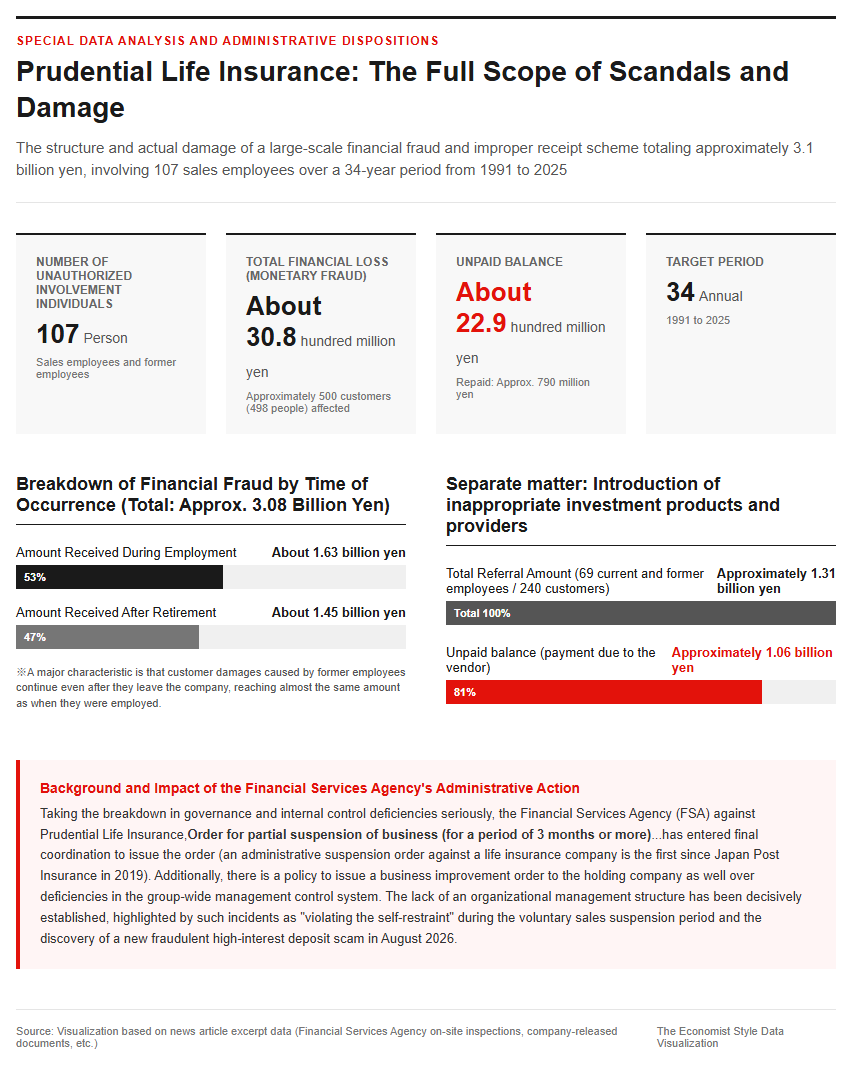
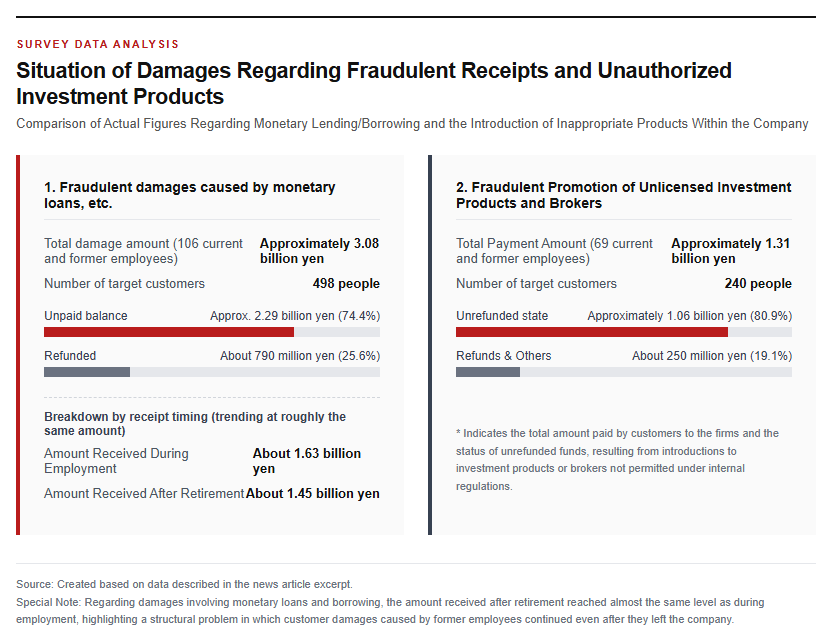
The scandal that has recently come to light is considered extremely malicious not only because of the large amount of financial damage, but also because it has been systematically covered up and left unaddressed over a long period. The main methods of fraud vary widely, including approaching customers with fictitious financial products or investment schemes not approved by the company, misappropriating funds by abusing forged documents bearing the company name, and personal financial lending and borrowing. Specifically, money received by 106 current and former employees from 498 customers, both during and after their employment, totals approximately 3.08 billion yen. Of this amount, about 790 million yen has been refunded, but approximately 2.29 billion yen remains unpaid. Of particular note is the fact that out of the total damage, the amount received while employed was approximately 1.63 billion yen, while the amount received after leaving the company was approximately 1.45 billion yen—nearly the same amount—indicating that customer victimization by former employees continued even after their retirement. It was also revealed that, separately, 69 current and former employees introduced investment products and handlers not permitted under internal regulations to 240 customers. The total amount paid by customers to these providers reached approximately 1.31 billion yen, of which about 1.06 billion yen remains unrefunded. As shown in the figure below, much of the fraud was carried out in closed customer interactions, exploiting the deep trust built over many years of serving as their representative.
The Structural Factors That Destroyed the “Strongest Sales Team”
The Management Vacuum Created by the 100% Commission System and the Sole Proprietor Model
Prudential Life Insurance achieved rapid growth through a sales model that headhunted top talent from other industries and trained them as professionals called life planners. However, behind this highly profitable structure lay structural flaws that easily induced misconduct. The company’s compensation system is designed so that from the third year of employment onward, the base salary drops to zero, transitioning entirely to a full-commission model. While producing high results can yield annual incomes ranging from tens of millions to hundreds of millions of yen, employees are exposed to intense pressure where their income plummets immediately if they fail to close deals. Sales representatives’ in-office obligations were limited to morning meetings twice a week, and their daily activities, client meetings, phone calls, and handling of money were kept in a black box as independent contractors. Management and headquarters evaluated employees solely on metrics such as sales and performance, lacking a monitoring system for processes or suspicious behavior. An organizational culture was formed in which headquarters and superiors hesitated to intervene with high-performing sales staff, leading to hollowed-out governance. For many years, a breeding ground was left unchecked where employees, feeling desperate over the depletion of prospective clients and declining incomes, targeted clients who trusted them through long-standing relationships, resorting to financial fraud and illegal solicitation as shortcuts.
Governance Deficiencies and Frequent Violations of Information Disclosure Obligations
The failure of the organization’s self-cleaning mechanism to function was also a major factor behind the Financial Services Agency (FSA)’s decision to impose severe administrative penalties. Despite the wrongful conduct continuing for over 30 years, it was not discovered spontaneously through internal compliance checks or internal audits, but rather surfaced due to external alerts and police investigations. In the FSA’s on-site inspection, not only criminal acts such as monetary fraud were uncovered, but a large number of company-wide violations of the duty to provide information at the time of concluding insurance contracts were found. Flaws in the solicitation management system became clear, where contracts were promoted without properly explaining important disadvantageous matters of products or the policy clause contents to customers. Following the public disclosure of the issue in January 2026, the company renewed its management team by having President Hiroshi Mahara resign to take responsibility as of February 1, 2026, and appointing Hiromitsu Tokumaru, president of Prudential Gibraltar Financial Life Insurance, as his successor. However, the successive discovery of voluntary restraint violations and new scandals in the field even after the management structure was revamped solidified the FSA executives’ conviction that drastic self-cleaning reforms by the current management team would be difficult. Alongside the administrative disposition, the company has been pushed into a situation where stricter accountability for management and the reconstruction of governance—such as the further resignation of top management and comprehensive external intervention in the management structure—are indispensable. As shown in the figure below, the overhaul of internal controls is deemed an urgent priority.
Impact on Policyholders and Future Outlook of the Entire Insurance Industry
Impact of Business Suspension on Existing Subscribers and Services
The Financial Services Agency’s partial business suspension order is expected to be limited to measures expanding sales operations, such as soliciting and selling new insurance contracts, developing and applying for approval of new products, and running TV commercials and advertisements. Therefore, it will not have a direct negative impact on existing customers who currently have insurance contracts with the company. Payouts for death benefits and hospitalization riders in the event of an emergency will be made as usual, and policy maintenance operations—such as address changes, policy modifications, and cancellation procedures—will not be suspended. Because the company is not facing immediate bankruptcy, policyholders should be careful not to rush into cancellation procedures. In particular, if a savings-type insurance policy is canceled prematurely, there is a risk that the cash surrender value will fall significantly below the total amount of premiums paid, resulting in a financial loss. Furthermore, if policyholders currently have health concerns, they may not be able to rejoin an insurance plan with another company. Self-protection measures that policyholders should check right away include verifying whether their premium payment accounts are set up as the individual sales representative’s personal account or handled via cash payments, and ensuring they have not entrusted money to special investment frameworks or high-interest investment schemes that are unauthorized by the company. If there are any suspicious points, it is important to contact the company’s head office customer center directly—rather than the individual representative—to verify the facts.
Review of the Life Insurance Industry’s Business Model and Key Points to Watch
The unprecedented scandal at Prudential Life Insurance has sent shockwaves far beyond a single company, dealing a major blow to Japan’s entire life insurance industry. It has laid bare the fact that the “life planner” model, long praised as ideal consultative selling, and the underlying business model—predicated on mass hiring and high turnover driven by excessive meritocracy—have reached their limits. Similar financial damages have been uncovered at Gibraltar Life Insurance, another group company, making a fundamental review of the institutional design itself, rather than merely individual ethics, indispensable. Going forward, the Financial Services Agency (FSA) plans to step up its supervision of life insurance companies regarding their oversight structures for sales staff and the appropriateness of their compensation systems. Key points to watch will be the FSA’s announcement of official disciplinary actions and the effectiveness of the resulting recurrence-prevention measures. Specifically, it will test whether measures such as mandatory system logging of interviews and proposal processes, regular direct customer check-ins by headquarters bypassing the assigned representative, and greater transparency in whistleblowing systems can be effectively enforced. In the insurance industry, where trust is the ultimate product, the ability to balance meritocracy with robust governance is being called into question, demanding a transformation of the industry’s very structure.
Reference page
- [Prudential Life Insurance Co., Ltd. News Release (January 16, 2026)] https://www.prudential.co.jp/news/pdf/980/20260116_2.pdf
[#PrudentialLife #BusinessSuspensionOrder #FinancialServicesAgency #Governance #LifeInsurance #Compliance #Scandal]


コメント