It has been revealed that Kao will repurpose its precision interface control technology, cultivated over many years, to fully develop its semiconductor chemicals business as a pillar of overseas growth. Anticipating the maturation of the domestic consumer goods market, the company aims to shift its business structure toward the high-value-added B2B sector.
- A Turning Point for “Washing Technology” Aiming for 1 Trillion Yen in Overseas Sales
- Expansion into Front-End Processes and Ambitious Targets Through 2035
- The Mechanism of “Selective Cleaning” Born from 140 Years of Chemical Expertise
- High market share in back-end processes and advanced packaging capabilities
- Customer-centric co-creation by the Hsinchu, Taiwan development base
- Medium- to Long-Term Outlook and Challenges for Business Expansion
A Turning Point for “Washing Technology” Aiming for 1 Trillion Yen in Overseas Sales
Major Japanese daily goods manufacturer Kao is advancing a strategy to repurpose its “cleaning technology,” cultivated through detergents and cosmetics, for semiconductor manufacturing processes, elevating it into a core pillar of growth in overseas markets. According to the latest developments in October 2026, the company has solidified its policy to move away from its conventional overseas expansion centered on consumer daily goods and concentrate its management resources on the B2B chemical business, which boasts high technological superiority. Kao’s consolidated net sales for the fiscal year ending December 2025 stood at 1.6886 trillion yen, of which the domestic Japanese market accounted for approximately 57%, or 963.4 billion yen. Because the domestic market is structurally facing difficulties in expecting significant volume growth due to a declining population, the company aims to expand its overseas sales from the current approximately 725 billion yen to the 1 trillion yen scale in the medium to long term, targeting total sales of 2 trillion yen. Rather than directly competing with giant overseas consumer goods manufacturers like P&G and L’Oréal in advertising expenditures and retail shelf space, the company has chosen the semiconductor materials sector, where it can compete on technological precision. By applying interface control know-how cultivated through household detergents to advanced cutting-edge industries, Kao aims to transition into a highly profitable business structure.
Expansion into Front-End Processes and Ambitious Targets Through 2035
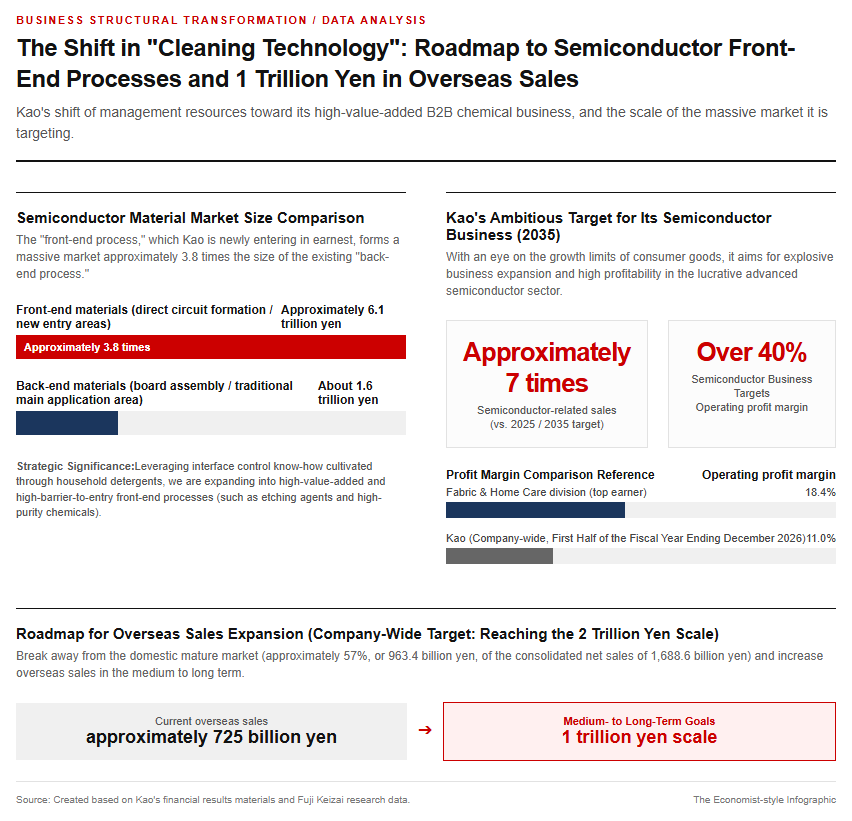
Kao has traditionally developed its business centered on precision cleaning agents for the “backend” process of assembling finished chips onto substrates. However, moving forward, the company will make a full-scale entry into the chemical field for the “frontend” process, where microscopic circuits are directly formed on silicon wafers. According to research data from Fuji Kezai, the market size for semiconductor frontend materials is approximately 6.1 trillion yen, boasting a massive scale about 3.8 times larger than the approximately 1.6 trillion yen for backend materials. To capture this vast market, Kao has set extremely ambitious numerical targets: increasing sales in its semiconductor-related business by roughly 7 times by 2035 compared to 2025 levels, and aiming for an operating profit margin of over 40%. The company’s corporate operating profit margin for the first half of the fiscal year ending December 2026 stands at 11.0%, making the target of over 40% an exceptionally high level, even when compared to the 18.4% of the Fabric & Home Care division, which is currently the company’s most profitable segment. Looking ahead, Kao aims to expand adoption in advanced logic semiconductors responsible for AI computing and the DRAM sector including high-bandwidth memory, while also expanding its entry into areas such as etching agents and high-purity chemicals. Please refer to the figure below.
Precision Interface Control Technology and Competitive Advantage in the Industry
The Mechanism of “Selective Cleaning” Born from 140 Years of Chemical Expertise
Since its founding in 1887, the knowledge of surface science that Kao has accumulated for nearly 140 years through the development of facial cleansing soaps and laundry detergents has become its greatest weapon in the semiconductor business. The semiconductor manufacturing process consists of more than 500 steps, of which approximately 30% to 40% are “cleaning” operations. As circuit miniaturization and 3D stacking progress, even the persistence of minute metal particles or organic residues on the nanometer scale can cause short circuits and disconnections, significantly reducing yield. Kao’s strength lies in its “selective cleaning” technology, which pinpoints and removes only unnecessary impurities and residues without damaging the substrate or metal wiring. Starting with the water-based cleaning agent “Cleanthrough,” developed in 1991 following the complete phase-out of CFCs under the Montreal Protocol, the company has evolved its molecular design technology for surfactants that control the boundary between water and oil. For example, in the “KS-2200 series” for front-end processes, super-hydrophilic modification of the silicon surface spreads a water film uniformly, actively preventing the adhesion of approximately 7 trillion silica particles onto a 300mm wafer.
High market share in back-end processes and advanced packaging capabilities
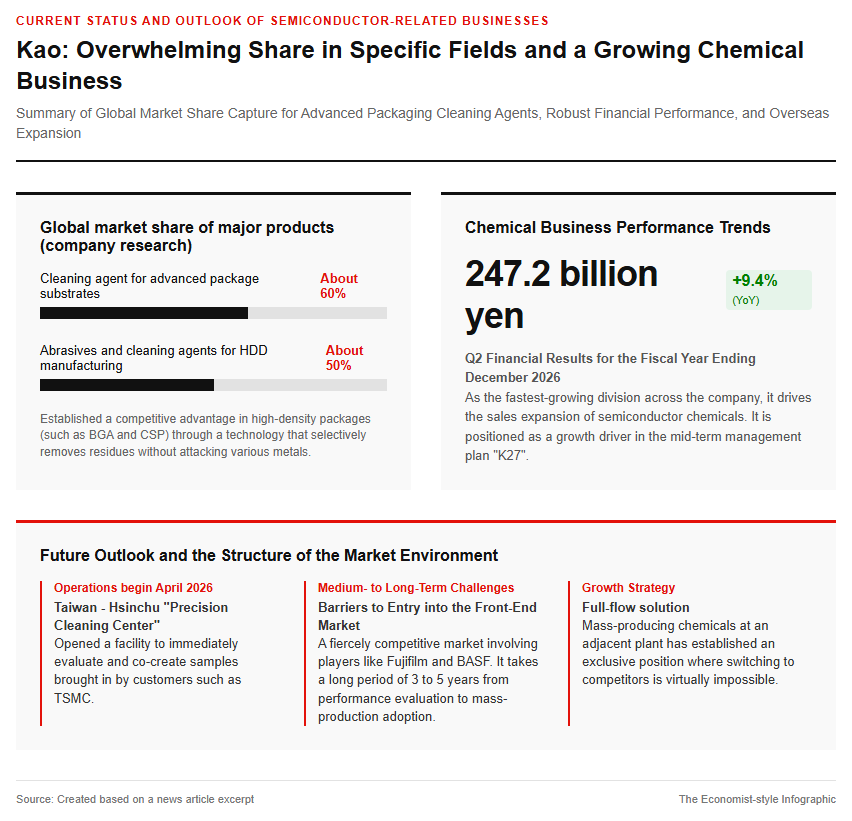
Kao’s semiconductor-related business is not starting from zero; it has already secured an overwhelming global market share in specific fields. According to the company’s own research, Kao holds a global market share of approximately 60% in cleaning agents for advanced package substrates used to connect semiconductor chips to substrates. Furthermore, it maintains a global market share of about 50% in abrasives and cleaning agents for the manufacturing of hard disk drives, which are storage devices for data centers. Products such as the company’s “CLEANTHROUGH 750H” are capable of selectively dissolving and removing rosin-based flux residues in high-density packages such as BGAs and CSPs without attacking various metals such as copper and gold. With the spread of generative AI, demand for 2.5D and 3D advanced packaging technologies, represented by TSMC’s CoWoS, is surging rapidly. In structures where multiple chips are stacked at high density, insufficient cleaning of minute gaps directly leads to connection failures, thereby increasing the number of highly difficult cleaning processes. Kao supplies consumables with high technological stickiness to these growth markets and is deeply integrated into the supply chains of major semiconductor manufacturers.
Future Outlook and Key Points of Interest in Overseas Markets
Customer-centric co-creation by the Hsinchu, Taiwan development base
As a specific regional strategy to achieve high growth targets, Kao opened its first overseas “Precision Cleaning Center” in Hsinchu, in northwestern Taiwan—where major global players like Taiwan Semiconductor Manufacturing Company (TSMC), the world’s largest wafer foundry, are concentrated—and began full-scale operations in April 2026. Under the conventional system, when receiving large substrate samples from Taiwanese customers, it was necessary to send them to the Wakayama Plant in Japan for testing, which took time for evaluation. With the completion of the Hsinchu facility, an environment has been established where customers such as TSMC, various substrate manufacturers, and packaging companies can bring in actual chips and substrates, allowing them to immediately evaluate optimal chemicals and coordinate process conditions jointly with Kao researchers. Once semiconductor materials are integrated into a mass production line, the cost of re-verifying reliability is extremely high, making it difficult for customers to switch to other companies. At the Hsinchu facility, Kao provides a full-flow solution that mass-produces customer-specific chemicals at an adjacent plant, and by participating from the initial stages in the development of next-generation products such as AI semiconductors, it is establishing an exclusive position that leaves no room for competitors to follow.
Medium- to Long-Term Outlook and Challenges for Business Expansion
In its mid-term management plan “K27,” Kao positions the electronic materials and cosmetics businesses as “growth drivers” that will shoulder future earnings, promoting portfolio management by reinvesting funds generated from its stable domestic businesses. In its financial results for the second quarter of the fiscal year ending December 2026, the Chemical Business saw sales increase by 9.4% year-on-year to 247.2 billion yen, making it the company’s fastest-growing segment. Moving forward, in addition to expanding sales of semiconductor chemicals, the company is also considering M&A activity involving firms possessing high-purity chemical technology. On the other hand, clear challenges remain in achieving its goals of a “7-fold increase in sales and an operating profit margin exceeding 40%.” The front-end market is a fiercely contested arena where influential chemical manufacturers such as Fujifilm, Kanto Chemical, and Germany’s BASF compete intensely, and a long period of 3 to 5 years is required from performance evaluation to actual adoption in mass production. Furthermore, the company faces demands to strengthen accountability to investors, such as navigating the silicon cycle waves peculiar to the semiconductor industry and addressing the fact that the disclosure of specific standalone financial data for the semiconductor business is still restricted. All eyes are on future outcomes to see whether Japan’s detergent giant can transform itself into a company that supports global semiconductor infrastructure through the power of chemistry. Please refer to the figure below.
Reference Page
- [Kao Corporation Investor Relations (IR)] https://www.kao.com/jp/corporate/investor-relations/
- [Kao Group Mid-term Management Plan K27] https://www.kao.com/jp/corporate/strategy-and-mid-term-plan/
- [Kao Chemicals Semiconductor Chemicals (CLEANTHROUGH)] https://chemical.kao.com/jp/electronics/cleanthrough/semiconductor/
[#Kao #Semiconductor #PrecisionInterfaceControlTechnology #CleanThrough #TSMC #K27 #ChemicalBusiness #GlobalStrategy]
コメント