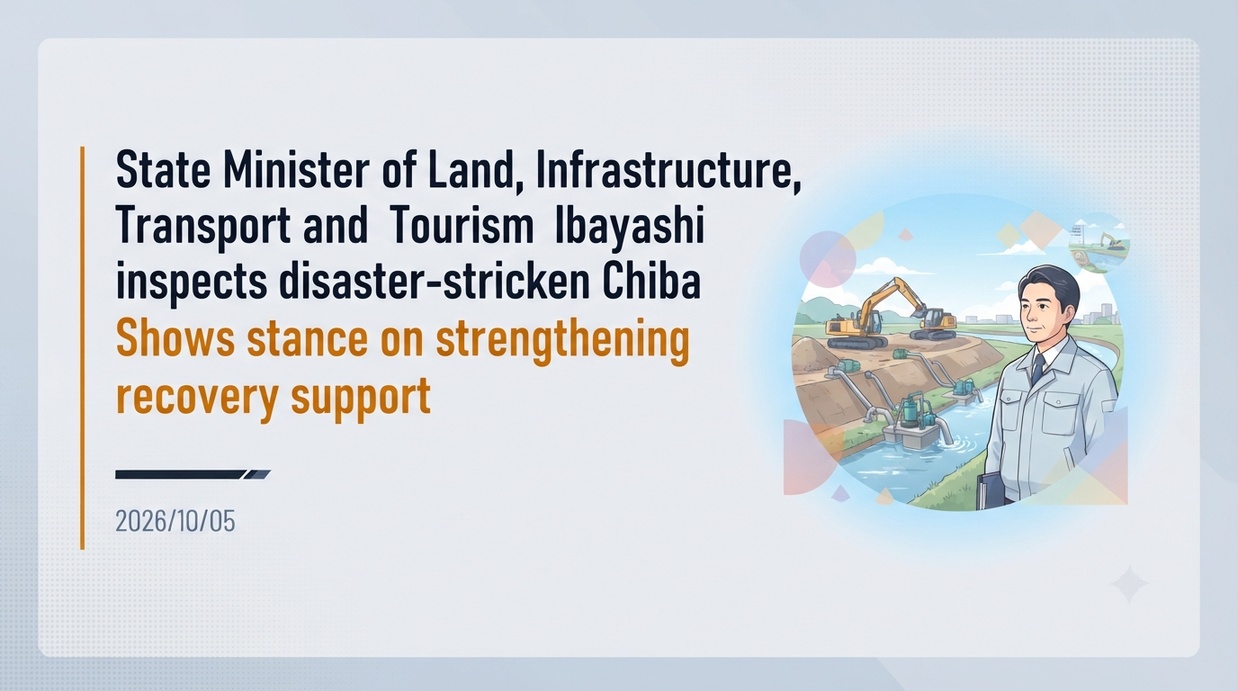
Minister of Land, Infrastructure, Transport and Tourism Tatsunori Ibaragi inspected disaster-stricken areas in Chiba Prefecture that suffered severe damage from Typhoon No. 25, and pledged to strengthen recovery support. The background includes the levee breach of Lake Inbanuma, extensive flooding, and widespread impacts on transportation and key industries.
- Minister of Land, Infrastructure, Transport and Tourism Ibayashi’s Inspection of Disaster-Stricken Areas and the Current Situation on the Ground
- Recovery Challenges That Struck Transportation and Infrastructure
- Formation of “Team Inbanuma” and Concrete Measures for Emergency Drainage
- Impact on Core Industries and Blow to Regional Economies
- Lessons from the Past and the Promotion and Verification of “River Basin Flood Control”
- Strengthening Pre-disaster Disaster Prevention and Future Prospects
Minister of Land, Infrastructure, Transport and Tourism Ibayashi’s Inspection of Disaster-Stricken Areas and the Current Situation on the Ground
Minister of Land, Infrastructure, Transport and Tourism Tatsunori Ibayashi conducted an on-site inspection in Chiba Prefecture, which suffered severe damage from Typhoon No. 25 as it approached the Kanto region with a large and powerful force. The typhoon brought record-breaking heavy rains to Chiba Prefecture, with total rainfall exceeding 450 mm, leading to widespread and successive disasters caused by overflowing rivers and landslides. The Minister directly visited the area around Lake Inba, where a breached levee had exacerbated flood damage. At the site, where a temporary levee made of earth has been completed, he received a briefing on the progress of emergency restoration work to reliably prevent flooding by installing iron plates toward full-scale restoration. Minister Ibayashi indicated his intention to begin with an investigation into why the breach occurred, emphasizing his stance that related organizations will work together as one to powerfully promote swift safety assurance and restoration. The aspects of damage and restoration work at the site are diverse and wide-ranging.
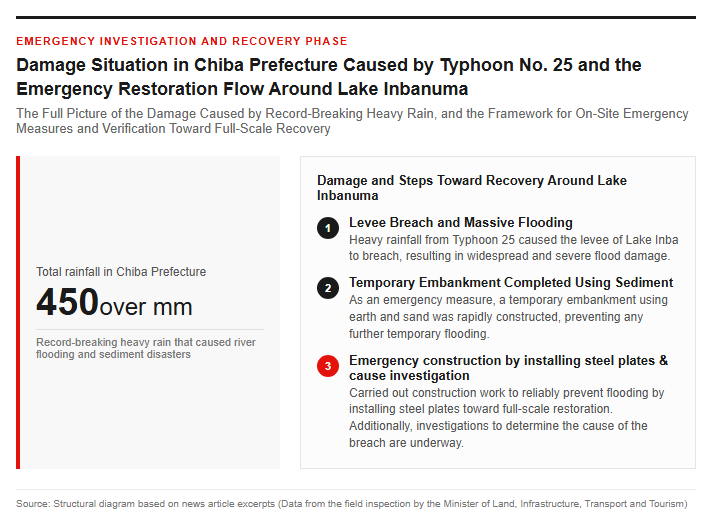
While acknowledging the harsh conditions on the ground in the disaster-affected areas, the government has outlined a policy to continue providing the maximum possible support.
Recovery Challenges That Struck Transportation and Infrastructure
Heavy rain from Typhoon No. 25 caused severe disruptions to transportation networks and local roads across Chiba Prefecture. On the JR Uchibo Line, between Anegasaki Station and Nagaura Station, extensive damage occurred when a large volume of earth and sand washed onto the tracks. During an on-site inspection, it was estimated that it will take about three months to fully restore the entire line, and replacement bus services have been launched to secure transportation options for local residents. In addition, within the road network, frequent large-scale sediment runoffs occurred around Nezumizaka in Nagara Town on the Chiba-Mobara prefectural road (Mobara Kaido), while road collapses and slope failures occurred in succession in areas such as Ichihara City and Otaki Town. Restoration work on the affected roads and infrastructure is ongoing in various locations.
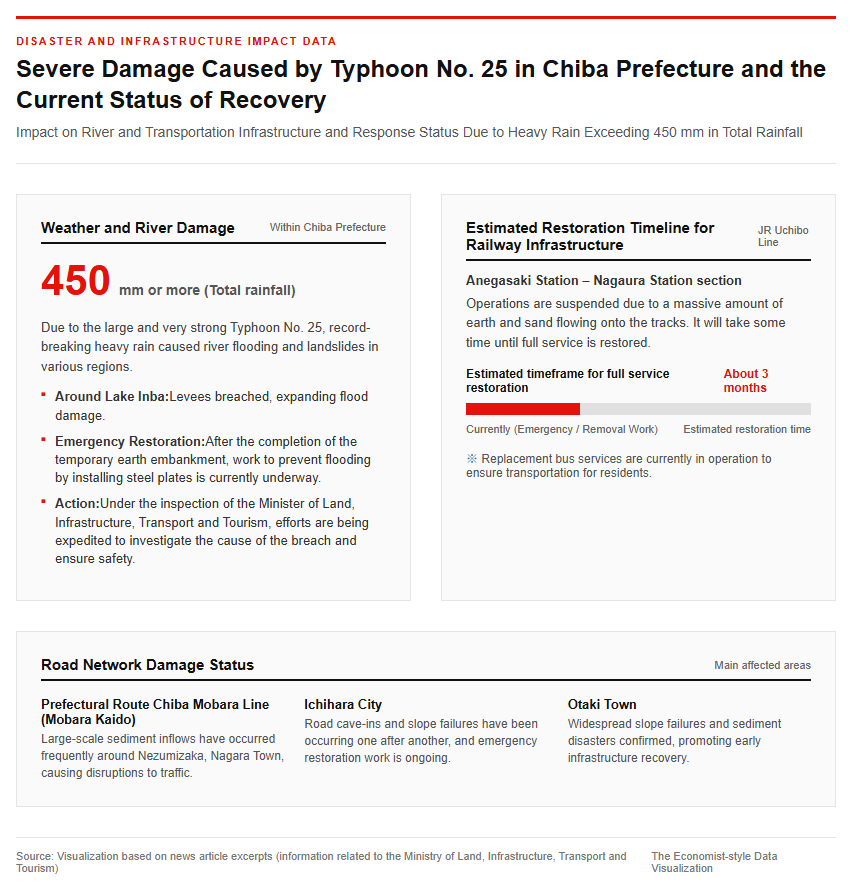
Member companies of the Chiba Prefecture Contractors Association are working through their days off, deploying heavy machinery, and rushing to remove earth and sand and clear roads. Amid the constant danger of secondary disasters caused by fallen trees and tangled power lines, dedicated emergency response efforts are underway in cooperation between the government and the construction industry.
The Full Picture of Recovery Support Measures and Emergency Drainage Operations
Formation of “Team Inbanuma” and Concrete Measures for Emergency Drainage
At a post-Cabinet press conference on September 25, 2026, Minister of Land, Infrastructure, Transport and Tourism Ibayashi officially announced the “Emergency Drainage and Other Operations Around Lake Inbanuma” to address flood damage around Lake Inbanuma. In light of expected worsening weather conditions and the approach of Typhoon No. 26, this initiative will implement three emergency measures aiming for a period of about one week. Specifically, drainage pumps will be operated at maximum capacity with the policy of lowering the water level of Lake Inbanuma—which was approximately 3.0m as of September 25—back to the normal level of 2.3m within a day or two. Furthermore, technical support will be provided for the emergency restoration of levee breaches at four locations across three districts, and the number of drainage pump trucks dispatched to flooded areas will be increased from before to carry out intensive drainage work with a total fleet of 30 vehicles. To promptly advance these measures, a joint organization named “Team Inbanuma” has been formed by three parties: Chiba Prefecture, the Japan Water Agency, and the Kanto Regional Development Bureau of the Ministry of Land, Infrastructure, Transport and Tourism.
Impact on Core Industries and Blow to Regional Economies
Heavy rain and flooding caused by Typhoon No. 25 dealt an extremely severe blow not only to daily infrastructure but also to the core industries supporting the local economy. On September 25, 2026, JFE Steel announced that its steel production is projected to decrease by approximately 600,000 tons, following the flooding of facilities at its East Japan Works Chiba District due to the heavy rains in Chiba in August and Typhoon No. 25 in September. This scale of production reduction is substantial, equivalent to just under 20% of the district’s fiscal 2025 crude steel production of 3.59 million tons. Although the blast furnaces themselves continue to operate, delivery delays for some products have occurred due to flood damage to downstream processing facilities, forcing the company to respond with alternative supplies from other bases and inventory adjustments. Similarly, facility suspensions and partial flooding occurred at Nippon Steel’s East Japan Works Kimitsu District. Concerns are growing that the production slump by the major steelmakers will ripple through the entire supply chain of a wide range of downstream industries, including automotive and construction.
National Resilience and Key Issues in Future Flood Control Administration
Lessons from the Past and the Promotion and Verification of “River Basin Flood Control”
Following the recent embankment breach of Lake Inbanuma, past flood control measures and water resource administration are once again being called into question. Drawing lessons from incidents such as the embankment breach in Mabi-cho, Kurashiki City, Okayama Prefecture, during the 2018 torrential rains in western Japan, the Ministry of Land, Infrastructure, Transport and Tourism (MLIT) has progressively implemented strengthening measures across rivers nationwide, including emergency embankment inspections, river channel excavation, and raising embankment heights. Furthermore, to cope with the intensifying severity of water-related disasters driven by climate change, the Ministry has been promoting “basin-wide flood control” nationwide, combining hard and soft measures such as utilizing existing dams, rainwater storage facilities, and strengthening evacuation systems. Although preparatory measures were underway for Lake Inbanuma prior to this event, unprecedented heavy rainfall ultimately led to the breach. The national government, in cooperation with Chiba Prefecture—the river administrator—is prepared to conduct a thorough technical investigation into the causes of the local breach and implement specific, fundamental measures to prevent and mitigate recurrence of the disaster.
Strengthening Pre-disaster Disaster Prevention and Future Prospects
Following successive heavy rains and typhoon damage, accelerating pre-disaster preparedness and disaster reduction measures by national and local governments has become a top priority. The Sanae Takaichi administration is strongly promoting national resilience policies that emphasize pre-disaster preparedness and the repair of aging infrastructure. The establishment of the “Disaster Management Agency” as a command center directly reporting to the Cabinet is scheduled for November 2026, raising high expectations for speeding up disaster response and establishing cross-ministerial flood control and disaster prevention systems. It is essential to strengthen collaboration with construction consultants and local construction companies that support rapid on-site road clearance and emergency restoration, as well as to develop monitoring systems utilizing digital technology. In addition to enhancing the disaster prevention capabilities of entire communities, long-term initiatives toward rebuilding resilient social infrastructure against large-scale disasters are expected to gain even further momentum moving forward.
Reference Page
- [Ministry of Land, Infrastructure, Transport and Tourism] Summary of Minister Ibayashi’s Press Conference https://www.mlit.go.jp/report/interview/daijin260925.html
【#Typhoon25 #ChibaDisaster #MLITMinisterIbayashi #InbaMarsh #DisasterRecovery #NationalResilience #FloodControl】
コメント