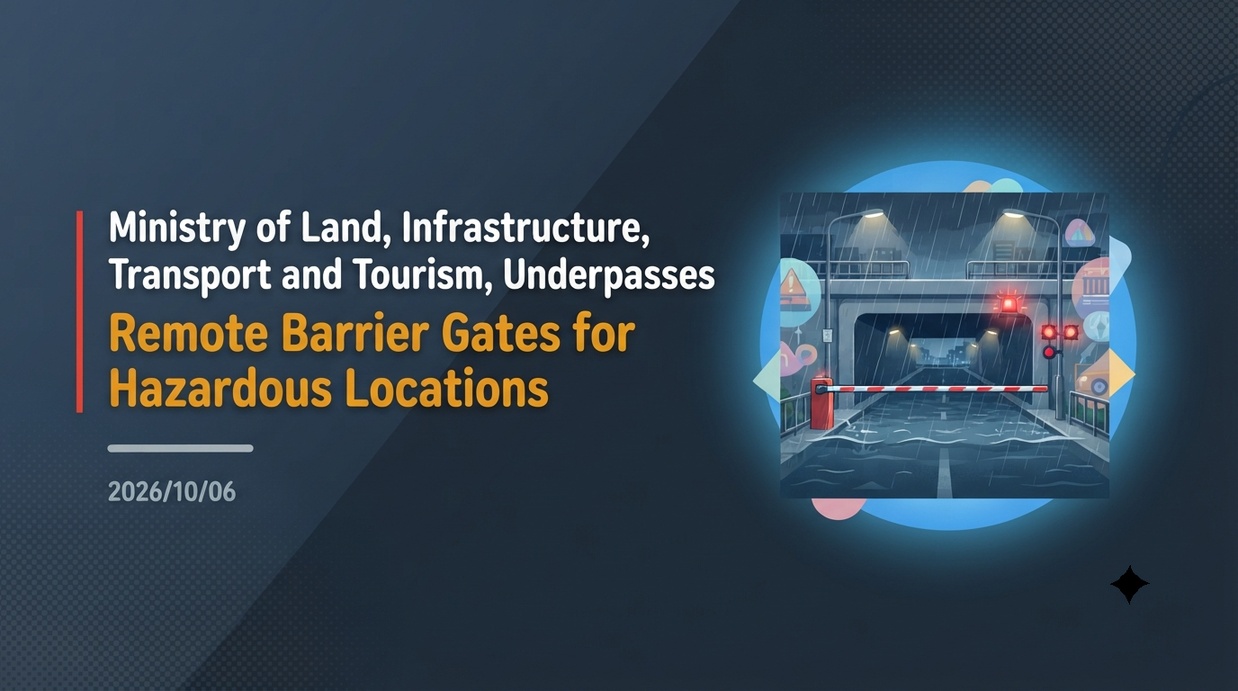
On October 6, 2026, the Ministry of Land, Infrastructure, Transport and Tourism released operational guidelines aimed at preventing flooding accidents in underpasses nationwide. Following a series of submersion accidents caused by frequent sudden torrential downpours and power outages, the ministry is embarking on full-scale safety measures, such as requesting the installation of remote barriers based on the degree of danger and clarifying criteria for preemptive traffic restrictions.
- [Breaking News Summary] Background on the Release of Operational Guidelines Following a Series of Submersion Accidents
- [Systems and Standards] 4-Stage Classification of Inundation Risk and Requests for Remote Cutoff Switches
- 【Operational Mechanism】 Thorough Implementation of Multi-Layered Defense Based on Fail-Safe Principles
- [The Nature of the Danger] The Physical Structure That Renders Vehicles Immobile in Minimal Water Depth
- [Integrating Technology] Latest Private-Sector Technologies, Such as Air Circuit Breakers and Monitoring Services
- [Future Outlook] Continuation of Financial Support and Safety Measures Drivers Should Take
[Breaking News Summary] Background on the Release of Operational Guidelines Following a Series of Submersion Accidents
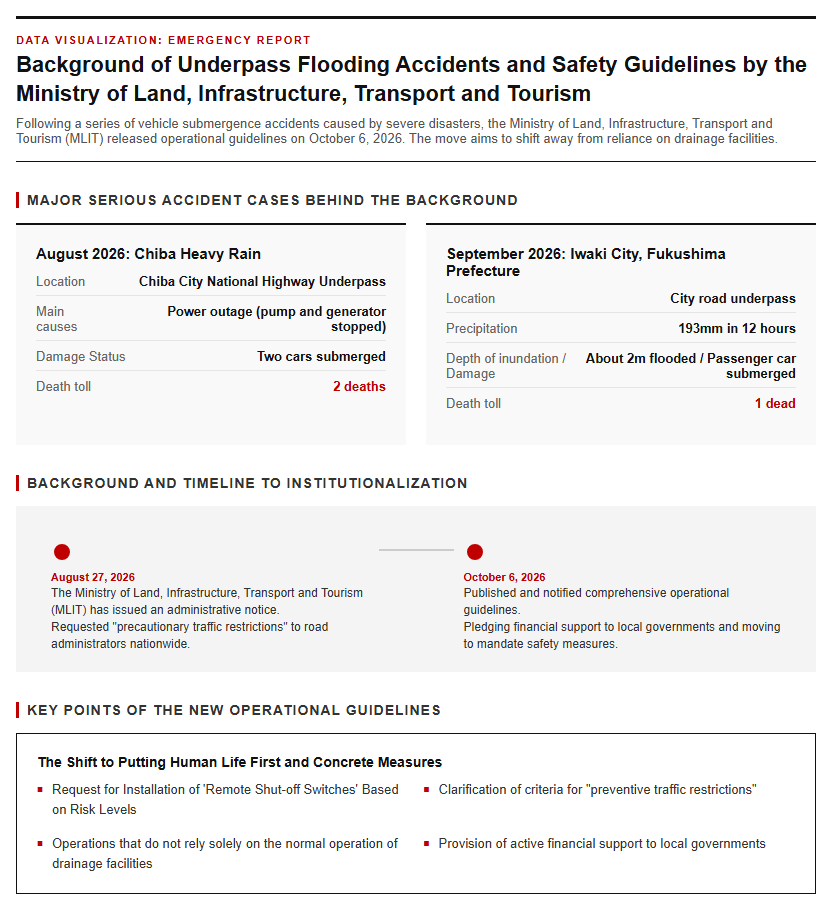
On October 6, 2026, the Ministry of Land, Infrastructure, Transport and Tourism (MLIT) released and issued operational guidelines to road administrators and local governments nationwide to prevent flooding accidents in underpasses. At a press conference, Minister of Land, Infrastructure, Transport and Tourism Ibayashi clearly indicated his intention to provide financial support to local governments. Behind the formulation of these new guidelines are the tragic vehicle submersion accidents that have occurred one after another in various regions due to increasingly severe heavy rains in recent years.
Specifically, the following serious accidents had occurred:
– August 2026 Chiba Heavy Rainfall: A power outage occurred at a national highway underpass in Chiba City, causing drainage pumps and emergency generators to fail, leaving two cars submerged and two people dead.
– September 2026 Iwaki City Accident, Fukushima Prefecture: Due to record-breaking heavy rainfall of 193 mm in 12 hours, a municipal road underpass was flooded to a depth of about 2 meters, submerging a passenger car and resulting in one fatality.
The Ministry of Land, Infrastructure, Transport and Tourism (MLIT) had issued an administrative notice as of August 27, 2026, calling for preemptive traffic restrictions, but in light of the successive damage, it promptly moved to formalize these into official guidelines. There is a strong demand for a shift toward measures that prioritize human life above all, rather than relying solely on the proper functioning of drainage facilities. Please refer to the figure below.
[Systems and Standards] 4-Stage Classification of Inundation Risk and Requests for Remote Cutoff Switches
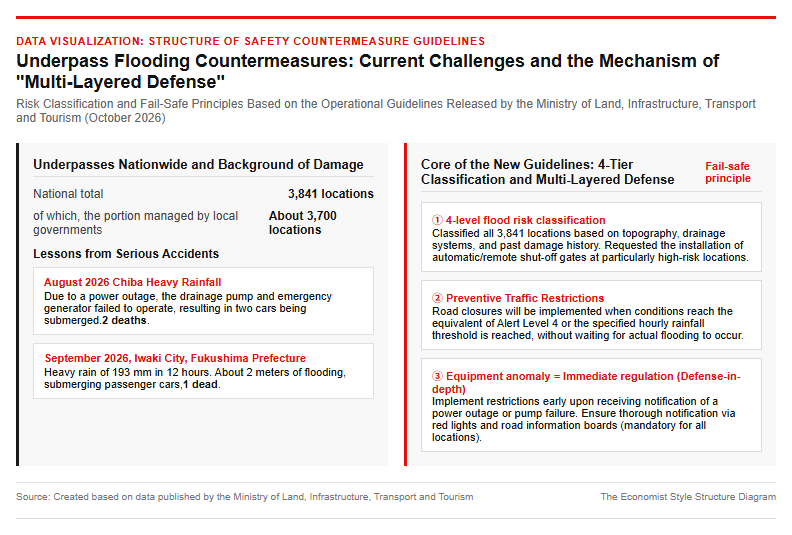
The published guidelines stipulate that all 3,841 underpasses nationwide (of which approximately 3,700 are managed by local governments) must undergo a “four-stage inundation risk classification” based on their topography, drainage systems, and past damage history.
The main countermeasure standards according to the risk classification are as follows.
– Particularly high flood-risk areas: High-risk locations where flooding and human casualties have occurred in the past, for which the installation of automatically operated barriers or remotely controllable barriers has been requested.
– Preventive pre-emptive road closures: Implemented without waiting for actual flooding to occur when disaster prevention weather information equivalent to Alert Level 4 is issued, or when the 1-hour rainfall including forecasts reaches a specified value.
– Safety equipment common to all locations: Regardless of the degree of risk, the installation of red lights and road information boards is mandated so that regulatory status can be understood even from a distance.
The policy is to allow the use of existing local allocation tax grants for the installation and renovation of these facilities, aiming to rapidly advance nationwide deployment while reducing the financial burden on local governments.
“Multi-Layered Defense” and Physical Mechanisms to Prevent Waterlogging Accidents
【Operational Mechanism】 Thorough Implementation of Multi-Layered Defense Based on Fail-Safe Principles
At the very heart of these guidelines are the design philosophies of “defense-in-depth” and “fail-safe.” Rather than relying solely on the operation of drainage pumps as in the past, a system is built by combining three elements: warning displays, preemptive traffic restrictions, and physical entry barriers, ensuring that a single equipment failure does not prove fatal.
The fail-safe operational points that are particularly emphasized are as follows.
– Early traffic restriction during power outages or equipment malfunctions: Upon receiving notification of a power outage or pump failure, traffic restrictions will be initiated early, even if the road is not yet flooded.
– Lessons from past lawsuits: In the Wakayama underpass flooding accident caused by the 2018 typhoon, the failure to properly charge the private generator’s battery was called into question, and the Wakayama District Court (July 2021 ruling) held the administrative authorities liable for state compensation.
It is strictly required to thoroughly implement operational procedures that err on the side of safety—treating an equipment abnormality as an immediate road closure—while constantly anticipating the risk that emergency generators might fail to operate during a power outage. Please refer to the figure below.
[The Nature of the Danger] The Physical Structure That Renders Vehicles Immobile in Minimal Water Depth
Behind drivers mistakenly entering them thinking, “I can drive through this,” lie the underpass structure and the physical vulnerabilities of automobiles. Underpasses feature a depressed structure dug about 3 meters lower than the surrounding area, and during heavy rain, rainwater rapidly concentrates at the mortar-shaped bottom.
The changes in vehicle inundation depth and associated risks are as follows.
– Water depth of 10–15 cm: Reaches the vehicle’s minimum ground clearance, and water begins to flood the underside of the floor panels.
– Water depth of 30 cm: Water enters through the engine’s air intake, causing a “water hammer effect” that stalls the engine. At the same time, the tires lose traction, and the vehicle becomes buoyant, floating and spinning its wheels like an “iron life ring.”
– Water depth of 50 cm: External water pressure presses the door firmly shut, creating a “water pressure lock” state that cannot be opened manually.
It is impossible to accurately measure water depth with the naked eye at night or during heavy rainfall. Even attempting to reverse after entering will result in a loss of traction and make self-rescue impossible, making avoiding entry beforehand the only survival strategy.
The Forefront of Disaster Prevention Solutions and Future Prospects
[Integrating Technology] Latest Private-Sector Technologies, Such as Air Circuit Breakers and Monitoring Services
To prevent intrusions without waiting for on-site staff to arrive, the adoption of the latest security and disaster prevention solutions by private companies is progressing. Technologies designed to cope with on-site labor shortages and the rapidly rising water levels of localized heavy rain are being commercialized one after another.
Examples of representative private-sector technologies and services are as follows.
– Nagoya City’s air barriers: Self-inflating barriers being introduced since 2023 that link with water level sensors to inflate balloons and block roads in a matter of tens of seconds.
– Nagoya Electric Works’ “Kurousu-kun” and Balloon-Type Barrier: A display device released in February 2025 that uses flexible materials to prevent damage even in the unlikely event of a vehicle collision.
– ALSOK’s underpass monitoring service: Operating under a 24/7 monitoring system, it handles everything from alarm detection to the remote activation of barriers.
By combining these technologies with security companies’ remote control systems, an environment is being established to minimize the time lag in arriving at the scene during heavy rain to the absolute minimum and prevent accidental entry incidents before they occur.
[Future Outlook] Continuation of Financial Support and Safety Measures Drivers Should Take
Following the latest guideline notification by the Ministry of Land, Infrastructure, Transport and Tourism (MLIT), road administrators nationwide will now formulate concrete plans for the risk classification of underpasses and the installation of barrier gates within their respective local jurisdictions. While infrastructure renovation utilizing national subsidies is getting into full swing, attention is also growing in the stock market for disaster prevention infrastructure and construction consultant-related stocks due to expanding investment opportunities.
Future challenges and the safety behaviors drivers should be mindful of are as follows.
– Accelerating municipal development: In parallel with securing budgets, advance the priority deployment of remote shutoff devices in particularly high-risk areas.
– Utilization of information tools: Check the Ministry of Land, Infrastructure, Transport and Tourism’s “Road Disaster Prevention Information Web Map” and hazard maps from each local government in advance to identify areas at risk of flooding.
– Thorough Risk Avoidance: Avoid underpasses when heavy rain warnings are issued, and if you encounter a flooded road, never enter it and take a detour instead.
By combining technology that lowers hardware-level hurdles, the thorough enforcement of operational rules on the software side, and individual drivers’ hazard-avoidance behaviors, we aim to achieve zero tragic flooding accidents.
Reference page
- 【Ministry of Land, Infrastructure, Transport and Tourism Road Disaster Prevention Information Web Map】https://www.mlit.go.jp/road/bosai/doro_bosaijoho_webmap/
- [Nagoya Electric Works Co., Ltd. Press Release] https://www.nagoya-denki.co.jp/
- [ALSOK Underpass Monitoring Service] https://www.alsok.co.jp/
【#MinistryOfLandInfrastructureTransportAndTourism #Underpass #FloodCountermeasures #DisasterPrevention #SuddenTorrentialRain #VehicleSafety】

コメント