Medical AI startup Iris Inc. has agreed to adopt Sakana AI’s Japanese-specialized LLM, “Sakana Namazu,” for its evidence search tool for physicians, “Evidence Finder.” The backdrop includes the need to improve the reliability of responses in medical settings and the government’s policy promoting the use of sovereign AI.
- Key Points of Sakana AI’s Japanese LLM Adoption and Agreement
- Features and Challenges of the Physician Search Tool “Evidence Finder”
- Performance evaluation achieving a 96.4% accuracy rate on the 120th National Medical Examination
- Significance of Adopting Japan’s Homegrown LLM “Sakana Namazu” and Data Sovereignty
- Ensuring Safety in Clinical Support and Physicians’ Legal Liability
- Future Developments and Key Focus Areas of Healthcare DX and Sovereign AI
Key Points of Sakana AI’s Japanese LLM Adoption and Agreement
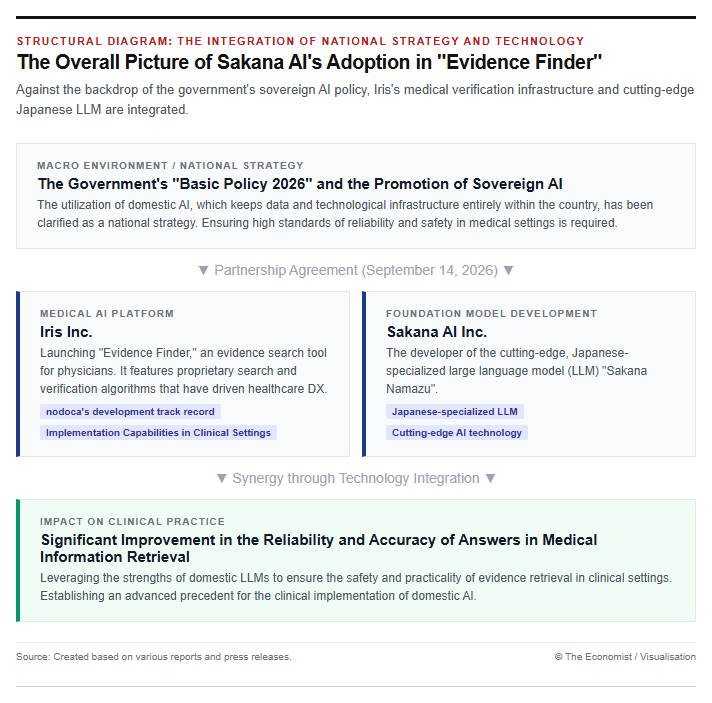
On September 14, 2026, Iris Inc., a medical AI device development company, announced an agreement to adopt “Sakana Namazu,” a Japanese-optimized large language model (LLM) developed by Sakana AI Inc., for its “Evidence Finder” evidence search tool designed for physicians. Founded in 2017 by practicing physician Sho Okiyama and others, Iris is a company that has driven medical DX through the development and dissemination of “nodoca,” an AI-powered influenza diagnostic medical device. This partnership represents an initiative fusing Iris’s independently cultivated search and verification algorithms with Sakana AI’s cutting-edge Japanese LLM technology. The “Basic Policy on Economic and Fiscal Management and Reform 2026” (Basic Policy 2026) set forth by the Japanese government also clearly emphasizes promoting the use of “sovereign AI” (domestic AI) that keeps data and technology infrastructure entirely within the country. This initiative is garnering significant expectations as an advanced precedent for clinical implementation in the medical field in alignment with national strategy. Please refer to the figure below for an overview illustrating the concept of the partnership.
Features and Challenges of the Physician Search Tool “Evidence Finder”
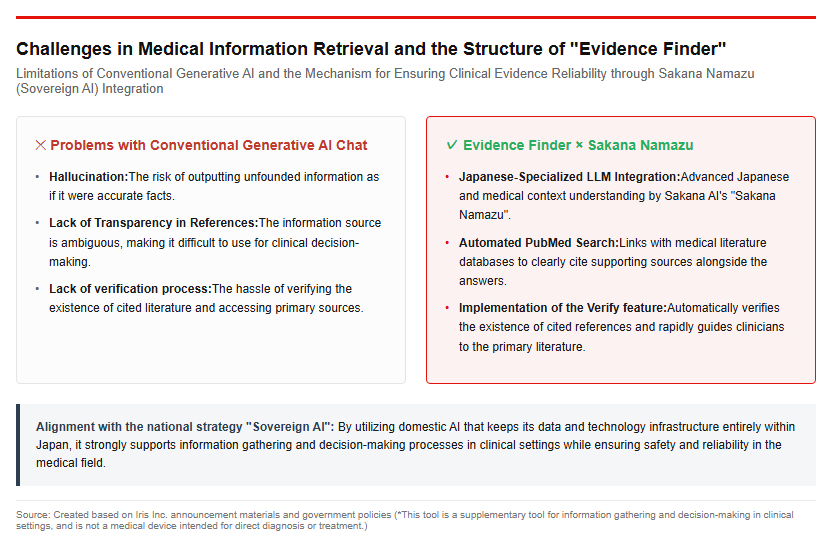
The “Evidence Finder,” into which Sakana Namazu is now integrated, is a dedicated tool designed to quickly and accurately search for and present the medical evidence sought by physicians in clinical settings. With conventional generative AI chat tools, serious issues included hallucinations—where unfounded false information is output as if it were correct—and the opacity of cited literature. Evidence Finder features a mechanism that automatically searches medical literature databases such as PubMed in response to physicians’ queries and clearly displays the cited literature alongside the answers. Furthermore, it comes standard with a “Verify function” that automatically checks whether the literature cited by the AI actually exists as a published paper, establishing a dedicated pathway that allows clinicians to quickly access primary sources. Note that this service is not a medical device intended for the direct diagnosis or treatment of specific patients, but is designed as a support tool to enhance the accuracy of clinical decision-making and information gathering. Specific screens illustrating the workflow from literature search to generation are as follows.
Demonstration of Technical Features and High Model Performance
Performance evaluation achieving a 96.4% accuracy rate on the 120th National Medical Examination
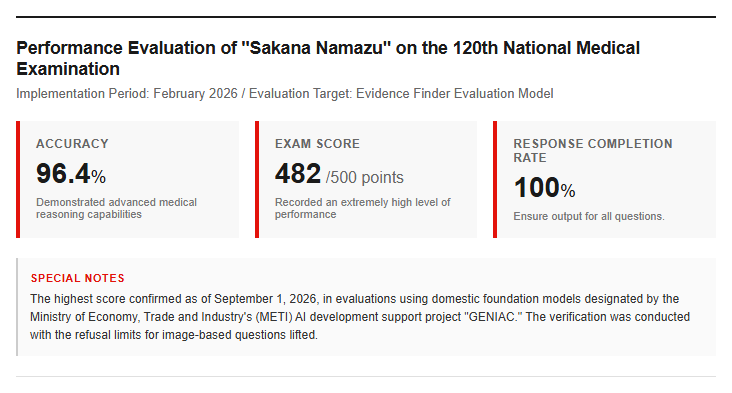
A verification test was conducted in which past questions from the 120th National Medical Examination, administered in February 2026, were solved using an evaluation model for Evidence Finder incorporating Sakana AI’s Japanese-specialized LLM, “Sakana Namazu.” As a result, it scored 482 out of 500 points, recording an exceptionally high accuracy rate of 96.4%. It also achieved a 100% completion rate for answering. According to an announcement by Iris, this result represents the highest score confirmed as of September 1, 2026, among evaluations using domestic foundation models specified by the Ministry of Economy, Trade and Industry’s AI development support project “GENIAC.” During the test, the restriction in the product version that rejects image-based questions was lifted to measure the model’s inherent text comprehension and medical knowledge reasoning capabilities. This objectively demonstrates its ability to understand advanced technical terminology and adapt to Japan-specific clinical contexts. Data on the transition of the accuracy rate and a comparison of scores are summarized in the graph below.
Significance of Adopting Japan’s Homegrown LLM “Sakana Namazu” and Data Sovereignty
Adopting domestic LLMs (sovereign AI) rather than foreign-made LLMs in the medical field holds significant safety implications that go far beyond mere computational accuracy. Patient case data and medical records are highly sensitive personal information, raising ongoing security and privacy concerns regarding data transmission and processing on overseas servers. Adopting Sakana Namazu makes it possible to keep data within a domestically managed, closed environment, thereby maintaining a high level of security and data sovereignty. Another major advantage is the ability to mitigate external risks commonly associated with foreign models, such as unexpected specification changes or sudden service terminations. Utilizing its proprietary post-training technology, Sakana Namazu prevents catastrophic forgetting—the loss of existing knowledge and reasoning capabilities—while achieving advanced adaptation to complex Japanese instruction-following, domestic medical systems, and medical record terminology.
Clinical Implementation in Medical Settings and Future Prospects
Ensuring Safety in Clinical Support and Physicians’ Legal Liability
As the medical applications of generative AI expand, stricter operation based on the “Generative AI Guidelines (Medical Edition)” formulated by the Ministry of Health, Labour and Welfare and related administrative agencies is being required. The guidelines clearly state that generative AI is merely an auxiliary tool to support a physician’s judgment, and that the ultimate decision-making authority and responsibility for diagnosis and treatment rest with the individual physician. Even in the event of a medical accident or adverse outcome resulting from medical care that utilized AI output, legal liabilities such as civil damages or criminal liability for professional negligence resulting in death or injury will be determined not by the AI development vendor, but by whether or not the practicing physician breached their duty of care. Rather than being a tool that automates diagnosis, Evidence Finder adopts a design that transparently presents literature-based evidence, thereby supporting an environment where physicians can make objective and appropriate clinical judgments under their own responsibility.
Future Developments and Key Focus Areas of Healthcare DX and Sovereign AI
In the future medical AI market, expectations are growing for the establishment of a clinical ecosystem that seamlessly integrates multiple AI technologies, going beyond the mere introduction of standalone search tools or diagnostic imaging AI. Iris has raised a total of 5 billion yen in funding, advancing the nationwide rollout of its influenza diagnosis AI “nodoca” while focusing on the development of new disease diagnosis algorithms. Prompted by this technical collaboration with Sakana AI on Evidence Finder, attention will likely focus moving forward on strengthening integration with healthcare DX infrastructure such as electronic health records and PHRs (Personal Health Records). If a clinical workflow can be realized that consistently supports everything from medical interviews and literature searches to medical record creation assistance, it will help compensate for the shortage of specialists in regional and rural healthcare and alleviate the heavy administrative burden on physicians. In medical settings where technological innovation intersects with strict regulations, how the social implementation model of domestic AI evolves from here on will be a major point of attention.
Reference page
- [Aillis, Inc. Press Release] https://aillis.jp/news/post/20260914
- [Evidence Finder Product Introduction Page] https://overview.evidencefinder.jp/
- [Sakana Namazu Official Page] https://sakana.ai/namazu/
- 【Sakana AI Official Announcement】https://sakana.ai/namazu-aillis/
- [Aillis, Inc. Official Website] https://aillis.jp/
【#MedicalAI #SakanaAI #Iris #EvidenceFinder #SakanaNamazu #SovereignAI #MedicalDX】

コメント