On October 8, 2026, Google released “Google AI Edge Foresight for macOS,” an AI-powered note-taking app for macOS. This release is driven by the technical demand to overcome data security risks and communication latency associated with conventional cloud-dependent AI, enabling advanced AI features to be executed safely and swiftly in a local environment.
- Key Points of the Event and App Overview
- Background of Development and the Demand for On-Device Processing
- Multimodal Embeddings with EmbeddingGemma 2
- Gemma 4 Models and How Fully Local RAG Works
- Smart Automatic Integration of Meeting Minutes and Project Documents
- The Spread of On-Device AI: Future Developments and Key Points to Watch
Key Points of the Event and App Overview
On October 8, 2026, Google officially released “Google AI Edge Foresight for macOS,” a smart AI note-taking app that processes conversations and business data locally on Mac devices without sending them to the cloud. This application is a system that understands conversational audio input from the microphone and various files on the desktop in real time, and provides advanced support for users’ note-taking and search tasks.
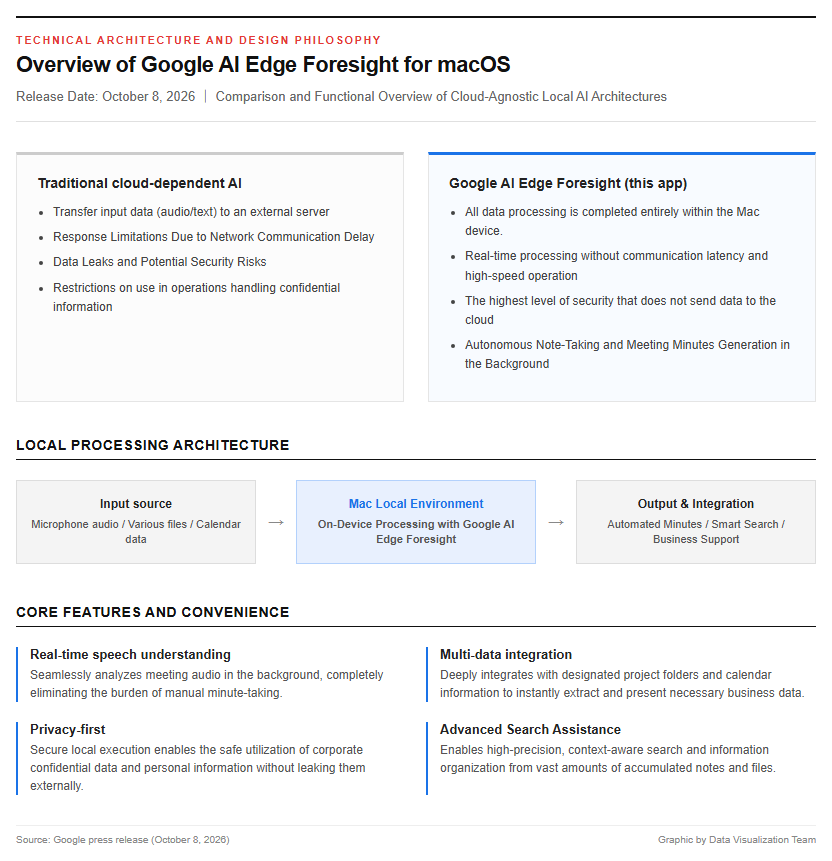
Most conventional generative AI assistants have relied on a mechanism where input text or audio is first transferred to an external cloud server for processing. In contrast, Google AI Edge Foresight features an architecture that completes all data processing locally within the Mac device. Users do not need to manually create detailed meeting minutes; simply keeping the notes app running in the background automatically generates polished minutes summarizing the key points. Furthermore, by integrating with data from specified project folders and calendars, it enables the instant retrieval of information necessary for business tasks.
The following diagram shows the overall architecture of Google AI Edge Foresight.
Background of Development and the Demand for On-Device Processing
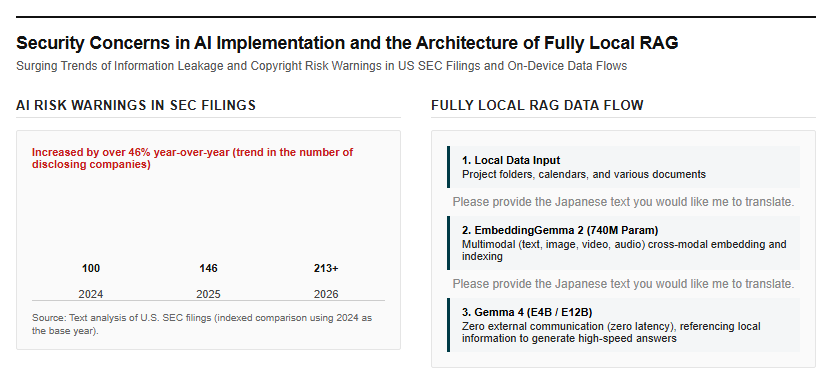
The background behind the development of this application lies in the growing security and privacy concerns regarding cloud-based AI among corporations and individuals. From 2024 to 2026, concerns about entrusting confidential data to external servers rapidly escalated, as evidenced by a more than 46% year-over-year increase in the number of companies warning against information leakage and copyright risks associated with AI adoption in their filings with the U.S. Securities and Exchange Commission (SEC).
Particularly in fields requiring strict data management, such as finance, legal, and healthcare, there have been frequent cases where uploading audio and documents to the cloud is restricted. In addition, latency associated with network round-trip communication has been a major challenge in real-time business support. Against this backdrop, demand has grown for lightweight, high-precision on-device AI models that operate on PCs and smartphones equipped with around 16GB of memory, culminating in the release of this local AI memo app for Mac.
Technical Mechanism and Fully Local RAG Architecture
Multimodal Embeddings with EmbeddingGemma 2
Powering the foundational technology of Google AI Edge Foresight is an on-device multimodal embedding model developed by Google called “EmbeddingGemma 2.” Despite its lightweight size of 740 million parameters, this model features an innovative structure that integrates and maps text, images, video, and audio into a single vector space.
In conventional multimodal processing, an intermediate step was required to first convert images and audio into text data, which caused increased computational costs and information loss. EmbeddingGemma 2 achieves cross-modal semantic search, which directly compares and searches data of different modalities within the same vector space without intervening conversions. This makes it possible to directly and with high accuracy search for specific scenes in videos, charts in images, and spoken content in audio using text queries.
Gemma 4 Models and How Fully Local RAG Works
Another technical core of this app is a fully locally connected RAG (Retrieval-Augmented Generation) pipeline that generates natural responses based on retrieved information. This system incorporates “Gemma 4 E4B” or “Gemma 4 E12B”, which are language models optimized for on-device use.
When users specify project folders, reference materials, charts, and calendar events in Foresight, EmbeddingGemma 2 rapidly indexes the local files. Then, when the user asks questions in chat or uses the “Live Assistance” feature, the on-device Gemma 4 model references the local files and instantly generates accurate answers without communicating with an external network at all. Because network latency is zero, it significantly reduces preparation time during meetings or situations requiring a response, supporting prompt decision-making.
The following diagram shows the data flow of the local RAG pipeline.
Business Process Transformation and Future Outlook & Key Points
Smart Automatic Integration of Meeting Minutes and Project Documents
The introduction of Google AI Edge Foresight fundamentally transforms the hassle of information organization and sharing in daily desk work. In conventional operations, a vast amount of time and effort was spent on transcribing recorded data, categorizing materials into folders, and searching through past logs. By utilizing this application, users can simply leave brief bullet-point notes and complete high-quality notes cross-referenced with background audio listening data.
Additionally, without having to manually organize files, the app automatically learns and maintains business context, ensuring that important reference data is instantly presented when needed. It minimizes the time spent on “returning calls” and advance preparation, making it possible to dramatically improve the speed of internal communication.
The Spread of On-Device AI: Future Developments and Key Points to Watch
This release of the app for Mac goes beyond merely providing a single application; it marks a decisive turning point indicating a shift in the mainstay of AI technology from “reliance on massive clouds” to “on-device processing completed on the local device.” Moving forward, key areas to watch will include its deployment to various operating systems and mobile devices other than the Mac, as well as the expansion of local integration APIs with third-party apps.
In particular, the combination with ultra-lightweight models of under 1GB and quantization-aware training (QAT) technologies is rapidly advancing the capability to perform inference on smartphones and edge devices on par with large-scale models. Looking ahead, it is predicted that an era will begin in earnest where companies can embed intelligence into their local environments without worrying about API usage fees or the risk of data leakage, generating great expectations for future updates and the expansion of supporting ecosystems.
Reference page
- 【Google AI Edge Foresight for macOS Official Developer Page】https://developers.google.com/edge/foresight
- EmbeddingGemma 2 Model Card (Google AI)
- [Gemma 4 Core Model Documentation (Google AI)] https://ai.google.dev/gemma/docs/core?hl=ja
【#Google #Mac #LocalAI #AIEdgeForesight #OnDeviceAI #Gemma4 #RAG #Transcription】
コメント