
The Consumer Price Index (CPI) for September, announced by the Russian Federal State Statistics Service, rose 0.3% month-on-month, in line with market expectations. The shift back to positive growth from the previous month’s negative trend is driven by structural upward pressure on prices caused by excess demand led by military spending and a severe labor shortage.
- Key Points of the September CPI Increase and Changes from the Previous Month
- Price Changes by Item and the Impact of Seasonal Factors
- Background of the Policy Rate Hike to 21% and Gradual Rate Cuts
- Structural Inflation and the Limits of Supply Constraints
- The Saturation of Military Keynesianism and the Expansion of Fiscal Deficits
- Future Economic Growth and Market Focus
Key Points of the September CPI Increase and Changes from the Previous Month
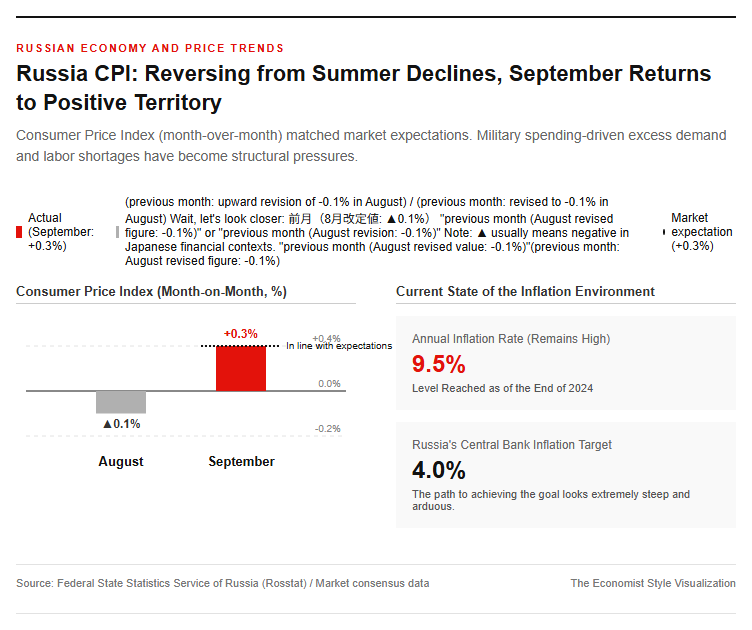
The Consumer Price Index (CPI) for September 202X released by the Federal State Statistics Service of the Russian Federation showed a 0.3% increase from the previous month, perfectly matching the preliminary average market forecast of +0.3%. Since the revised figure for August, the previous month, showed a temporary decline of -0.1% month-on-month, it has become clearly evident that prices returned to an upward trend entering September. Viewed on a year-on-year basis, the inflation rate continues to trend at a high level, and the aftereffects of the high inflation that reached an annual rate of 9.5% at the end of 2024 continue to affect the entire domestic economy. The results of this latest indicator vividly tell the reality that the temporary and limited stabilization of prices seen during the summer has ended, and consumer prices have begun to move firmly upward once again. Inflationary pressure within Russia is not merely a temporary supply shock, but is being driven by fiscal stimulus measures accompanying the protracted invasion of Ukraine and a strong expansion of domestic demand. Among market participants, the view is strengthening—as indicated by the September trends—that the path toward achieving the 4.0% annual rate targeted by the Russian Central Bank is extremely steep. Although the figures for the economic indicators were in line with pre-market expectations, the current pace of price increases remains high, raising concerns about a decline in actual purchasing power.
Price Changes by Item and the Impact of Seasonal Factors
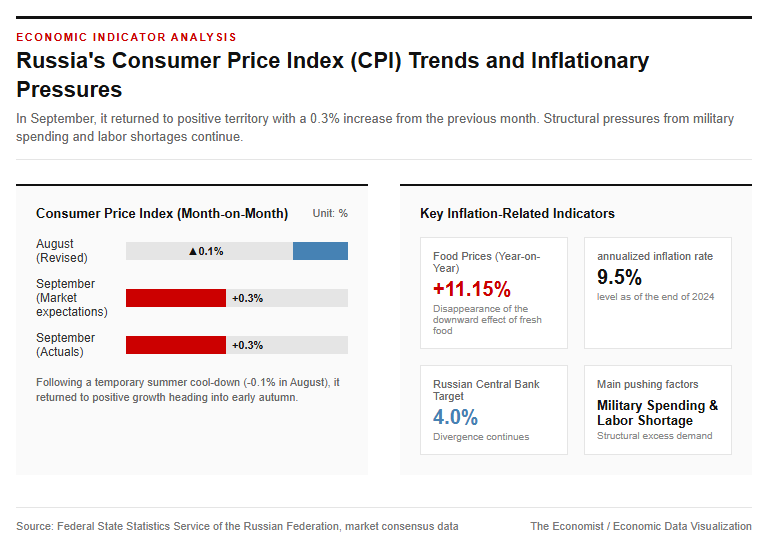
A detailed analysis of the September CPI breakdown reveals clear variations in price trends across different categories. Fresh food prices, such as fruits and vegetables, which had been on a downward trend during their summer harvest season, saw their decline come to a halt as early autumn arrived, turning into upward pressure on overall food prices. Overall food prices recorded a massive year-on-year increase of 11.15%, directly driving up the cost of living for citizens. Meanwhile, price trends in the non-food sector, such as home appliances and communication equipment, remain at high levels due to increased transaction costs associated with exchange rate fluctuations and changes in import routes. Furthermore, the surge in automotive fuel prices, including gasoline and diesel, during the autumn, and successive upward revisions of public utility rates by the central and local governments became strong factors boosting overall prices. In the service sector as well, the momentum of passing on rising labor costs—driven by labor shortages—along with revisions to airline and railway passenger fares, into selling prices is accelerating. With the disappearance of the seasonal decline effect of fresh food in this way, underlying inflationary pressures are surfacing, confirming a comprehensive price rise spanning across all items.
The Conflict Between the Russian Central Bank’s Monetary Policy and Inflation Control
Background of the Policy Rate Hike to 21% and Gradual Rate Cuts
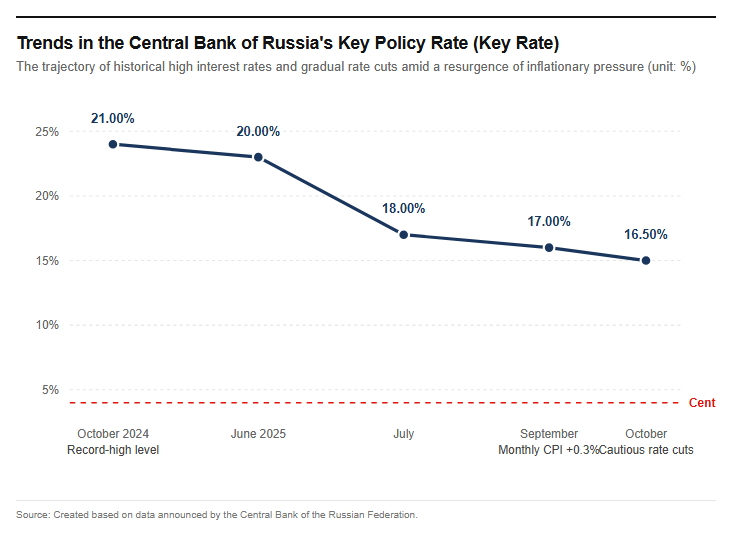
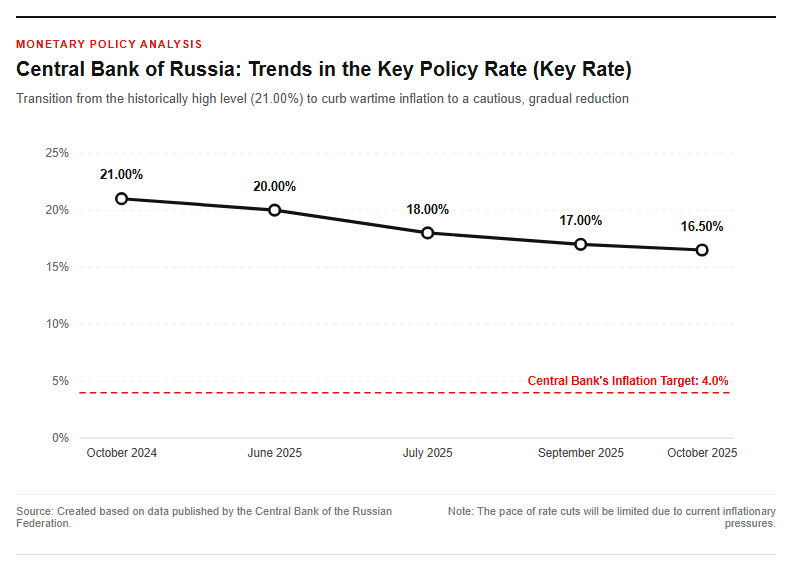
To cope with soaring wartime inflation, the Central Bank of the Russian Federation has been forced to implement historic monetary tightening. At its monetary policy meeting in October 2024, the Bank of Russia raised its key policy rate to an unprecedented high of 21.00% per annum. This high-interest-rate policy was implemented with the aim of curbing the surge in private lending, cooling aggregate demand by encouraging a greater propensity for household savings, and stabilizing the ruble exchange rate. Subsequently, as signs of disinflationary trends emerged entering 2025, the central bank implemented gradual cuts to 20.00% in June, 18.00% in July, 17.00% in September, and 16.50% in October. However, the central bank remains extremely cautious about cutting rates merely as an economic stimulus, continuously guarding against current upward price pressures and high inflation expectations. The fact that the September CPI turned back to positive growth at +0.3% month-on-month served as proof of just how dangerous it is to accelerate the pace of rate cuts. The central bank is thus forced to maintain stringent monetary conditions with the goal of returning to its 4.0% inflation target, leaving limited room for further interest rate reductions.
Structural Inflation and the Limits of Supply Constraints
At the root of the soaring prices plaguing the Russian economy are structural supply constraints that cannot be resolved by monetary policy alone. The ongoing invasion of Ukraine has driven a sharp surge in the influx of labor into conscription and the military-industrial complex, severely exacerbating an unprecedented labor shortage in the civilian-led industrial sector. The tightness of the labor market, which is close to full employment, has rapidly accelerated wage growth, creating a vicious cycle in which this is directly passed on to the selling prices of goods and services. Furthermore, capacity utilization rates in the manufacturing industry have reached near-limit levels, and supply capacity to meet additional demand is hitting its expansion ceiling. In addition, economic sanctions by Western countries and the intensification of “secondary sanctions” against Russia have forced disruptions in payment procedures and the bypassing of logistics routes, dramatically driving up the procurement costs of imported consumer and producer goods. No matter how high the Russian central bank maintains its policy interest rate, it is impossible to eliminate such physical bottlenecks as labor shortages and the cutoff of supply chains from abroad. The gap of “demand overheating and supply shortages”—where demand driven by military and private consumption continues to expand while the expansion of supply capacity fails to keep pace—is precisely the primary factor entrenching high inflation.
The Limits of the Wartime Economy and Medium- to Long-Term Economic Outlook
The Saturation of Military Keynesianism and the Expansion of Fiscal Deficits
The economic stimulus driven by massive military expenditures that has sustained the Russian economy—the so-called “military Keynesian effect”—is rapidly exposing its limitations. Defense and security-related expenses account for approximately 41% of the 2025 budget expenditures, and the excessive injection of state capital drove real GDP growth rates of +4.1% in 2023 and +4.3% in 2024. However, the production capacity of the military-industrial complex has already reached a saturation point, and no further growth-boosting effects can be expected. Meanwhile, the colossal military spending is straining state finances, with the fiscal deficit projected to expand to -2.6% of GDP in 2025. To plug this deficit, the Russian government has been forced to decide on a tax reform that will raise the Value-Added Tax (VAT) rate from the current 20% to 22% starting in 2026. Excessive military dependence and fiscal expansion have dampened private-sector investment and consumer sentiment, with domestic investment turning negative for the first time since the invasion, dropping 3.1% in the third quarter of 2025. An economic structure overly skewed toward wartime support is losing its sustainability, and the loss of fiscal leeway along with the increase in the public burden is severely eroding the foundation for future growth.
Future Economic Growth and Market Focus
The Russian economy is projected to face a significant slowdown in growth, driven by the deceleration of the military-industrial boom and the entrenchment of high inflation. According to the Russian central bank’s forecasts, real GDP growth for 2025 and 2026 is expected to remain sluggish at 0.5% to 1.5%. While the overheating of the economy is gradually cooling, the planned VAT hike and additional utility rate increases slated for 2026 will uniformly act as upward pressures on prices, posing a high risk of slowing the pace of disinflation. From a medium- to long-term perspective, key points to watch include, first, how the central bank will steer interest rates between curbing inflation and preventing an economic stall, and second, whether import routes and payment systems can be maintained as the web of Western secondary sanctions expands to friendly third countries. Furthermore, if sluggish crude oil prices and stricter international regulations against the “shadow fleet” further reduce oil and gas revenues, the fiscal foundation will become even more vulnerable. As high interest rates, high inflation, and labor shortages act in combination, global markets are closely monitoring future inflation indicators and fiscal management trends to see how long the Russian economy can maintain its “wartime fortress economy.”
Reference page
- 【Central Bank of the Russian Federation Monetary Policy Guidelines (MONETARY POLICY GUIDELINES FOR 2026–2028)】[suspicious link removed]
- [arXiv Paper: Do Sanctions Backfire? New Evidence on the Macroeconomic Effects of Supporting Ukraine] [suspicious link removed]
【#RussianEconomy #Inflation #CPI #BankOfRussia #MonetaryPolicy #WartimeEconomy】


コメント