Elon Musk has explicitly denied rumors that TSMC will participate in operating the massive Texas semiconductor fab “Terafab,” reaffirming his policy to build and operate the facility in-house. Behind this decision lies a strong intention to maintain collaboration with development partner Intel and to drive the complete in-house development of the computing infrastructure required for his AI and robotics businesses.
- Elon Musk’s Decision to Dismiss Rumors of TSMC’s Involvement
- Market Turmoil Revealed by News Reports and Stock Price Reactions
- Overview of the Mega Manufacturing Facility Totaling 9 Billion
- The Goal of In-House Proprietary AI Chip Development and the Vertical Integration Model
- Intel’s Adoption of the Cutting-Edge 14A Process and Partnerships
- The Future Envisioned by Terafab and Key Focus Areas for the Semiconductor Industry
Elon Musk’s Decision to Dismiss Rumors of TSMC’s Involvement
On October 7, 2026, entrepreneur Elon Musk officially dismissed market views on social media X (formerly Twitter) that Taiwan’s TSMC (Taiwan Semiconductor Manufacturing Company) would be involved in the operation and management of the massive semiconductor fab “Terafab,” which is currently under construction. In his post, Musk emphasized, “We are building and operating the factory. Please let there be no doubt about that,” and stated clearly that there is no possibility of TSMC’s involvement other than the option to sublease a portion of the site. This remark serves as a direct rebuttal to speculation reported by technology newsletters like “Calpium” suggesting that “TSMC may take charge of the ownership or operation of the Terafab plant.” Please refer to the figure below.
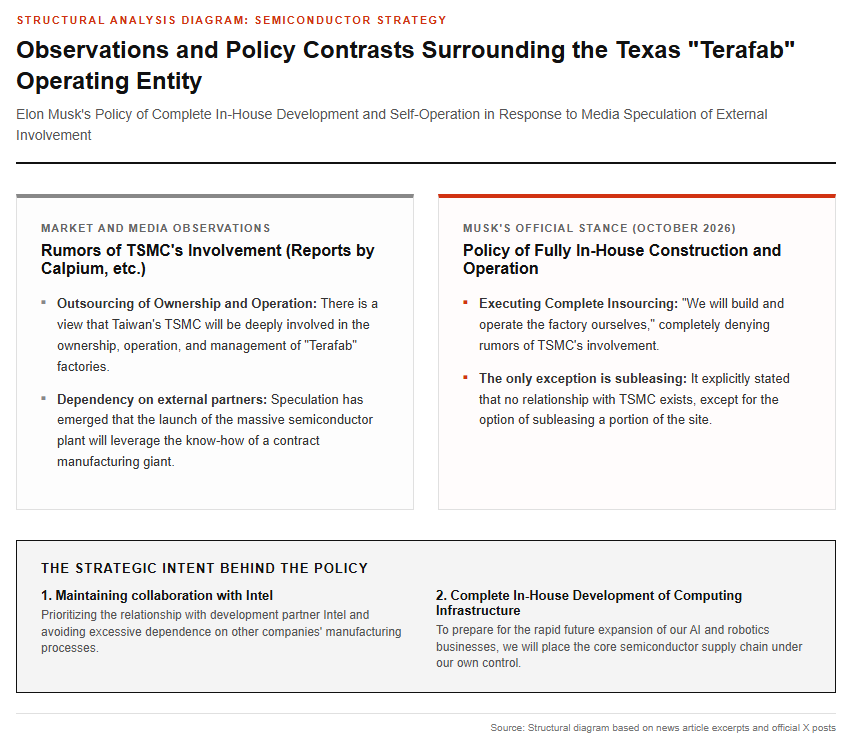
The key points regarding Musk’s announcement are as follows.
- Ownership and operational control of the factory facilities are limited to the company’s own group, such as Tesla and SpaceX.
- As for TSMC, it stops at considering subleasing a portion of the site if requested.
- Maintain the policy of building dedicated in-house semiconductor manufacturing facilities without relying on external foundries.
Thus, Musk has once again made it clear that he is rejecting the scenario of operating factories with the assistance of TSMC, the world’s leading contract manufacturer of cutting-edge semiconductors, and is instead steering toward the establishment of a self-led, vertically integrated model.
Market Turmoil Revealed by News Reports and Stock Price Reactions
Behind these remarks lies the severe turmoil that occurred in the stock market immediately after rumors of a collaboration with TSMC surfaced. When reports emerged in early October 2026 that TSMC would support the operation of TeraFab, Intel’s stock price, which had participated as a key partner since April 2026, temporarily recorded a sharp decline of over 3% to 4%. This was because concerns spread among investors that Intel might be squeezed out of the project. However, market sentiment shifted dramatically on October 7 when Musk denied TSMC’s involvement in operations. While Intel’s stock rose 1.6% in pre-market trading, TSMC’s American Depositary Receipts (ADRs) fell by 1.3%. Additionally, speaking to Bloomberg at an event in Tokyo on the same day, Intel CEO Lip-Bu Tan officially stated that Intel remains involved in the TeraFab project. Among market observers, some view Musk’s mention of TSMC as a maneuver to gain leverage in price negotiations with Intel, while others analyze that it would be difficult to easily exclude Intel, which receives subsidies from the U.S. government.
The Full Picture of the Massive “Terafab” Project and Its Semiconductor Strategy
Overview of the Mega Manufacturing Facility Totaling 9 Billion
“Terafab,” jointly promoted by Tesla, SpaceX, and xAI, is an unprecedented, large-scale manufacturing project that defies conventional wisdom in the semiconductor industry. The construction site has been selected in Grimes County, located approximately 100 kilometers northwest of Houston, Texas, with a site area reaching about 100 million square feet (equivalent to roughly 1,700 soccer fields). The investment for the first phase, which broke ground in August 2026, stands at $16.8 billion (approximately 2.7 trillion yen), backed by substantial tax incentives and subsidies from local authorities. The total investment across all construction phases is projected to reach up to $119 billion (approximately 18.8 trillion yen), with plans to create at least 3,000 new jobs. Please refer to the figure below.
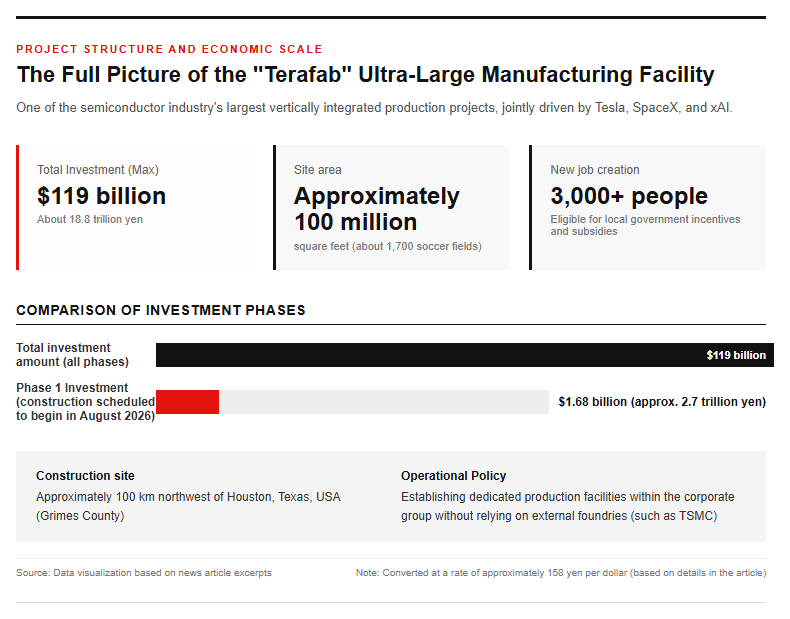
The primary goals and features that TeraFab aims to achieve are as follows.
- Aims to supply a staggering amount of AI computing power equivalent to 1 terawatt (1 trillion watts) annually.
- Consolidate everything from chip design, manufacturing, memory production, advanced packaging, and testing within the same facility.
- Considering the introduction of innovative technology to seal wafers in a nitrogen environment to reduce cleanroom construction costs.
With rising geopolitical risks surrounding Taiwan in mind, Musk is rushing to establish a self-reliant framework that can keep his company’s production activities going even if the semiconductor supply chain from Asia is disrupted.
The Goal of In-House Proprietary AI Chip Development and the Vertical Integration Model
Semiconductors produced at TeraFab will not be sold externally and are planned to be supplied exclusively to products within the Tesla group. Specifically, the targets include Tesla’s autonomous robotaxi “Cybercab,” humanoid robot “Optimus,” SpaceX’s AI chips for space data centers (D3), and xAI’s training infrastructure. To break away from its dependence on existing general-purpose chips made by NVIDIA, Tesla is rapidly advancing the development of its in-house chips, “AI5” and “AI6.” AI5 is designed to achieve high inference performance while keeping power consumption down to one-third of NVIDIA’s latest “Blackwell” chip, and production is planned using TSMC’s 3nm process and Samsung Electronics’ 4nm process. Furthermore, the next-generation AI6 will adopt Samsung Electronics’ 2nm process, committing to an unprecedented development speed of “updating one generation every 9 months.” Musk’s true goal is to simultaneously achieve improved AI processing performance and dramatic cost reductions by realizing a vertically integrated model that minimizes the distance between design and manufacturing, thereby optimizing both hardware and software.
Maintaining Collaboration with Intel and Future Industry Outlook
Intel’s Adoption of the Cutting-Edge 14A Process and Partnerships
Intel plays an extremely crucial role in the TeraFab vision. In April 2026, Intel announced its participation as TeraFab’s sole manufacturing and development partner, with its cutting-edge process node “14A” designated as the adopted technology for the facility. For Intel, which is seeking to rebuild its foundry business, securing major customers like Tesla and SpaceX—both of which are making massive investments—served as a golden opportunity to prove the reliability of its manufacturing technology to the world. Intel’s external foundry revenue for the second quarter of 2026 stood at just $293 million, making orders from TeraFab the most critical project for improving the company’s revenue structure. With rumors of TSMC’s involvement dismissed and CEO Lip-Bu Tan explicitly affirming the maintenance of the relationship, Intel will continue to play a pivotal role in areas such as technology licensing and packaging support using the 14A process. Please refer to the diagram below.
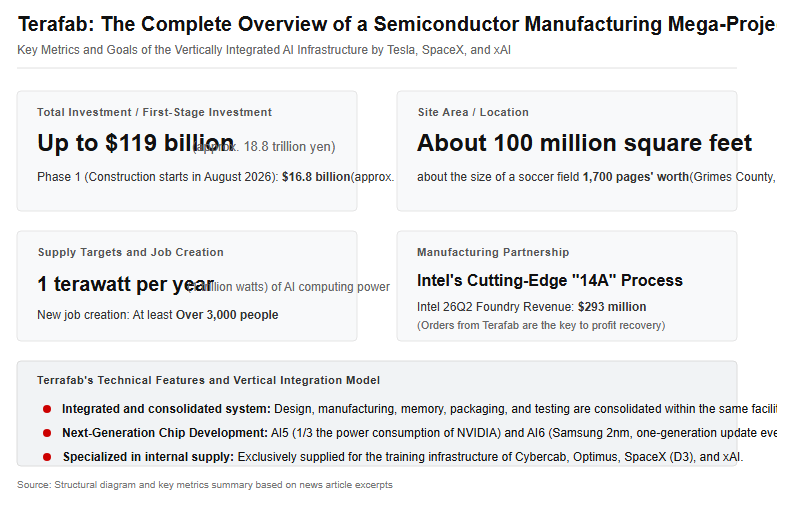
The expectations for the partnership between Intel and Terrafab are as follows.
- Establishing a track record of practical application for external customers using the cutting-edge 14A process
- Securing new revenue streams through technology licensing fees and advanced packaging processing
- Strengthening the Resilience of the Advanced Semiconductor Manufacturing Supply Chain in the United States
The Future Envisioned by Terafab and Key Focus Areas for the Semiconductor Industry
Musk’s challenge of building and operating a factory on his own faces numerous hurdles on the path to practical application. Establishing a semiconductor plant from scratch and achieving a stable yield (good product rate) typically requires five to seven years and extremely advanced manufacturing know-how. Currently, as the start of mass production for the Cybercab and Optimus draws near, the reality is that during the transition period until the early 2030s, when TeraFab is projected to begin full-scale operations, outsourcing to Samsung Electronics and TSMC will have to be continued in parallel. The main points to watch in the industry going forward are as follows.
- Progress on limited operations scheduled by the end of 2027 and validation of initial yields
- Disclosure of detailed contract terms, cost-sharing, and revenue-sharing models between Intel and Tesla
- Tesla’s overall capital expenditures exceeding $20 billion (approx. 3.1 trillion yen) in 2026 and the maintenance of financial health
If Terafab succeeds, it will shake up the structure of the semiconductor industry, where the traditional horizontal division of labor model has been the mainstream, but how it overcomes the barriers of massive capital investment and manufacturing technology will be the biggest focus moving forward.
Reference page
- 【Investing.com】https://jp.investing.com/news/stock-market-news/article-1703941
【#Semiconductors #ElonMusk #TSMC #Intel #Terafab #AIChips #Tesla #AutonomousDriving】


コメント