Governments and municipalities are strengthening initiatives to develop digital talent and support the adoption of AI and digital technologies in healthcare and nursing care settings. Behind this is a strong sense of urgency to address the declining birthrate and aging population toward 2040, as well as the severe shortage of healthcare and nursing care workers, with the aim of improving operational efficiency on the front lines and establishing a sustainable service delivery system.
- Key takeaways: Government workforce development initiatives progressing in medical and nursing care
- Tokyo’s Healthcare DX Subsidy Support: Full Subsidy Up to 500,000 Yen
- Nursing Care DX Core Personnel Training: Developing Leaders on a 5,000-Person Scale
- The 2040 Problem and the Background Behind the 200-Billion-Yen-Scale Budget Allocation
- Healthcare AI Guidelines and the Utilization of Pseudonymized Information
- Future Developments and Key Focus Areas: Challenges in Task Shifting and Organizational Integration
Key takeaways: Government workforce development initiatives progressing in medical and nursing care
In Japan’s medical and nursing care sectors, the national and local governments are providing full-scale support for the development of specialized talent capable of mastering digital technologies such as artificial intelligence (AI) and ICT. In a Japan facing a declining birthrate and an aging population, it is estimated that while demand for medical and nursing care will peak in 2040, the shortage of frontline workers will reach a critical state due to the rapid decline in the working-age population. To address these structural challenges, moving beyond the mere introduction of devices, the promotion of digital transformation (DX)—which leverages digital technology to overhaul business processes themselves—has become an absolute imperative.
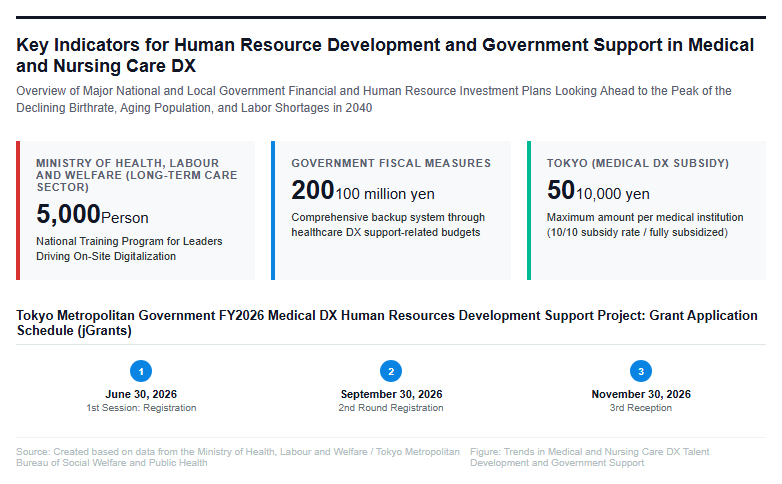
The Ministry of Health, Labour and Welfare is promoting a national plan to train 5,000 leaders in the nursing care sector, and local governments such as the Tokyo Metropolitan Government have also launched programs to fully subsidize the expenses incurred by employees of private medical institutions in acquiring IT certifications. Furthermore, the government is building a comprehensive backup system from both financial and human resource development aspects, including financial measures on the scale of 20 billion yen as a budget related to medical DX support. These measures, aimed at reducing operational burdens on-site and enabling advanced data integration, are positioned as a crucial trump card for maintaining the future foundation of community medical and nursing care.
Tokyo’s Healthcare DX Subsidy Support: Full Subsidy Up to 500,000 Yen
The Tokyo Metropolitan Government’s Bureau of Health and Medical Services is implementing the “FY2026 Medical DX Human Resources Development Support Project,” targeting hospitals and medical clinics within Tokyo. This project aims to enable staff at private medical institutions to acquire IT and DX-related knowledge and skills necessary for operating electronic medical records and introducing medical information sharing platforms. By directly supporting the initial costs and training burdens faced by medical institutions, the initiative aims to accelerate digitalization across the entire region.
The main eligible expenses and conditions for the subsidy are as follows.
– IT/DX-related training course fees (including on-site training)
– Costs for acquiring related qualifications and examination fees for skills certification tests
– Costs for hiring or dispatching substitute staff to cover for training participants
– Base amount: 500 thousand yen (500,000 yen) per medical institution
– Subsidy rate: 10/10 (fully subsidized)
Applications for grants will be accepted online via “jGrants,” and will be conducted in a total of three rounds: the first round (June 30, 2026), the second round (September 30, 2026), and the third round (November 30, 2026). Subsidized medical institutions are required to advance digitalization efforts, such as introducing electronic prescriptions and connecting to the national electronic medical record information sharing service. Please refer to the system overview diagram below.
Nursing Care DX Core Personnel Training: Developing Leaders on a 5,000-Person Scale
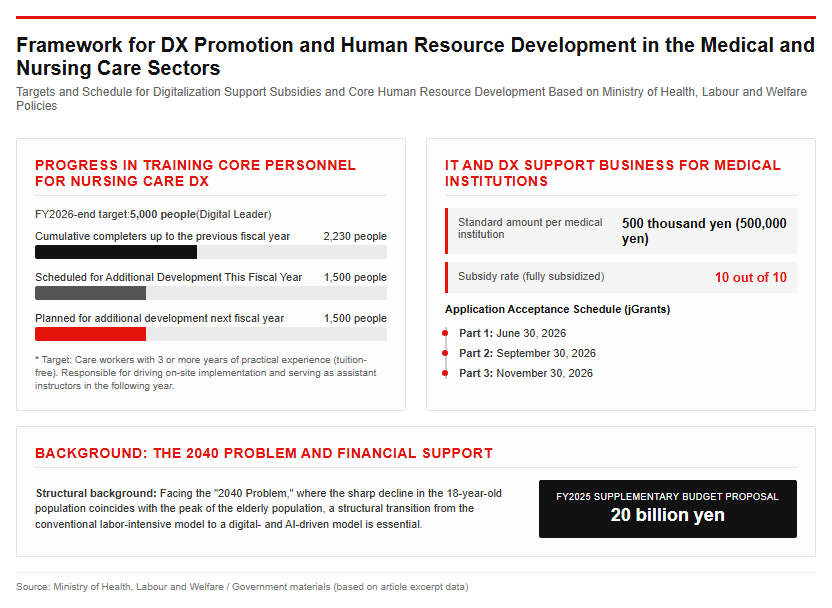
To accelerate the introduction and adoption of technology in nursing care settings, the Ministry of Health, Labour and Welfare is implementing the “Digital Core Human Resource Training Program.” This program targets nursing care staff with three or more years of practical experience and is held free of charge, combining online and in-person training. By the end of the last fiscal year, a cumulative total of 2,230 people had completed the program. The ministry aims to additionally train about 1,500 people each in the current and next fiscal years, producing a total of 5,000 digital leaders by the end of fiscal 2026.
This 5,000-person training target has also been designated as a key performance indicator (KPI) set by the government’s “Digital Administrative and Fiscal Reform Council.” Program graduates will not only serve as champions to promote the adoption and operation of nursing-care robots and ICT devices in their respective nursing-care facilities, but will also play a role in supporting trainees from other facilities as assistant instructors in training sessions from the next fiscal year onward.
In addition, the Ministry of Health, Labour and Welfare is collaborating with local governments such as Yamagata and Mie prefectures to conduct demonstration tests aimed at building a community-led development model. By utilizing nursing-care technologies such as monitoring sensors and automatic recording software, the initiative aims to reduce the psychological burden and workload of frontline staff, thereby securing high-quality care time to engage directly with care recipients.
Institutional Background and Frontline Innovation Driven by AI Utilization
The 2040 Problem and the Background Behind the 200-Billion-Yen-Scale Budget Allocation
Behind the government’s strong backing of digital transformation (DX) talent development and digitalization in the medical and nursing care sectors lies the so-called “2040 Problem.” In 2040, as the 18-year-old population plummets, nursing and medical schools are projected to face successive shortages of applicants. At the same time, medical and nursing care needs are predicted to peak significantly alongside the peak in the elderly population. There is an intense concern that continuing with traditional labor-intensive approaches will make it impossible to maintain the current regional medical and nursing care delivery systems.
To address this challenge, the government has decided to allocate 20 billion yen in the supplementary budget for fiscal year 2025 to support digitization and infrastructure development in medical institutions. The main policy directions are as follows.
– Financial support for the digitalization of medical institutions and the development of DX infrastructure
– Introduction of remote classes and flexibility in study periods and credit recognition at training schools
– Establishment of task shifting and task sharing to review the division of labor across job roles
– Flexibility in medical fee schedules and consideration of a public certification system for efficiency-focused hospitals
At a review meeting of the Ministry of Health, Labour and Welfare, discussions are held monthly in collaboration with professional organizations such as the Japan Medical Association, advancing a system design that balances the utilization of digital technology with flexible personnel training. Please refer to the roadmap image below.
Healthcare AI Guidelines and the Utilization of Pseudonymized Information
To promote the social implementation of AI technology in medical settings, the Ministry of Health, Labour and Welfare launched the “Healthcare AI Development Acceleration Consortium” and has been organizing challenges focusing on six priority areas: diagnostic imaging support, genomic medicine, diagnosis and treatment support, drug discovery, nursing care and dementia, and surgical support. Although the vast amount of medical data and medical images accumulated within hospitals are highly valuable data resources, the difficulty of obtaining individual consent under the Act on the Protection of Personal Information has traditionally been a barrier to AI development by private companies and academia.
To address this challenge, the government has established the “Guidelines for the Utilization of Medical Digital Data in AI Research and Development, etc.” The guidelines explicitly state the procedures for safely and appropriately processing and operating medical information as “pseudonymized information,” clarifying the legal basis and standards for medical institutions and private companies to develop AI diagnostic software and other tools through joint research.
This is accelerating the development of support systems for the automatic entry of electronic medical records and test data, image interpretation assistance, and alert systems to prevent medical accidents. Progress is being made in creating an environment where medical professionals can be freed from administrative tasks such as paperwork and concentrate on face-to-face consultations with patients and high-level decision-making operations.
Future Developments and Key Focus Areas: Challenges in Task Shifting and Organizational Integration
The greatest point of focus in the future of medical and nursing care DX is the extent to which the introduced digital technologies and cultivated human resources will become systematically established in actual workplaces and result in improved productivity. According to research on nursing care sites, psychological resistance such as “confusion over operation” and “concerns about system failures” tends to arise in the initial stages of introducing ICT equipment and sensors, and it has been pointed out that simply distributing equipment is not enough to achieve sufficient effects.
Therefore, moving forward, the following points will serve as important evaluation metrics.
– The Effectiveness of On-Site Reforms Led by 5,000 Core Digital Personnel at Each Facility
– Establishment of an organizational consultation and support system that ensures psychological safety for frontline staff
– Degree of Progress of Task Shifting and Task Sharing from Doctors and Nurses to Other Professions
– Expansion of ICT and AI utilization evaluations in medical and nursing care fee revisions
The true objective is to reinvest the time freed up through digitization-driven efficiencies into direct support for patients and care recipients, thereby achieving both work-style reforms for workers and improvements in service quality. Coordinated efforts by the government, local governments, and healthcare and nursing care providers will determine the sustainability of Japan’s medical and nursing care infrastructure leading up to 2040.
Reference page
- [Tokyo Metropolitan Government Bureau of Health and Medical Services] FY 2026 Medical DX Human Resources Development Support Project: Subsidy Overview for Private Medical Institutions
 令和8年度医療DX人材育成支援事業|民間医療機関向け補助金概要|東京都保健医療局東京都保健医療局の令和8年度医療DX人材育成支援事業(民間医療機関向け補助金概要)のページです。www.hokeniryo.metro.tokyo.lg.jp
[#MedicalDX #NursingCareDX #TalentDevelopment #Subsidies #AIUtilization #MinistryOfHealthLabourAndWelfare #BusinessNews]

コメント