The government has decided on the prospective designation of the series of disasters—ranging from the Reiwa 8 Baiu front heavy rains to Typhoon No. 25—as severe disasters, along with a policy to expand subsidies for restoration costs. Behind this decision are the massive infrastructure and economic damages in various regions, including Chiba Prefecture, and the strong need to reduce the financial burden on affected local governments and businesses while accelerating early recovery.
- Key points of the event: Expected designation as a severe disaster and simplification of assessment
- Financial Support Structure for Local Governments and Disaster-Affected Infrastructure
- Reconstruction Support Program for Disaster-Affected Small Businesses and the 1-Million-Yen Subsidy
- Safety Net Funds (Municipal Certification Framework) and Interest Subsidy Measures
- Labor Shortage in the Construction Industry and Effectiveness Issues in Infrastructure Restoration
- Future Developments and Key Points to Watch: Preventive Infrastructure Maintenance and the Second Supplementary Budget
Key points of the event: Expected designation as a severe disaster and simplification of assessment
On October 9, 2026, the Cabinet Office announced that it expects to additionally designate support measures for severe disasters (major severe disasters) regarding the “disasters caused by the series of weather phenomena from the 2026 rainy season front heavy rains to Typhoon No. 25.” Under this prospective designation, the policy is to widely add support not only for public civil engineering facilities such as roads and rivers, but also for the restoration of joint-use facilities of agricultural and fishery cooperatives, community centers, and private schools, as well as infectious disease prevention projects such as disinfection implemented by municipalities.
On the same day, the Ministry of Land, Infrastructure, Transport and Tourism (Water and Disaster Management Bureau, City Bureau) announced the application of the “Streamlining (Simplification) and Prior Rules for Disaster Assessments during Large-Scale Disasters” to expedite the restoration of roads, rivers, and other infrastructure by local governments. Specifically, the following procedures will be implemented.
- Significantly reducing the workload of on-site surveying and design drawing creation by utilizing existing maps and aerial photographs
- Raised the maximum limit for document-based appraisals (desk appraisals) from the usual under 10 million yen
- Raised the upper limit for disaster recovery project costs that can be approved locally in a lump sum from the usual under 400 million yen.
- Applying a special exception to consolidate or divide disaster-affected locations according to construction schedules and ordering units, treating them as a single construction project.
These special measures will alleviate the administrative burden on disaster-affected local governments and enable the early commencement of infrastructure restoration work.
Financial Support Structure for Local Governments and Disaster-Affected Infrastructure
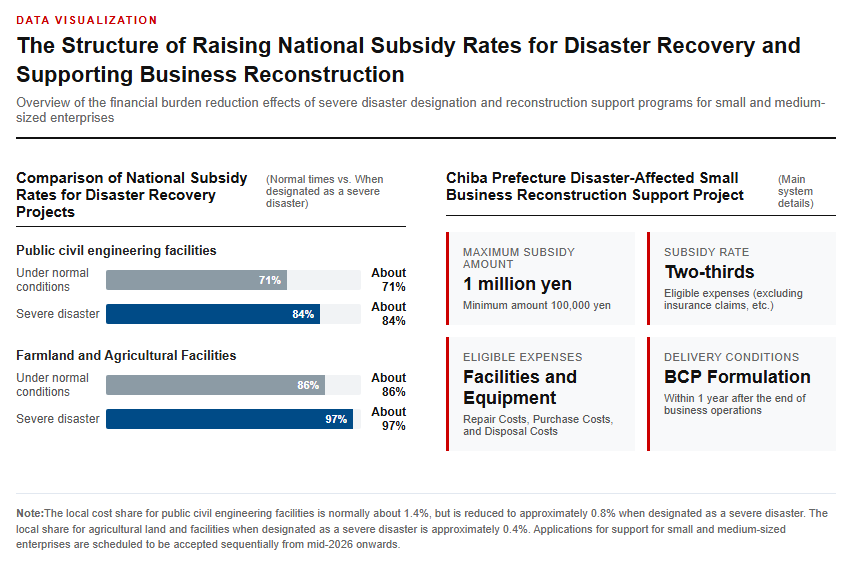
The Severe Disaster system is a legal framework designed to alleviate the financial burden on local governments when exceptionally severe disasters occur and to encourage disaster victims’ drive to rebuild. While the national subsidy rate for public civil engineering facilities in regular disaster recovery projects remains at around 71% (with the local share at approximately 1.4%), designation as a severe disaster raises the national subsidy rate to about 84% (with the local share at approximately 0.8%).
Furthermore, for agricultural land and agricultural facilities, the national subsidy rate will be increased from approximately 86% to roughly 97% of the standard subsidy (with the local contribution at about 0.4%), dramatically reducing the financial burden on local governments and business operators. In target areas such as Aomori Prefecture, Tochigi Prefecture, Chiba Prefecture, and Chiba City, special procedures are concurrently underway for roads and rivers under the jurisdiction of the Ministry of Land, Infrastructure, Transport and Tourism, as well as facilities managed by its City Bureau.
Specific effects of the financial assistance include the following:
- The central government will subsidize up to approximately 90% of the massive restoration work costs that local governments cannot fully bear on their own.
- Expansion of local allocation tax measures for the principal and interest redemption of local government bonds used for restoration project costs
- Increased subsidy rates for the restoration costs of public schools, public housing, welfare facilities, flood control material expenses, etc.
With the government’s generous financial support now indicated, prompt budget execution and the full-scale launch of restoration work are expected in the disaster-stricken areas.
Chiba Prefecture’s Financial and Subsidy Support for SMEs and Businesses
Reconstruction Support Program for Disaster-Affected Small Businesses and the 1-Million-Yen Subsidy
Chiba Prefecture has decided to implement the “Small Business Disaster Recovery Support Project” targeting small businesses within the prefecture that were affected by the “August 2026 Chiba Torrential Rain” disaster that occurred on or after August 13, 2026. Aiming for the early resumption of business activities, direct subsidies will be provided for repair costs of facilities such as stores and factories, purchase costs of machinery and equipment, and disposal costs of business equipment.
The main details of this subsidy program are as follows.
- Maximum subsidy amount: 1 million yen (minimum amount: 100,000 yen)
- Subsidy rate: Up to 2/3 of eligible expenses (excluding already received insurance payouts, etc.)
- Retroactive application: Targeting expenses incurred on or after the date of the August 2026 Chiba heavy rain.
- Grant conditions: Must formulate a BCP (Business Continuity Plan), etc., within one year of project completion.
When applying, it is mandatory to receive comprehensive support from local commerce and industry associations or chambers of commerce, and applications will in principle be accepted electronically. Applications are scheduled to open in mid-November 2026, with deadlines divided into two separate periods: mid-December and early January 2027.
For the restoration concept for stores and facilities, please refer to the diagram below.
It serves as an effective grant measure to prevent disaster-stricken small businesses from giving up on continuing their operations due to financial anxieties, and to enable them to promptly proceed with equipment repairs and business resumption.
Safety Net Funds (Municipal Certification Framework) and Interest Subsidy Measures
Chiba Prefecture has started offering the prefectural institutional loan “Safety Net Fund (Municipal Certification Framework)” for small and medium-sized enterprises in 21 cities and 4 towns (including Chiba City, Ichikawa City, Funabashi City, Mobara City, Kashiwa City, and Tateyama City) where the Disaster Relief Act has been applied. The fund is available to businesses that have suffered damage from heavy rain and have been certified by their municipal mayor as having experienced a sales decrease of 20% or more in the most recent month compared to the same period of the previous year, with the same trend expected to continue for the following two months.
The main conditions of the financial support measures are as follows.
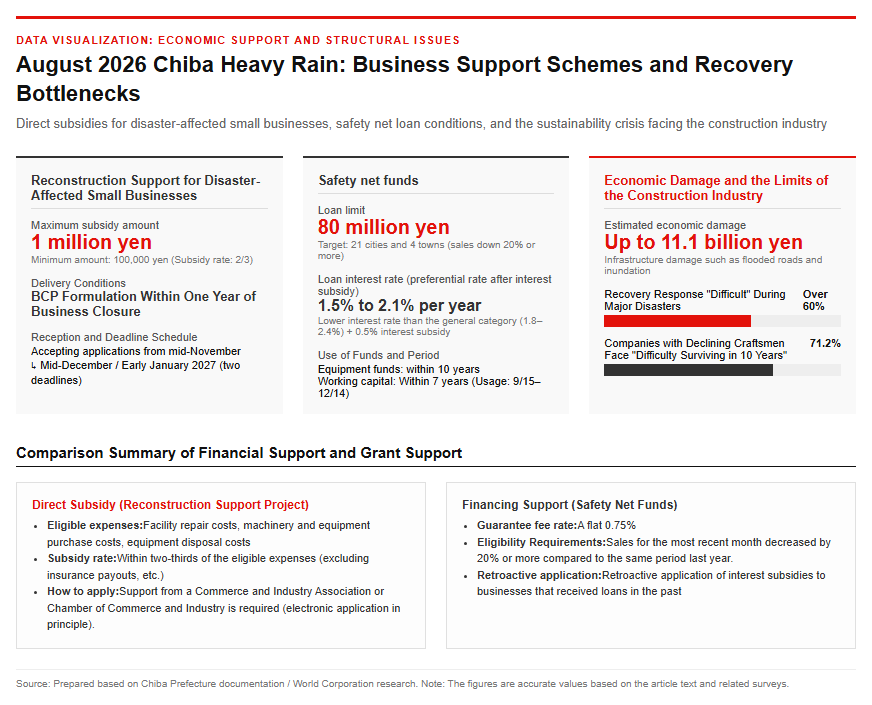
- Loan limit: Up to 80 million yen per business operator
- Loan interest rate: 1.5% to 2.1% per annum (set lower than the 1.8% to 2.4% of the general category)
- Guarantee fee rate: Flat 0.75%
- Use of funds and term: Capital investment funds within 10 years, working capital within 7 years
- Usage period: From September 15 to December 14, 2026
Furthermore, Chiba Prefecture plans to implement a 0.5% subsidy (interest subsidization) for the interest incurred on this funding, and has indicated its policy to apply it retroactively to businesses that have already received loans. By cooperating with local financial institutions such as Chiba Bank, Keiyo Bank, and various credit unions, the prefecture is strongly backing the stabilization of cash flow for affected small and medium-sized enterprises (SMEs).
Challenges for Recovery and Medium- to Long-Term Flood Countermeasures
Labor Shortage in the Construction Industry and Effectiveness Issues in Infrastructure Restoration
While the government and local authorities are rolling out generous financial support, the construction industry, which carries out actual restoration work on the ground, is facing serious structural challenges. According to a survey conducted by World Corporation Co., Ltd., over 60% of companies in the construction industry responded that “it is difficult to respond to restoration efforts in the event of a large-scale disaster.”
The main structural challenges hindering the recovery work are as follows:
- The significant decline and aging of construction craftspeople and site engineers who support worksites
- 71.2% of construction companies facing a decline in skilled artisans respond that “business continuation will be difficult in 10 years”
- Increase in bankruptcies among specialty contractors, such as scaffolding businesses, and the active job openings-to-applicants ratio remaining at a high level
The Chiba torrential rains of August 2026 are estimated to have caused economic damages on a scale of up to 11.1 billion yen, and restoration work for daily infrastructure—including flooded roads and above- and below-floor inundation—is currently underway in various regions.
Please refer to the diagram below for the restoration concept of the infrastructure site.
Concerns have been raised that no matter how much budgetary measures and subsidies are expanded, delays in the full restoration of infrastructure and housing will occur unless the shortage of on-site craftspeople who actually handle construction is resolved.
Future Developments and Key Points to Watch: Preventive Infrastructure Maintenance and the Second Supplementary Budget
The government has begun considering narrowing down the content of the second supplementary budget for fiscal 2026 to disaster response, such as reconstruction support for the Chiba torrential rains and the Kumamoto earthquake, thereby keeping the scale of expenditures to a minimum. While compiling ex-post supplementary budgets for unexpected disasters is essential, the importance of pre-disaster infrastructure investment (preventive maintenance) prior to the occurrence of disasters is being strongly debated.
The main points of focus in future recovery and urban flood control measures are as follows.
- Integrated Promotion of River Improvement and Inland Flood Countermeasures Based on the “Chiba Prefecture Vision for Resilience Against Urban Floods”
- Establishment of a wide-area disaster prevention network that implements watershed-wide flood countermeasures and prevents entry into hazardous areas
- The effect of reducing future restoration costs through proactive maintenance of aging roads, embankments, and other infrastructure
- Maintenance of ongoing consultation and support systems for subsidies and financing programs for disaster-affected small businesses
In the face of increasingly severe and frequent storms and floods in recent years, the key to enhancing the overall disaster resilience of local communities is how effectively we can simultaneously advance emergency recovery support and long-term preventative infrastructure development in a well-balanced manner.
Reference Page
- [Subsidy for Small Businesses Affected by the August 2026 Chiba Heavy Rain (Affected Small Business Reconstruction Support Project)] https://www.pref.chiba.lg.jp/keisei/genkist/8gatsugouu-hozyokin.html
- [Regarding the Start of Availability of Safety Net Funds (Municipality-Certified Category) for Damage Caused by the August 2026 Chiba Torrential Rain] https://www.pref.chiba.lg.jp/keishi/chuushou-yuushi/chibagouu.html
- 【Regarding the Vision for “Creating a Chiba Prefecture Resilient to Urban Floods”】https://www.pref.chiba.lg.jp/kendosei/press/2026/vision.html
[#SevereDisaster #ChibaHeavyRain #DisasterRecoverySubsidy #SMEsupport #Typhoon25 #SafetyNetFunds]
コメント