On October 8, 2026, NTT Docomo Business and Classiq concluded a strategic business partnership aimed at the industrial application of quantum computing. This is driven by the challenge that, as quantum technology transitions from the experimental to the practical application stage, the difficulty of developing quantum algorithms, which requires advanced expertise, has become a barrier to entry for companies.
- Background and Purpose of the Strategic Business Partnership Between NTT Docomo Business and Classiq
- Challenges and Barriers in Conventional Quantum Algorithm Development
- Development Automation Using the Qmod High-Level Language and Synthesis Engine
- Cross-platform capabilities supporting multiple types of quantum hardware
- Implementation Scenarios in Finance, Drug Discovery, Manufacturing, and Logistics
- Future Developments and Key Focal Points Toward the Full-Scale Arrival of the Quantum Society
Background and Purpose of the Strategic Business Partnership Between NTT Docomo Business and Classiq
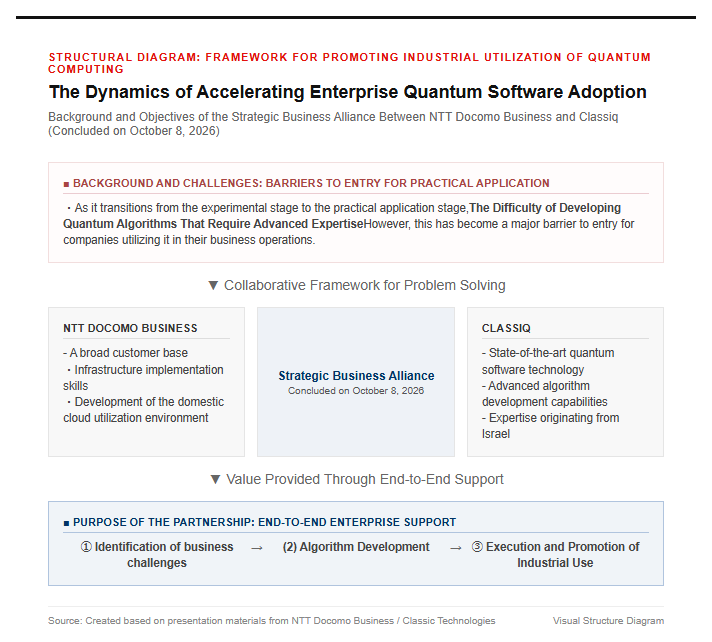
On October 8, 2026, NTT DOCOMO Business Inc. and Classic Technologies LLC—the Japanese subsidiary of Israeli quantum software company Classiq—concluded a basic agreement on a strategic business partnership to accelerate the industrial application of quantum computing. Industrial expectations for quantum computing are rising rapidly as a technology capable of solving complex computational problems that have been difficult to address with conventional computing. In Japan, environments allowing the use of gate-based quantum computers via the cloud are also beginning to take shape, and many companies are transitioning from the research and development stage to actively considering concrete business applications. In response to these changing market conditions, the two companies have jointly established a framework to conduct proposal activities for enterprise clients, offering seamless, end-to-end support from identifying business challenges to developing and executing quantum algorithms. By combining NTT DOCOMO Business’s extensive customer base and infrastructure deployment capabilities with Classiq’s state-of-the-art quantum software technology, the companies aim to drive digital transformation across domestic industries and foster the widespread adoption of quantum technology. The diagram below illustrates the cooperative framework of this partnership.
Challenges and Barriers in Conventional Quantum Algorithm Development
When enterprises consider the practical application of quantum computing, the most significant obstacle is the extreme difficulty of algorithm development. In implementing quantum algorithms, it has been necessary to deeply understand physical laws such as qubit superposition and quantum entanglement, decompose quantum circuits down to their most fundamental operations, and design them manually. Furthermore, because operable commands differ depending on the operating principles and models of quantum hardware—such as superconducting, neutral atom, ion trap, and optical approaches—individual circuit design and optimization dependent on specific hardware were indispensable. This high level of specialized expertise has posed an extremely high barrier to entry for typical companies that do not employ quantum mechanics specialists. As a result, many companies have continued to recognize the potential of the technology while remaining unable to take the step toward concrete verification or integration into practical operations. This partnership has the primary objective of precisely resolving such bottlenecks in development and providing an environment where more engineers can intuitively utilize quantum technology.
Technological Innovation and Flexibility Enabled by the Classiq Platform
Development Automation Using the Qmod High-Level Language and Synthesis Engine
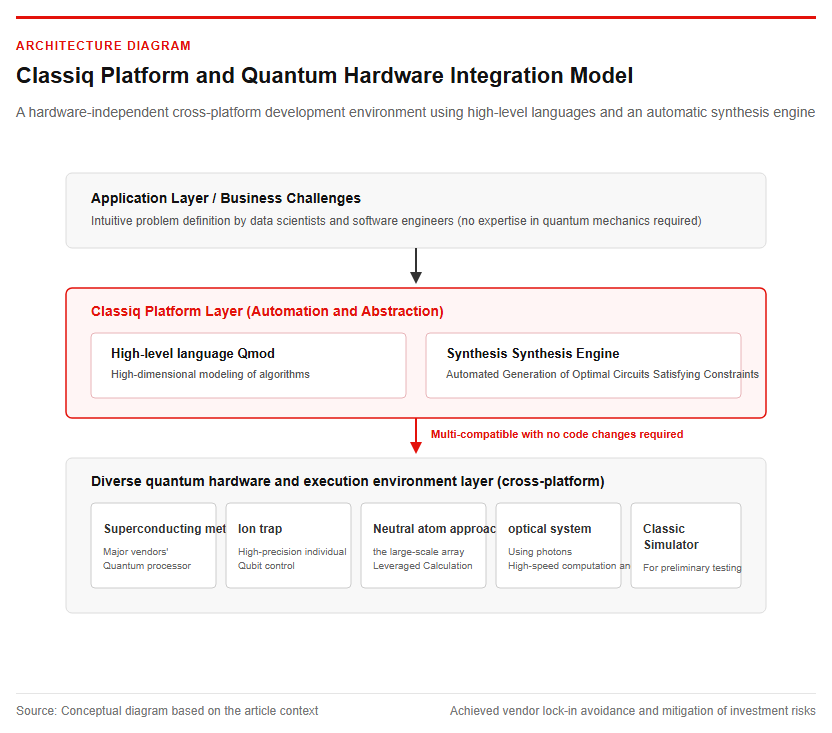
The quantum development platform provided by Classiq features two core technologies that dramatically lower the barriers to quantum software development. The first is Qmod, a proprietary high-level modeling language that allows quantum algorithms to be described at a high level of abstraction. By utilizing Qmod, developers can intuitively code the business problems and mathematical constraints they want to solve without needing to worry about complex physical-layer control. The second is Synthesis, a synthesis engine that automatically generates optimal quantum circuits based on the described model. The Synthesis engine automatically converts them into efficient circuits while satisfying specified constraints and the limitations of the target quantum hardware. This enables data scientists and software engineers with knowledge of AI, machine learning, and linear algebra—even without being experts with a Ph.D. in quantum mechanics—to immediately begin developing quantum algorithms. A significant reduction in development time and an improvement in accuracy are realized, enabling companies to focus on driving innovation.
Cross-platform capabilities supporting multiple types of quantum hardware
One of the greatest strengths of the Classiq platform lies in its open interoperability, which does not depend on any specific quantum hardware technology. Currently, the development of quantum computers is progressing through various approaches such as superconducting, ion traps, neutral atoms, and optical methods, and it has not yet been determined which approach will ultimately achieve dominance. An algorithm once written on the Classiq platform can be executed on diverse quantum hardware and classical simulators with different operating principles without rewriting the code. Corporate users can freely select the optimal execution destination according to their application, cost, and machine time availability, making it possible to avoid specific vendor lock-in. Furthermore, since previously created code assets can be directly inherited to match hardware evolution, it significantly reduces corporate investment risk. The following illustration shows the collaborative structure between diverse hardware and software layers.
Deployment of Practical Applications and Medium- to Long-Term Outlook in the Industrial Sector
Implementation Scenarios in Finance, Drug Discovery, Manufacturing, and Logistics
The use cases expected to be created through this partnership span a wide range of industrial sectors. In the financial sector, applications are progressing toward portfolio optimization, high-speed and high-precision calculation of credit risk, and verification of high-frequency trading algorithms. In the chemical and pharmaceutical fields, expectations are high for the development of new materials through simulations of complex molecular structures and significantly shortened drug discovery processes. Furthermore, in the manufacturing and logistics fields, applications are being verified for combinatorial optimization problems—such as optimizing delivery routes in global supply chains and adjusting factory operation schedules—where calculation times would explode using conventional supercomputers. Through individual dialogues with client companies, NTT DOCOMO BUSINESS and Classiq will extract the true operational bottlenecks and jointly promote specific PoCs (Proof of Concepts) that directly link to actual business results.
Future Developments and Key Focal Points Toward the Full-Scale Arrival of the Quantum Society
NTT Docomo Business is leveraging its “customer zero” approach—validating solutions by acting as its own first user—to advance the integration of quantum computing with security technologies such as Quantum Key Distribution (QKD) and Post-Quantum Cryptography (PQC), as well as network optimization technologies. Through this partnership, the company plans not only to sell quantum software but also to comprehensively provide training support for internal engineers and consulting services, thereby embedding sustainable quantum development skills within client companies. Moving forward, in line with the technology roadmap for 2026 and beyond, key areas to watch will include integration with AI-Centric ICT platforms and the realization of quantum-classical hybrid computing in next-generation data center infrastructure. There are high expectations that quantum technology, which has tended to remain confined to specialized fields, will be integrated as part of standard business IT infrastructure and serve as a catalyst to fundamentally elevate Japan’s industrial competitiveness.
Reference page
- [NTT Docomo Business News Release] https://www.ntt.com/about-us/press-releases/news/article/2026/1008.html
【#NTTDocomoBusiness #Classiq #QuantumComputing #QuantumSoftware #Qmod #DX #TechnologicalInnovation】

コメント