On October 7, 2026, Preferred Networks (PFN) announced “plamo-3-translate,” a domestic large language model specialized in translation, and integrated it into its proprietary AI translation service, “PLaMo Translation.” The model achieves Japanese translation accuracy on par with the world’s most advanced frontier models at a significantly lower cost—less than one-tenth—while expanding the number of supported languages to 53.
- Key point of the event: The emergence of frontier-class translation models
- Model Architecture and Features Based on PLaMo 3rd Generation
- High-Quality Datasets and Proprietary Computational Methods
- Performance and Cost Comparison with Leading Overseas Models
- Practicality of Support for 53 Languages and Online Meeting Translation Features
- Future Outlook and Key Points: Open Model Releases and the Future of Domestically Developed AI
Key point of the event: The emergence of frontier-class translation models
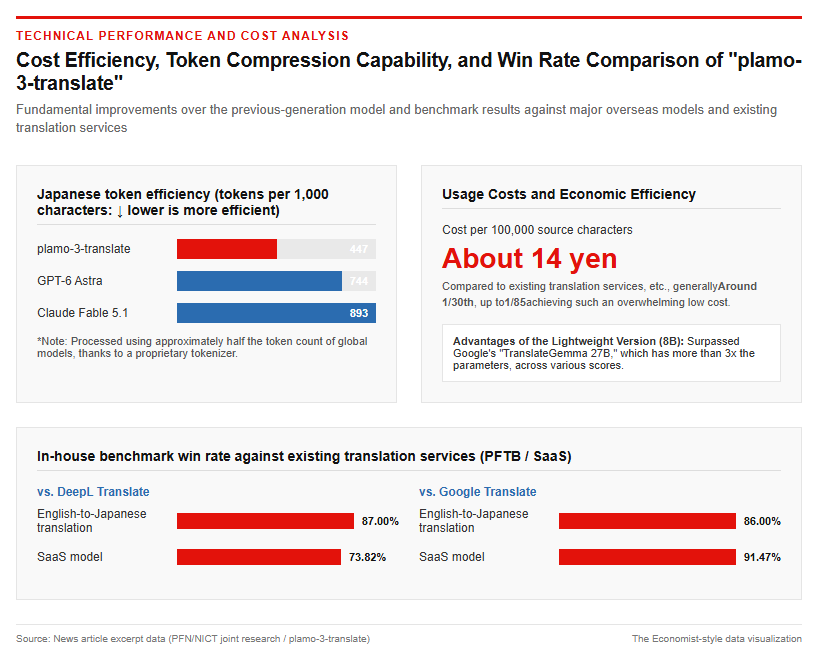
On October 7, 2026, Preferred Networks, Inc. (PFN) announced “plamo-3-translate,” a translation-focused large language model combining its latest-generation foundation model technologies, and launched it on the same day through its AI translation service “PLaMo Translation.” The model boasts a size of up to 31B (31 billion parameters) and achieves Japanese translation accuracy on par with world-leading frontier models such as Claude Fable 5.1 and GPT-6 Astra. Its greatest strength is its exceptional cost efficiency, achieving usage costs that are generally around 1/30th and up to 1/85th of major overseas models and existing translation APIs. It is available at a low price of approximately 14 yen per 100,000 characters of source text. A major feature of the model is its radical improvement over the previous-generation “plamo-2-translate”—which faced challenges such as excessive free translation, added or missing information, and inadequate multilingual support—enabling it to output accurate and natural translations.
Model Architecture and Features Based on PLaMo 3rd Generation
The foundation of “plamo-3-translate” is built on “PLaMo 3 NICT,” a pre-trained model developed through joint research by PFN and the National Institute of Information and Communications Technology (NICT). Rather than fine-tuning existing overseas models, it is a purely domestic LLM developed entirely from scratch in Japan, spanning from the collection of pre-training data to the design of the model architecture. With Japanese accounting for approximately 30% of its pre-training data—significantly exceeding typical global models—it is capable of generating content with a deep understanding of Japanese-specific contexts, phrasing, and honorific expressions. Furthermore, by adopting a proprietary tokenizer independently developed by PFN, it has dramatically improved the token efficiency of Japanese output. For Japanese output, it achieves 447 tokens per 1,000 characters, boasting roughly twice the conversion efficiency of Claude Fable 5.1 at 893 tokens and GPT-6 Astra at 744 tokens, thereby simultaneously achieving reduced output costs and improved processing speeds on a character-count basis.
Technical Approaches and Benchmarks Supporting Performance
High-Quality Datasets and Proprietary Computational Methods
Behind the overwhelming quality improvement achieved is the dramatic increase in the scale of training data and computational resources. In the development of “plamo-3-translate”, the amount of training tokens and the computation for data synthesis were scaled up several hundredfold compared to the previous-generation model. Starting from open data such as Aozora Bunko, large-scale and high-quality parallel translation data was synthesized and organized by leveraging high-performance models like DeepSeek. For model fine-tuning, supervised fine-tuning (SFT) using the proprietary format PFML2 (Preferred Markup Language 2) was implemented to enable precise control over writing styles (the polite desu/masu style or the plain da/dearu style) and the translation of specific terms. Furthermore, by executing a three-stage Iterative DPO (Direct Preference Optimization) utilizing a translation reward model, and performing model merging to average the weights of the generated models, unnatural translations were eliminated, enabling fluent and accurate dialogue for humans.
Performance and Cost Comparison with Leading Overseas Models
In multifaceted internal and external benchmark evaluations, “plamo-3-translate 31B” delivered results that outperformed existing translation services and large language models. In LLM-based translation comparison experiments using internal benchmarks (PFTB, SaaS), it achieved win rates against DeepL Translate of 87.00% for English-to-Japanese translation and 73.82% for the SaaS format. It also demonstrated overwhelming win rates against Google Translate, with 86.00% for English-to-Japanese translation and 91.47% for the SaaS format. Furthermore, even the lightweight 8B (8-billion-parameter) model “plamo-3-translate 8B” showed performance that surpassed Google’s translation-specialized model “TranslateGemma 27B”—which has more than triple the parameter count—across various scores. As is also clear from the following graph illustrating the correlation between translation accuracy and usage cost, it successfully achieves a combination of world-class quality and low cost.
Impact on Business Operations and the Outlook for Domestic AI
Practicality of Support for 53 Languages and Online Meeting Translation Features
With this update, “PLaMo Translation” has significantly expanded its supported languages from the traditional two (Japanese and English) to 53 languages. Furthermore, as a major practical highlight, it officially launched the “Meeting Translation” feature (supporting 15 languages), which is compatible with online meetings on Zoom, Google Meet, Microsoft Teams, and others. A dedicated bot joins the meeting, transcribes the audio for each speaker in real time, and displays highly accurate bidirectional translated text. By registering a glossary in advance, it is possible to prevent mistranslations of technical terms and proper nouns. In addition, rather than mere literal translation, it automatically performs free translations based on business context—such as polite greetings in business emails, claim expressions specific to patent documents, and contextual nuances (e.g., translating “pints” as “beer” depending on the context)—dramatically increasing its practicality in business settings.
Future Outlook and Key Points: Open Model Releases and the Future of Domestically Developed AI
PFN plans to roll out “plamo-3-translate” in multiple model sizes in the future, releasing them sequentially as open-weight models on Hugging Face and other platforms. The “PLaMo Community License” will apply, allowing developers and companies to freely evaluate and utilize the models in local environments. Furthermore, since the entire process from data collection and training to service provision is completed domestically, it prevents the risk of information leakage overseas and can be operated with peace of mind even in confidential areas such as government, finance, and manufacturing where strict security is required. Trial uses in government infrastructure, such as the Digital Agency’s promoted government AI “Gennai,” are also progressing. From the perspective of establishing “sovereign AI” (AI sovereignty) that does not depend on specific overseas vendors or export controls, the future evolution and societal implementation of domestic translation LLMs are definitely worth watching.
Reference page
- [Preferred Networks, Inc. News Release] [suspicious link removed]
- 【PFN Tech Blog – plamo-3-translate】https://www.preferred.jp/ja/blog/tech/plamo-3-translate-product-release
- [PLaMo Translate Official Website] https://translate.preferredai.jp/
- [PLaMo Development Repository (Hugging Face)] https://huggingface.co/pfnet/plamo-2-translate
【#PreferredNetworks #PLaMo #plamo3translate #LLM #AITranslation #MachineTranslation #GenerativeAI #SovereignAI】


コメント